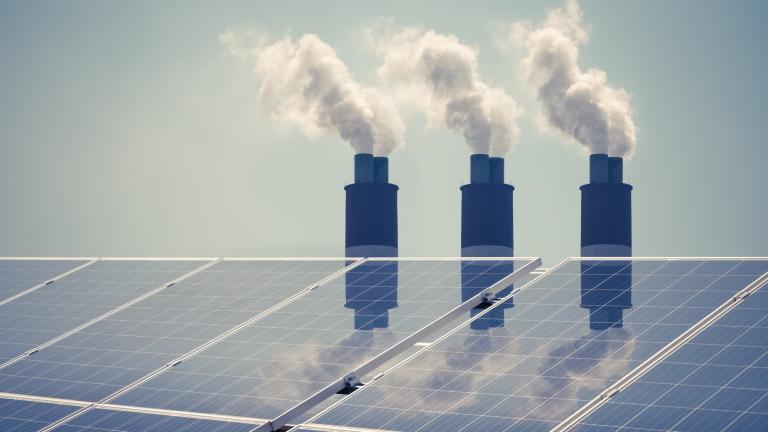
Last week, I posted about World Bank economist Don Mitchell's controversial report on biofuel and food prices. According to Mitchell's calculations, U.S. and E.U. support for biofuels accounts for 70 to 75 percent of the recent rise in global food-commodity prices -- one that could force an additional 100 million people worldwide into poverty conditions, according to the U.N. Food and Agriculture Organization.
The jump in food prices has an ecological component, too. With commodity crops like corn, soy, and wheat trading at or near all-time highs, farmers are scrambling to take advantage by putting as much land as possible into production, and showering their land with agrichemicals to ensure the highest yields possible. As a result, the world's largest agrichemical firms have experienced a windfall.
But as I pointed out in my post, as damning as Mitchell's study is to U.S. and E.U. biofuel policy, his analysis has what I see as a blindspot: He never accounted for the fact that over the past 20 years, the globe's governments have systematically sold off their grain reserves, on the reasoning that grain stores "interfere with the market."
With the globe's grain stores gutted, it was no surprise that commodity prices shot up when the U.S. government began mandating that huge portions of the U.S. corn crop (one-third this year; more next) be diverted to making car fuel.
And a according to Patrick Woodall, a senior researcher for Food and Water Watch, the World Bank itself contributed to the push to sell of grain stocks.
From an article in the Delta Farm Press:
Woodall says another factor driving stocks down in the Third World is "the World Bank has pressured countries to eliminate their own reserve programs, much like the U.S. eliminated theirs and the EU and China reduced their buffer stock programs.
"Countries like Kenya and Malawi were forced by the World Bank to sell off their reserves. That was partly because of fiscal austerity reasons. But it was also partly to repay debt to the World Bank."
Woodall said other countries including India, Senegal, Zambia, and Tanzania reduced regional marketing programs. "Those included a lot of regional (storage) programs that were used to take in crops and bring them to market. But also as a reserve against times of crisis for high food prices and a hedge against low supply."
As these programs have been eliminated to conform with World Bank directives, "we're now in a situation where there's no buffer to protect people from a severe food crisis."
And word from the recent G-8 meeting is "more of the same bad medicine. The next round of WTO talks at Doha will present a new opportunity. But it's really just more of the same. And more of the same in the current environment won't help farmers and consumers in the developing world or here at home."
Comments
View as Threaded
archigeek Posted 2:25 am
06 Aug 2008
The mellotron is your friend.
Permalink
Russ Posted 2:48 am
06 Aug 2008
The resulting commodity price surge both directly benefits global agribusiness and softens up 3rd world populations for a general onslaught of predatory "austerity" requirements as the blood price for international aid.
"Countries like Kenya and Malawi were forced by the World Bank to sell off their reserves. That was partly because of fiscal austerity reasons. But it was also partly to repay debt to the World Bank."
You see the vicious circle - moneybags forces the already starving to further impoverish themselves as debt service (this is just pennies to the trillionaires, of course, but practically everything the victims have), which renders them even more vulnerable, more dependent, eventually more indebted, and thus ripe to be further exploited.
At Chicago they openly called this the shock treatment.
Permalink
vakibs Posted 3:01 am
06 Aug 2008
Basically, don't use an assumption if you don't need it. It could either be the theory of peak oil or that of greedy corporations softening up 3rd world populations for a general onslaught of predatory "austerity" requirements as the blood price for international aid.
These things might very well be true, but unnecessary to the topic in question.
Permalink
Ron Steenblik Posted 3:23 am
06 Aug 2008
A few thoughts:
Even in a purely private market, market participants will maintain a certain minimum amount of inventory. But many foods are perishable and degrade quickly, especially in damp, tropical climates where vermin are prevelant, so there is a trade-off between holding onto grains and keeping the stockpiles small enough so that they turn over rapidly.
Another problem -- perhaps a factor in the pressure on countries to reduce stocks -- is that some of them have no doubt been used more to control internal markets than as a relief valve to respond to changes in international markets. In some countries, the costs of intervention buying have been very expensive (and often badly managed). And when the stockpiles have grown too large, some governments have then dumped the surpluses on the international market (rather than on their own markets, which would depress prices), which then only makes the situation worse for other countries' producers.
I am only speculating here, but perhaps what happened as countries stopped intervention buying was that nobody thought to ask what would then happen to stocks globally if every country did that.
These are only my personal opinions.
Permalink
Russ Posted 3:33 am
06 Aug 2008
As for Peak Oil, which we discussed on the other thread, again I related simple facts and theories which so far have had observation match prediction, while you simply tossed out seemingly random statements which were empirically wrong.
You concede these might be true, but call them "unnecessary"!? If there's even a chance they're true, what could possibly be more relevant to progressive-oriented discussions of globalization or civilizational energy?
As for my underlying hatred of greed and materialism, and my propensity to find them active in most places where exploitation, injustice, and/or stupidity are prevailing, my study of history tells me that unfortunately one will rarely go wrong doing so.
So yes, that tends to be my assessment of the activities of the powerful. I can't imagine what motive factors you look to first, but I'd certainly place my money on you as to who is "needlessly multiplying entities".
Permalink
MAD MAC Posted 6:53 pm
06 Aug 2008
If you studied history it should be painfully obvious that people are at their most creative and energetic when the potential for large scale profit exists. Massive undertakings can only be conducted with massive capital.
Greed and materialism can be harnessed. It is a two edged sword. It's also part of human nature. It won't go away any more than the desire to have sex, regardless of how much you wish it would.
Victory in Pattani
Permalink
Russ Posted 7:38 pm
06 Aug 2008
If you studied history it should be painfully obvious that people are at their most creative and energetic when the potential for large scale profit exists. Massive undertakings can only be conducted with massive capital.
Human creators - I of course speak primarily of artists and thinkers - create out of an inner urge. No one was ever creative who needed the profit motive as an incentive, and most of history's great achievers - I again stress, human achievement occurs in the realm of the mind and spirit, not in vulgar temporal contexts - did not have "profit" even as one of their secondary goals.
Of course, it should be "painfully obvious" to anyone who reads what I wrote that I do not consider size to be a value, that indeed among man's structures I despise anything "large-scale" or "massive", on both philosophical and aesthetic grounds.
In economics, politics, society, far from being a value, large size is a pure evil, the source of all man-made evils. The great hope that Peak Oil and energy descent holds out for humanity is that it will sweep away all large structures, as if it were an ethical whirlwind.
Permalink
Ron Steenblik Posted 7:52 pm
06 Aug 2008
So, can we assume that you would be in favor of breaking up Canada, China, India, Brazil, the European Union, Russia and the United States into their constituent states or provinces, and making each of those sub-national units into independent nations?
These are only my personal opinions.
Permalink
MAD MAC Posted 9:08 pm
06 Aug 2008
Just because you despise anything on a large or massive scale doesn't mean the rest of us do. The Pyramids are awe inspiring for MOST of us. The golden Gate bridge was a remarkable architectural achievement. Major pharmaceutical breakthroughs were done by massive funding investments that have been life saving achievements. The "Arts" are very low on my particular priority list, mostly because artists tend to think they are smarter than the rest of us, when they're not.
"In economics, politics, society, far from being a value, large size is a pure evil, the source of all man-made evils. The great hope that Peak Oil and energy descent holds out for humanity is that it will sweep away all large structures, as if it were an ethical whirlwind."
What you may consider "vulgar" someone else might consider "grand". Just because you think large scale is "pure evil" doesn't make it so.
And the energy descent if peak oil arrives also means death for a couple of billion people and quite possibly a third world war - on a grander scale than anything seen heretofore.
Be careful what you wish for.
Victory in Pattani
Permalink
spaceshaper Posted 10:40 pm
06 Aug 2008
Mac on the other hand is very much given to making grand and sweeping pronouncements, with no modifiers and no supporting evidence, as if they were matters of established fact. No wussy IMHO in his repertoire. "If you studied history it should be painfully obvious that people are at their most creative and energetic when the potential for large scale profit exists." Guess he's thinking of the slave trade, CAFO farming, wars for oil and the occupation of Iraq while conveniently ignoring Medecins sans Frontieres, Oxfam and Live Aid, Pasteur and Harvey and Lister and the Curies and a thousand others.
With regard to the content of Russ' post, I too have an implicit distrust of over-large projects. The gargantuan urban renewal projects of the sixties and seventies devastated whole neighborhoods and communities past the point of no return - we are still suffering the consequences. Small-scale renewal, one building at a time, has by contrast a successful track record in revitalizing depressed urban areas while respecting and supporting existing community resources. Size and scale DO matter. Let's not ignore those lessons in our new challenges, as in the quest for truly renewable, sustainable and environmentally-sane energy resources.
The true meaning of life is to plant trees, under whose shade you do not expect to sit.
Permalink
vakibs Posted 10:55 pm
06 Aug 2008
I hate materialism and obscene spending. I agree that the best creative potential of man comes not out of a profit motive, but out of an inner urge. In other words, I am as much a hippie as you are.
But where I digress from you is that I don't suffer from wishful thinking like the great hope that Peak Oil and energy descent holds out for humanity is that it will sweep away all large structures, as if it were an ethical whirlwind.
No, this is not going to happen like that. I will tell you what will happen if peak oil arrives and we suddenly discover that there is no energy. The poorest parts of the planet will see massive famine due to food shortage. People will die in numbers that have never been seen before. The mad fight for survival will turn brothers into enemies, and war will splurge humanity into horrors completely unheard before, and which will make nazis look like angels.
The richest of the people will continue with their obscene spending and build bigger buildings, bigger guns and bigger airplanes. This will continue until the very day where there exists no fuel and we will revert to the days of slavery.
Then, why am I not getting shit scared of this dystopia ? Because I don't believe completely in peak oil - my estimates vary from yours, and I also trust in human ingenuity which will discover newer methods of producing energy.
Permalink
Russ Posted 11:55 pm
06 Aug 2008
So, can we assume that you would be in favor of breaking up Canada, China, India, Brazil, the European Union, Russia and the United States into their constituent states or provinces, and making each of those sub-national units into independent nations?
If you mean, would I love to see such breakups, that would be a big fat YES.
As far as I'm concerned, history's finest political delineations were achieved in the city-states of ancient Greece and the Italian Renaissance. It's no coincidence these were also history's finest efflorescences of culture and the spirit.
When I dream of post fossil-fuel utopia, I envision people living vigorous physical and spiritual lives free of vulgar materialism and "politics", harmonized with the land, with the basic political unit being the watershed district (and without large-scale irrigation projects, which always only re-establishes tyranny).
Mad Mac:
What you may consider "vulgar" someone else might consider "grand". Just because you think large scale is "pure evil" doesn't make it so.
Spaceshaper already answered for me on claiming universal authority.
The only caveat I'll add is, since I had the misfortune to be born into a time which is hostile and oppressive for my kind, I certainly have the right to fight back. It's your system which is totalitarian in the literal sense, valorizing all things, pegging all these marketized values to the desires of gluttons, and forcibly demanding that anyone who wants to live more simply is still either conscripted into the rat race or has to go live in a cave.
You only have the luxury of telling others their values aren't absolute because your kind has been able to forcibly impose yours (so far) as de facto absolutes.
So while I certainly don't claim philosophical certitude, as a matter of practical action I've learned this from this world - this is a zero-sum battle for total power.
The "Arts" are very low on my particular priority list, mostly because artists tend to think they are smarter than the rest of us, when they're not.
What a bizarrely petty reason to reject the pinnacle of humanity's achievements.
As for the pyramids of Egypt and Mesoamerica, the Parthenon, Angkor Wat and the myriad other architectural wonders of antiquity and the preindustrial age, I have great admiration for these.
For me the great dividing line where man passed from his progressive stage to his decadent stage was the advent of fossil fuels and the industrial revolution.
vakibs:
The horrors you describe are certainly possible, and I don't relish the thought of them.
But if that proves to be the price man incurs, if those are the necessary growing pains as man is forced to relinquish his technological toys, evicted from the ICU, forced to stand on his own two feet again, and assume adult responsibilites on this Earth, so be it.
(BTW vakibs, you accused me above of "conspiracy"-mongering, yet I just read your latest comment over on the Globalization Death Watch thread, and you were using terms like "plunder" and "colonialism". So if I'm a conspiracy theorist, it seems I'm not the only one. :) )
Permalink
amazingdrx Posted 11:57 pm
06 Aug 2008
Either they correct this problem or they will be seen as part of the problem, with agrichem fuel farming versus survival for millions of people they are charged with helping out of poverty.
The board that "elected" Wolfowitz, giving in to Bush administration pressure tactics, ought to resign. It is the only way to clear the air after this most recent problem of food versus fuel, and the attempted suppression of the report.
http://amazngdrx.blogharbor.com/blog John Schneider, Northern Wisconsin
Permalink
amazingdrx Posted 12:00 am
07 Aug 2008
A hippie who hearts a nuclear power plant? That's a new one. Hehey.
http://amazngdrx.blogharbor.com/blog John Schneider, Northern Wisconsin
Permalink
vakibs Posted 2:29 am
07 Aug 2008
I have my reasons to support nuclear power. I thought carefully about this and made my opinions.
If you are a hippie, it doesn't mean you are stupid. It doesn't mean you subscribe to herd behavior.
I may very well be the odd man amongst the crowd, but I am okay with it.
Permalink
MAD MAC Posted 3:24 am
07 Aug 2008
So let me see if I follow this. You want to:
a. Eliminate CAFOs and replace them with other organic food sources.
b. Eliminate all coal and oil fired power plants and replace them with renewables.
c. Get rid of the suburbs and rebuild our cities so they are walkable and ecologically friendly.
But you don't want to engage in any large scale projects? Got it.
Victory in Pattani
Permalink
spaceshaper Posted 4:40 am
07 Aug 2008
The true meaning of life is to plant trees, under whose shade you do not expect to sit.
Permalink