Dear Umbra,
I finally went vegetarian several months ago, and one of my main reasons was the environmental impact of meat production. The other day, however, a friend pointed out that soy foods take a great deal of energy to produce too. So is there really that big of an environmental difference between TVP [textured vegetable protein] and free-range beef? And how does dairy compare? Should I just try to stick to nuts and beans?
Sarah Amandes
Brooklyn, N.Y.
Dearest Sarah,
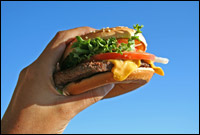
Have you ever wondered whether TVP might be the hot dog of soy products? All the soy boogers and intestines, mushed up into a bland-seeming "food"? Just a thought.
Here comes the bun.
Yes, there is a big environmental difference between eating meat and not eating meat. We are concerned with land use, water use, water pollution, air pollution, habitat, and packaging, and animals have a larger impact than plants in most of these categories. I'll go over some numbers from the Union of Concerned Scientists' Consumer's Guide to Effective Environmental Choices (mwah!) and an article from the American Journal of Clinical Nutrition, which surveyed European life-cycle studies of food production.
The journal picked soy studies for a comparison, lucky for you. Meat production took more land (6 to 17 times as much), water (4.4 to 26 times), fossil fuels (6 to 20 times), and biocides (a lumped-together category of pesticides and chemicals used in processing -- 6 times as much). In fact, meat lost in every category. When processing and transport is factored in to the equation, the difference becomes less extreme, but it's still there. Meat-based diets use about twice as many environmental resources as soy-based diets. Despite concerns about deforestation and genetic engineering, soy appears to be the winner here.
If you are thinking of veggie but non-soy choices, take a look at the numbers from UCS, which compared red meat and pasta. Meat used 20 times the land, and generated thrice the greenhouse-gas emissions. Ye who have obeyed my Buy the Book Command know UCS splits water pollution into two categories, common (caused by soil and biological matter) and toxic. Meat was worse in the former category by a factor of 17, and in the latter by a factor of 5. UCS also estimates that a quarter of the threats and damage to U.S. ecosystems and wildlife comes from the production of the meat and poultry we eat.
It makes sense. In our current system, we grow plants and feed them to animals, which we then eat. Land and other resources are used during both phases of production. The animals are densely raised, which intensifies their ecological impacts. (Giant, overflowing hog-waste ponds are a dramatic example of this problem.) If we have a plant-based diet, we reduce animal grazing, manure management, biocide treatments (I like our new word), packaging, etc. And dairy is also better than meat, although both come from animals. Dairy cows produce many times their body weight in milk each year, while cattle produce less than their body weight in meat. Using a somewhat similar amount of land and feed, dairy herds produce three and a half times the weight in food.
Let's be careful not to make the situation too black and white, though. Life-cycle analyses can help separate and elucidate factors at play, but they also raise questions. There is some indication in these studies that sustainably raised, locally procured meat-based diets can hold their own, environmentally, against heavily processed, far-shipped veggie diets. So I prefer to believe that eating my local bacon is better than eating frozen veggie burgers, not just gastronomically but ecologically. Of course, we still may eat veg for a multitude of other reasons. Like, for example, baby sheep are cute.
TVPily,
Umbra

Comments View as Flat
Skapo Posted 6:44 am
12 Oct 2005
Let us keep in mind...
A few things to keep in mind when discussing the differences in environmental impact between bringing a meat diet to the table and bringing a vegetarian diet to the table:
- Most of the soy produced in the world goes to feed livestock. Therefore, simply bringing our livestock their feed is nearly equal to bringing a vegetarian their diet.
- The waste produced by livestock themselves must be compared to the waste produced from plants themselves. How we process the food is gievn up to the individual consumer. We have the power to buy locally or not, buy processed or not, buy meat or not. Let us make the right choices.
- We should be fair when comparing the two diets in question. When you compare the best practices of producing a meat diet against the worst cases of producing a vegetarian diet it is, at best, a form of spin. Try comparing the average production of a meat based diet and the average production of a vegan diet (I am vegan).
Being environmentalists I would hope we would choose any little change we could to improve the current environmental situation, and not even think twice about making such a simple change to bring about such a huge difference.To quote an Alternative Baking Company cookie wrapper: "No single food choice has a farther-reaching and more profoundly positive impact on our health, the environment, and all of life on Earth than choosing vegan."
I will finish by adding to and paraphrasing Moliere: "Let us be mindful to the woes of our decisions, for it is not only what we do, but also what we do not do, for which we are responsible."
Permalink
charcoal Posted 9:35 am
12 Oct 2005
Do the best you can
Not everyone can make the commitment to be a vegan -- I have a lot of respect for those who can. I am a vegetarian (not vegan) and have been for almost 2 years (I am 40 years old). Over the years I had slowly reduced my meat intake, first eliminating red meats, then poultry, and finally sea food.
I made the change mostly for environmental reasons -- I had read about how many resources it required to bring meat to the table. But also, it angered me that the cattle industry was growing and expanding into territory where bison, wolves, and elk once lived. The worst stories I heard of were of bison that had wandered out of Yellowstone, only to be immediately slaughtered by over zealous ranchers. The bison were slaughtered because of unfounded fear of disease and also I think out of jealosy -- the ranchers want to encroach upon Yellowstone itself. They consume so much land.
I thought that if every person could reduce the amount of meat they ate, then the cattle industry could shrink (sorry ranchers, but you just take up too much space), and maybe some of that ranch territory could again become wild.
I gave up fish as I read more about how our oceans are over fished, how genetically different farmed fish are comingling with wild ones, and how coral reefs are destroyed by the fishing industry.
So, we can't all be vegans or vegetarians, but we can reduce our consumption animals. Take it from a former red-meat lovin', beer quaffing, military veteran.
Permalink
SolarBozo Posted 9:42 am
12 Oct 2005
Market Pressure
One thing not mentioned in the article is the judicious use of market pressure to bring about overall change.
Umbra Fisk stated at the end of the article, "There is some indication in these studies that sustainably raised, locally procured meat-based diets can hold their own, environmentally, against heavily processed, far-shipped veggie diets. So I prefer to believe that eating my local bacon is better than eating frozen veggie burgers, not just gastronomically but ecologically."
This is an oft-used justification for eating meat, and this kind of argument obscures the other issue. From what you have said so far, the apparent true best result comes from buying veggies locally, in this part of your editorial, you are comparing apples and oranges.
The fact is, by buying meat raised locally, you are putting nearly the same market pressures on the beef industry that you would be by purchasing feed-lot beef. Sure, you are increasing the demand for the more sustainably ranched meat, but it also supports the more general demand for meat which does not consider how or where it is raised.
This certainly diminishes a bit of the "buy local" benefits that folks talk about. Maybe now it is time to compare buying local veggies vs. non-local veggies. At a minimum, you would at least be comparing apples with apples and oranges with oranges.
Permalink
bakirita Posted 10:01 am
12 Oct 2005
soy vs. meat
An inquiry: I have heard that ADM and other agribusinesses are tearing up forest regions in Brazil to plant soy. Is this so, and if so, how would it affect the environmental damage equation? I have come to believe that in the current climate, businesses can take the most innocuous thing and turn it into a weapon of destruction if they can make money with it.
Permalink
thelastsasquatch Posted 10:04 am
12 Oct 2005
meat vs oil
I became a vegetarian 6 years ago. I started eating meat again last month.
I have been learning about Peak Oil and how much North American oil consumption is as a % of the world (30+%!). As oil peaks and goes into decline, its importance in our lives will be starkly apparent. The decisions we make by living in the 'system' of cell phones, automobile commutes to work, flying home for Christmas and holidays, etc all dominate the decision to eat beef or not, in terms of greenhouse gas use. I chose to eat soy because I decided not everyone on the planet could eat meat and be sustainable, therefore eating meat was unsustainable. I chose to eat meat again, because I drive a car 15 miles to school each day and take vacations - one trip to Hawaii takes care of most of the ecological savings of being a vegetarian. I couldnt justify the practice for the reasons I had chose it.
There are of course shades of grey on this issue - I still dont eat pork for other reasons, and a vegetarian diet is probably better for us, cheaper, and clearly more ethical. Thanks for your article
Permalink
seafoam Posted 10:48 am
12 Oct 2005
global warming
No mention of the carbon dioxide and methane given off by cattle, versus the carbon sink provided by soy.
Permalink
LauraH Posted 2:04 pm
12 Oct 2005
vegan good, free-range meat better
I fully understand that feedlot and factory-farm meats are among the worst choices of foods available. However, I think the criticism of ranchers for "consuming" large amounts of land is simplistic at best. Where I come from, ranch land is the healthiest land around. Over huge areas, ranch land is the last refuge for wildlife that has lost the vast majority of its habitat to crop production. Meanwhile, cropland has lost 50% of its productivity since these prairies were broken a century ago. To reduce soil erosion, farmers have switched to zero tillage with high chemical use. If you want to use this land to grow food, the gentlest, most effective way to harvest it is with a grazing animal. There is no destruction of soil biota through tillage, no consumption of fossil fuels for tillage and seeding and harvest, no hazardous concentration of manure, and no need to transport manure back to fields. Yes, there is often some fossil fuel consumption involved in managing and processing these grazing animals for meat. Yes, cattle give off methane, but this problem is reduced (and their efficiency of meat production is increased) when they get a better diet. Native grassland pasture is an excellent diet for cattle; research shows that they produce more meat from less plant material on this pasture (compared with tame forage pasture). Yet native grassland is still being destroyed here. Unless you dream of strict legal protection for native grassland (yeah, right, since when do politicians even notice the rural prairies, let alone attempt something so controversial?), the best hope to preserve our native grassland is to generate a significant market for range-fed bison and beef. I'd buy some, if I could just get that freezer cleared out...
Permalink
LauraH Posted 2:11 pm
12 Oct 2005
leaving it wild
Another point - just in case you're thinking that the answer for the prairies is to "let them go wild" - that approach would not work on the small pieces of native prairie that remain. It's been tried. The grassland gets engulfed by trees, brush, and invasive introduced plants. It might work if you could "rewild" a large tract of land and let wildfires and wild bison do their work. Good luck with the politics of that.
Permalink
LauraH Posted 2:15 pm
12 Oct 2005
on sinks
Soy is no more of a sink than a cow; they both store carbon in their tissues, they both transfer some of that carbon to their human consumers, and they both release some of it when their non-food parts break down.
Permalink
Ken Johnson Posted 3:39 pm
12 Oct 2005
The down side of soy
I went veggie a couple decades ago, but a few years ago I started to have some qualms about soy when I heard about a study that seemed to link soy consumption with premature dementia in Hawaiian men of Japanese descent. For a laundry list of soy horrors, see www.thewholesoystory.com. I think vegetarianism is a good idea, but there's a lot more good stuff to eat than just soy.
Permalink
jennylynn Posted 2:45 am
13 Oct 2005
what about other people?
And there is also the fact that on average 8 pounds of grain go into making one pound of meat. That is a lot of grain that could potentially feed a lot of people.
Permalink
pps21649 Posted 4:52 am
13 Oct 2005
Your health and TVP
I realize our main discussion here is environmental issues related to veggie vs. meat based diets. But I feel the need to share some information I've come across recently regarding the toxicity and common occurance of MSG and other glutamates in our overly processed food supply. Textured Vegetable Protein is another form of MSG and the health impacts should be carefully weighed before consuming even moderate amounts.
Truthinlabeling.org is a good first resource for understanding how much MSG is in our food supply and what it can do to your body (mostly your brain and nervous system).
What I am not clear on is if TVP from organic sources is any better with regards to the toxic effects on your body. I am guessing that it doesn't matter since the harmful elements come from a combination of the plant itself (regardless of growing conditions) and the processing that is done to it.
I am all for locally grown foods (plant and animal) and also knowing what went into the food you are eating and how it was processed (what was added/changed). So much of that information is hidden from the American consumer, but it greatly(!) affects not only our environment but our bodies as well.
Permalink
Pandu Posted 6:10 am
13 Oct 2005
a few quick comments:
About 13 years ago I was in college working on an envirionmental studies degree when I realized that the biggest impact I could have as an environmentalist was to give up meat. I took two months to think about what I could eat, and then made the switch. It was pretty easy. The hardest part is that so few people are vegetarians, making eating out more of a challenge.
A vegetarian diet uses 1/10 of the land compared to a meat-based diet. (Vegan uses 1/20.) Therefore a vegetarian population can free up 90% of the agricultural land for whatever other use.
Regarding the bison and native grasslands, if more people were vegetarians, then so much land could be left to the bison, whom we wouldn't have to kill. Why not allow them to graze in peace on all that extra land?
I don't know what the big deal about soy is. Soy makes up a very small part of my diet. Protein really isn't an issue.
Permalink
Payton Chung Posted 1:09 pm
13 Oct 2005
High horses
"the biggest impact I could have as an environmentalist was to give up meat."
Actually, no. The "Consumer's Guide" that Umbra mentions states pretty clearly that energy consumption in home and transportation are larger impact items than food.
We all agree that beef can be quite destructive and energy consuming, but poultry and fish require many fewer calories of plant energy to create their protein, and don't have the ruminants' problem of methane-filled farts. Let's not pick on meat using the most obvious examples--again, apples to apples. Even if we did revert the prairies back to bison (and it'd be politically difficult) you'd have a problem of bison overpopulation: millennia before Whites settled the Plains, bison's primary predators were humans. Hence, Ted Turner's chain of bison grills to cull the populations on his Montana ranches.
Personally, I eat a meat-light, largely local diet, with variety and moderation rather than exclusion as the guiding principle. Indeed, I challenge someone to stick to a largely local vegan diet through a Midwestern winter. On the other hand, I never drive. Heck, I rarely even ride buses. I challenge any car-driving vegan to a low-impact duel!
.pc
Permalink
sjdunnejr Posted 12:58 am
14 Oct 2005
missing the bigger picture
I think one of, if not the biggest reason for going vegan is the ethical and moral reason! I am proudly Vegan and cannot justify as an intelligent and compassionate person, the killing of an animal, the taking of life only to satisfy my greedy tastebuds..for 10 mins of satisfaction. If there are alternatives to getting the protein etc.., then what possible reason is there for continuing this brutal practice? Life is quality of life is sacred, or should be. I am not coming from a religous standpoint at all, but a spiritual one I suppose. Taking of life for no qualifiable reason other than selfishness can not be acceptable, just as taking human life is not. I see no difference, as we are all on this planet together and should live in harmony as much as possible. That may sound corny, but it's still true. All other animals in nature find a balance with each other yet as intellignet and civilized as we are, we still allow the slaughter and torture (dairy and poulty industry) as if it were something totally normal and acceptable. Times and peopels attitudes have to change if we will have any hope of avoiding self destruction both physically, ethically and spiritually. This is coming from one of the biggest meat and cheese eaters in history...so if I can wake up and do it, anyone can.
Permalink
arminius Posted 2:35 am
17 Oct 2005
The Hunting Issue
I found it a litttle odd that there was no mention of wild protein consumption via hunting. I do in fact hunt whitetail deer for several reasons.
- Kilocalories - it requires much fewer KC worldwide for me to drive my paid-for vehicle to the public woods up here, hunt and stalk and shoot a deer, drag it out w/o the use of any type of mechanization, load it and haul it home and do all the processing myself. Costs about 20 hrs of my time once it was home.
- Ancestry - We all descend from people who for tens of thousands of years had to hunt and/or gather for their nutrition and lives. Then 5-6 thousand years ago the earliest forms of agriculture began, as you know. I, for one, pay attention to whre I am coming from.
- Quantity - There are simply way too many deer in our environment at the moment. Like some other species (raccoons, coyotes, ragweed, and too-many invasive species), they are a weed. But, they are wonderfully adapted to their environment which then provides an adequately skilled woodsman a fair quarry. I would truly rather hunt and eat that red meat rather than hit one or pay for a lb. of fatty beef raised in a factory farm or feedlot. They taste like.., well, they taste bad.
Yes, venison does taste better than soy. The energy required of our planet to get the venison on my plate barely registers in comparison to the mega machinery and energy involved in getting so many other types of foods. The oil required (part of the KC total) to ship and haul the food is unsound environmentally and adds to ExxonMobils' billion$ in annual profits.Lastly, you wouldn't think that a hunter would see their prey as 'cute' but Bambi IS a clever, cunning, gorgeous animal that will challenge and benefit everyone who pursues such a beautiful American treasure as this. And no, I am NOT a member of the NRA, just a sportsman liberal who prefers cotton and wool to gore-tex.
Permalink
sjdunnejr Posted 3:53 am
18 Oct 2005
hunter
apparently you skipped my post completely...it just amazes me. Everything is a weed tha should be killed..but aren't humans the most overpopulated species on the planet? And we are invasive, we are everywhere! So why sin't it ok to cull humans? And the thought process of "wow, look at that amazing and bueatuiful, majestic and wild free creature, i have to kill it!" Just blows me away, I feel like I'm the craz one in this world. As for overpopulation of deer, it's only because they have less and less land to live on do to humans cutting down their forests and spreading roads and houses etc.. like a disease. Why is the notion of not killing and murdering animals so hard to grasp?
Permalink
jfranke Posted 5:55 am
18 Oct 2005
Not the whole story
As is too often the case with this type of story, apples are being compared to oranges in the source material that's referenced. Of course factory farming of meat animals uses far more resources than growing soybeans. A more careful analysis would compare grass fed beef with feedlot beef, and a number of parameters would have to change. Consider this: much of the world, particularly the prairie and steppe regions, are not suitable for agriculture and these ecosystems have co-evolved with large herds of grazing ungulates. When converted to agriculture, their biodiversity and topsoils are lost. They are better left to either wild animals (fat chance given the density of humans on the planet) or other grazers, such as cows, sheep, etc. There have been many successful instances where carefully managed grazing has actually benefited native ecosystems. Of course, most of the grazing done on public land in the U.S. is very poorly managed, but again, that's not the main point here.
Permalink
LauraH Posted 2:00 am
19 Oct 2005
deer overpopulation
no, sjdunnejr, the deer are not short of land to live on. They are thriving because human modification of prairie landscapes suits them perfectly. Humans suppress fire, allowing groves of trees and shrubs to establish. Humans add tree rows and hedges. Thus the deer have places to shelter from storms and hide from predators (most of which humans have already removed). Humans grow crops and put up hay piles and generally make it easier for deer to find food, especially in winter. I am speaking of the prairies in southern Saskatchewan, Canad, the area I am most familiar with, and an area where whitetail deer were virtually non-existent before European settlement, and now are abundant. Like robins and dandelions, deer do just fine with people. Btw, your vegan lifestyle doesn't save them from trucks.
Permalink
Wren Posted 2:07 am
24 Oct 2005
Soy in a veggie diet
Just had to add that I agree that I'm not sure why it seems to be the consensus that vegetarians consume so much soy. Sure, when I first became a vegetarian I ate more "meat replacement" soy products, but now I hardly do, except on occasion. Once you've given up meat long enough, at least in my experience, you don't even crave fake meat (I once bought fake meat that tasted so real I couldn't eat it, and gave it to our dog, who was quite happy for the treat).
Oh yeah... and just a question to the person who said "one trip to Hawaii takes care of most of the ecological savings of being a vegetarian." Wouldn't you have taken that vacation weather or not you were a vegetarian? Isn't it better to offset the ecological impacts of the trip than to have the trip AND the meat-eating, if the environmental impact is your reason? Or did I misunderstand?
Peace to all! ^.^
Permalink
3pin Posted 2:24 am
24 Oct 2005
Why hunt?
I'll never forget the shock on faces in the environmental ethics classroom at the University of Montana when I "came out" as a hunter. One woman called me a heartless killer. The guy next to her called me a sadist. I immediately became an outcast in the environmental studies department. The ethics teacher was the only person in the department who seemed willing to discuss my reasoning for hunting. It's too bad, because I shared many opinions on other issues with my fellow students - as do environmental groups and hunting/conservation organizations.
This is why I hunt:
I grew up in a rural area, and hunting was part of the culture. My family always procured a substantial part of its protein from wild meat, including fish. We also gathered wild rice and had a large organic garden. I didn't wrestle with ethical or environmental reasoning as a youth. I hunted because that's how we obtained much of our food. I also loved being in the outdoors with my father and friends.
By the time I was in my 20s, I did begin to think about the ethical/environmental issues surrounding hunting (and fishing). Part of the reason I pursued an environmental studies minor in college was to explore those issues. This was real for me, not an abstract exercise for people who didn't have any experience with hunting. I guess I wanted to find out who I was, and why I was who I was.
The day I came out in class and received my scarlet "H", I started thinking the environmental community (at least the one at that place, at that time) shared many aspects of conservative religions. There was no room for someone who was not a true believer. The dogma declared hunting ethically and environmentally unsound, a principle that could not be questioned.
I eventually learned, when people started talking to me again after a year or so, that most of my fellow students had no real connection to the land and its creatures. They hiked and backpacked occassionally, or rode their mountain bikes. Few had a garden, and only one had hunted in the past. They talked a good game about "thinking globally, acting locally," but most of their food came from Washington, Oregon and California. Much of the fuel for the food trucks and farm tractors - and for their cars and SUVs, and my '67 Chevy pickup - came from the Middle East. When I pointed this out in an environmental science class, which I thought would be an appropriate forum, other students told me they had to live in the system they were in, but they were trying to change that system. I agreed that our commercial food production/distribution system needs changing, but said I'd chosen another system for much of my food - nature. That just got us back to the heartless killer/sadist comments. When I pointed out that cattle, hogs and other animals are imprisoned in terrible conditions to produce food, leather, gelatin and other products, but elk and deer have a free life and a fair chance to escape a hunter, the only response was that being a vegetarian/vegan relieves one of that ethical line of thought. The man who said it wore leather shoes, a leather belt, a backack with leather shoulder straps and drove a nearly new Nissan SUV. I didn't point that out to him because I didn't want to personalize the discussion. But I did decide then that my hunting is ethically and environmentally sound.
My personal environmental ethic, if I can call it that, developed in those environmental studies classes. I try to live as close to the land as possible in the modern United States of America. Ideals and beliefs are fine, and I respect vegetarians and vegans for living their ideals. I just don't agree that becoming a vegetarian/vegan has an appreciable effect on the environment. Cultivated land destroys natural habitat, and in my area of the country, even organic food is often trucked large distances to the co-op's shelf (where we do shop, and try to get local produce).
In comparison, the one or two deer I shoot each year provide calories and protein with little energy expenditure. Hunting doesn't destroy natural habitat (in fact, money from the licenses and taxes on hunting equipment provide most of the cash for public conservation measures). The meat is much healthier than commercially produced beef, pork, lamb or poultry. It tastes good, and I like the feeling of heading into a northern winter with meat in the freezer, meat from a deer that I killed (as quickly as possible - I don't shoot unless I know I have a quick kill), meat that I butchered, meat that I dragged out of the woods with my two legs.
I also eat beef and poultry that I buy from organic producers. I have a small garden that will expand. I eat fish that I catch. I haven't gathered wild rice in years, but I buy it harvested locally from the wild. A hybrid car purchase is in the planning stage, and I'm looking at adding wood heat to augment natural gas. My wife and I freeze and can our garden vegetables. I believe decisions and actions such as these are my small contribution to a healthier environment.
I know not everyone can live like this, and I applaud vegetarians/vegans in urban areas for sticking to their ideals. I wish they could understand my point of view and respect my decision to hunt. I'm on their side in most important issues. I've just chosen a different path to a similar goal. I know I kill to feed myself. The blood is on my hands. But I believe it's a part of living - and eating - close to the land.
Permalink
tingbudong Posted 10:51 am
02 Feb 2007
Kudos
3Spin,
Your background is almost a carbon-copy of my own (substitute Montana for Northern British Columbia), and I too moved to an urban enviroment to study an environmental related degree. I also encountered similar weekend warriors with little or no connection to the land who carried around psuedo-evangelical beliefs of 'either your with us 100 percent or against us'. Their attitude essentially chased me out the faculty. I couldn't study with such black and whites.
I can't add much more other than it's good to see I'm not the only hunter-environmentalist.
Permalink
Fabulous2007 Posted 8:45 pm
04 Jul 2007
Red meat is not so unhealthy
Do you think red meat and healthy eating are not compatible? Read this article and you will know how to enjoy red meat and stay healthy.
Permalink
Fabulous2007 Posted 8:47 pm
04 Jul 2007
7 reasons to eat beef
Is beef considered to be healthy food? Is eating beef really bad for you? It is pretty easy to get confused, and we women are especially vulnerable, because we want to be healthy and look good. Find the truth in this article.
Permalink
amc89 Posted 4:27 am
09 Aug 2007
study from Japan
I find the new Japanese study quite interesting, and further evidence that we should all be staying far away from beef. The research, though carried out in Japan, is surely representative of the impact of modern farming methods in the rest of the industrial world and suggests that one kilogramme of meat creates the equivalent of over 36kg of global warming gases.
There are a lot of environmental problems with poultry factory farming as well as health concerns, especially with the rise of the bird flu virus. The manure from poultry farms pollute local waterways. The large numbers of chicken factory farms in my state are one of the major sources of pollution of our rivers and the bay.
Tofu is great, but we should be mixing up your sources of protein (even meat-eaters). There's also seitan (wheat gluten), nuts, legumes, and whole grains, and even vegetables like brocali have protein. Plant-based sources of protein have the added advantage of also containing fiber and many important cancer-fighting chemicals, particulary nuts. And most people eat way too much protein, with the meat industry making us think we need much more than we actually do, so when you plan your diet, figure out how much protein is healthy for you considering your sex and ideal weight. Too much protein can cause all types of health problems, incuding obesity.
Permalink
sloppymoose Posted 4:13 am
28 Feb 2008
local bacon
pork is unhealthy, as is TVP. i think both should be avoided.
all of these comments seem to be admitting that a vegan diet is good for the earth. if we are congregating on this board talking about improvements for mother earth, why not go vegan? everyone should be doing everything they could, because we are quickly going to hell in a handbasket.
Permalink
wittenfan Posted 2:41 am
04 May 2008
Your stand point
You claim your stand point is a spiritual one, but if you know anything about the bible the killing of the fattest calf is always one of
Gods favorite to sacrificed. So the killing of animals in certain circumstances are in the bible and they are for eating except that of the dirtest animal the pig which in fact is one of the cleanest and the sacrifice.
Permalink