The Weigh of All Flesh

Umbra on sustainable meat 32

Dear Umbra,

My wife and I recently began changing the way we eat. We located several free-range/pastured farms here in the area, and found that some local restaurants buy meat from these farms. We plan on supporting these establishments. My question is, are there any major food chains that use good meat?

Rich Brantner
Fair Grove, Mo.

Dearest Rich,

Vegetarians may wish to skip today's column.

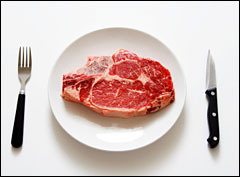
Meet your meat.

Photo: iStockphoto

Let's define "good" meat as pasture-raised by small-scale farms, just for the purpose of this small-scale article. I'm not quite sure which are the chain restaurants in Missouri (the only restaurants on the Fair Grove site are a Subway and a pizzeria), so I'm going to sidestep your question a bit and talk about buying meat directly from the producer.

Before I utterly bail on you, though, I want to encourage all persons to ask restaurants about meat. If you're shy about being picky, you can always use mad cow as your excuse, and no one will think twice. Usually a chain restaurant will get beef shipped from some large business, or the wait staff will give you a brand name, which you can differentiate from "we get it from Bob's butcher on M Street." And you can always look on a restaurant's website. If a place is spending money on pastured meat, they will usually tell you all about it.

One more thing: I have noticed that the two big chains you would normally think of when you think of meat are making some efforts to better their purchasing here and there. McDonald's uses organic beef in some locations, and Burger King has committed to buying a small percentage of its eggs and pork cage-free. But out of billions and billions served, that accounts for a mere beakful. And because I think it's unlikely that smaller, regional establishments like Bob's Big Boy are buying pastured meats (but I know dearest readers will write in with any firsthand knowledge), I will now move on to buying meat directly from the producer.

If you cook meat at home, this is a wonderful way to support sustainable meat production and family-scale farming in your area, and improve your diet. Many folks only eat meat out at restaurants, but since most restaurants buy what we could call generic meat, this habit is environmentally counterproductive.

There are a few ways to find local meat producers if, unlike Rich, you have not discovered them. If no meat is sold at the farmers' market, the market manager might still know enough about local agriculture to be able to connect you with small producers. The internet is a good resource, through sites like foodroutes, or through searching by state and product until you find something such as the AgriMissouri Buyer's Guide. I have luck looking for small farm programs within the states, usually run by an extension or a state university, and those programs usually lead to a list of farms or something similar. If the internet and the farmers' markets don't pan out, I noticed that Fair Grove has a custom meat processor. They are not the only place to have a small custom meat processor, which will likely know how its customers are raising their stock.

There's no quality assurance better than knowing your grower. I have never met a small-scale meat farmer who wasn't smart, very well informed, and happy about raising animals responsibly. Sometimes with small producers you buy the meat "on the hoof," meaning you technically own it while it is still alive, and pick up the meat after on-farm harvest. This is a way for small growers to get around USDA inspection rules, which are designed for large-scale production and are quite a hassle. Other times, such as at farmers' markets, you are purchasing meat slaughtered under USDA inspection. Either way, you'll pick up your frozen meat and merrily carry it home, knowing the producer cared deeply about quality and safety -- after all, you know who raised your meal. Our family had a chest freezer and used to buy an entire side of beef (all hail the Athens Mastodon, the chewy fellow we got one year); you could buy a whole lamb or a quarter pig, or sign up to get a chicken a month. Or you can buy individual cuts as it suits, depending on the farms you find and their systems.

By the way, the meat will taste different, because the animal's diet and exercise regimen were healthy.

Beefily,
Umbra

 

Yours is to wonder why, hers is to answer (or try). Send your green-living questions to Umbra.

Umbra Fisk is Grist Research Associate II, Hardcover and Periodicals Unit, floors 2B-4B.

Advertisement
Advertisement
  1. amc89 Posted 2:22 am
    13 Aug 2007

    Eating outI agree that if you are an omnivore, it's best to only eat meat you've purchased yourself from a reputable source and avoid it when eating out unless the restaurant specifies that the meat is both humanely and sustainably raised. And eating out is a good time to experiment with vegetarian meals. For vegetarian friendly retaurants in your area, check out happycow.org
  2. chiquitamegan Posted 3:53 am
    13 Aug 2007

    Helping Free-Range FarmingI am a vegetarian, but a friend recently sparked my interest.  Is it better to not eat meat at all (for sustainability purposes), or to help the free-range market by occasionally purchasing sustainably raised meat? Would it be beneficial and productive to promote the use of free range instead of avoiding all meat-eating altogether? eg. lowering the cost of such meats, promoting others to eat by these means. I'm conflicted by this, and was hoping others might have insight. I am not converting back to meat-consumption, but it would helpful when I talk to people who question my reasons for not eating meat, and encourage them to make better decisions for sustainability.
    -Meg
  3. askantik's avatar

    askantik Posted 4:16 am
    13 Aug 2007

    In response to Meg moreso than the articleMeg, why would it be better to buy some "sustainably-raised meat?"  Meat is meat.  Meat is dead animals, and I don't eat dead animals.  There is no kind way to slaughter an innocent creature.  Even if they are allowed to truly run free for years and years and enjoy a nice life, they are still raised for one purpose and one purpose only: slaughter for our insatiable appetite for flesh.  Disgusting and I won't support it.  Buying organic or "sustainable" meat instead of not eating it at all is just someone looking for a cop-out, in my opinion, unless they are doing it solely for the environment...  Even if you ignore the debate about whether environmentalists must not eat meat (some say it's a contradiction), I don't see how you can have compassion for the planet but not the creatures that live on it.  For the record, "humane" animal raising is BS.
    Humane means to be treated like a human, and we don't slaughter and/or eat human beings.  
  4. keichline Posted 4:45 am
    13 Aug 2007

    Major Chains - and defending MegHi Rich.  This may not be available in your area, but if you are still looking for a major chain restaurant, Chipotle (the burrito place) boasts that they use free-range, antibiotic-free, "all-natural" pork in their carnitas (shredded pork).  Also, their black beans are primarily organic, tho they are very up-front about the fact that they can't purchase sufficient quantity of organic black beans to be able to say they use "only" organic.  Not sure what their policy is on beef.
    Askantik - Please don't attack Meg for her inquiry.  If you read her entire question, it is insightful.  Perhaps it is in contrast to your belief system but please respect that people have opinions that differ from yours.  The world is not black and white, and people sometimes make decisions we don't agree with.  Tolerance and compassion compels us to accept people in spite of our differences.  Just a thought.
    ---Sasso
  5. anthony11 Posted 4:48 am
    13 Aug 2007

    Stop kidding yourselves

    There is no such thing as sustainable meat.  Look at the widespread devastation that grazing has brought our lands.  Somewhere between 60-70% of the grain grown in the US is fed to livestock, and pigs in the US generate more bodily waste than humans.  If "sustainability" is what people seek, cessation of the mistaking of animals for food is one of the biggest and easiest steps to take, for the preservation of farmland and aquifers.  Land currently used for livestock could be turned to other, better uses.
    "Free-range" is meaningless.  Anyone who doesn't understand this has had their head buried quite deep in the sand.  One hundred thousand debeaked mutant chickens (meat chickens are wholly unnatural) in a barn with a 10x10 concrete pad open at the top count as "free range".  There are a very, very few truly pastured livestock out there, but it's not finacially viable at any scale, and the large amounts of land needed to support such are incompatible with any dream of "sustainability".
    "Would it be beneficial and productive to promote the use of free range instead of avoiding all meat-eating altogether?"  That's tantamount to fighting lung cancer by smoking only thin cigarettes.  Even if "free range" animal products truly were available, polluting our watersheds with tons of animal shit, our skies with prodigious volumes of methane, and our bodies with  prions, antibiotics, hormones, and other toxins (commercial chicken feed, fed to "free range" chickens, deliberately contains ARSENIC!) is incompatible with the concept of sustainability - all it does is demonstrate that people don't want change, only the illusion of change to wrap themselves in because it's currently "chic".  If you want to do something beneficial and productive, stop rationalizing your laziness and get off the animal products.  "Free range" CJD, colon cancer, kidney stones, coronary disease, and diabetes are hardly "beneficial and productive" to anyone other than Cargill and all the other huge  agribusiness zillionaires.


    Meg, if you'd like to have reasons to give people for not mistaking friends for food, hand them a copy of T. Colin Campbell's "The China Study".  Campbell isn't even a vegan (but rather a strict vegetarian) and this book is packed full of science -- epidemiological and (unfortunately) animal studies of diet and chronic disease.
    Howard Lyman's "Mad Cowboy" tells the story of a cattle farmer who saw the light.
    You can't teach compassion, but you can teach people nutrition and environmental cause/effect.
    As for the original article's notes about pesky USDA inspection:  "Umbra", clearly you've had your eyes and ears closed for the last 20 years if you believe that USDA inspection safeguards anything.  The USDA's charter is agribusiness protectionism, and they don't even deny it.

     
  6. wayneluke Posted 4:58 am
    13 Aug 2007

    Local MeatMy wife and I have had a friend grow a pig for us for the last five years. They grow it and then it gets shipped to the meat processor/butcher to be processed and smoked if appropriate. We then pick it up when it is ready. For use it is a lot cheaper and the meat tastes better. Added on to this, we know the animal was raised in a humane way with plenty of area to grow in. The reason we started is that they had grown pigs for a while because their children were in 4H. However when the kids left 4H, they still wanted to raise a pig a year for themselves. Pigs are social creatures and a solitary animal doesn't do as well. So they suggested we buy the second pig.
    We also get local chicken, turkey and rabbit when available. We had looked into raising a steer but it was more meat than we could handle and wasn't really viable. Instead we have recently switched to locally grown bison as it is healthier than beef and more readily available from a small local farmer.
  7. akbeancounter Posted 5:12 am
    13 Aug 2007

    Free Range or None?Meg said:

    Is it better to not eat meat at all (for sustainability purposes), or to help the free-range market by occasionally purchasing sustainably raised meat?
    Given the amount of food and water that goes into meat production, the best bet for the environment is probably no meat at all.  By buying meat that you don't really want, you would ever-so-slightly tilt the market percentages toward sustainable practices, but more animals overall would be bred and slaughtered.  Seems to me that a better idea would be to encourage meat-eaters to reduce their consumption (nicely, please) and to switch to more sustainable choices, as Umbra suggests.
    As I have noted on these hallowed blogs before, terms like "free range" and "pasture fed" are not very tightly regulated, so if you really want to be sure that you're buying humanely raised animals, you should get to know your farmer.
    -- A.
  8. akbeancounter Posted 6:06 am
    13 Aug 2007

    AttitudesAnthony, look at your post, then look at everybody else's comments, before and after.  Notice any difference in the tone?
    Meg mentioned at least twice in her comment that she doesn't eat meat.  Her goal is noble enough: she wants to shift the market toward more humane practices.  As I said in my last post, I find her approach misguided at best, and probably counter-productive.  But I didn't attack her as "rationalizing her laziness," nor did I have to resort to profanity (see "polluting our watersheds..." at #3) to make my point.
    Jumping down peoples' throats for eating meat (even though Meg doesn't) isn't the way to win converts.  I've given up on joining a vegetarian/vegan organization because of attitudes like that.  Any attempt to suggest that humans were meant to eat some meat is met with poorly-researched generalizations, unconfirmed and/or obviously biased studies, and emotional rhetoric meant to shock people into submission rather than to educate.  Yet, such charades are thoroughly unnecessary; there are plenty of facts out there to illustrate how commercial meat production is bad for animal, human, and planet alike.  But I guess that's just not flashy enough for some people.
    I wouldn't argue that American meat consumption is even close to what nature intended; we've become a society who wants more of everything, dirt cheap and always available, and we don't care how we get it.  But I refuse to join an organization where facts take a back seat to attention-grabbing charades.
    -- A.
  9. amc89 Posted 6:29 am
    13 Aug 2007

    Agree with akbeancounterNo, I don't think "it would be beneficial and productive to promote the use of free range instead of avoiding all meat-eating altogether?" We should promote free-range, humane certified and grass-fed over the conventional crap, but not over healthier more sustainable plant-based alternatives.
    If you're already vegetarian, great, stay that way, as the vegetarian diet has less of an environmental impact than even diets based on grass-fed livestock. Livestock, even grass-fed, emmits significant quantities of greenhouse gases like methane and ammonia.  Switching livestock from grain-fed to grass-fed reduces the emmissions, but does not eliminate them.
    "eg. lowering the cost of such meats" I umderstand where you're coming from, but we need more people going vegetarian or vegan to reduce the cost of meat and dairy substitutes and other plant-based sources of protein!
  10. askantik's avatar

    askantik Posted 7:33 am
    13 Aug 2007

    Don't think I was being a jerkIf anyone finds my comment abrasive, I apologize, but I won't revoke it or reword it.  I don't mean to hurt anyone's feelings or offend anyone, but the truth is the truth.  If you find the truth offensive, uh, it ain't my problem.
    I read someone's opinion (this article, the comments...) and left my own.  I'm sorry that it's rude to tell people they have no compassion if they kill animals for food when it is totally unnecessary.  In my mind (and the minds of many others), this is only common sense.
  11. mearph Posted 7:40 am
    13 Aug 2007

    Definitely not black or whiteI agree that everything is not black or white. You can't instantly change everyone's mind.  You can curse and yell and pout about it all, but that won't get you anywhere. You have to work with people to slowly get them to understand the better option.  And yes, 'free range' and 'pastured' can be confusing and misleading but not if you know your farmer.  If I can get there, I go to a farm to buy cheese and meat. I see the cows and I know they are well cared for. I also like that I am supporting the endangered small farmer.  He loves what he does and I like what he does so, I like to support that. He manages his manure and waste responsibly.  And I agree that we should eat less meat but being a vegetarian or vegan isn't for everyone.  Food is very important.  It's not just about the environment and nutrition but its also about tradition and culture.  It can even be almost religious to people.  You just can't forget about that and assume they will also forget. If you can get them to choose the better option then you are doing a good thing.
  12. greenlagirl's avatar

    greenlagirl Posted 12:28 pm
    13 Aug 2007

    eating outSustainable Table's Eat Well Guide's a good resource for locating non-factory farm meat. The database -- searchable via zip code --lists farmers' markets and stores as well as restaurants --
  13. latenac Posted 10:26 pm
    13 Aug 2007

    MegI don't think the farmer who runs my CSA and who raises lamb, chicken, beef, pork as well as veggies would think it would be better for you to abandon your principles and buy the meat she raises. She might ask that you buy some eggs from her since you're not a vegan. But she has very strong principles herself and I can't imagine her asking someone else to abandon theirs.
    As I picked up my share yesterday and thought about this column. I did wonder what my CSA farm would be like if it went vegan, financial considerations aside. Right now the tomatoes I picked up were grown in the hoop house where the laying hens spent the winter and contributed to the soil. The lambs and other grazing animals are rotated and help to eat cover crops so new crops can be planted. Manure from all of the animals help the veggies I get grow. Horses help to cut down on tractor and other fossil fuel vehicle usage. It's basically an ecosystem in the Polyface farm way that Michael Pollan wrote about. Each component is dependent on another and helps out a component in some way.
    Admittedly my impressions of veganism make it seem extreme to me, would the ideal vegan farm have no animals whatsoever? Would no manure be used? With the short growing season in Vermont I doubt any farm could make a real go of it without using some animals. Most of the farms here have a few chickens or a couple of cows or farm horses. I just have difficulty wrapping my head around how it would be better to use chemicals to fertilize crops rather than manure from farm animals and how you could have a complete ecosystem for a sustainable farm without using animals. But maybe I'm wrong and veganism doesn't preclude that.
  14. nikki Posted 11:17 pm
    13 Aug 2007

    the guise of organic & free rangebig industry - again and still - is finding a way to prey on the compassion of their consumers...

    please do research on free range/organic and what they actually mean...
    i can back up anthony11's facts,here....while eating out or purchasing mass-produced animals/by-products, you can guarantee that those individuals were abused, and in conditions that pollute our environment.
    regardless of the much needed humane treatment of these animals, look into the links between their treatment and healh conditions for those who eat them http://www.pcrm.org/news/health021218.html
  15. nikki Posted 11:26 pm
    13 Aug 2007

    comments to meg about veganismHi meg!  

    I can't speak for all vegans, but I am one.  
    As for your "using animals" comment, my basic premis behind being vegan is the reality that humans don't have to use them to excel in life...non-human animals should, on all accounts, be afforded the right to live their lives as a means to their own end...

    just because we can utilize them and their resources doesn't mean we should...

    i do realize that in todays day, it's impossible to partake in any event that doesn't contribute to their use...our entire culture has booomed because of it!

    i hold firm that if we were to shift (obviously not any time soon....) to a culture that lives in harmony with all living creatures, a means to do that sustainably would be determined...but since little if any attention's been given to it, there have been no solutions (that I know of).

    again, i can't speak for all vegans...that's just my input...

    thank you for posting the question in a friendly, non-discriminatory way....  =)
  16. latenac Posted 11:42 pm
    13 Aug 2007

    nikkiThanks for answering my question in a friendly way. Can you paint a picture of what the ideal vegan farm would look like? Where does the fertilizer come from? How do you do pest control? Is there a model somewhere that I can read about of a vegan farm like I can for the Polyface model of "grass farming"? Small local, sustainable farms are very important to me and how my family eats. I would think there has to be a market for small, local sustainable vegan farms or maybe I'm wrong. I'm not going to give up being an omnivore but I am curious and would support a sustainable vegan farm as much as I support my sustainable omnivore one. Or maybe there isn't really all that much of a difference.
  17. nikki Posted 12:13 am
    14 Aug 2007

    More for Meg.....I briefly searched the web for insight on the vegan farming issue, and this site seems to break it down cleanly..

    http://www.thevegetariansite.com/env_veganorganic.htm
    This site offers additional information..

    http://www.veganorganic.net/index.php?option=com_content& ...
    As for omnivorous farming practices, from what I hear, the Polyface you refer to is the best bet.  
    I applaud you for inquiring and pursuing the open range option that smaller family-type facilities practice.  Where my values about non-human animal consumption differ from yours, I am truly appreciative of your contribution to humane treatment and environmental respect.  The animals involved, your family's health and our Earth are all better off for it...
  18. Grevangelical Posted 12:19 am
    14 Aug 2007

    Meg has a valid question...In Minnesota and the Midwest the most environmentally sustainable farms I know of include both vegetable products and meat. Most (if not all) of these farms are ideological descendants of Aldo Leopold. The techniques that go into the farms I know best are management-intensive grazing, mixed crops, companion planting, crop rotation and replication of native prairie with 2/3rds or more of the land. By replicating the prairie and using management intensive grazing the herds (whether cattle or bison) simulate the way the land operated before the white-man turned it into an agricultural wasteland. The prairie (including nitrogen-fixing clover and a variety of carbon sequestering grasses) and the manure of the herd work together to restore the land and improve the topsoil before it is rotated into plant farmland. This setting is also ideal for native animals, who aren't killed in the burning or cutting of this temporary restoration. Farms which use these techniques see numbers of native wild animals jump exponentially in the first few years. It also eliminates the needs of any kind of fertilizer transport and turns animal waste into fertilizer.
    Of course, one farm like this will produce more than 20 calories of plant food for every calorie of meat. That is also closer to the ratio of what we should be eating.
    Disclaimer: I'm actually a vegetarian, born and raised. My stomach can't handle meat, but environmentally it can be sustainable, so I must argue in favor of it.
  19. bahairus Posted 12:45 am
    14 Aug 2007

    Kudos to latenecThank you, latenec, for pointing out how things work at Polyface.
    "The Omnivore's Dilemna" is a great book; one of the chapters lays out the Polyface model in detail. The veggies from these farms benefit from the existence of the animals and then grow without chemical help. Nikki, I did follow your links to Vegan-farming. Very interesting. I just wonder how many different ingredients are requires for good fertilizer? Aside from the compost, how far do the ingredients have to travel? I am in the upper-midwest.. limes are not a local crop.
    If anyone has any interest in eating meat, I would guide you to buy only from small, local/regional farms that truly pasture their animals. (Often, you can visit these places and see how the animals are raised.) Assuming that the cows are truly pastured and the chickens are out of the pen, you are avoiding a lot of the environmental pitfalls mentioned above. BTW: Veggies should be purchased in the same way: local, small-farm-grown and organic. Just because it isn't a animal product does not mean it is sustainable.
  20. amc89 Posted 12:54 am
    14 Aug 2007

    Veganic produceA number of farmers are experimenting with "veganic" farming, which means neither using animal manure or chemical fertilizers.
    Read more at http://en.wikipedia.org/wiki/Veganic_gardening
    http://www.navs-online.org/voice/plant.html
    "Eliot Coleman, author of The New Organic Gardener (1996), has gardened organically for more than 40 years, the last 15 of which he has used veganic methods. He was given a grant in the early '90s to experiment with supplying all the fertilizer needs of a commercial organic farm through composted plant-matter rather than animal manure. Through his research, Coleman determined the number of acres of hay needed to fertilize one acre of food crops. He found a one-to-one ratio of compost-producing ground to food-producing land, and this was in Maine, where the soil is rocky and relatively hard to work."
    "Homesteading pioneers Helen and Scott Nearing, best known their book Living the Good Life, gardened veganicalty for decades. Freya Dinshah, Vice President of the American Vegan Society, recalled a gardening class taught by Helen where an organic grower asked for suggestions on how to deal with insects. Helen was unable to provide an answer because in aLL her years of farming, she had never experienced the problem."
  21. bahairus Posted 12:55 am
    14 Aug 2007

    Hi, GrevangelicalGreat comment! I am in Minneapolis and pull from a CSA farm that uses these techniques. I also realize how blessed we are up here. I just moved from Ohio. When I was there, I had more trouble finding good meat-supplying farms. In that case, I ate a much smaller percentage of meat.
    The 20 to 1 ratio is also great to point out. We eat way too much meat in this country. I usually keep my total meat consumption to no more than two or three meals a week (including fish) and eating only the recommended serving size, which is tiny compared to what you get in a restaurant. (I.E. 4 oz of steak compared to 16 oz of steak.) If this is grass-fed beef, all the better. It is very rich in flavor (sorry, vegans) and high in bio-available omega 3s.
  22. nikki Posted 1:05 am
    14 Aug 2007

    Veganic farming- Yeah!Excellent, amc89!

    Thank you VERY much for the input!

    I'm working with a clean energy organization, which includes alternatives to green house gass emitting practices...which your links provide evidence to support!

  23. snickwah Posted 2:29 am
    14 Aug 2007

    An Animal's PlaceJust read all these comments after coming in from doing the morning chores on a small, family farm (which raises vegetables and pastured meats).  As I pulled the Polyface-esque chicken pens across the pasture (moving the birds to a fresh patch of grasses and bugs, leaving their droppings behind to fertilize the pasture) I stopped to look at the surrounding landscape: a vast, inland ocean of corn and soybeans.  A number of the vegans and vegetarians I have known have subsisted on a heavily soy-based diet.  I'm just curious how many folks who have decided to go meatless have thought about the implications of raising all that soy (not to mention other monocultures of vegetables), which is practically dripping with chemical fertilizers and pesticides.  
    My intention isn't to be critical of vegetarian diets.  As someone who is trying to be as much of a "locavore" as possible, I find myself sitting down to a number of vegetarian meals.  Still, I don't think it is easy to completely write off meat as unsustainable and unethical.  In fact, it may be important.  My family's farm operates with very few inputs, producing food for a number of families while building up the soil for future generations.  The chickens, turkeys, pigs, and cattle are a necessary piece of this.
    Also, just curious if anyone has read Michael Pollan's essay, "An Animal's Place," or Barbara Kingsolver's discussion of harvesting turkeys in Animal, Vegetable, Miracle?
  24. cconservationist Posted 2:40 am
    14 Aug 2007

    pastoralists uniteJust to add another angle on the debate--I am studying livestock and the environment in Israel.  The Bedouin make up a minority population in Israel.  Their traditional lifestyle was nomadism, based on herding sheep and goats.  They are not the only nomadic group out there.  While if you engage in herding you can't eat much meat (think about it) you clearly eat some.

    In Israel, the beef industry is subsidiary to the dairy industry.  If you raise cows for milk, what do you do with the baby bulls?

    While I definitely agree with people being critical of their food supply, and think that it is great to be vegetarian (as long as you acquire an understanding of human nutrition) native cultures of humans as well as biodiversity of domesticated animal species would disappear if everyone were.
  25. nikki Posted 4:32 am
    14 Aug 2007

    to snickwah....hi!  i applaud you for contributing to sustainable living....and not partaking in the egregious acts of factory farming (FF)

    i agree with your monoculture statement...as a recent recipient of a bachelors in wildlife ecology and conservation, i've learned quite a bit about the detriment to the environment/soils/crops when unsustainable practices are engaged in....lands going fallow for a time is imperative, as well.  i - too -am aware of the abundance of processing soy goes through...clearly not the "miracle food" we'd all like it to be....
    as for ethics and sustainability relative to animal agriculture, the current day FF techniques fail with flying colors.  please follow the link below to the Humane Society of the United States website for quotes from the UN's Food and Agriculture Organization (FAO) and the US Department of Agriculture (USDA) on the environmental degredation and contributions to climate change afforded by FF....
    http://www.hsus.org/farm/news/ournews/earth_day_livestock ...
    I haven't read your suggestions, but am currently reading Pollan's "Omnivores Dilema" that follows the multi-step process of corn, beef cattle and chicken (i'm not quite 1/2 way through it....there'll be more nail-biting as I go, i'm sure).
    i, too, thought animals would be needed for crop production to be chemical free and sustainable, until I looked into the links I refer to above....where current evidence exists and shows crops thrive without any animals or chemicals....
  26. LandMan Posted 7:59 am
    14 Aug 2007

    Hunting for itPerhaps the best way to eat meat is if you hunt it yourself. There are a lot of great tasting game animals; and if you do you're research, you can kill you're own food and take comfort that you are providing a valuable ecological service. Wild hogs, for example,  are a great thing to hunt because there is perhaps no other introduced animal that causes as much damage to our natural areas as feral hogs. I think they taste much better than farm raised.
    There are also crtain herbivores (deer, elk) in many areas that require hunting to keep their populations down in the absence of carnivores (wolves. mountain lions), else we suffer the ecological damage from over grazing and out competing the more selective herbivores.
    I know there are many cases of sportsmen lobbyists forcing hunting of a particular species in a particular place where it should not be allowed, but if you do you're research you can provide yourself with a cheap supply of great-tasting meat while providing a valuable service that protects the environment.  
  27. amc89 Posted 1:21 am
    15 Aug 2007

    Organic soyNot all vegetarians and vegans subsist on only soy products. Most vegetarians I know, myself included, make an effort to vary protein sources, and to buy organic and local produce. And most of the soy products available at places like Whole Foods are organic, so don't blame vegetarians on the over-use of pesticides. In fact, in a previous Grist column, Umbra mentioned research on the environmental impacts of soy compared to the environmental impacts of beef, and soy was clearly the winner. It takes a tremendous amount of pesticides to grow feed for livestock and poultry. And there are the greenhouse emissions from livestock.
    As for hunting, one of my concerns has always been that in places where deer, elk, or moose numbers are low, hunters seem to always lobby for killing seasons on their predators. For example, in Alaska, hunters are killing wolves to boost moose numbers, in some areas in the southwest, hunters want seasons on mountain lion to boost elk numbers and in Maine, trappers are killing coyotes with the cruel neck snare to boost deer numbers. So I've always had a hard time taking seriously that hunters care so genuinely about the ecosystem.
  28. dhwert Posted 4:11 am
    15 Aug 2007

    Meat haters are counterproductiveWhile I appreciate the tone of the more recent comments, the ones from askantik and anthony11 really do more harm than good.
    Here's the reality:


    Many, many people in the U.S. eat meat.

    Factory farming is terrible to the animals and the environment.


    With these two realities, what are our options for improving the situation?  Meg raises a good challenge: should we advocate for veganism/vegetarianism (no meat), or sustainable meat (better meat)?
    To deny that better meat exists, or claim that all meat production is essentially the same (morally, ethically, environmentally, health-ly, etc.), as askantik and anthony11 do, is ridiculously wrong*, but even worse, it perpetuates the problem stated in the above two realities.  It gives meat eaters only one option: no meat.  For those millions of meat eaters who won't give up meat, they can only reject the proposed option as extreme, continuing with a diet of conventional meat.  They might deplore the factory farm system as well, and want to reduce suffering, but are presented with no better options than this "all or nothing" approach.
    Thus, I think the only responsible approach is to present people with multiple options that help to solve the problems posed by factory farming:


    Go vegetarian!  Try it, maybe it will work for you. (But don't forget that industrial farming of grains, beans, and veggies also has ethical implications and impacts on animals!)

    If you don't want to give up meat altogether, find local farmers who raise animals on pastures, and buy primarily from non-factory farm raised sources.  The extra expense of this higher quality food will probably lead to the next option...

    Eat less meat.

    and there are probably others that I'm not even thinking of or listing


    While the goal to have everyone go vegetarian may be laudable, it's unrealistic and counterproductive to promote it as the only option.  There are no one-size-fits-all solutions to the problems we've got in this world, and those who claim there are, are part of the problem, I'm afraid.
    Cheers,

    Dave
    *To argue how the anti-meat/all-meat-is-the-same attitudes are wrong would repeat good work done by Tom Philpott here at Grist, Michael Pollan, Joel Salatin, Wendell Berry, Jo Robinson (eatwild.com), Sally Fallon (http://www.westonaprice.org), and a few comments on this page, so I won't go into my rebuttals.
  29. dhwert Posted 4:26 am
    15 Aug 2007

    good grassfed cookbook and other resourcesNo, the cookbook isn't grassfed...
    http://grassfedcooking.com/

    Shannon Hayes has written two books on cooking with grassfed meat.  I've had recipes from both, and they are excellent!  Since grassfed animals tend to be leaner, it can affect the cooking approach somewhat.
    As mentioned in my last post, another good place to learn about the benefits of grassfed meat (vs grain-fed meat) in terms of animal, human, and environmental health is

    http://www.eatwild.com/

    They include a listing of local grassfed producers by state.
    Dave
  30. blueberrysushi Posted 5:52 am
    15 Aug 2007

    Where animals are bestIn The Worst Hard Time, Timothy Egan does a beautiful job describing changes to the landscape of the driest parts of the southern plains as the bison were first replaced by cattle, and then by crops. According to Egan, the cattlemen saw the practices of farmers as highly destructive, as the grass was overturned and facing "wrong side up."
    My point is that, while the destruction of the bison was terrible, their replacement by cattle was, ecologically, not a disaster. At least not as bad as the tillage that happened with the farmers, who created a wasteland in very short order. Some places may be more suitable for grazing, and while it would be wonderful to always have native animals grazing the lands, it may be acceptable to have limited numbers of domesticates grazing. Especially if the alternative is to turn over the grasses and wait for the droughts that bring black skies and misery.
    As an aside, when I was living in Kyrgyzstan, I ate some meat. The land there was not fertile enough for crops, and I'm glad they didn't raise them. The soils were too shallow and rocky (subalpine, mostly). They depended on sheep for their meat, and it was a local food source.
    There are legitimate reasons for being a vegetarian. Someone mentioned Sally Fallon, and I think she's way too dogmatic about her disdain for vegetarianism. But there are legitimate reasons for meat-eating, as well. Context and circumstances can change the relative merits of dietary choices, and strict adherence to vegetarianism is not necessarily a responsible choice.
  31. snickwah Posted 11:14 am
    15 Aug 2007

    To nikki and amc89: thanks for your thoughts!nikki, thanks for the link about factory farms.  The cattle on my family's farm graze in a pasture that butts up next to a veal barn, so (unfortunately) I have first-hand experience with the dark side of factory farming--especially the stench of toxic amounts of animal manure.  Many opinions have been expressed in this discussion about what to eat, and I think it's clear that factory-farmed meat is the least desirable option.  The Omnivore's Dilemma does a good job of illustrating that point.  When farms operate on such a large scale, the plants and animals, the environment, the eaters, and even the farmers are dealt a losing hand (as far as I can tell, the only "winners" in this game are large companies who sell farm "inputs" and the food processors that purchase the cheap commodities).  
    Thanks, also, for the information about vegan farming.  I haven't heard much about it before, and I look forward to learning more.  Still, I'd like to stress the value of small farm economies that include animals.  As Pollan describes so eloquently when writing about Polyface Farm, the animals of these systems aren't really "used" so much as they're depended upon--and encouraged--to express their specific natures.  We should remember that farm animals exist only because they have co-evolved through time in direct relationship with humans (a topic discussed in another great book by Pollan, The Botany of Desire).  On small farms like Salatin's and my family's, pigs aren't crammed into dark barns with their tails snipped.  Instead, they're encouraged to root around (as they are inclined to do) in a mixture of straw and manure, turning it into fluffy compost for the garden.  Chickens aren't de-beaked and shot full of hormones and antibiotics.  Instead, they're put out on pasture where they can peck fly larvae out of cow pies.  And in the end, after the farmer has fed them for a time, they feed the farmer.  I don't think the question is whether or not we should eliminate animals from our farming.  I think it's more important to consider the scale at which we farm.
    I suppose my comments are starting form a response to amc89's post about organic soy vs. crops grown for livestock feed.  Again, I think we should consider scale.  It would seem that most of the people posting comments here agree that genetically-modified monocultures of corn and soybeans grown for feedlot animals shouldn't define our agricultural landscape.  I know I'd be a lot happier if they didn't surround my family's gardens and pastures.  But I have to ask: are giant fields of vegetables grown in California and trucked across the country really that much better?  As others have said, I don't think it comes down to what we should eat.  I think it's better to ask how we should eat.
    I'm sure some of you are accusing me of simply paraphrasing Wendell Berry.  That's because I am.  I think it would do us some good if we all put down what we are doing and read something by him right now.  Thanks for the lively conversation, everyone.
    (And as long as we're talking cookbooks, I'd like to second the recommendation for The Grassfed Gourmet by Shannon Hayes.)
  32. amc89 Posted 5:53 am
    16 Aug 2007

    Helpful veg websitesFew people are claiming that people everywhere should all be vegan. Extreme examples like herders in Kyrgyzstan are being used here, but I can't really think of a legitimate excuse why any middle-class North American Grist reader couldn't become a vegetarian.  Vegetarianism is really not that difficult if you have an open mind and just do a little research on proper nutrition and read up on new cooking techniques and new foods. There's a wealth of website and books out there to guide people through the transition.  Two suggestions: http://www.vegforlife.org and http://www.humaneeating.org

Add a Comment

You are not logged in. Thus, you cannot post a comment. If you have an account, log in. If you don't have an account, well, by all means go make one! Meet you back here in five.

Hello, Visitor!    Why not register?

Advertisement