Jet vs. Vette

Umbra on planes and cars 8

Hi Umbra,

Which is less harmful to the environment when traveling long distances, flying or driving? A jet puts out a lot of exhaust, but since it carries a lot of people, maybe it's less than having everyone drive themselves?

Craig
Denver, Colo.

Dearest Craig,

Jeepers it was fun to find out the answer to this question for you -- the Math Whiz has joined me in the basement, and we are dorking out on carbon emissions on your behalf. Here's what we think: airplanes and cars are roughly comparable on CO2 emissions, but certain particularities of airplanes, particularities that are only beginning to be understood, likely make them worse, overall, than cars.
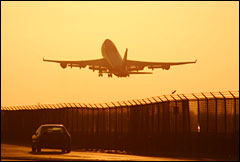
Dilemma a la mode.

Photo: iStockphoto

Cars and planes have a range of emissions. Some cars get more miles to the gallon, some planes are more efficient than others. Some car trips are loaded with the whole family and the dogs, others are driver alone; some planes fly from Denver to Tucson, some fly from Denver to Thailand. Let's go over what the Nobel Prize-winning Intergovernmental Panel on Climate Change has to say on the matter. If you like, follow along, in "Aviation and the Global Atmosphere" -- we'll be looking at figure 8.4. Long-haul planes emit fewer warming gases than medium and short-haul planes, because landing and takeoff are the big emissions culprits; long-haulers emit about 32 grams of carbon per passenger-kilometer, short-haulers about 100 g/p-km. The Nobellers show the least-emitting car as a small two-passenger spewing about 20 g/p-km, whereas the most emitting would be a light truck with only a driver inside, at about 99 g/p-km. So you see, the two sets of numbers are roughly comparable. But wait!

Cars travel on the ground, whereas a plane flies quite high and fast, and does not follow road routes. These differences, which we all learned at around age 3, turn out to have serious effects on the relative impact of transport emissions. Planes emit their climate-changing gases higher in the atmosphere than do cars, and hence have a distinct, stronger effect on climate. Apparently to attempt an accurate whole measurement of air travel's climate impact, one needs to account for "radiative forcing": how the released gases, including nitrogen oxides and water vapor, alter the radiation entering our atmosphere. The science of radiative forcing is quite complex and in flux, what with the variety of flights and the changes in weather and the uncertainties of science and so forth, hence airplane emissions are often calculated by multiplying the carbon emissions with a set number. The Nobel Prize-winning IPCC sets a multiplier of 2.7.

If you are deciding between cars and planes on a particular route, you can get even more specific than "cars are probably better than planes, what with this radiative forcing." The average U.S. car emits approximately 9 kilograms of CO2 per gallon; the average, 22-mpg American car therefore emits about 0.4 kg CO2 per mile. Do the math for your car on the anticipated journey. To calculate the airplane emissions from an identical trip, try the offsetter atmosfair's emissions calculator, which includes radiative forcing. Then compare. Atmosfair's description of its calculator's calculations is also a helpful description of all the known factors involved in air-travel emissions. Is that more information than you need, or what?

I am obliged to remind us all of the bus and the train. Buses are cheap and trains are fun. Did you know that Amtrak has a frequent-rider program akin to a frequent-flyer program, called Guest Rewards? Of course, buses and trains don't always fit into our modern schedules, but we should use them when we can to avoid planes and cars.

Forcefully,
Umbra


Yours is to wonder why, hers is to answer (or try). Send your green-living questions to Umbra.

Umbra Fisk is Grist Research Associate II, Hardcover and Periodicals Unit, floors 2B-4B.

Advertisement
Advertisement
  1. jennyhall98006 Posted 12:32 pm
    17 Oct 2007

    Dimmer switchesI have heard that having a dimmer switch on a light switch is inefficient.  Is that true even when the light is not dimmed?  What about 3-way bulbs?
  2. scatter Posted 6:45 pm
    17 Oct 2007

    RFIJust a quick comment on non-CO2 emissions and RFIs. The 2.7 figure you quoted has been widely picked up but is quite shaky (even if it did come from Nobel prize winners ;) and not the correct way to quantify non-CO2 effects. What is certain is that there are effects which go beyond the CO2 emissions. How strong they are is a topic of fierce discussion.
    If you're really keen, an attempt to explain it can be found in the following document but I warn you that it's a little dry, and the climate scientist who pointed me towards said "it is a complex issue and one needs to understand the details of RF calculations for this to 'click'". I'm still scratching my head...
    http://snipurl.com/aviationandrfi (p29 onwards)
    There's a much more user friendly discussion here (and lots of other interesting aviation & climate related info):
    http://snipurl.com/pandd
  3. ClosetEnvironmentalist Posted 2:22 am
    18 Oct 2007

    What about # of passangers?I'm just wondering, is the number of passengers included in those g/p-Km numbers?  It seems to me that because long haul planes have a much higher capacity than short haul, large planes would be more efficient than small ones. So my question is, are these numbers calculated assuming the planes are the same size, or are capacity and fuel consumption differences taken into account?
  4. scatter Posted 5:10 am
    18 Oct 2007

    Load factor is very importantDon't forget larger aircraft need to burn more fuel to carry their load.
    Load factor (% of seats full) is very important. From the UK to Europe with our crazily cheap flights, load factors on the low cost airlines average around 80% (Easyjet 82%). The large traditional operators are maybe 75% (BA 77%, Virgin 73%) and the charter operators are as high as 90% (First Choice 91%).
    (stats from http://www.caa.co.uk/statistics 2006)
    However the carbon factor (gCO2/km) doesn't just depend on the load factor but also the distance flown. An aircraft flying on a 1 hour sector will spend a greater proportion of its time climbing at high throttle. An aircraft on a 7 hour sector will spend a long time at the most efficient cruising altitude. After a certain distance, the carbon factor starts to creep slowly up again because you have to burn more fuel to carry that extra bit of fuel for the end part of the journey (if you get my drift). This is illustrated on the Atmosfair methodology graph here:
    http://snipurl.com/atmosfairmeth (p10)
    Even more important is the load factor of the car you're comparing flying against. If you've got a car that puts out 200g per vehicle-km and you fit 4 people in it you've got 50g per passenger-km. If the choice is 1 person driving or flying then it's quite possible that flying is better. If it's 2 people then the balance starts to shift towards driving. 3 or more and driving is most likely the best option. But it all depends on so many factors and the data simply doesn't exist to make an informed decision.
  5. amc89 Posted 5:32 am
    18 Oct 2007

    I am a proud Amtrak Guest Rewards memberI live on the east coast, so when I'm just doing trips up and down the coast, Amtrak usually works out the best. May take longer than flying but you do spend less time in security, and the stations are usually in downtown locations so are usually closer to your final destination than the airports, and you don't have to worry about airsickness.  
  6. Greta Posted 7:18 am
    18 Oct 2007

    Yes, but......when you factor in the extreme aggravation of trying to use the Amtrak website, train is no option.  Heck, I could walk to my destination faster than I could find information about the point-to-point travel on their website.  Well, then, I guess that Amtrak is better for the environment as it makes you prefer to walk.
  7. AlexS Posted 9:45 am
    18 Oct 2007

    paper. etc.Dear Umbra,
    Which are there more of--farm animals, or wild animals (excluding

    non-cephalopod invertebrates?)
    Will habitat disrupters (global warming, deforestation, mining,

    overfishing, chopping down trees with nests, and cattle grazing) mean

    there will be permanently be less anmals suffering, or will it mean

    there will permanently be

    more animals suffering?

    (Or will new species adapt?)
    Does cattle grazing mean fewer net animals?

    Whose lives would be better--the animals otherwise eliminated by

    grazing, or free-range cattle?
    How much suffering does the West cause, (as much as by factory farming?)

    Would I cause more suffering than good if I become an author , or

    other job involving paper, or a movie maker--even if I contribute to

    animal rights organizations?
    Once factory farming is abolished, will the life of each human still

    mean the suffering of more than one creature?
    Warmest regards, Alex
  8. racc Posted 2:26 am
    19 Oct 2007

    Missing the PointThis is like asking the question "Which side of the Titanic was it best to sink on?"
    Neither forms of long distance travel are sustainable. We all need dramatically reduce the use of both planes and automobiles.
    A great high-speed rail system would be much better than both planes and automobiles.

Add a Comment

You are not logged in. Thus, you cannot post a comment. If you have an account, log in. If you don't have an account, well, by all means go make one! Meet you back here in five.

Hello, Visitor!    Why not register?

Advertisement