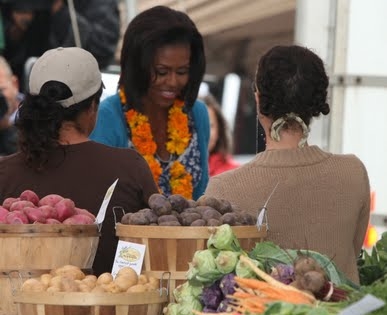
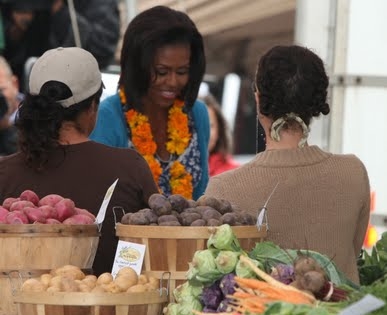
With all the talk of Michael Pollan and Jamie Oliver lately, it’s easy to ignore the person who right now is, given her current address, the most influential voice on food policy in the country. Naturally, I’m talking about First Lady Michelle Obama. While she’s been exercising what diplomats would call her “soft power” for a while, i.e. planting a garden, making speeches on healthy eating, and so on, indications are that she’s quietly developing a set of policy recommendations to reform the food system. Obama Foodorama has been tirelessly reporting on these maneuvers, which have remained under the radar—even to the point of Mrs. Obama holding “secret meetings” between her policy team and USDA officials.
The speeches continue—she gave another one just the other day at the Department of Health and Human Services. But according to Ob Fo, the First Lady’s policy team—White House Food Initiatives Coordinator Sam Kass and Policy Director Jocelyn Frye—are currently fleshing out a new set of national food and health initiatives. And while nothing is imminent, it now appears that the White House is embracing the “addiction model” of food consumption as portrayed in former FDA chief David Kessler’s new book The End of Overeating:
[T]he book has become something of a bible for Mrs. Obama and her food policy team, and required reading in the White House. Dr. Kessler holds that our bodies and minds are completely changed when we consume sugar, fat, and salt and he maintains that there needs to be all kinds of behavioral changes focused on countermanding this. So while creating better food infrastructures in schools, and promoting educational programs that include cooking and gardening, and promoting better access to healthy foods for the general population through edible gardens and farmers markets, etc., ect., is crucial—these are only part of the very complicated dynamic that gets people to permanently embrace healthier eating. Mrs. Obama and her food policy team are fully aware of this, and they’re busily working on ways to encompass Dr. Kessler’s ideas in upcoming policy initiatives.
I’m very curious to hear how Mrs. Obama translates Kessler’s treatise into policy. Because not only are sugar, fat, and salt addictive, they are accompanied by billions of dollars in marketing designed to get you hooked in the first place. The WaPo’s Ezra Klein summed it up nicely when he observed that:
People like crap food. It’s convenient. Brilliant, highly paid scientists have spent millions of dollars precisely calibrating it to the modern palette. Innovative, award-winning advertisers have spent billions of dollars making us want it.
Resisting that onslaught is impossible even for many of the most jaded, highly-educated, “cosmopolitan” Americans. And yet even chef and activist Jamie Oliver—who is witness to this phenomenon on a daily basis as he tries to change the food habits of a working class American city—can’t avoid indulging in a serious game of Blame the Parents:
“I’m a respectful person, and I’m going to try to do things in the nice way. But it’s almost as if parents here have stopped saying no. It’s as if the kids rule the roost.” We came upon a table of Krispy Kreme doughnuts. “They’re a treat, there to be loved,” he said. “But start having them every day, job done. It’s harsh to say, but these parents, when they’ve been to the doctor and keep feeding their kids inappropriate food, that is child abuse. Same as a cigarette burn or a bruise.”
The abuse, Mr. Oliver, is in fact perpetrated by beverage and snack company executives who develop the products, concoct the marketing campaigns and have the gall to declare things like “soda is a staple food.” Meanwhile, a new study out of UCLA’s Center for Health Policy Research offers compelling, if not overwhelming, evidence that focusing like a laser on sugar in general and soda in particular may really offer the most bang for the buck:
[R]esearchers found that adults who drink a soda or more per day are 27 percent more likely to be overweight than those who do not drink sodas, regardless of income or ethnicity.
“The science is clear and conclusive: soda is fueling California’s $41 billion a year obesity epidemic,” says CCPHA Executive Director Dr. Harold Goldstein, an author of the research brief. “We drink soda like water. But unlike water, soda serves up a whopping 17 teaspoons of sugar in every 20-ounce serving.”
Research shows that over the last 30 years Americans consumed 278 more calories per day even as physical activity levels remained relatively unchanged. One of the biggest changes in diet during that period was the enormous increase in soda consumption, accounting for as much as 43 percent of all new calories. According to Goldstein, that research, combined with this new data on soda consumption, offers conclusive proof of the link between soda and obesity.
And while adult soda consumption is troubling, consumption trends among children paint an even more alarming picture for the future health of California. The study found that 41 percent of young children (2-11 years of age) are drinking at least one soda or sugar-sweetened beverage every day. Adolescents (12-17) represent the biggest consumers, with 62 percent (over 2 million youths) drinking one or more sodas every day—the equivalent of consuming 39 pounds of sugar each year in soda and other sugar-sweetened beverages.
According to the study, Americans consume 22g of added sugar daily—that’s up to four times the recommended daily amount of sugar. And that’s just the median amount, which means half of Americans are consuming even more than 22g of sugar a day. That. Is. A. Lot. Of. Sugar.
It sure looks like an addiction to me. Just as with tobacco, we must have government intervention to get anywhere in the obesity epidemic—and Michelle Obama has positioned herself to advocate for just that. Now we just have to wait and see if and how she survives the firestorm that will erupt the minute she does.

Comments
View as Flat
ejgrist Posted 7:58 pm
14 Oct 2009
Permalink
Tom Laskawy Posted 6:36 am
15 Oct 2009
Permalink
ejgrist Posted 6:46 am
15 Oct 2009
Permalink
deborahlee Posted 9:21 am
15 Oct 2009
Healthy fats are a wonderful and essential food group; unhealthy fats are the abomination, not fats in general!
Thanks for a great article, by the way...
Permalink
Patti Garland Posted 10:59 am
15 Oct 2009
Permalink
Cdrates Posted 6:04 am
16 Oct 2009
Permalink
deborahlee Posted 7:34 am
16 Oct 2009
Consumers and farmers in many states are waging legal battles or circumventing standard means of milk production to ensure access to that real milk. http://www.realmilk.com/whichchoose.html and related sites have a lot of useful information. I love particularly the experiments where they put hazardous bacteria in fresh milk -- the bacteria die -- and grocery store milk -- where they multiply. Once you've tasted the difference, you won't even care about the science that confirms the superiority of fresh milk.
Permalink
earthlysue Posted 12:00 pm
15 Oct 2009
Permalink
rexx Posted 12:28 pm
15 Oct 2009
Permalink
foodprovider Posted 1:21 pm
15 Oct 2009
Permalink
damspam Posted 8:45 pm
15 Oct 2009
Permalink
foodprovider Posted 7:23 am
16 Oct 2009
You want change in our food industry? So do I. But more and more regulation will only drive out more and more small scale producers, farmers and the small processors that may have your best intrest in mind. Use your food dollar as your weapon. If people do not buy twinkies, they will stop producing twinkies. No regulation needed, no dollars carelessly spent to regulate. Instead of going around blaming what you call industrial ag or big ag for your problems, teach people how to cook, teach them how survive without having to buy a frozen pizza, or going through the drive through.
Permalink
anil Posted 5:56 am
16 Oct 2009
Permalink
foodprovider Posted 9:53 am
16 Oct 2009
Permalink
ejd Posted 11:02 am
16 Oct 2009
Permalink
foodprovider Posted 2:35 pm
16 Oct 2009
Permalink
ejd Posted 4:44 pm
19 Oct 2009
It is not any great secret that America's system of agricultural subsidies suppresses the prices of commodities like corn and soy. After all, the United States and the European Union have both been "sued" at the World Trade Organization by developing nations over their ag subsidies. The US lost that battle and the WTO ruled that we had to eliminate the subsidies or pay fines. We haven't eliminated the subsidies.
Anyway, it's simple math... if you suppress the price of the primary commodity, you also suppress the price of all of the by-products-- like corn syrup, corn starch, hydrogenated oils etc, etc, many of which are common, empty-calorie ingredients of junk food and processed foods. Cheap junk/processed food ingredients = cheap junk/processed food. Since the prices of these foods are artificially cheap, the price signals for junk/process foods are distorted. So, it's not as simple as just "supply and demand". The market is being distorted, so you can't just blame the consumer here.
Permalink
foodprovider Posted 7:13 am
20 Oct 2009
Sorry if I misunderstood your comment on corn syrup. (For example, subsidies that ultimately make things like corn syrup artificially cheap).
If grain subsidies are the reason for cheao grain, then why is it not so cheap right now? Grain is a world commodity, they have to compete with grains produced by other grain exporting countries, such as Brazil and Argentina for example. As the price of grains go up, the level of subsidies goes down. The prices for the last few years have been well above the trigger prices of $1.86 for corn and $5.54ish (can't quite recall that figure) for soybeans. Even milk is still above the target price before payments are triggered. And Yes, even the organic growers get theses subsidies. The US was sued over the type of subsidy, not that there was a subsidy. The EU subsidizes their farmers at a much higher rate than we do.
Permalink
amazingdrx Posted 8:52 am
22 Oct 2009
The fact is that agribizz lobbyists have invented a system of redistribution of wealth that any good commie would be proud of. The only "profit" grain fasrmers ever make comes from the rest of US taxpayers. Our wealth redistributed in order to make sure corn sugar and fat are the main inputs to both animals we eat and ourselves.
Keep on teabaggin' faithfilled patriots, you are destroying the GOP as we blog. And that's good for america. Marginalize the party of corporate lobbyists with your mindless rants. In a twisted way you really are "patriots".
Permalink
ejd Posted 3:48 pm
22 Oct 2009
http://www.nffc.net/Learn/Fact Sheets/King Corn Fact Sheet.pdf
There are other things that come into play here with respect to American's eating habits... for example being misled on the issue of saturated fats and heart disease (Micheal Pollan discusses this in Omnivore's Dilemma). Ever since the low-fat diet has been pushed on us since the 1970s, heart disease rates and obesity have not improved, in fact they have worsened. Many of the low-fat processed foods Americans buy substitute things like corn starch for the emulsifying effect that fats formerly played. The net effect was to raise the glycemic index (blood sugar-spiking effect) of many of these supposedly healthier "low fat" foods. Low-glycemic index carbs is a contributing factor to obesity and heart disease.
Also, the push to replace natural saturated fats like butter with man-made hydrogenated oils has also made the heart disease problem worse. Hydrogenated oils are a fat humans were never exposed to until the 20th century. I read one time that some Inuit populations in northern Canada used to eat a mixture of seal blubber and berries as one of their staple foods. They did not have heart disease problems. Some decades ago, they began using more hydrogenated fats and less seal blubber and heart disease became a problem.
Then there is the practice of feeding cows corn which has been shown to raise Omega-6 fatty acid levels in beef (this is a bad fat) and lower the Omega-3 levels (good fat). Grass fed beef has a much healthier Omega-3/Omega-6 fatty acid ratio. Corn is used because it is a cheap feed, but cheaper doesn't make it healthier. Mother Earth News had an article earlier this year (citing 3 or 4 studies in the footnotes) showing free-range eggs are healthier and more nutritious than factory farm eggs. Factory farm eggs may be cheaper, but they are less healthy.
Long story short: Industrial foods are definitely a culprit. They are ubiquitous and bad policies help make them cheaper to buy than healthier alternatives.
Permalink
ecofma Posted 6:48 pm
22 Oct 2009
I'm not as familiar with all the wheat or rice ramifications but we can safely say that big food runs the show of the whole shooting gallery. The industrial farmers, together with Monsanto (GM seed, Round-up, other chemicals have this heavy petro-input system (fuel, fertilizers, pesticides). All this leads to loss of top soil, polluted ground waters, rivers, streams, lakes and ponds, and depleted ozone. These industrial farmers are not only subsidized and guaranteed level profits because of price fixed commodity crops, but because the big food manufacturers, together with our Uncle Sam need all four of these crops (the ones I know most about are corn and soy, 90% and 70% respecitvely are GM) because corn and soy are in about 2/3 of the 50,000 items in the middle aisles of the supermarkets (which Walmart now, by the way, sells 1/3 of. That's right, Walmart now sells 1/3 of all the food in the country!).
Now the small farmer, who is trying to ecologically raise diverse food crops can't compete fairly because there is no level playing field. In almost every way, the deck is stacked against him. Supply is obviously way down compared to the "machine" of industrial farming and demand (though growing) is miniscule in comparison to the cereal grains and soy. Though supply is low and actually below demand, there is just a point of "toleration" of price because Americans have become accustomed to spending only 10% of their incomes on food. When a local, organic tomato is priced against an imported, factory farmed, hot house tomato, there is just so far price can go against the low cost leader. Still, because of our government/big business food system, upwards price pressure is put on the products from the small ecological farmer.
In terms of the cereal grains (mostly GM and mostly corn) being used as feed, it brings in to play the monster of a problem which is not addressed at all in the farm bill which is CAFOs (confined animal feeding operations). There are other problems besides the ones you mentioned (excellent points by the way and I'm grateful for the references--I'll use them!)of the nutritional affect to the cows. CAFOs are to blame for H1N1. This set up leads to the spread of disease. Why wouldn't it? The cows and chickens (mostly the problem species because of a small handful of meat producers--shall we name names?)are sick. They're administered massive doses of antibiotics (they're nearly immune so they are literally pumped full--now we carry tolerance to antibiotics through our lives)and other chemicals. The treatment these animals receive is less than humane. It is actually monstrous and criminal. Monsanto again has its "reach" in this arena, especially in the dairy industry but also with other growth hormones. The gross negligence of animal care and outright abuse is only surpassed by the shocking envirnmental degradation, caused by lagoons of manure.
The solution as Pollan says is to "vote" with our forks. We can do this in three ways. First, we need to take responsibility for our own diets and eat a sensible mix of fresh, natural foods. When choosing processed foods, try to stick with those with as few ingredients as possible, avoiding the things you've mentioned, and things like petro-based artificial colors (did you know that yellow #5 isn't allowed in Europe and much of the rest of the world, and our own manufacturers, who started in our country, reformulate for other countries, but here, where they grew by the support of hard working Americans, they continue to use yellow #5 because it is cheaper to do it that way!!!!).
Secondly, tell food companies we want more aternatives of safe, healthy, ecological foods. Food companies, like all manufacturers respond to demand. But we have to communicate to them or they will continue to produce according to the laws of supply and demand.
And third, tell legislators to stop supporting price fixed corn, soy, wheat and rice; to reform CAFO standards and not allow them to be operated under industry standards (industry=big food); to reward farmers who use less pesticides and fertilizers; and to support green manufacturering processes and companies that voluntarily practice CSR (Corporate Social Responsibility), TBL (Triple Bottom Line) principles, and RT (Radical Transparency).
You can do the last two ways of voting by going to one website and taking action, at http://www.raiseyourfork.com. Our initiative is called Raise Your Fork for Reform and we will really appreciate your activism.
The last point I want to make, in spite of how angry I may sound, is that the food industry should not be vilified. We can NOT produce our own food. Naturally we're glad for small farmers and it is a good idea to buy local and eat organic, but the the biggest problems are caused by big food and we don't have many options there, except to help them reform.
We have a rich agricultural history, even though it has gone very wrong for the last 50 years or so and our food system is efficient and really pretty amazing. Corporations are really just people and most people do not want to see children put in danger and most people do not want to destroy our planet. The job at hand is a joint effort and the stakeholders are consumers, government, food retailers, wholesalers and manufactures and foodservice operators. We will fix this problem by putting our heads together and embracing a bright hopeful future.
Permalink
ejd Posted 3:41 pm
23 Oct 2009
Permalink
foodprovider Posted 1:24 pm
25 Oct 2009
Subsidies.... The subsidies you talk about are also paid to organic producers. Wheather you feel subsidies are good or bad, the organic and the non-organic producers qualify. The US in not the only country to offer subsidies. the EU subsidizes their farmers at a higher level, Austrailia is very very protective of their farmers.
Permalink
Patti Garland Posted 11:24 am
16 Oct 2009
Permalink
foodprovider Posted 2:37 pm
16 Oct 2009
Permalink
treesky Posted 3:58 am
17 Oct 2009
Permalink
carol from jersey Posted 9:15 am
20 Oct 2009
Permalink
ecofma Posted 6:42 am
19 Oct 2009
Our work focusses on trying to get food companies to make more safe, healthy and ecological products. Our consumer website (which is new) is http://www.raiseyourfork.com and our blog to help food company executives start practicing the "triple bottom line" is http://www.forkinbasics.blogspot.com. The fact is, you have to show the executives the financial benefits of producing better foods because that is the language they speak. Making money is not a bad idea, but making unhealthy foods and then trying to market them as healthy is unacceptable.
All comments, suggestions and offers of help (does anyone have the connection to the First Lady?) will be much appreciated. The line is "the planet will thank you, our children and grandchildren will thank you, and the stockholders of the companies will thank you).
Permalink
heart inspiration Posted 10:28 am
20 Oct 2009
The data about soda consumption in this article is striking. The gov't should warn against it as they do with tobacco! I think many people simply don't know that it is so fattening!!
I largely gave up pop several years ago and now when I drink it can feel the sugar in my body, just like when I occasionally injest caffeine.
Permalink
pclemens Posted 1:38 pm
20 Oct 2009
Permalink
plantqueenie Posted 9:22 pm
20 Oct 2009
However, I would say that it SHOULD be the government's responsibility to provide healthy, balanced lunches at every public school. That is one area where a positive difference could reach the vast majority of our youth - in a very direct manner. Feed the kids right, put well-structured PE and recesses back into the schedules at school and lets reverse this devastating trend!!
Permalink
ejd Posted 3:18 pm
22 Oct 2009
However, the argument weakens as you go down the income ladder from there. Food deserts in inner city areas are a real problem. Most low income inner city neighborhoods have few, if any grocery stores. There are convenience stores with soda and junk food, and in some areas bare bones stores that have a lot of processed, corn syrup and hydrogenated oil-laden food and little produce. It can be very difficult for inner city populations to have easy access to good food.
Permalink
plantqueenie Posted 4:42 pm
22 Oct 2009
Besides.... my guess is that suburban, middle-America touts the pudgiest kiddos. Definitely no excuse there.
Permalink
eriqa Posted 9:48 am
25 Oct 2009
I don't understand this particularly American way of thinking, where as long as one extraordinary person can overcome massive social barriers, it is as if those barriers aren't important for the millions of ordinary people.
Why spend time parsing moral fine points within a system we all agree is dysfunctional? Let's just make the system better by redirecting subsidies to healthier foods, having clever nutrition education in schools to counter the junk food adverts, and doing simple things like helping farmers markets accept WIC and food stamps.
Permalink
plantqueenie Posted 8:32 pm
25 Oct 2009
Again, I will point to the importance of healthy food in public school lunches and being taught in the classroom.... this will set up ALL children with a firmer foundation in healthy food choices. I totally agree that measures should be put into place to provide those on food stamps the option of using them at farmers markets & the like...
But I do resent too much government involvement into the free market of food - specifically a "fat tax" or subsidies for healthy choices. Who would or COULD objectively determine what's healthy vs. unhealthy??
Permalink
annied Posted 6:44 am
21 Oct 2009
Must lament that feminist in me is sad to see Michelle Obama confining herself to traditionally feminine issues though. Where's the noise on national security (and don't you dare say food is food security) or Darfur or a number of other public issues?!
Permalink
cheapiphones Posted 1:46 am
22 Oct 2009
http://www.gotcheapappleiphones.com/
Permalink
amazingdrx Posted 8:39 am
22 Oct 2009
Permalink
John O'Brien, PA-C Posted 12:57 pm
22 Oct 2009
Permalink
Crimson Wife Posted 1:52 am
26 Oct 2009
Our bodies may be designed to prefer sugary and fatty foods, but we're the ones making the choice of what to put in our mouths. Do we choose a Big Mac with fries & a Coke or do we choose a grilled salmon filet with a baked sweet potato & a juice spritzer?
Permalink