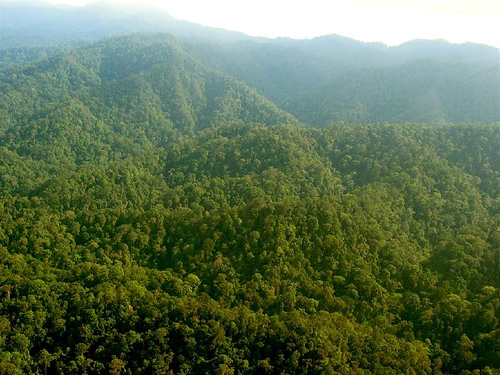
Bukit Tigapuluh Forest is truly one of those special places. It’s got three endangered species, two minority groups of indigenous people and a superlative: it’s the last remaining stand of tropical lowland forest left on the island of Sumatra.
Funnily enough, it’s also about to be cut down.
Notorious rainforest destroyer Asia Pulp and Paper has cut a road through the forest and is working on getting a concession to convert the forest (containing over 1,000 species of trees) into a tree plantation (containing maybe 2 species).
They’re calling this development.
Nonprofits and businesses around the world are calling it deforestation. Unfortunately, the new forest part of the of the climate change treaty (called REDD) under negotiation this week here in Bangkok may end up calling it carbon savings and subsidizing its destruction.
Only two days into Bangkok, REDD talks have been picking up from the snail’s pace that they were running at in the Bonn sessions earlier this year. Developing countries like India and Brazil have come out with stronger positions that are challenging developed countries to truly make forests a priority in the negotiations, and formerly timid Australia is stepping up to the plate.
But forest definitions remain a problem. As the situation currently stands, the proposed treaty text does not distinguish between intact natural forests (those that humans didn’t plant) and tree plantations. Not only is this a problem from a cultural and biodiversity point of view – since tree plantations don’t provide any of the habitat or cultural benefits of natural forests – it’s a problem from a climate point of view.
Intact natural ecosystems like forests store and absorb massive amounts of carbon, tree plantations, being younger and less diverse, store and absorb significantly less carbon. This equation means that converting forests to plantations is a net loss for the climate, increasing the 20 percent of global greenhouse gas emissions caused by deforestation, rather than decreasing it, which is ostensibly, the point of REDD.
Right now, Bangkok is all about setting rules for how the game of REDD will be played. Just like in any sport, we need to know where the goal is and which plays will draw a red card. If the rules aren’t set out clearly, we may end up permanently offsides.
Forest definitions sound geeky, but they really do matter. If a treaty intended to protect forests and the climate can’t save a place like Bukit Tigapuluh, then what are we doing here?
A message from
Your support keeps our climate news free.
Grist is the only award-winning newsroom focused on exploring equitable solutions to climate change. It’s vital reporting made entirely possible by loyal readers like you.
At Grist, we don’t believe in paywalls. Instead, we rely on our readers to pitch in what they can so that we can continue bringing you our solution-based climate news. Donate today to keep our site free.