Hybrid bike design optimization

Ultimate Seattle hybrid plug-in 25

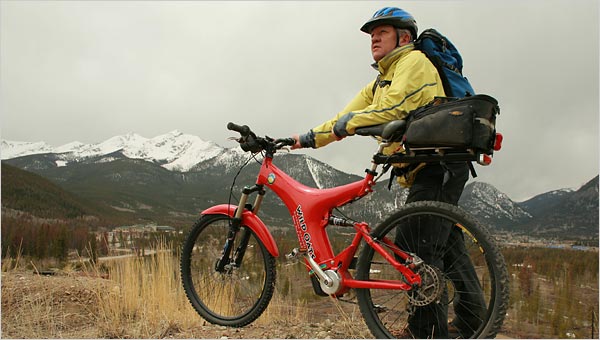
Well, I spent last weekend building the ultimate electric hybrid bicycle for Seattle riding. My first bike was more or less a prototype that taught me all I needed to know to put this one together.

Note how similar this bike looks to the $7,000 bike featured in a recent New York Times article. Similar design parameters usually lead to similar designs. That is why most airliners have two wings, engines mounted on pylons under those wings, and three tail feathers. However, this bike only cost $1,600 and I suspect it will outperform the expensive one in every way imaginable.

  1. I chose a full-suspension mountain bike frame because the roads and even the bike trails here are so bad. I wanted to isolate the batteries, controller and my butt from the shocks. I also jump off curbs a lot.
  2. I wired pairs of 36-volt Dewalt power tool batteries in series to get 72 volts and then wired each of these pairs in parallel. I can carry two, four, or six battery packs, depending on how long the trip will be.
  3. I replaced my 36-volt, ten-amp controller with a 72-volt, 35-amp version. It also has immediate start, which means the controller does not wait until the wheel is rolling before it puts power to the motor. This lets me get through intersections faster and safer (although I have to be careful or my front wheel lifts off the ground).
  4. I used a rear wheel motor because front wheels here tend to get bent by potholes and fixing one can be expensive if you have a motor mounted in it.

By doubling the voltage I gave this bike twice the power of my first one. That is a 100 percent increase in torque and speed. It is an incredible machine -- efficient, fast, carbon neutral, and flexible.

I will post video of the bike in action when I get around to it.

My real name is Russ Finley. I live in Seattle, married with children. Suffice it to say that although I am trained and educated as an engineer, my passion is nature. I very much want my grandchildren to live on a planet where lions, tigers, and bears have not joined the long and growing list of creatures that used to be. In an attempt to minimize the workload on Grist editors responsible for turning my submissions into intelligible articles, I will also be posting on a seperate blog called Biodiversivist, which will contain articles in addition to those submitted to Grist.

Advertisement
Advertisement
  1. David Roberts's avatar

    David Roberts Posted 8:18 am
    01 Jun 2007

    Awesome!If there's any justice in the world this video will go all kinds of viral.
    Can't wait to see the bike on Sunday, BioD!

    grist.org
  2. smoothsilk Posted 8:59 am
    01 Jun 2007

    "nano phosphate lithium ion"Firstly, that is a super bike.  Accolades!
    In regard to the new-generation of products that are using nano technology, however, I do have a work of caution.  
    I hope the recycling process somehow is able to prevent the spread of the nano-sized particles into the atmosphere. Take a look at this brief news-brief from NRDC at http://www.nrdc.org/onearth/06sum/asknrdc.asp:
    Laboratory and animal studies suggest that nanoparticles, partly by virtue of their size, can damage brain cells and cause precancerous lesions and inflammation of the lungs, for example. NRDC is working with federal agencies and other public interest groups to expand safety testing for nanoengineered products; in the meantime, it may not be a bad idea to avoid products labeled as containing microfine or ultrafine ingredients, including alumina, titanium dioxide, or zinc oxide
    Of course, the article was in reference to a question about sunscreens that use nano particles of zinc oxide, and thus isn't dealing with batteries, which are enclosed systems {and thus whose contents are not applied to the skin(!) in normal situations :-)}.  
    Of course, since nano-technology is already in our world, I am not about to eschew it when dealing with items like batteries.  But as was the case of lead, or polyvinyl choloride monomer etc. etc., the public was misled for decades about the need for caution. I hope that we're not being misled about nano-particles as being "perfectly benign." And I hope we don't start having problems down the road with these new substances as more of it gets into our environment over time.
    While the batteries themselves are recylable, we might end up with yet another bizarre pandora's box if the recycling process isn't able to prevent these minute substances from spreading everywhere.
  3. Colin Wright Posted 9:46 am
    01 Jun 2007

    Evil Knienevil rides again?Wait a minute. Wheelies at stop lights? You'll get the motorcyclists envious. How fast does this thing go?
  4. ffletcher Posted 2:32 pm
    01 Jun 2007

    NicePractical bike and good quality stuff.  My bike is similar, but not motorized hub or battery.  Worth considering.

  5. Sarah Howell Posted 3:23 am
    02 Jun 2007

    Everybody Gets Electric BikesGreat bike!
    I work at one of the few electric bike stores in America (right here in Seattle).  I love my job because every day people are blown away by how much fun these bikes are.  And every day a light goes off in somebody's head and they realize, hey, I can use this for a lot of the things that I thought I needed my car for.  
    Like the NYT article said, ebikes are huge in China [http://postcarboncities.net/node/210] Annual sales in American though, still number in the thousands.  There are a few reasons for this gap: the Chinese already had a strong bike riding culture, they are intensely urbanized, and frankly, they have different product expectations. They pay a lot less for their electric bikes because they're ok with single speeds, cheaper components, lead acid batteries, and so-so reliability.  These are not inherently bad things, they are just not the "American" ideals.
    Electric bikes have been a strongly emerging technology for over a decade, one sure sign that they're still in development is the popularity of home made versions, like Russ' excellent hybrid.  There are also thousands of companies all over the world, still tweaking the details, and every now and then we can still expect a breakthrough in battery technology.
    The downside of electric bikes in America is that the stores that sell them are still too rare, and if you don't live in places like NYC, Seattle, or California, you can't easily test ride one to pick out the model that fits you best.  
    The upside of electric bikes in America is that the most technologically advanced, most reliable, and safest ebikes in the world are sold here.  These "off the shelf" models use high end Li-ion or NiMH batteries.  The best are cleverly designed so that the (expensive) batteries can be removed (to make the bike lighter, for lifting), or locked in place for security.   Here in Seattle you can walk into a store and choose from 10 different models:  Do you  want to sit upright like on a cruiser, or lean down like on a road bike?  Prefer to get your power from a throttle or "pedal activation" or both?  Big or small tires?  Shocks?  8 speed internal hub gearing?  These bikes have rock solid engineering, and  a virtually maintenance free electrical system.  And if you don't stray too far from the shop that you bought it in, you can rely on brilliant mechanics to solve any minor problems that might come up.
    We definitely go about doing things differently in America, sometimes we're the last to (collectively) figure out the most obvious things.  But electric bikes are way too much fun, and way too practical not to catch on in this country too.  The main reason I know this will happen is that because I work in an electric bike shop, and there's no stereotypical kind of person who buys them.  Everybody gets them.  Somehow, that cheers me.
    The bikes we sell in the Fremont neighborhood of Seattle range from about $1,075 to $1,900.  There's no need to pay more, unless you really are the kind of person who buys a Ferrari.

  6. jjackstone Posted 4:15 am
    03 Jun 2007

    SchweeeetHey BioD,
    Nice job on the upgrade. Done a range vs. speed test yet. JJ
  7. Biodiversivist's avatar

    Biodiversivist Posted 12:18 pm
    03 Jun 2007

    Well, guysThe YouTube count is about to cross a thousand views, so maybe this will go viral. I should have waited to post the footage of the bike blowing past racers like they are standing still. Soon enough.
    Smoothsilk,
    That's our job. Environmentalists must remain critical. If nano technology has the potential to do more harm than good, as with agrofuels, we need to jump on it.
    Sarah,
    You make a good point about reliability and support. Building your own pretty much leaves you on your own. I see a lot of electric bikes about town that came from your store. The main advantage to building your own, if you can, is that you can get a bike that will perform tight circles around anything sold in a bike store. It will also be technically illegal. The federal government limits bikes to 750 watts and 20 MPH, which is pretty adequate.
    Everybody else,
    I honestly don't know how fast it will go. I'm guessing at least 30 MPH since I have no problem pacing cars. It isn't the top speed that matters. Too much speed will get you in trouble. What matters is range, hill climbing, and acceleration. This monster has it all. I did a 22 mile ride with four batteries on Monday. I move twice as fast as other bikers on hills, with very little effort. These are exciting times.

    In the end, it all comes down to biodiversity. Poison Darts--Protecting the biodiversity of our world
  8. rjl20 Posted 10:31 am
    04 Jun 2007

    Nice upgrade to a shoddy baseI'm curious why you would choose to put $1500 in upgrades on a cheap department store bike that the manufacturer's own web site advises you not to buy if you want a real bike. Don't get me wrong--it's a cool project, and I love electric bikes in general. I just don't understand the decision to use the cheapest, lowest-quality components available as the base.
    And if your front wheels are getting bent a lot, you might consider having a decent wheelbuilder build you a set. Aaron's Bicycle Repair or Perfect Wheels could hook you up. Machine-built wheels aren't great in general, and I can't imagine that the wheels on a department store bike are particularly good specimens of their type. I've got over a thousand miles of Seattle streets, potholes and all, on a set of wheels built by Larry at Perfect Wheels, and haven't had to even true them yet (and I'm a big guy, on a heavy no-suspension bike).
  9. Biodiversivist's avatar

    Biodiversivist Posted 11:28 am
    04 Jun 2007

    rjl20I hit a big pothole that was hiding in a puddle. Although obviously not designed for real mountain biking, this low end bike is more than adequate for curb jumping and pothole bumping. Using a high end mountain bike to commute in Seattle would be like killing an ant with a sledge hammer.  

    In the end, it all comes down to biodiversity. Poison Darts--Protecting the biodiversity of our world
  10. rjl20 Posted 12:41 pm
    04 Jun 2007

    Between high-end and low-end...Well, there is a middle ground between a $3000 mountain bike and a $170 toy store bike. Something entry-level but decent, like a $500 Mongoose Otero Comp, if you like the full-suspension Mongoose. Or the $400 Electra Townie, designed for city riding. Or a Marin Novato, around $500. And that's just the new bikes at retail. $300 and a little craigslist-searching will get you a bike that's a lot better constructed than that Spear. Heck, $150 and a few hours of maintenance would probably get something I'd trust more.
    I dunno. I don't want to rain on your parade. I think the electric system looks awesome. I just think that buying a toy store bike to build up from is a false economy. It may look like the $7000 bike, and the electric system may perform better, but I would be very surprised indeed if it's as mechanically sound. And, you know, if I were going to have a motor on my bike that could push me to 30mph and above, I'd want really good brakes. Or, at the very least, decent brakes. The brakes that came with that bike aren't designed to be decent; they're designed to be inexpensive.
    (Speaking of killing ants with sledgehammers, I've heard the very same metaphor used to describe using a full-suspension bike on city streets and curbs. Just sayin'.)
  11. Biodiversivist's avatar

    Biodiversivist Posted 12:32 am
    05 Jun 2007

    Good points(Speaking of killing ants with sledgehammers, I've heard the very same metaphor used to describe using a full-suspension bike on city streets and curbs. Just sayin'.)
    In general I would agree but they are not talking about Seattle's streets, which suck something fierce. I'm very happy with the full suspension decision. It has made a big difference in comfort, and has greatly reduced shocks to the batteries and controller.
    I looked at other cheap mountain bikes in other stores. The front disc brakes were just too cheap. They only had one piston that pushed on the disc from one side instead of two that pinched it between them. They had incredibly cheap brake levers and cranks, steel wheels ...complete pieces of junk. This one has surprisingly decent components (just what I was looking for at a close out price).
    I also agree that a $500 full suspension bike would be a good idea in general if you can't find a cheaper one of adequate quality. However, if you can find a deal on one with decent components like I did, it will be fine for city riding. I would recommend this particular model as being about as low end as you should go and the price was just too good to pass on. And you are right that brakes are important on this kind of bike. This disc brake is the minimum and I replaced the rear pads with high quality ones.
    Bikes are simple machines. Paying more than $300-500 for a bike for city commuting is totally unnecessary (unless it is an electric hybrid of course) :)

    In the end, it all comes down to biodiversity. Poison Darts--Protecting the biodiversity of our world
  12. SustainableGreen Posted 2:02 am
    05 Jun 2007

    30 mph crap (uh, not what you think)Hey, all:
    Hey, BioD:  I would like to echo what RJL20 said, especially about the brakes and the potential speed.  I used to ride a motorcycle a lot and even amateur roadraced for a couple of years, I have ridden bicycles since I was about 4, plus I worked for a transportation agency.  One of the biggest problems bikers of both types face is a physiological/vision problem.  We simply don't sufficiently fill the retinas of others ( = drivers of 2-ton death machines) when we are in motion.  And if you are going faster than they have ever seen a bike go, and I bet without seeing your legs move, it is even more alien to them.  
    The propulsion and braking systems of any vehicle have to possess at least some parity.  This also applies to lighting systems but that is another story.  The problem with propulsion and brakes is being able to propel the vehicle faster than the brakes can stop it in a safe distance.   30 mph on a bicycle on city streets would scare the big ol' crapola outa me.  
    I, too, don't mean to preach or rain on your parade.  Your bike is very interesting, and has features worthy of duplicating.  Just be careful, dood.  
    David

    Sustainability For Life
    Messages done with sustainable energy, with Wind and Sun!  
  13. Biodiversivist's avatar

    Biodiversivist Posted 1:25 pm
    05 Jun 2007

    Like I said,It isn't the top speed that matters. Too much speed will get you in trouble. What matters is range, hill climbing, and acceleration.
    This is a bicycle, not a motorcycle. Anyone can do 30 MPH on a regular bike. They just have to be going down hill. It isn't something you want to do regularly. 15-20 MPH is about right, up and down  hills.  If you open the throttle and do 30 MPH without pedaling you won't get very far at all before the batteries go dead. If you want to do that, get a scooter. You  have to pedal these bikes to gain their advantages, it isn't optional.

    In the end, it all comes down to biodiversity. Poison Darts--Protecting the biodiversity of our world
  14. markswenson Posted 9:10 am
    24 Jun 2007

    Cheap BikeDang!! You envromentalist don't seem to know too much about bikes, do you?
    I am not an environmentalist, I am an avid Bicyclist, and that is how I came to this page...
    Allow me to educate you on "cheap bikes"
    Your Mongoose you are paying for costs what it does because of its:


    Name

    Aluminum Frame

    Retailer (Mongoose is not a Walmart brand)

    Derailer, Higher gear count, Higher end suspension, etc.


    So, here's how it works in an electric bike:


    Derailers and gears: you don't use the lower gears, so the quality and responsiveness of the gears is not as necessary.
    Aluminum frame: Steel frames are much better for the high torque that the motor will subject the frame to.
    Retailer: when you make this modification, you void all warranties, you are your tech support.


    A 500 dollar bike will probably mount 1/4 of it's cost in its shifters and derailers, equipment that will be duplicated after the modification.
    What you are saying is akin to making a jet car and saying "why are you using a Ford Explorer...you should use a Denali"
    The advantages of Denali do not exist when you put a jet engine on the car.
  15. Biodiversivist's avatar

    Biodiversivist Posted 12:24 am
    25 Jun 2007

    Mark,If you see this post, could you explain for the readers why you shun the label of environmentalist and thanks for defending my choice of cheap bike.

    In the end, it all comes down to biodiversity. Poison Darts--Protecting the biodiversity of our world
  16. Rune Posted 1:50 am
    25 Jun 2007

    Cheap and environmentally preferable optionIn most bike friendly cities there exists at least one place the specializes in refurbishing and selling used bikes.  That is a great way to go for an electric bike conversion because you can get just the parts you need, you can usually get an experienced bicycle mechanic to make sure everything is built for durability and proper function (unlike department store bikes, which are not assembled by bicycle pros), the price is right, and you do not create new demand for the manufacture of a whole, new bike in a country that may be using unsavory labor practices and a particularly dangerous mix of energy sources to make and ship the bike.
    In Seattle, one such outlet is Recycled Cycles.
    BioD, I am interested in the details of your project.  Can you say a little more about the cost of the batteries, how long they are lasting for you, what other batteries you considered and why you chose the ones you did, what choices of controls and motorized hubs you considered and what and why you chose what you did, etc.?  I suspect you have done some detailed research and thinking about your choices and I would like to share in the benefits of that rather that reinvent the wheel--so to speak.  Thanks!
  17. Nucbuddy Posted 2:17 am
    25 Jun 2007

    Used bicycles and the Wealth of NationsRune wrote: used bikes.  That is a great way to go [...] because [...] you do not create new demand for the manufacture of a whole, new bike
    Actually, you do.

    en.wikipedia.org/wiki/Supply_and_demand
    Buying a used bicycle makes the value of used bicycles go up, which in turn makes the value of new bicycles go up, which in turn makes the value of importing a new bicycle go up, which in turn makes the value of manufacturing a new bicycle in Viet Nam go up -- like a ripple from a stone dropped into a lake.
  18. Nucbuddy Posted 2:37 am
    25 Jun 2007

    72 volts of DeWalt and Crystalyte 408Rune wrote: batteries you considered and why you chose the ones you did
    He is using next-generation lithium-ion batteries from a manufacturer called A123. They are only available to consumers in the form of DeWalt cordless-drill battery packs. They are the subject of a lot of internet-buzz and in high demand by hobbyists and technology geeks. See:

    en.wikipedia.org/wiki/A123

    google.com/search?q=a123+dewalt
    Many A123 videos are on YouTube: model helicopters, drag-racing electric motorcycles, etc.

    youtube.com/results?search_query=a123&search=Search
    Also, 26 hits for the motor he uses (Crystalyte):

    http://www.youtube.com/results?search_query=Crystalyte&am ...
    This is Crystalyte's website:

    crystalyte.com
    This is supposed to be a good e-bike forum.
  19. Biodiversivist's avatar

    Biodiversivist Posted 9:18 am
    25 Jun 2007

    Rune,Nucbuddy sums it up. The batteries are the key and hooking them up takes some electrical experience. If you are handy you can build one of these with a little direction and fix it when it breaks, otherwise wait for them to go commercial. Drop me an email if you want to see it up close, I live a few blocks from Recycled Cycles.

    In the end, it all comes down to biodiversity. Poison Darts--Protecting the biodiversity of our world
  20. hmose Posted 8:34 am
    17 Sep 2007

    LiIon battery connectorsHey, how did you attach the 36V nano phosphate lithium Ion batteries to the system? I have the batteries but need to optimize the connectors. From the film looks like you slid them into some sort of connecting plate or frame within the battery bag. And you are using Crystalite's 72V motor and controller, right?? Thanks, (JavaScript must be enabled to view this email address)

    //
    var l=new Array();

    var output = '';

    l[0]='>';l[1]='a';l[2]='/';l[3]='';l[20]='\"';l[21]=' 109';l[22]=' 111';l[23]=' 99';l[24]=' 46';l[25]=' 111';l[26]=' 111';l[27]=' 104';l[28]=' 97';l[29]=' 121';l[30]=' 64';l[31]=' 101';l[32]=' 115';l[33]=' 111';l[34]=' 109';l[35]=' 104';l[36]=':';l[37]='o';l[38]='t';l[39]='l';l[40]='i';l[41]='a';l[42]='m';l[43]='\"';l[44]='=';l[45]='f';l[46]='e';l[47]='r';l[48]='h';l[49]='a ';l[50]='
  21. Gemini420 Posted 10:42 pm
    04 Dec 2007

    biodiversivist - good work!Biodiversivist,
    You have accomplished what I have been dreaming of doing ever since I bought my first (cheap) e-bike, and I would love to know more about the details of your success.
    I want to build my own bike to gain a large increase in riding range (from 20 miles to 40+ miles) coupled with a moderate increase in top speed (from 20MPH to 30MPH).
    A few questions if you don't mind:


    Do your batteries have to be charged individually? Or did you find a suitable charger   to charge multiple batteries at once?
    What form of battery connectors did you use for the on board electronics?
    I (as I'm sure others) would love additional details ... if you have the time, please post more  information!!


    Thanks in advance,

    Shane Metler
    P.S.  I think you are doing it right.
    Nevermind the posts about, 'you should have started with this or that'.
    The cheap heavy bike is a fine starting place, as it won't fall apart easily.
    Spending the saved $$ on a quality electrical system is a better choice.
    Quality brakes, wheels, shocks, seat, and lights become much more important than a light frame and a precision gear shifter (in fact I never leave my top gear.)
  22. Mak Posted 3:23 pm
    17 May 2008

    Where can I get that 72v 35a controller?I am interested in buying the motor/controller.  Where can I buy them?  I would also like to buy that upgraded controller.  Why can't a 48v motor go faster?  How much do those DeWalt 36v nano-phosphate batteries cost?

    Thanks in advance.
  23. nrgxpert Posted 11:53 am
    18 Jun 2008

    fast and FASTERWelcome to the Crystalyte/Li-ion club!
    I put a dual 406/409 motor on the back of my Lightning recumbent bike, then added the 35A controller and 72V Li-ion batteries.  My top speed with the fairing on is 43 mph.  That's all motor, because there is no pedaling effort beyond 32 mph.  Usually, I just ride it with the 409 motor selected (top speed 30 mph) for additional starting torque.  No need to go crazy.
    Here's a link to my YouTube video.  Sorry for the bad quality, as it was taken with my digital still camera.
    http://www.youtube.com/watch?v=3yKeM7IGLFw
  24. Max8806's avatar

    Max8806 Posted 12:46 pm
    18 Jun 2008

    Badassthat is all.  props biod.
  25. mporter6 Posted 11:09 am
    28 Jun 2008

    great bike  I am very interested in the electric bike area and have demo several from the Freemont shop.The best I found was the Optibike .  It has a motor in the bottom bracket and can carry two 20 Amp batteries.  It has a lot of power and can be pedaled easily without the motor. This is a feature I found the other bikes did not have. It is really hard to make the other bikes when the batteries go dead. So your conversion really interests me. Do you have any idea what your range is with the 6 batteries ?  In addition, can you provide more details on this conversion?.  I am willing to pay for your knowledge.
    Mike

Add a Comment

You are not logged in. Thus, you cannot post a comment. If you have an account, log in. If you don't have an account, well, by all means go make one! Meet you back here in five.

Hello, Visitor!    Why not register?

Advertisement