Who Will Get the Jobs?

An environmental-justice advocate responds to the biofuels boom 12

I am very excited to see this Grist series, because I am a biodiesel user. I am also very worried about the growth of the biofuels industry, because I am an environmental-justice advocate, and I see this industry rapidly leaving my community behind.
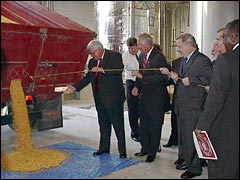
What happens after the photo shoot?

Photo: house.gov

The growth of the biofuels industry creates significant economic benefits and downsides, economic winners and losers. Today, my words are a request that we ask hard questions about those winners and losers, about who is poised to benefit from this nascent industry.

Let's start with some recent history.

Did you ever see that PBS series, Revenge of the Nerds, about the genesis and rise of the computer industry? Passionate, brilliant visionaries plus strategic, timely public and private investments plus emerging marketplace added up to gobs of new companies, new jobs, and wealth creation.

But there was a part of the story called Xerox's X-Park, where the company gathered a bunch of the best and the brightest computer folk, gave them access to whatever technology or equipment they wanted and all the soda they could drink, and said, "Have at it!" There, they developed email, graphical user interface, and other innovations fundamental to the industry's eventual success.

Here's what I wonder: What if the Xerox folks had said, "Oh and hey, best and brightest? We can't have a digital divide or anything like that. We don't want poor folks and people of color left out of this industry, so figure out how to share the wealth, OK? There should be plenty for everyone, anyway."

Well, and of course they did not do that.

Imagine if they had. Imagine how different things would be, how many lives would have been impacted if these communities were included among the direct economic beneficiaries of this now colossal industry.

But of course, they did not. And, biofuels brothers and sisters -- and broader relations in the rest of the sustainability world -- we are not doing it now. The same choice is right in front of us, and we are taking the same exclusive road.

We have passionate and brilliant biofuels visionaries; we have strategic, timely public and private biofuels investments; we have an emerging biofuels marketplace. Undoubtedly, we will create more new companies, new jobs, and new wealth. But know this: Unless we do something purposeful, these economic benefits will allocate the same way as those of the computer industry, and the same way we distribute the economic benefits of other environmental industries.

Maybe you just have not thought about this. Maybe you have been working so hard (week after week, year after year) to make biofuels happen, to realize these economic and environmental benefits, that you just have not thought about equity -- about just who will work in those factories or start a business that benefits from a cluster relationship with biofuel production or distribution. Maybe nobody brought it to your attention.

Well, consider this article your notice. Here's your chance to do the right thing, to put the equity leg on the sustainability stool, the chance to put your knowledge at the service of those trying to create job and business opportunities for low-income and people-of-color communities.

You see, you know this industry, and we don't.

We do know how to work with employers and governments to ensure that these communities get a piece of a publicly funded or publicly subsidized economic pie. We have been working on that for decades, on new highways, construction projects, and light-rail lines. There are models.

We also know how to work with these communities, how to help individual community members and businesses get ready for those economic opportunities that have made a commitment to a diverse workforce or minority contracting.

But we do not know the biofuels industry. We don't know what kind of jobs and business opportunities will be created, what skills and/or technical assistance they will require. And not just jobs and businesses at the farm or factory levels, but the vendors, suppliers, consultants, and so on who will connect with a given biofuel's production and distribution.

You know this stuff, so you can help.

All of us know the truth: the sustainability movement produces environmental results and economic results, but not much equity. In funder reports, sustainability groups can detail firm environmental and economic deliverables (e.g., policies enacted, businesses supported, research completed and shared), but fill their equity sections with soft words like "partner," "explore," and "outreach."

Maybe you have found yourself sitting around a table with your elected officials, accompanied by few, if any, participants from low-income or people-of-color communities, and frustrated by the lack of consistent political support for sustainability. At the same time, and throughout the country, many low-income or people-of-color communities struggle to secure steady jobs with good wages and benefits. They are economically marginalized, left out of sustainability's growing economic benefits.

You know this stuff, so you can help.

Alan Hipólito is executive director of Verde.

Advertisement
Advertisement
  1. Erik Hoffner's avatar

    Erik Hoffner Posted 4:54 am
    11 Dec 2006

    Who gets the jobsAlan,
    Great point about who benefits from the building of a biorefinery.
    Coop Power, a consumer owned renewable energy coop, which was profiled on Grist the other day (Small Potatoes) is operating on a model that will benefit the little city of Greenfield its (soon to launch) biodiesel refinery is in, directly, with good manufacturing jobs for folks from all walks. It will also produce a premium product from a waste stream that will generate a lot of sales locally to benefit the local economy. Coop Power's model is replicable elsewhere and is a way that we can all harness our collective buying power as consumers to root capital for renewable energy in our home places. More here: http://cooppower.coop
    Erik Hoffner

    Board member,

    Coop Power
  2. Delay And Deny's avatar

    Delay And Deny Posted 8:25 am
    11 Dec 2006

    Only Solution to Energy Crisis

    There's only one solution: Global Warming.   Hopefully the Earth will have heated up enough by 2030 that we won't have to burn up as much oil to heat ourselves.  Also, cars will run more efficiently.
  3. millercs Posted 2:45 pm
    11 Dec 2006

    Regulatory Reform for Environmental JusticeIn Los Angeles there is biofuels production plan that would provide environmental justice in waste management. It would spread new jobs that are currently located in an affluent area to seven different sites throughout the county. The plan is called RENEW L.A. and it is revolutionary in its concept and positive impact on environmental justice and quality of life.
    Problem is that the plan cannot be deployed until regulatory control and permitting rules are changed in Sacramento. This plan, which would expand recycling and divert huge amounts of unrecyclable material waste toward the clean production of biofuels and electricity, has been blocked by Californians Against Waste (CAW) - the entrenched recycling establishment of California. They have no earthly reason to obstruct positive programs like RENEW L.A.
    Anyone who can help convince CAW to support the regulatory changes that need to be made will be helping L.A. achieve some environmental justice - along with cleaner air, less dependence on landfills, green electricity generation, and production of biofuels.
  4. Biodiversivist's avatar

    Biodiversivist Posted 3:33 pm
    11 Dec 2006

    Venture capitalists and ethanolEthanol power brokers are honing their arguments (thanks in large part to all of the critique they have received). They didn't use to have such sophisticated comebacks. The main argument has now boiled down to this: You must support corn ethanol and all of its environmental destructiveness, and happily pay all of the subsidies if you want new and improved biofuels to replace it.
    Don't buy it. If government support for corn ethanol stopped today, corn ethanol production would stop. Research into cellulosic would continue and could even be funded like a Manhattan project, at a fraction of the cost of today's subsidies. If research finally finds the magic bullets to make cellulosic economically viable, the infrastructure to make and distribute it would pop up and be in place in just a few years. We don't need to build an infrastructure in anticipation of cellulosic becoming economically viable.
    Khosla is preaching to the choir here about cellulosic ethanol. It beats hell out of corn. But even it has drawbacks. He starts by telling us we should put the 40 million acres of wildlife habitat and carbons sinks of the conservation reserve program back into production. Add to that, the 80 million acres of corn exported. Never mind that food production has to increase 50% in the next 50 years to feed the world's 50% increase in population. If we stop feeding the world's hungry, and instead feed our cars, new ecosystems must fall to plant crops to take over for the shortfall in world food supply--simple math.
    You see these people make protests about corn ethanol. To me, those are people with an agenda...
    Damn. He stopped short of saying what that agenda is, or who those people are (environmentalists). Saving the planet would be my guess. Makes me wonder what his agenda is?
    ...because nobody in their right mind is proposing we get all our ethanol from corn.
    True, so lets just chalk that statement up as one of those worthless strawman arguments.
    First and foremost, I'm suggesting we reduce subsidies on ethanol and make them countercyclical.
    That is not a reduction in subsidies. It simply makes the subsidy an inverse percentage of the price of oil. It would greatly increase subsidies when the price of oil drops.
    You have to think about the way the investment world works: Corn ethanol is establishing that there's a market for ethanol.
    It does not take a rocket scientist to understand how markets work. The only market for ethanol is the one forced onto consumers by government mandates. Drop the mandates and subsidies and the market would vanish in about a day, along with the investors skimming profit from those tax dollars. Not many people will deliberately pay more for a fuel that gets 30% worse gas mileage. I'm guessing he has been too busy to read this article from Consumer Reports.
    Nobody's going to take the risk of cellulosic and other investments if the market doesn't exist
    If that is his way of saying that power brokers won't invest in a dog like corn ethanol unless the government covers their profit margin, well, yes, that's true. And, other than the Canadians, very few are investing in cellulosic except for research.
    So, practically speaking, we could have a seamless transition from a corn-ethanol system to a cellulosic ethanol system?
    "In cars, absolutely. In infrastructure, absolutely. The production is different but the use is not".
    Now there's a confusing statement. It is rather obvious that flex fuel cars and ethanol gas pumps are two parts of the infrastructure that can use ethanol, regardless of how it is made. America's new car fleet could be made flex fuel in one year should the need arrive, at negligible costs. Hungry businessmen looking for profit could also put ethanol compatible pumps in place in very short order if so motivated by demand for the fuel. There is no need to grease the skids for a technology like cellulosic before it arrives (assuming it ever does).
    The production part of the infrastructure is different at the front end, similar at the back. How seamless these big ticket items will transition won't be known until the engineers finish the task of determining whether or not it will be cheaper to convert an existing corn ethanol plant into a cellulosic one, or starting over. Dumping the existing infrastructure will not be cheap and somebody will not be happy, all assuming cellulosic has enough technological breakthroughs to finally become economically viable.
    So it's really a question of price, not a question of can we do it.
    Talk about your Darwinian IQ test. I mean, give me a break (to borrow a couple of phrases).
    I read a report from the [Government Accountability Office] that official direct subsidies to oil are over $140 billion. That's not a free market. The best thing for ethanol would be to allow it to compete in a real free market.
    I find it interesting that power brokers are supposedly lobbying our government to subsidize oil, while other power brokers are lobbying it to support alcohol. If this 140 billion-dollar annual subsidy is real, then by eliminating it, ethanol should be able to stand on its own without subsidy. Am I the only one who sees the absurdity of having the government subsidizing forms of competing energy? Maybe the answer is to convince our government to stop listening to what power brokers tell it to subsidize?
    I've been a lifelong registered Republican. I'm a free-market person.
    I've been a lifelong registered Democrat. I'm also a free-market person, who does not support government subsidies (contracyclical or otherwise).
    And we have to include in the price of oil the hidden costs -- the environmental and military costs.
    Ironic statement coming from a supporter of the dimwit who got us into this God-awful war with erroneous data (essentially by accident), and then managed to convince most Americans that it had something to do with the terrorists who took down the twin towers. Me, I don't trust Bush, and by association, power brokers who support him.

  5. jimbeyer Posted 12:14 am
    12 Dec 2006

    I thought VC Billionaires are supposed to be smartI don't know why someone hasn't slapped this guy and said "Dude, you are wasting a bunch of your (well, probably someone else's) money!"
    Ethanol (cellulosic or otherwise) is the new fuel hoax to replace the finally discredited hydrogen economy.  Why?  OK, here are 4 good reasons:


     PHEVs (Plug-In Hybrid Electric Vehicles) will probably work, and when they do, they will need less fuel, so the fuel choice, ethanol or otherwise, will be much less important. (i.e., with a PHEV, you won't care that gasoline is $6.00 a gallon).
     With a given amount of biomass, one can obtain about twice the energy content of methane than one can of ethanol.  (This is what landfills do, and much less expensively to boot.)  One might comment that a gaseous fuel is less practical than liquid ethanol, but at less than half the cost, we endure a little impracticality.  More seriously, there isn't enough biomass around to waste half of the energy content making ethanol.
     Vinod has commented that Brazil has used ethanol to become independent of oil.  This is a totally impractical comparision.  Brazil has much more available land to devote to ethanol (probably not sustainably), a tropical climate (we have winters) and a much smaller fuel use per capita.  We can NEVER grow our way out of oil dependency the way Brazil has.
      The is no infrastructure in place to deliver E-85!  If you are thinking of our gas stations, think again.  The pump fittings need to be changed to accommodate high percentage ethanol fuels, plus, the vertically integrated oil companies aren't keen on selling anything that is not their product.


    If Vinod has this much money to throw (i.e. waste) on ethanol, he should instead throw it at struggling inventors that are finding real solutions to our problems.  I know a lot of them, and they all are more realistic at actually accomplishing something than this guy.
  6. atreyger Posted 1:20 am
    12 Dec 2006

    quick comment about Braziljimbeyer,

    Brazil is slightly smaller than US, they have approximately 6.9% arable land, while the US has 18% arable land (remember we are still larger) (cia.gov). Brazil is a tropical country with a longer growing season but lower amounts of light during the growing season (mostly 1:1 ratio). That is, plant respiration during the night cancels out photosynthetic gains during the day much quicker than it does up here, where the ratio can climb to 2:1.
    The soils in Brazil are generally much lower in quality due to their very old age. US has a mixture of soil types, some bad, but mostly good. It has been frequently shown that agricultural productivity in the tropics is lower than in temperate zones, and while many people like to contribute it to laziness or lack of technological advances of tropical workers, in reality it's the soils and the climate that is not as conducive to agricultural production. Forest productivity in the tropics is higher due to long periods of evolution and very tight niche differentiation allowing for both intense competition and filling of ecological space. That does not apply to agriculture except for small scale slash and burns.
    The only difference is that there are 190 million Brazilians, with much less per capita usage of energy. If we implemented major conservation and planning measures, did not drive everywhere, and used efficient biofuels such as willows, grasses, algae, and utilized 'waste' methane, we actually might be able to grow ourselves out of the petro age, while creating a more carbon-neutral economy. However, we also should develop every other possible means of alternative energy supply, such as wind, geothermal, tidal, hydroturbines (not dams) and whatever else we can imagine, since Americans will never bite the bullet unless forced to.
  7. GRLCowan's avatar

    GRLCowan Posted 4:27 am
    12 Dec 2006

    Also, Brazil has raised seabed oil extraction ...to about 1.5 million barrels per day in the same years it has been raising ethanol production to, in energetic terms, about a seventh of this.
    Engineer-Poet did, on "The Oil Drum" a while back, explain why Khosla is at best an idiot.
    --- G. R. L. Cowan, former hydrogen fan

    Boron: internal combustion with nuclear cachet
  8. Biodiversivist's avatar

    Biodiversivist Posted 1:12 pm
    12 Dec 2006

    One more before I drop this threadRight. Producing fuels from biomass is viable in most countries, whether you're India or China or the U.S. Agrarian cultures in the developing world, especially Africa, could benefit hugely from a growing biofuels market. In fact, the biggest single thing we could do for poverty would be if biomass became the source of our energy.
    This post by Julia Armstead tells us about how the president of Ugunda is razing rain forests to grow palm oil and sugarcane. The price of cane being driven up by ethanol production.
    Destroying rain forest carbon sinks to grow food for your people is forgivable, destroying them to feed the forests to our cars is not.  
  9. AAMiller Posted 11:27 am
    20 Feb 2007

    Cellulase cost is no longer limitingI know this thread is a bit stale, but I'd like to correct an error in case anyone else stumbles across this. The cost of cellulase enzymes is no longer a major barrier to cellulosic ethanol production. Enzyme developers such as Novozymes have used "directed evolution" techniques to generate cellulases with higher activites. With more efficient enzymes, less is required, reducing costs. Here is a link to a Novozymes powerpoint presentation, see slide 24 for a cost breakdown.
    http://www.novozymes.com/NR/rdonlyres/A0E8CDF5-DC67-42E7- ...
  10. kgpc Posted 7:51 pm
    30 May 2007

    BioenergyFor daily updated news on bioenergy, ethanol and climate issues, please visit:

    http://www.ethanol-news.de
  11. Hodbrid Posted 7:08 pm
    06 Sep 2007

    Eco friendly carI really like driving cars which are environment friendly like hybrid cars...Fuel efficiency and is not that a great issue when choosing cars 'coz, there's already a lot of car manufacturers who's designs were meant to solve that concern...

    So,anyway, just a reminder, your vehicle's  catalytic converter plays an essential role in reducing harmful emissions. When your catalytic converter is working properly it successfully changes auto emissions into harmless water vapor. When your catalytic converter is malfunctioning, the pollutants leaving your vehicle can exacerbate local pollution levels.There are four ways for you to determine whether your catalytic converter needs replacing or not:1.Busted or rusted out converter body or end tubes.2.Small pieces of substrate in other areas of the exhaust system.3.No rattle in a pellitized converter (If the converter does not rattle, the pellets may have melted together or fallen out).4.A rattle in a monolithic converter (A rattle in this kind of converter indicates the substrate has separated.)If you are unable to determine failure your state, provincial, or local vehicle inspection program will reveal that to you the next time your car comes up for inspection. If your car fails its inspection, you will have to replace your catalytic converter before you car can be passed.Replacement of your catalytic converter is a procedure that can be done by professionals such as through your dealer's service department, through a muffler shop, or by a local garage. If you are handy, you can do the work yourself and save money on parts as well as on labor costs.Only purchase a catalytic converter that meets or exceeds your vehicle.I have here my catalytic converter and Dodge fuel door, and I am well satisfied with it...Again, driving without a catalytic converter is illegal and the potential harm you create to the atmosphere simply isn't worth it
  12. Hodbrid Posted 9:13 pm
    31 Jan 2008

    How did you first get interested in biofuels?Okay..
    I am doing some research about different types of candle holders until these things comes to my mind... It is not a homework... Just research on how biofuels will be beneficial for us in the years coming.. I know about the environment and how it will reduce CO2 emissions but thats all I got... I'm very interested in this research... Please help guys!

Add a Comment

You are not logged in. Thus, you cannot post a comment. If you have an account, log in. If you don't have an account, well, by all means go make one! Meet you back here in five.

Hello, Visitor!    Why not register?

Series Intro
A Grist special series on biofuels 28
How the world got addicted to oil, and where biofuels will take us 28
A lighthearted look at biofuels through time 28
The numbers behind ethanol, cellulosic ethanol, and biodiesel in the U.S. 28
All the resources you need to hop on the biofuels bandwagon 5
Find out which cars can run on ethanol and biodiesel 13
A look at the impacts of biofuels production, in the U.S. and the world 13
The what, where, and why of E85 ethanol 5
How cash and corporate pressure pushed ethanol to the fore 5
Using grease and other goodies, small biodiesel producers are making a big difference 3
An interview with Seattle biodiesel distributor Dan Freeman 3
Richard Branson chats about embracing ethanol and slashing airplane emissions 6
A handy biofuels glossary, and videos to boot 5
An interview with David Pimentel 18
Three perspectives on the biofuels debate 18
Silicon Valley investor Vinod Khosla chats about the promise of ethanol 12
To fulfill its environmental promises, biofuel policy needs a kick in the pants 18
Toward a community-owned, decentralized biofuel future 18
An interview with Greasecar founder Justin Carven 12
An environmental-justice advocate responds to the biofuels boom 12
Not quite, but cellulosic ethanol may be coming sooner than you think 12
Grains become fuel at the world's first cellulosic ethanol demo plant 2
Biofuel pioneer Lee Lynd points the way toward a "carbohydrate economy" 2
An interview with Missouri farmer and ethanol co-op member Brian Miles 3
Check out the latest entries in the celeb-biofuels biz 3
It's time for a real "food vs. fuel" debate 3
As its neighbors back biofuels, Central America gears up for business 0
A biodiesel entrepreneur in Argentina spreads seeds of wisdom 5
What Brazil can teach the U.S. about energy and ethanol 5
The strangest biofuel sources you've never heard of 5
The top 10 reasons to give a hoot about biofuels 6
How a grassroots biodiesel group can show the way for others 6
An interview with Mary Beth Stanek, General Motors energy director 6
What we've learned from the biofuels series 6
Advertisement