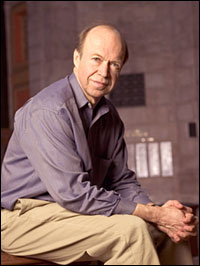
James Hansen.
Photo: nasa.gov
James Hansen, NASA's top climate expert, believes scientists have an obligation to speak out when their findings have important implications for the public -- and he certainly put that belief into practice last year when he told The New York Times that the Bush administration was trying to muzzle his calls for reducing greenhouse-gas emissions.
Hansen has been speaking publicly about the threats posed by climate change for more than two decades, though it's only in the last couple of years that the public has begun to listen. These days, Hansen is the closest thing climate science has to a celebrity. Lately, he's been using his star status to draw attention to the evils of coal-fired power plants and to chastise the Intergovernmental Panel on Climate Change for not making strong enough statements on sea-level rise.
During a recent stop in Seattle, Hansen spoke with Grist about the growing urgency of global warming, why a molecule of CO2 from coal is worse than a molecule of CO2 from oil, and what we need to do to get the climate crisis under control.
You've been speaking out about climate change since the '80s. How have your own observations and predictions changed over the years?
Unfortunately, they've changed in the sense of it becoming more urgent.
The question is, what is the level of global warming that would constitute dangerous climate change? We wrote an article in about the year 2000 in which we argued that 1 degree Celsius additional warming might be OK, but 2 or 3 degrees is not. But what's now become clear is that maybe 1 degree Celsius is dangerous, because already we're seeing on West Antarctica a net loss of ice and the ocean is warming and it is beginning to melt the ice shelves.
The other change that has occurred, as many people predicted, is that China and India, the developing world, have increased their emissions at a significant rate in the last decade. So it really is becoming more urgent.
You said a few years ago that we had 10 years before we hit that tipping point where we couldn't go back. Is that a hard and fast number?
I think I said that in 2005, so I was really thinking 2005 to 2015. Now we've come two years into that period, and I haven't seen the numbers in the last year, so I can't really say what the two-year change is just yet.
There's plenty of potential to achieve an alternative scenario, but we would have to become serious about vehicle and building improvements in efficiency. If we did that, then the need for new coal-fired plants would greatly decrease. We had been going from coal to oil to [natural] gas, each one being less carbon-intensive. But now all of a sudden we're leaping back toward coal. That is the big concern, because that's where the huge potential CO2 amount is.
What needs to happen, in your opinion, in the next few years if we're going to prevent reaching that point of no return?
A moratorium on coal-fired power plants and phasing those out over the next few decades. I think that's perhaps the most important thing.
Then we also need to conserve the liquid and gas fuel so that we can develop the next phase of the industrial revolution because we're going to have to find energy sources that don't produce CO2. In order to give us time to do that, we need to use oil and gas, which are precious fuels, as if they were precious.
Another one is addressing this ice-sheet issue. For example, if the National Academy of Sciences would issue a report on this, that would help draw attention to the fact that we are so close to a major tipping point.
We're probably going to pass the dangerous level of atmospheric CO2, and we're going to have to figure out some ways to draw down atmospheric CO2. That tells us we should have greater emphasis on good agricultural and forestry practices and perhaps even burning biofuels in power plants that capture CO2.
What is your opinion on the IPCC reports that have come out this year?
I was very disappointed that their comments about sea level didn't make clear that there's been a huge change in our understanding of that situation, and it's a much more dangerous problem than we had realized. Their report actually caused confusion by giving smaller numbers than they gave in the previous report. They should have underlined that more clearly so they didn't confuse people.
I thought the public reaction and the press reaction was good, in that they did point out that now the consensus was getting ever stronger. [The reports got] the consent of many countries that you know would be very reluctant to sign on if they didn't have to. So I think [the reports were] very good.
You have a new paper that will be coming out on the implications of peak oil in the climate debate. Can you tell us a little about the conclusions of that report?
The main point of that paper, which I think is fairly important, is that gas and oil already have enough CO2 in them to take us to approximately the dangerous level, and perhaps beyond the dangerous level. It's pretty clear we're going to use those fuels, and it's not practical to capture the CO2 in oil since it's used in mobile sources. Some of the CO2 from gas used in power plants, you could capture the CO2, but there are no plans to do that yet.
That means that the only way to keep CO2 from exceeding 450 parts per million would be to say we'll have no more emissions from coal, and that would mean that we should not be building any more coal-fired plants until we have the sequestration technology. A molecule of CO2 from coal, in a certain sense, is different from one from oil or gas, because in the case of oil and gas, it doesn't matter too much when you burn it, because a good fraction of it's going to stay there 500 years anyway. If we wait to use the coal until after we have the sequestration technology, then we could prevent that contribution. I don't think that has sunk in yet to policy makers, because there are many countries going right ahead and making plans to build more coal-fired power plants.
You've taken a lot of flak for speaking out over the years, since scientists aren't usually very vocal about their observations or beliefs. What do you think should be the role of scientists in addressing climate change?
I think that scientists need to help connect the dots, because otherwise the dots are connected by special interests. The public doesn't easily connect all the dots themselves, especially when public affairs offices at scientific agencies are controlled by political appointees.
I've actually written a paper and submitted it called "Scientific Reticence and Sea Level Rise" [PDF], because it just seemed to me that there was a gap between what scientists really thought and what was in the public knowledge in regards to ice sheet stability and sea level rise. That first became very apparent to me when I was being questioned by the lawyer for the automobile manufacturers in the Alliance of Automobile Manufacturers vs. California Air Resources Board case. The lawyer said, "Can you name one scientist who agrees with you that sea level is likely to go up one meter?" and I couldn't do that. I couldn't name a glaciologist, even though there are some that I have spoken to who believe that. They're reticent to say it and I sort of understand why. If you make a bold assertion like that, there can be negative repercussions. It seems to me that the funding agencies treat more conservative scientists as being more authoritative. On a problem that you have a long time scale to figure out what's right and what's wrong, then maybe it doesn't matter. But in fact we do have this inertia in the system and these tipping points, and it [is] very dangerous to hold back.
Do you think the politicization of science is going to continue? Are you hopeful about political changes making a difference as far as climate policy?
Unfortunately, it's likely to continue because the scale of the economics of what's involved is so huge.
Obviously, there's a lot of change in the air. It seems like there will be some action in the next couple of years, but it's a question of what that action will be and whether it will be commensurate with the problem. The fact that now some of the industries that were denying that there was a problem are coming around and coming to the table is more a reflection of the fact that they want to help determine what is done. And if they succeed in making what is done negligibly small or much less than what is needed, then that will be very unfortunate. But it remains to be seen. It's going to be interesting in the next few years.
Comments
View as Flat
DrColes Posted 3:22 am
15 May 2007
Junk science is infesting the media, the Internet and public schools, affecting public health, squandering your tax dollars, poisoning sick people and miseducating our children.
Pseudoscientific claptrap abounds. Quackery is now found everywhere.
Consensus is NOT science. Educate, inform yourself, take a 9th grade science class.
Additional information http://www.InteliOrg.com/co2_climate_change.html
Stop listening to folks that have a financial interest in the subject. Unfortunately, many have learned to spin information, thusly have become intellectually and academically dishonest.
Unfortunately, we can no longer trust most of the media for information, as they no longer assign "Reporters" that investigate then report on a subject, most just parrot or reinterpret the information to fit their bias, thusly we have a world of disinformation and junk science.
Information Vetting: I have no financial interest in this subject.
Permalink
stevenearlsalmony Posted 3:27 am
15 May 2007
Humans still face looming challenges
May 27 marks the 100th anniversary of the birth of Rachel Carson, a woman of distinction who is widely recognized as one of the most brilliant and brave scientists in modern history.
Some people have called Carson the mother of the contemporary environmental movement. She could rightly be compared to other great 20th-century women like Rosa Parks, the mother of the racial equality movement, or to Maria Montessori, a mother to teachers of children.
If, as Carson and so many other great scientists have courageously held forth, human beings evolved on Earth (did not descend from heaven or come here from some other place in the universe) and the emerging data of the environmental destruction of the planetary home God has blessed us to inhabit are somehow on the right track, then humanity could soon confront daunting global challenges.
Scientific research from Chapel Hill's very own Russell P. Hopfenberg indicates population scientists, demographers and economists in our time could be widely sharing and consensually validating inadequate understandings of the way the world in which we live works. By so doing, they appear to have failed to appreciate and communicate to the human community the necessity for regulating certain global human "overgrowth" activities. That is to say, humanity could soon be presented with an unacknowledged, unannounced and abhorrent predicament produced by increasing and unchecked per capita consumption of limited resources, seemingly endless expansion of production capabilities in a finite world, and unbridled species propagation.
Perhaps these unrestrained activities are occurring synergistically at a scale and growth rate that result in the needless loss of wildlife and wilderness, the reckless consumption of scarce resources, and the pernicious destabilization of the global ecosystems.
Huge and leviathan-like are the potential threats posed to humanity by certain unregulated, distinctly human consumption, production and propagation activities now overspreading our planetary home. Even so, we can take the measure of whatsoever the looming global challenges and find solutions to our problems that are consonant with universally shared values. -- Steve Salmony, Chapel Hill
http://www.chapelhillnews.com/155/story/7278.html
Permalink
Bart Anderson Posted 4:01 am
15 May 2007
Abstract
arxiv.org/abs/0704.2782
full text (PDF)
arxiv.org/ftp/arxiv/papers/0704/0704.2782.pdf
Permalink
GreyFlcn Posted 4:09 am
15 May 2007
http://greyfalcon.net/swindle
http://greyfalcon.net/swindle2
http://greyfalcon.net/swindle3
Sad part is, you can't do anything but regurgitate evidence which hasn't already been disproven.
Which shows how close we are to a scientific consensus when the other side can only use fraud in their arguements.
Exactly how things were with the Tobacco / Lung Cancer debate.
http://greyfalcon.net/denial
And exactly how things were with the CFCs / Ozone layer debate.
http://www.desmogblog.com/deniers-evolution-from-ozone-to ...
_
Consensus isn't Science, but Leadership is all about preparing for the future without perfect information.
And we can't afford to have negligent Leadership.
As shown with 9/11, Iraq, and Katrina.
Leaders failing to plan and act ahead of time, is equivalent to treason.
Permalink
GreyFlcn Posted 4:30 am
15 May 2007
All thats left on the other side is either disproven, or unverified.
A total lack of compelling evidence isn't enough to demand that we halt taking precautions for what could be a global disaster.
Permalink
Earth Shaman Posted 1:25 pm
15 May 2007
Permalink
TheSSG Posted 3:04 am
16 May 2007
"If I can find AT LEAST ONE point that the scientists cannot disprove, regardless of how insignificant, it means they are all wrong!!!"
Read the IPCC reports. They NEVER said 100% undeniable. They say there is a 90% statistical liklihood that humans are causing the warming.
Where did you goons come from? Was remedial science class let out early today?
My God...
"Pseudoscientific claptrap abounds. Quackery is now found everywhere."
-Dr.Coles
The IRONY!
Permalink
dobermanmacleod Posted 3:27 pm
16 May 2007
American hero. He is absolutely analytically correct about coal emissions, peak oil, plus the albedo flip, rising sea levels, and the level for dangeous melting.
Second, I would like to contradict Dr Hansen, because he is giving an unrealistic prescription. While being correct that coal emissions must be stopped to avoid dangerous warming, he advocated a moritorium on non-capture, separate, and sequester (CSS) coal fired plants. This is plainly unrealistic, and therefore Dr Hansen ought to find a more realistic prescription to advocate.
Third, the reason a moritorium on new non-CSS coal fired power plants is unrealistic is availability and cost:
The technology to capture, separate, and sequester CO2 emissions from coal fired power plants is not currently available. While you would think that developed countries would make designing and implimenting such technology their first priority, they have not. Instead, the time from the design board to universal application makes it vitually irrelivant, because by then we'll have very likely passed the tipping point.
Assuming the CSS technology was currently available, it is estimated that it will take a significant amount of energy to run, and such a coal fired electic power plant would be significantly more expensive to build and maintain. As an example, China currently doesn't generally run scrubbers on their coal-fired plants, which uses widely available and what some consider cost efficient technology to remove a vast majority of harmful pollution (except CO2) from emissions. Why? Because running it uses power and costs money to maintain. Even with Japan funding scrubbers, the Chinese think it is too expensive to use! CSS technology would take much more energy and cost much more to maintain than simply scrubber technology.
In summary, since Dr Hansen is obviously prescribing an unrealistic moritorium on non-CSS coal-fired power plants, he is making himself irrelivant. For instance, China's demand for electrical power increased 15% for the first quarter of this year-and well over 50% of China's power generation comes from burning coal in dirty plants. What is China going to do to generate such vast sums of electricity until CSS becomes widely available, and developed nations find it expedient to pay China to build and run them?
No, a moritorium on non-CSS coal fired plants is a non-starter, and wildly idealistic. Instead, I suggest immediately improving nature's ability to soak up the CO2 after it has been emitted, using genetic engineering. Nature already soaks up about half of mankind's CO2 emissions. I suggest using genetic engineering-perhaps seed a GMO into the ocean.
Permalink
Tom McLoughlin Posted 8:01 pm
16 May 2007
http://www.sydneyalternativemedia.com/blog
I've been elected to local government then retired, I've worked as a corporate lawyer and dropped out, and a reader analyst of Big Media 2 years, and now community media worker some 10 years now.
I have a zoology degree from the Australian National University in the 1980ies.
My professional opinion of James Hansen at NASA is that he is a straight shooter. That he is speaking out to stay sane because knowing big stuff like some kind of exponential sea rise increase based on collapsing ice shelf in West Antarctic and Greenland etc forces a man to either speak up, take action or indeed go mad, take the substance abuse track or get sick and die.
We have our own official Australian of the Year Professor Tim Flannery who is speaking out on this big time as well. He is making our government very uncomfortable because basically they are eco dunces, have been their whole life. Sceptics shouldn't feel bad or intimidated. I don't know how to fix cars much or do brain surgery either.
Anthropologists tell us every successful population has expanded beyond its eco limits. We are the same. Not different. The same.
I've only picked up actively pursuing this issue since about November, more interested natural heritage stuff. But its all converging, not least carbon store of forests standing not trashed.
My hard won advice to Hansen and his supporters back to modern Rome there
1. it's a matter of personal honour now whatever the goof ups with power think or do
don't internalise this historic momentum to eco unravel after 200 years of the industrial revolution - we are stuck in the tide
just tell what you know, do your best no more or less.
I fully expect that 5 metre sea rise potential as per the PDF paper via link and I'm smart, not stupid, and I wish I was wrong. The reason is people don't believe until they see and CO2 is invisible so it will be too late by then.
Permalink
remond Posted 1:47 am
18 May 2007
Putting the focus on only coal fired plant will solve only a part of the problem.
To balance the CO2 greenhousegas on our planet we must:
Reduce CO2 emission
Increase reforestation (CO2 capture) and use wood in a rational way from the forests
Stop pollution of our oceans.
A proposal is:
a: Stop using fossil fuels for powergeneration.
(use inherently safe nuclear power stations in co-generation)
b: Replace all gasoline and diesel engines by fuel cells working on hydrogen. No large scale hydrogen infrastructures but local hydrogen generation in "Off-Peak" hours for local power station (co-generation).
c: Increase public transportation using Maglev trains for interregional transportation and monyrails for in the congested cities locations.
d: Start massive reforestation programs for the Sahara desert and Sinai desert.
This can be done with cheap nuclear energy in combination with solar energy.
e: Stop with the pollution of the oceans.
Picking out only coal fired plants will not solve the problem.
On of my directors ounce said:
Changes do not come by creativity.
For changes you need:
A man (or a woman)
A bright solution
A disaster
Then the chance will come by itself.
The problem with global warming is dangerous:
Can we stop it when it really starts?
Has man ever been capable to understand exponential growth functions.
The fall of the Roman Empire is a good example how changes can take place.The Roman Empire was on small scale. The down fall took a longer period.
Permalink
stevenearlsalmony Posted 10:20 pm
18 May 2007
Perhaps someone can offer some guidance to those many elders in my not-so-great generation who have evidently chosen to eschew science and, for the sake of our lives alone, to hold onto our one and only God: wealth accumulation. Regardless of the consequences to environmental health, human wellbeing, the future of life, and the integrity of Earth, we want to possess more and more money and the many things derived from it. We call ourselves Masters of the Universe. We are loathe to live within the limits of biophysical reality, share resources, make behavior changes, and do what is necessary for assuring life as we know it to coming generations.
Would you consider assisting me with an unfulfilled responsibility to young people and future generations.......... a responsibility I call a "duty to warn".
Without success over the past several years, I have been inviting population scientists, demographers, biologists, economists and anyone else with appropriate expertise to openly comment on the apparently unexpected evidence on human population dynamics and the human overpopulation of Earth from Russell P. Hopfenberg and David I. Pimentel. Where, pray tell me, might I find a deeply dedicated, top-rank brother or sister in the scientific community who possesses the necessary expertise and is willing to report in a professional manner on their research?
Thanks for considering this humble request for help. Please feel free to contact me directly with a name or else have the scientist get in touch with me by email. I will do whatsoever is necessary to fulfill this unlikely personal obligation.
Sincerely yours,
Steve
(Steven Earl Salmony, Ph.D.,M.P.A.
AWAREness Campaign on The Human Population
1834 North Lakeshore Drive
Chapel Hill, NC 27514-6733
USA
Tele: 919-967-5764
Email: (JavaScript must be enabled to view this email address)
//
var l=new Array();
var output = '';
l[0]='>';l[1]='a';l[2]='/';l[3]='';l[22]='\"';l[23]=' 109';l[24]=' 111';l[25]=' 99';l[26]=' 46';l[27]=' 108';l[28]=' 111';l[29]=' 97';l[30]=' 64';l[31]=' 89';l[32]=' 78';l[33]=' 79';l[34]=' 77';l[35]=' 76';l[36]=' 65';l[37]=' 83';l[38]=' 69';l[39]=' 83';l[40]=':';l[41]='o';l[42]='t';l[43]='l';l[44]='i';l[45]='a';l[46]='m';l[47]='\"';l[48]='=';l[49]='f';l[50]='e';l[51]='r';l[52]='h';l[53]='a ';l[54]='
Permalink
henryjoe Posted 11:27 am
30 May 2007
Global warming should also increase snowfall accumulation rates in ice sheet interiors because of
the higher moisture content of the warming atmosphere. Despite high variability on interannual and
decadal time scales, and limited Antarctic warming to date, observations tend to support this expectation
for both Greenland and Antarctica (Rignot and Thomas 2002; Johannessen et al 2005; Davis et al 2005;
Monaghan et al 2006). Indeed, some models (Wild et al 2003) have ice sheets growing overall with
global warming, but those models do not include realistic processes of ice sheet disintegration. Extensive
paleoclimate data confirm the common sense expectation that the net effect is for ice sheets to shrink as the world warms.
Permalink
stevenearlsalmony Posted 12:33 am
01 Jun 2007
Great scientists have been villified and good science has been discredited, eschewed, ignored and the seeds of uncertainty otherwise sown by the "powers that be" and their many minions in the mass media. Magical thinking, contrived logic, rhetorical devices, biases, misrepresentations and disinformation have been employed for the sake of making that which is known to be false appear true and what is known to be real, according to the best available scientific research, appear illusory.
So preoccupied have many elders been by adamantly growing the world economy and by incessantly living without regard to Earth's limitations or human limits that they overlooked the potentially pernicious consequences resulting from the current scale and growth rate of human enterprise now overspreading Earth. These leaders have repeatedly refused to acknowledge and accept that there can be no manmade economy in the planetary home God has blessed us to inhabit without adequate natural resources and frangible ecosystem services of Earth, upon which any human economy depends for its existence.
Perhaps I am not understanding what looks to me like a human predicament, one that appears to loom ominously before humanity on the far horizon.
Sincerely,
Steve
Permalink
stevenearlsalmony Posted 7:02 am
24 Aug 2007
According to Russell P. Hopfenberg and David I. Pimentel, culture may at times mesmerize human beings in that it gives rise to illusions of the world as it is. This research, like some evidence before it, seems to disturb (because it comes into conflict with) certain culturally derived notions held by members of a culture about what it means to be human and about the "place" of Homo sapiens in the natural order of living things. Scientific facts of this particular kind are uniformly difficult for people to see, I suppose, because such data have a way of undercutting the pedestal from which we look upon our fellow creatures, nature itself and the universe. We humans may introject culturally biased and scientifically unsupported transmissions (i.e., memes) that confuse human reasoning and promote a certain cortical conceitedness which is not helpful when trying to apprehend what is real or to recognize certain requirements of reality. For a very long time cultural transmissions or memes appear occasionally and accidentally to pass from generation to generation, distorting human perceptions and making it difficult for us to see a scientific fact for what it is real about it.
When a psychological practitioner like myself thinks a patient is suffering from a mental illness, that determination is a matter of evidence-based clinical judgment. However, general standards of what is normal are not clinical judgments (and sometimes do not objectively correlate with reality), but are oten unverified matters of cultural norms and social conventions that are full of scientifically validated perceptions of reality alongside some misperceptions of what is real. Because some misperceptions are valued by those who share them, these memes get passed along AS IF THEY REPRESENTED REALITY.
In the cases of those deeply disturbed by mental illness, these patients are inclined to distort reality so drastically that their distortions are not widely held shared and held by other people. Instead, their mistaken impressions are labeled as examples of `craziness'. By contrast, governments, social organizations and cultures appear not to misperceive reality so sharply, yet distortions of what people in a culture perceive do remain.
A term of art in psychology is useful here, folie a deux. The term means that two people share an identical distortion of reality. This understanding leads to other terms, folie a deux million for a social order or folie a deux billion for a culture. These terms refer to misperceived aspects of reality commonly shared and held by many people of a government, a society, a culture. One way to define the highest standard of what is normal for the individual and for people in a particular socio-cultural aggregate is in terms of being able to see what is free of illusion, what is in scientific fact real. Hence, in taking note of the process of humankind becoming evermore aware of reality by means of the acquisition of valid scientific data through time, Homo sapiens can track the evolution of science.
From this perspective, nature is a perfected, self-regulating and self-sustaining system that has worked for millions of years, without human presence or input, and will likely continue for millions of years with or without human activities. Ancestors of Homo sapiens survived successfully on Earth for the past few hundred thousand years, and then some more. In all that time humankind presumably did not endanger itself, nor did we oddly expunge other creatures, massively degrade the environment or recklessly dissipate limited natural resources upon which our lives, other forms of life and even the global economy depend for their very existence.
In this context it is worth noting that something happened several thousand years ago. At some point not long after the end of the Ice Age Homo sapiens appear to have turned to growing and storing food and treating it as a commodity. As humans produced more food than the population needed for its immediate survival, our population numbers began going up, up, up, not up-and-down as do the population numbers of other species on Earth. Instead of continuing to exist as hunter-gatherers and collect food necessary for survival, Homo sapiens produced, stored and sold more and more food. The (agri)culture economy that developed over the last 8,000 to 11,000 years is forthrightly man-made, ever expanding, seemingly limitless and, just now, soon to become patently unsustainable at its current huge scale and its fully anticipated growth rate, and, therefore, in its present form. As this artificially designed economy has grown, human population numbers appear to have stopped fluctuating in a natural cycle as they likely had through unrecorded time. During the past few thousand years human numbers began to increase nearly exponentially. For the past several hundred years global human population numbers have skyrocketed.
The longstanding and generally accepted theory of the "demographic transition" is descriptive not deterministic. The widely shared and consensually validated current evidence related to the automatic occurrence of a so-called demographic transition at 9.2 billion people around 2050 appears to be preternatural, culturally skewed and, therefore, scientifically unsound.
Looking at regions where population is increasing at a decreasing rate or at a country like Italy with its decreasing population numbers may be distracting us -- and need not blind us -- from the apparently unforeseen knowledge of our continuously increasing absolute global human numbers and their potentially profound implications. We wish to look at trees, but need to see the forest.
According to the unchallenged and virtually irrefutable research from Hopfenberg and Pimentel, human population numbers are continuing to increase worldwide as a result of the production of food in greater and greater quantities. These food resources are then made ever more available by sale and delivery into areas on the planet with low human carrying capacity, where human life in large numbers and other life cannot simultaneously be sustained.
Could it be that we are not making hunger go away by means of maximally expanding the food supply, but instead giving rise to billions of hungry people, extirpating biodiversity and undermining the integrity of global ecosystems?
Please note that 3.7 billion people exist these days in our planetary home on resources valued at less than $2 per day. That number of people is greater than the total number of people on Earth in the year 1950!
Certainly human beings have sophisticated, forward-planning cultures and a progressive world economy. And for all the wonders of our pyramid-like global economic scheme, still there is apparently not an accepted scientific basis for concluding human beings have broken the bonds of our placement among the creatures of the world. Nor have the conditions of the natural world likely been suspended somehow for human benefit. No, the Hopfenberg/Pimentel evidence indicate that certain biological and physical laws of nature likely apply to all creatures of Earth, including human ones.
Permalink
stevenearlsalmony Posted 6:48 am
25 Aug 2007
2007 World Population Data:
http://www.prb.org/pdf07/07WPDS_Eng.pdf
II. Making the case for a reduction in per human consumption of limited resources.
The Wealth Report: Living Large While Being Green --- Rich Buy `Offsets' For Wasteful Ways; Noble, or Guilt Fee?
24 August 2007
The Wall Street Journal
It's not easy being green -- especially if you're rich.
With their growing fleets of yachts, jets and cars, and their sprawling estates, today's outsized wealthy have also become outsized polluters. There are now 10,000 private jets swarming American skies, all burning more than 15 times as much fuel per passenger as commercial planes. The summer seas are increasingly crowded with megayachts swallowing up to 80 gallons of fuel an hour.
Yet with the green movement in vogue, the rich are looking for ways to compensate for their carbon-dioxide generation, which is linked to global warming, without crimping their style. Some are buying carbon "offsets" for their private-jet flights, which help fund alternate-energy technologies such as windmills, or carbon dioxide-eating greenery such as trees. Others are installing ocean-monitoring equipment on their yachts. And a few are building green-certified mansions, complete with solar-heated indoor swimming pools.
Some people say the measures are a noble effort on the part of the wealthy to improve the environment. Eric Carlson, executive director and founder of the Carbon Fund, a nonprofit that works with companies and individuals to offset emissions, says the wealthy are taking the lead in alternative-energy markets such as solar technologies just as they take the lead in consumer markets.
"Obviously these people have different lifestyles from yours or mine," Mr. Carlson says. "At the same time, they're not obligated to do anything. We praise those who are doing things. We're trying to get to a market where the superwealthy are leaders in reducing their [carbon dioxide] footprint and playing a major role in changing this market."
Others say the efforts are little more than window-dressing, designed to ease the guilt of the wealthy or boost their status among an increasingly green elite. Environmentalists say that if the rich really wanted to help the environment, they would stop flying on private jets, live in smaller homes, and buy kayaks instead of yachts.
"Carbon offsets and these other things are feel-good solutions," says Lester Brown, founder and president of the Earth Policy Institute. "I'm always interested in people who buy a carbon offset for their jet to fly between their four big homes. These kinds of programs postpone more meaningful action."
Either way, an increasing number of companies are launching programs designed to help the rich live large while staying green. Jets.com, a private jet service, plans to start a program in early September in partnership with the Carbon Fund. After they take a trip, customers will get a statement on their bills telling them how much carbon dioxide their flight emitted and what it would cost to buy offsets from the fund.
The offsets are a bargain compared with the flights: A round-trip private-jet flight between Fort Lauderdale, Fla., and Boston costs about $20,000. The offsets for the 13 metric tons of carbon dioxide emitted would cost about $74, the company says.
V1 Jets International, a jet charter company, rolled out its "Green Card" program that it says accentuates "the positive effect your flight emissions will have on the environment." The company calculates the total emissions from the trip and then buys a carbon offset from the Carbon Fund. "From a jet perspective, we have a responsibility to look after the damage that these planes do," says Andrew Zarrow, V1's president. The company also has created technologies designed to make flights more efficient by selling seats on "deadleg" trips -- flights that are returning empty from one-way trips.
Yacht companies also are getting into the act. Trinity Yachts, a Gulfport, Miss., builder, this month announced it will pay for part of the cost of installing special oceanographic and atmospheric monitoring systems in all of its new boats.
The system, called the SeaKeeper 1000, measures water temperatures and salinity, as well as air temperature and wind speed. The data are sent to scientists who monitor the earth's oceans. Trinity's program is in partnership with International Sea-Keepers, a nonprofit marine conservation group founded by a group of yacht owners concerned about the environment.
"The caliber of client we have is very aware of what's going on in the environment," says William S. Smith III, vice president of Trinity Yachts. Still, the system doesn't reduce emissions from the yachts themselves, which can burn hundreds of gallons of fuel a day.
Some wealthy people are going green with their houses, too. The U.S. Green Building Council has certified at least three mansions for being leaders in environmental design, including one owned by Ted Turner's daughter, Laura Turner Seydel, and her husband, Rutherford, in Atlanta. The 7,000-square-foot-plus house, called EcoManor, is equipped with 27 photovoltaic panels on the roof, rainwater-collecting tanks for supplying toilet water, and "gray water" systems that use water from the showers and sinks for the lawn and gardens. The top of the house is insulated with a soy-based foam that is more efficient than fiberglass. The home has 40 energy monitors and a switch near the door that turns off every light in the house before the family leaves.
Mr. Seydel says the couple's energy bill is about half that of comparable homes. While he acknowledges they could have built a slightly smaller house, he said all the space is well used, between kids and visiting friends and in-laws.
"The wealthy have always been the early adapters to technology," he says. "I'm hoping that we can pave the way and show that you can have something that's luxurious that also makes a lot of sense from an energy and convenience point of view."
III. Making the case for a reduction in the seemingly endless economic globalization activities of BIG BUSINESS now overspreading Earth.
In Praise of Mother Nature
By Bret Schulte
Posted 7/15/07
US News & World Report
Science writers generally don't do whimsy, particularly those who have witnessed the aftermath of Chernobyl or the plundering of Latin America's resources. But in his provocative new book, The World Without Us, Alan Weisman adds a dash of fiction to his science to address a despairing problem: the planet's health. Weisman wonders how Earth would fare if people simply disappeared. With help from experts, Weisman discovered that, untended, humanity's achievements would stand little chance against Mother Nature, even in her weakened state. Sans electric pumps, the New York subway would flood within days. Pretty flowers would quickly crack sidewalks. And the life span of your house? About 50 years. Weisman spoke to U.S. News.
Environmental books are often depressing reads. Does framing a message around a hypothetical make it more approachable?
I would say so. I was looking for some way to seduce readers to keep following along so they could see what is going on in the world and how it all connects. Ultimately, once we take humans out of the picture we see how the rest of nature could flourish. We think, "Wow, if nature could do all that, then is there a way that this could happen that does not depend on our extinction?"
Your book takes us to a 14th-century European hunting preserve and demilitarized zones where nature has a free hand. Were you surprised by what you saw?
It was pretty weird. This fragment of primeval European forest on the Poland-Belarus border literally feels like it's out of Grimm's fairy tales. That's what it looks like, that's what it sounds like, that's what it smells like. But the incredible thing is that it doesn't feel exotic. For someone growing up in Europe or North America, it feels familiar. It feels right.
How did your visit to Chernobyl lead to this book?
I got a call in 2003 from an editor at Discover magazine who read the 1994 story I wrote after the explosion at Chernobyl, where I described how abandoned houses were being taken over by their own landscaping. Roots and trees and even flowers were breaking up sidewalks. A population of radioactive deer kept growing, and radioactive wolves kept coming after them. In 1994, she thought the article was depressing, but as she was editing all these depressing environmental stories, she said it had become one of the most hopeful stories: that no matter how badly we screw up, nature will find a way to overcome it.
What did you take away from these places?
I wasn't really expecting to realize the history of architecture is kind of like a bell-shaped curve. Our first dwellings were caves, then we started making caves-houses out of rock-and as we got more refined, our buildings grew higher and less permanent. Engineers tell me that our oldest buildings will outlast the newer ones...because we don't make them the way we used to, out of material from the Earth. The World Trade Center collapsed and St. Paul's Chapel, which is made out of Manhattan schist, is still standing. Other buildings around the World Trade Center that did not get hit by the airplanes collapsed anyhow.
Is this book a cold splash of water for humanity's many triumphs?
In some ways it's a wake-up call, but at the same time humans have done some beautiful things, things you have to admire. One of the surprises for me is coming away with so much respect for the people who maintain our infrastructure. If it wasn't for these guys keeping the bridges from rusting, or who keep our subway tunnels pumped, or who show up every day at our nuclear plants, stuff would start to disassemble rapidly. We live on the backs of some unsung heroes who are keeping it all together.
Three things: One of them is lovely, the Voyager spacecraft carrying our artwork, our music. I talked to John Lomberg, who put all that together for Carl Sagan, and it was beautiful to talk to someone who thought about what the message to posterity should be. On the darker side: nuclear waste. Depleted uranium has a 4.6 billion-year half-life. The planet is only going to last about 5 billion years before the sun expands. The other thing is plastics. No one really knows how long it will take for plastics to break down because they're relatively new. Plastic isn't filling up landfills; it's blowing into rivers and flowing to the ocean. It's breathtaking how much plastic we've generated.
Your book ends on a controversial note.
I ask: What if we tried one child per family for everyone? I don't want to deprive people of siblings, but I don't want to deprive people of species that are wonderful and part of our life. We can't live without them. If we could bring our numbers down, that would buy us some time to clean up our act.
Permalink
stevenearlsalmony Posted 10:16 pm
14 Sep 2007
Sometimes it looks to me as if some of our brothers and sisters are so singlemindedly focused on the accumulation of wealth and power, in feathering their own gigantic nests, frequenting exclusive clubs, flying private jets, sailing yachts and visiting exotic hideaways, that they have forgotten how human life depends upon Earth's limited resources and frangible ecosystem services for its very existence.
The "powers that be" have evidently failed to understand what it means when we say that the Earth is round, finite and has biophysical limits to which the human species is absolutely subjugated. One consequence of this denial of the requirements of practical reality by the masters of the universe among us is that the scale and rate of per capita consumption is dissipating natural resources at an accelerating rate, one that is growing much faster than the Earth can restore them for human benefit. So obviously unsustainable is the current level of per human overconsumption by a minority of people in our time that we can observe some of overconsumption's devastating effects: biodiversity is being extirpated, the environment degraded and humanity itself endangered.
Is the fulfillment of the insatiable wishes of unrestrained consumers a result of unbridled big business interests relentlessly pursuing a course of endless economic expansion, based upon the feckless consumption of the very limited resources needed for the survival of life as we know it?
Is the human species literally eating itself out of house and home?
How do things look to you?
Thanks for your consideration and comments here. Letters to news editors, social movements and cultural change are also encouraged.
Sincerely,
Steve
Permalink
stevenearlsalmony Posted 5:36 am
20 Nov 2007
With the establishment of the scientific consensus on climate change, is it reasonable and sensible to ask of government officials who remain obstructive and in denial of such overwhelming scientific data if they are perfidiously engaged in a violation of public trust and, therefore, malfeasant in office?
Steven Earl Salmony
AWAREness Campaign on The Human Population
http://sustainabilitysoutheast.org/
Permalink
stevenearlsalmony Posted 12:39 am
13 Dec 2007
Steven Earl Salmony, Ph.D., M.P.A.
AWAREness Campaign on The Human Population
http://sustainabilitysoutheast.org/
Permalink
stevenearlsalmony Posted 5:44 am
14 Dec 2007
Hello to All,
Thanks for your contributions to these discussions and for the uncommonly constructive way in which you participate. Perhaps you will be so kind and consider three following proposals.
The first proposal is an idea that has been deeply developed by Dr. Jack Alpert of the Stanford Knowledge Integration Laboratory (SKIL). According to his calculations, if we agreed, as one family of humanity, to begin now to implement VOLUNTARILY a "One Child Per Family" policy, it would be possible in the coming 50 years to rapidly decrease absolute global human population numbers to 1.5 billion rather than have human numbers worldwide grow to a fully anticipated 9.2 billion people by 2050 (UN Population Division projections). Although there is much more to say about this proposal, I am going to immediately pass on to the matter of modifying the global economy: the second proposal.
There are remarkably well-developed ideas by Aubrey Meyer of the Global Commons Institute in England regarding a plan for the "contraction and convergence" of the global economy, as a way of protecting the Earth from the reckless and relentless expansion of economic globalization that could soon become patently unsustainable on a relatively small planet with Earth's limited resources. It goes without saying that the Earth does not possess enough resources to sustain the human species, if every human being on the planet consumes resources as voraciously as people in the `developed' world do now.
My third proposal calls for a plan to be formulated that redistributes resources and caps excessive per-capita over-consumption. I suppose what I am trying to point out is this: current per human consumption in the `developed' world, unbridled increase of human industrial/production capabilities in the `developing' world, and skyrocketing human numbers in the `undeveloped' world cannot be sustained much longer by the limited natural resources and frangible ecosystem services of Earth.
As many have made clear to us elsewhere, there is plenty of blame to go around for the distinctly human-forced predicament in which humanity finds itself in these early years of Century XXI. At least to me, it appears that all of us in the human community are implicated in this situation, even though no one among us is responsible for our circumstances. Collective thought and action is anticipated; more sensibly sharing resources and cooperating with one another as a family of humanity is in the offing, I suppose.
With warm regards,
Steve Steven Earl Salmony
AWAREness Campaign on The Human Population, established 2001
Permalink