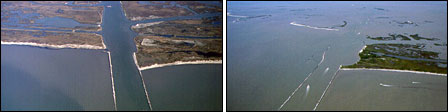
The fate of this navigation channel on the Louisiana coast, shown in 1970 (left) and 2001, offered a glimpse of things to come.
Photos: White House OMB
If an unsafe building collapsed and killed 1,000 people, we wouldn’t blame the building’s manager, even if he bungled his evacuation plan, or its maintenance crew, even if they had shirked their jobs before the disaster, or the rescue squad, even if it was terribly slow to respond. We wouldn’t shrug and blame Mother Nature. And we certainly wouldn’t blame the victims — especially if they had been assured the building was safe.
We would blame the architects and engineers who produced the unsafe building. And we might ask some tough questions about the way our buildings get produced.
Apparently it’s different with unsafe levees. Otherwise, the fingers of an outraged nation would point directly at the Army Corps of Engineers, the agency that drowned New Orleans a year ago. And the Hurricane Katrina anniversary coverage would focus on America’s dysfunctional system of funding water projects, a system owned and operated by shameless porkers in Congress and their environmentally destructive servants at the Corps.
Mother Nature took it relatively easy on New Orleans; Katrina was not even close to the Big One the Big Easy has dreaded for decades. It was a Category 1 or perhaps 2 when it hit the city; the Corps was supposed to protect against a Category 3. If the Corps had done its job, the New Orleans bowl never would have filled, families wouldn’t have suffered on their rooftops, and the Superdome wouldn’t have devolved into chaos. No one would have cared that FEMA director Michael Brown was a former Arabian horse commissioner, or that he wrote stupid emails about being a “fashion god.”
But somehow, America decided the scandal of Katrina was the federal response to the disaster, not the federal contribution to the disaster. The main scapegoats were Brown and FEMA, the feckless rescue squad of the opening paragraph. Mayor Ray Nagin, the building manager with the lame evacuation plan, also became a pariah. Some critics even blamed the corrupt Orleans Levee Board, which was certainly a laggard maintenance crew, but was mostly responsible for mowing the grass atop the city’s levees. The Corps was responsible for designing and constructing them.

Corps Col. Richard Wagenaar (right) points out damage to Bush and others four days after the storm.
Photo: White House
Incidentally, President Bush deserves criticism for the lousy response; FEMA deteriorated on his watch, and the Department of Homeland Security was his creation. But while some Democrats have accused Bush of betraying New Orleans by proposing budget cuts for the Corps, the city’s destruction was not his fault. The Corps is the only federal agency funded almost entirely by “earmarks,” individual pet projects requested by individual members of Congress. In fact, the Corps was spending more money in Louisiana than any other state before Katrina, but most of it was wasted on fiscally and environmentally disastrous pork that had nothing to do with protecting New Orleans — including one little-used navigation channel that actually amplified Katrina’s surge. Most of Bush’s proposed cuts for the Corps were aimed at boondoggles, which is why Congress ignored them.
No, the failure of the levees was a failure of the Corps, and by extension a failure of its congressional overseers, who used its projects to steer jobs and cash to constituents and contributors. Three separate independent investigations concluded that Corps design failures left New Orleans under water. And after ducking responsibility for eight months, the Corps finally admitted in April that its shoddy levees created the American Atlantis; the agency’s commander, General Carl Strock, resigned in August.
But you probably didn’t know that, because the media have ignored the Corps. Maybe it’s because the levees failed instantly with no witnesses, while the response failed over the course of a week on national television. Perhaps it’s because the Corps shrewdly deflected blame during the early days of the crisis, falsely proclaiming that its levees had been overtopped and overwhelmed by storm surges far exceeding the project’s design.
In any case, the Corps has now adopted “12 Actions for Change” to transform the agency. For example: “8. Assess and modify organizational behavior.” And: “11. Manage and enhance technical expertise.” Don’t you feel safer? The point is that the Corps is clearly focused on the future, so there’s no point dwelling on past mistakes.
Well, America has spent the last year dwelling on the mistakes of FEMA and DHS, while Congress has given the Corps even more money and power. So let’s do just a bit of dwelling on the mistakes of the Corps, so we can understand exactly what went wrong.
Five Big Easy Pieces
I should acknowledge I’ve got a history with the Corps. I spent most of 2000 investigating the agency for The Washington Post, showing how it was cooking the books of economic studies to justify wasteful and destructive projects that kept its political patrons happy and its employees busy. For what it’s worth, the Government Accountability Office, the National Academy of Sciences, and the Pentagon inspector general later published harsh reports that reached similar conclusions.
The one thing I didn’t really question was the engineering competence of the Corps. I did point out that the Corps had been fired from a Pentagon renovation project, which should have raised red flags, and that it had bungled a flood-control study that left a California community vulnerable. But I didn’t develop the theme. I’ll always regret that, because bad engineering helped destroy New Orleans.
But bad engineering was only the proximate cause; the dysfunction of the Corps and the skewed priorities of its leaders and their congressional allies were the underlying causes. In fact, the Corps and its projects shafted New Orleans in five separate ways:
1. Wetland destruction. The Corps has been at war with the Mississippi for a century, and the massive levees it built along the river have helped keep middle America dry. But this war on nature has had unintended consequences, choking off the river’s natural land-building process. The straitjacketed Mississippi no longer carried as much silt from its banks and its floodplain down to its delta, so it no longer created as many of the coastal wetlands that served as natural hurricane protection for New Orleans. The city was now safe from the river, but dangerously exposed to the gulf; 25 square miles of protective wetlands vanished every year — partly because of the oil industry, but mostly because of the Corps. And since the huge silt infusions that had shored up the city’s foundations no longer arrived, New Orleans began to sink.
Overall, scientists believe these land losses raised Katrina’s surge by several feet.
2. The Gulf Outlet. The Corps motto is “essayons,” or “let us try,” and its engineers love to build projects. But they especially love projects that benefit their influential allies in industry and Congress. One example was the $62 million Mississippi River Gulf Outlet, a 76-mile navigation shortcut to the Port of New Orleans. An official Corps history conceded that “the costs were shown to be high and the benefits … speculative,” and critics denounced it as a storm-surge shotgun pointed at the city’s gut. But under pressure from its friends at the port and Louisiana’s congressional delegation, the Corps approved it. It has destroyed 20,000 acres of marshes, and has never attracted many ships. But the Corps has defended it, and still spends $13 million a year dredging it.
Scientists believe the outlet intensified Katrina’s surge by as much as 40 percent.
3. Levees for development instead of safety. The Corps began building hurricane levees for New Orleans after Hurricane Betsy in 1965. But the Corps designed its project to maximize economic benefits — regardless of who got those benefits, or the cost of destroying wetlands, or the cost of human lives. So instead of protecting the city, it focused on building levees around low-lying swamps on the city’s outskirts, which would “hasten urbanization and industrialization,” making some landowners and developers rich. Only 21 percent of the land the Corps project aimed to protect was already developed. The rest was wet, but the Corps made it dry, encouraging the development of thousands of homes in a vulnerable floodplain.
Katrina put it all back under water.
4. No Category 5 protection. Corps levees on the Mississippi are designed for an 800-year storm. But the Corps only designed its hurricane levees for a 200-year storm — which the Corps calculated as a Category 3 hurricane, even though Betsy was Category 4. And the Corps was in no hurry: by 1976, the project’s completion date had already slipped 13 years, and federal investigators noted that the Corps never asked for more money: “To the contrary, the Corps has not been able to use all moneys allocated.”
That’s because the Corps focused more on building pork for its powerful friends. Like a $750 million lock designed to handle steadily increasing ship traffic on the New Orleans Industrial Canal — even though ship traffic was steadily decreasing. Or a $2 billion effort to convert the wild Red River into a placid barge channel. The channel didn’t attract barges, but the Corps did get to name four of its dams for Louisiana Congress members, and the entire channel for the project’s godfather in the Senate.
The Corps and the delegation knew the danger to New Orleans, but nobody tried to do anything until it was too late. It was a priority, perhaps, but never a top priority.
5. Shoddy engineering. In the end, New Orleans didn’t even get Category 3 protection. The Corps built badly designed floodwalls in overly soggy soils with inadequate reinforcement, so they collapsed even though they weren’t overtopped. The worst mistake by the Corps was failing to fight for floodgates that could have kept Lake Pontchartrain out of the city’s drainage canals. Local officials balked at paying their share, and the Louisiana delegation backed them, so the ever-accommodating Corps backed off.
And a great city was ruined.
Lend Me Your Earmarks
It would be nice to report that Katrina has changed everything, but it hasn’t.
After the storm, the Louisiana delegation immediately organized a “working group” of industry lobbyists to put together the state’s relief request. The result would have cost more than the Louisiana Purchase after inflation. It included $40 billion for Corps projects, including the Industrial Canal boondoggle and a port-deepening project for New Iberia that the Corps had rejected before Sen. Mary Landrieu (D-La.) tucked language requiring a restudy into an emergency funding bill for Iraq.
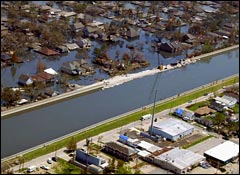
Note to Corps: you sank this city.
Photo: NOAA
Congress ignored Louisiana’s gargantuan funding request, but it is poised to pass a bill stuffed with $13 billion in new Corps goodies. Sens. John McCain (R-Ariz.) and Russell Feingold (D-Wis.) offered a modest amendment requiring the Corps to prioritize its most important projects, but the Senate overwhelmingly rejected it. The Senate did pass another amendment requiring independent reviews of Corps projects, but it’s not clear if that will become law. And “earmark reform,” which gained momentum after the Jack Abramoff and Duke Cunningham scandals, has predictably stalled in Congress.
The Corps has supposedly rebuilt its New Orleans levees back to Category 3 strength, but no one is sure they will hold. The Corps is also studying Category 5 protection — but instead of focusing on New Orleans, it seems eager to dike most of coastal Louisiana, which would presumably destroy more wetlands and promote more floodplain development. The Corps also has a $14 billion wetlands restoration plan on the table, but that’s gone nowhere. Since Katrina, Louisiana has gotten nearly 6,000 percent more funding for levees than wetlands. And while there’s a lot of talk of closing the Gulf Outlet, it hasn’t happened yet.
It’s only a matter of time before the real Big One hits New Orleans, and the Corps won’t be able to save the city. At best, it might be able to follow Action Nine of its new plan: “Effectively communicate risk.” But it tends to leave that job to others.