High Fidelity

What the West’s only communist nation has done right 13

Reports that Fidel Castro turned over power to his brother Raul last week because of surgery for intestinal bleeding have brought a flashback to the Cold War, with reporters rushing to doodle prematurely on his grave and interview the vociferous hard-right Miami expat constituency that has helped dictate U.S.-Cuba policy for the last 47 years. But they're missing a vital part of the story.

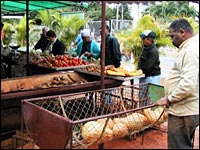
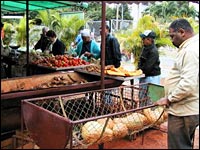
In Cuba, buying local is the only choice.

Photos: Erica Gies

Tired of my government's hyperbole on the subject, I visited Cuba not long ago. I wanted to see it for myself and draw my own conclusions, before Castro died and the United States annexed it as a Sandals resort.

Reports of Cuba's denigration are greatly exaggerated by people with ideological fish to fry. Cuba is no North Korea, and Castro is no Kim Jong Il. No, it's not a perfect system -- the most obvious, insurmountable issue being that its 11.4 million people are basically held prisoner on that island. Freedom of speech, press, and assembly are severely restricted, and there are no free elections. These are not circumstances I wish for myself, nor for the people of Cuba.

However, the people have not risen up against Castro for several reasons. OK, one reason is that he has allowed dissenters to leave in several waves, and has taken a stern hand against resident dissidents who don't hew to his view. But there's another reason, and it's just as important. Cuba had a long history of imperial domination by Spain and then the U.S., with just a few short years of not-so-democratic democracy before Batista's coup and Castro's revolution. Since 1959, Castro has delivered on many of the revolution's promises of equality, and the state has provided for the people in ways that often go unrecognized. Today, its approaches to public health and the environment could be a model worth following.

Castro just had surgery. He was in a good place for it. Cuba has one of the best medical systems in the world, with twice as many physicians per capita as the U.S. Its infant mortality rate and life expectancy are about the same as in the U.S., and its HIV/AIDS prevalence is almost nonexistent. The country also donates its medical expertise abroad: it made a huge contribution to the Pakistan earthquake-relief effort, sending 2,500 medical personnel. It even offers free medical training for students from disadvantaged areas of the U.S., provided they agree to return home and work in low-income neighborhoods. A political gotcha maneuver? Well, naturally. Fidel is a sly guy. But the mostly non-white and female doctors who otherwise wouldn't get a chance to practice medicine are grateful, and Cubans take a great deal of pride in the program.

Cubans also enjoy a level of race and gender equality that I haven't seen anywhere else in my travels through 24 other countries. The revolution's principles of equal pay and equal opportunity for all have woven themselves into the social fabric. Because many who benefited under Batista were white or of Spanish descent, they were the majority who left during the first wave of emigration. Today, Cuba has a slight black or biracial majority. Interracial dating is commonplace, and kids of every color play together. People of every shade and both sexes are liable to hold any job. Most don't live in fancy digs, but no one is homeless.
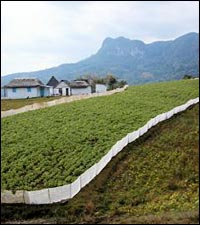
An organic farm in Viñales.

It may be the country's environmental gains, driven by economic necessity, that are most impressive. Cuba is the only country in the world to have converted to organic agriculture in less than 10 years. On my travels, I saw fields near Viñales where corn and beans were grown together for better pest control. I also glimpsed the network of small, urban gardens that augments the country's agricultural system, the beginnings of which are chronicled in a book called The Greening of the Revolution.

After the Soviet Union collapsed, Cuba lost $4 billion to $6 billion in annual support, including food, farming equipment, pesticides, and petroleum. Facing severe shortages, the country had to rapidly convert its fields to food crops; since there was no money for chemical inputs, farmers learned organic methods instead.

It was hard for several years. Food was scarce, and public sentiment turned against Castro. He called it the Special Period in Time of Peace, which basically meant suffering wartime scarcities without war. But by the late '90s, the system was up and running. In 1999, the Grupo de Agricultura Organica, the organic farming association that spearheaded the conversion, won an important international honor -- the Right Livelihood Award, known as the "alternative Nobel."

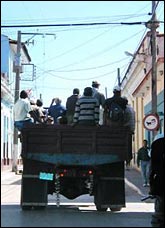
Hitching a ride in a government truck.

Castro knows how to make lemonade. After the collapse, when the Soviets were unable to supply fuel and the giant autopista (think: autobahn) running the length of the country lay empty because no one had access to gas, he bought 1.2 million bicycles from China and manufactured 500,000 more, distributing them to the people. Most didn't know how to ride, and accidents were common. But the government gave classes, and people got the hang of it. When I visited, bikers expertly threaded their way through classic American cars, horse-cart buses, pedicabs, and Coco taxis -- not quite with the fearless bravado of riders in Asia, but with more laid-back flair.

The government also passed a law dictating that government vehicles must pick up as many hitchhikers as they can fit. It's common to see 30 people standing up in the back of an industrial truck rattling along a road. Unfortunately, it's also common to see people standing on the side of the autopista all day, fruitlessly waiting for the ride that never materializes. While the cities are filled with all kinds of random conveyances -- including giant buses called camelos (camels) that can hold 200 people -- getting between cities is a bit more of a problem.
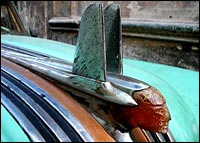
Old, but not finished.

While this devotion to alternative transportation is a step in the right direction, many vehicles in Cuba are still 1950s-era gas-guzzlers. In fact, air pollution has increased since 1990. This is particularly noticeable in crowded Havana. In other places, however, the relative scarcity of combustion engines offers clear vistas and easy breathing. And Cuba's per-capita CO2 output is one-tenth that of the U.S. While Castro's oil-bearing friend in Venezuela, Hugo Chavez, may help up that ratio slightly, his input isn't likely to have a dramatic effect any time soon.

Outside the cities, pristine land seems to abound, and that extends to underwater areas. I went to Guanahacabibes National Park and got a fantastic five-hour tour of unusually eroded limestone caves and related habitat from the ranger, who had extensive botanical, biological, and geological knowledge. I also went scuba diving off Maria La Gorda, part of the Guanahacabibes Biosphere Reserve, designated in 1987. The waters there have been recognized as among the healthiest in the Caribbean, due in part to limited coastal development. The sea fans are flourishing, the tube sponges are neon green, and the corals have retained their color -- unlike so many places around the world, where they are bleached.

So is Cuba in a position to show other countries -- especially its neighbor to the north -- how to succeed with health-care reform, sustainable agriculture, alternative transportation, and protected ecosystems? Maybe, but only if those countries put aside their broken-record, Cold War-era reactions and really listen.

Cuba's system has obvious flaws, but many charges against Castro -- suppression of dissent, torture of enemies, backroom dealings with nefarious world players -- can be made against certain other leaders as well. As Castro approaches what the U.S. government euphemistically calls "the biological solution," let's try to look at his Cuba clearly, to realistically evaluate the revolution's successes and failures -- and perhaps even learn something. With some members of the Bush administration champing at the bit to widen their democracy experiment to Cuba, let's remember how audacious it is to assume that there is only one true way.
Erica Gies is a freelance environmental writer who lives in San Francisco, Calif.

Advertisement
Advertisement
  1. RichardinKRV's avatar

    RichardinKRV Posted 6:01 am
    09 Aug 2006

    PART CORRECTI too have been to Cuba. But came away with a much different impression than Erica Gies did. Having travelled in China, Russia, Poland, Belarus, I had hoped to find Cuba a model of what I thought it was good at. I applaude the emphasis on free medical & education. But medications are few and far between - this from actual Cubans. Cubans with HIV/AIDS are not as Erica might think "its HIV/AIDS prevalence is almost nonexistent." I visited what then was the ONLY AIDS Support Group in Cuba. It met weekly in the Church of Our Lady of Monserrate in Havana, where they had mass only once a week. I attended one of their meetings. I was surprised that the group was about 50/50 male/female (in California such meetings are like 98% male)I got to talk several people and the priest in charge. The much hyped Cuban medical systems provides NO HIV DRUGS (at least in 1999 when I was there). None. Condoms are almost impossible to find. I brought in 2,000 to donate. A HIV+ fellow with the Cuban equivalent of the CDC took those.
    To me, Cuba seemed to be the bleakest of any current or recent communist countries. That it conserves energy and hasn't demolished it's old buildings is more by accident than by policy.
  2. imbibere Posted 10:04 am
    09 Aug 2006

    who knows for sure...I was fascinated by the story and the comment "Part Correct". I've never been to Cuba. Isn't it still illegal for U.S. citizens to visit? That just makes me curious about what our arrogant and self-righteous "leaders" don't want us to see. Castro has survived all this time without us while our government has done their level best to make everything difficult for Castro and his people. As for the lack of HIV/AIDS drugs or any other drugs for that matter, it's my understanding that we, The U.S. government has enacted a complete embargo on medicines to Cuba. It was also my understanding that we will not allow any other country that is our trading partner to ship medicines to Cuba. Does anyone out there know about this? In spite of the trade embargo, I heard on NPR just a few days ago that Cuba's economy is growing at a faster rate than America's. Hmmmmm... The statements of our current administration in response to Castro's recent disappearance from the public eye seem just a thinly veiled call for the Cuban people to stage a political overthrow. Greedy hands are wringing in Washington. Cuba's system is far from perfect. I fear it will only get worse if and when "help" arrives from Washington. I often wonder what the world would look like if any of the help we offer others was indeed genuine and selfless. It's a shame we are too arrogant and capitalistic to see that there are some benefits to learning from Castro.
  3. Maywa Montenegro Posted 3:05 am
    10 Aug 2006

    Our defiant little neighborIn response to Imbibere's question, "Isn't it still illegal for U.S. citizens to visit?" Yes, it is, but one can visas on special occasion. In fact, I recently read about the flood of journalists trying to get in to Havana to report on Castro's situation---many tried to get in on tourist visas instead of journalism visas and were summarily kicked out.
    My family had the unique opportunity to be invited to Havana for the International Esperanto Congress back in 1990. Though I was only ten years old at the time, my impressions were similar to Erica Gies's. I saw a country with certain trappings of communist-era industrialism but also with reminders of a pre-Revolution island resort. I saw buildings with peeling facades and crumbling porticos, barely hinting at their old-style Spanish glory days.  I saw people---mostly mixed black-Hispanic---on the Malecon, Havana's famous ocean front boulevard. And though they were obviously not wealthy to the Western eye, they appeared nourished and healthy, and were often chatting (even dancing!) as they went.

      Perhaps it is testament to the strength of the Cuban people, but after almost fifty years of being strangled by draconian U.S. embargoes, they seemed not bitter, but proud to be Cubanos. Yes, Castro has drastically limited their access to American media and yes, he has harshly persecuted dissenters. But these actions are precipitated and perpetuated by a giant neighbor to the North with no greater hope than to sanction the nation out of existence. Fortunately, other countries, such as Venezuela, China, and members of the EU, have stepped in to trade with Cuba where the U.S. will not.

       Finally, I was interested and surprised to hear that it was the lack of fuel and fertilizer after the Soviet collapse that actually forced Cuba to adopt organic farming and clean transportation. A resource crunch brought green innovation to Cuba.....I hesitate to be so bold, but wouldn't it be grand if something similar could come out of this fiasco in Iraq?
  4. Howell Haus's avatar

    Howell Haus Posted 3:21 am
    10 Aug 2006

    Castro's Cuba...I applaud the sentiments that Erica Gies has offered in her article. I am shameful that our leadership leans towards poking more holes in the Gulf of Mexico in search of oil, while completely overlooking the bleached coral dead-zones that now surround us.  
    It is my hope that our country will give rise to those who would give pause to the success Castro was able to achieve in his times of weakened economic support. Lord knows only private parties and churches were allowed to support Cubans during this time of need.
    It goes without saying that our leaders wouldn't purchase bicycles for us if oil supplies dwindle. They'd much prefer to amass an oil-draining presence of militia to horde every drop they can, killing thousands on both sides, just to keep their oil cronies well placed.
    I for one intend to sharpen my language skills and make haste to the waters she describes, hoping to catch a glimpse of what oceans should be, before democracy spreads any further south.  In the meantime, I'll see you out there... on my bicycle, of course - JD

  5. atreyger Posted 5:18 am
    10 Aug 2006

    HIVI wanted to briefly chime in here: prior to the fall of the Iron Curtain, the HIV rate in USSR was pretty much non-existent. I think there were somewhere about 200 documented cases. Granted, Russians and many eastern Europeans have a fairly large percentage of the population that is immune to HIV, but since the fall the rates have skyrocketed, mostly due to an increase in use of intravenous drugs, namely heroin.
    I would like to believe that the Cuban situation is very similar in that respect right now, because the prevention techniques used are similar.
  6. caniscandida Posted 6:37 am
    10 Aug 2006

    We miss Cuba!Thanks to Erica Gies, and to all those who have commented.  I am especially grateful to Maywa Montenegro for her observations, and to Howell Haus for his/their resolutions.
    The embargo is indeed a wrong-headed policy.  And the political cultivation of the Republican-voting Cuban "exile" community in Florida is disgraceful.  They are clearly one of the most disproportionately over-represented groups in the republic.  And yet they play us along with their fantasy-songs, about how much they love democracy, etc., when in fact the pre-Castro regime that had enriched them was hardly democratic, and was indeed tyrannical and racist.  And now, the descendants of those 1950s-era plutocrats unabashedly show to the media the deeds of their familial estates, and unashamedly state that they should be restored to those holdings once Fidel and Raul are deposed.
    Maywa's closing comment, rather ironic and sad, a valuable moral to Ms. Gies's report, that we learn to change, to conserve, and to conserve well, once we are helpless and can do nothing else in order to survive, is well worth taking to heart.
  7. choco Posted 10:10 am
    10 Aug 2006

    More AIDS info from Erica GiesHi all,

    Thanks so much for reading the column and for your great commentary! It's really rewarding to see the dialogue spiraling outward. In that vein, I noticed that a couple of people had questions about the AIDS comment, so I thought I'd add a bit of info I didn't have room to include in the article.
    First:

    HIV/AIDS - adult prevalence rate: less than 0.1% (2003 est.)

    Cuba is listed 125th out of 168 countries for prevalence. U.S. is 71st.
    People living with HIV/AIDS: 3,300 (2003 est.)

    Cuba is 120th out of 164 countries. U.S. is 10th.
    HIV/AIDS - deaths: fewer than 200 (2003 est.)

    Cuba is 114th out of 148 countries. U.S. is 34th.
    Source: CIA World Factbook -- https://www.cia.gov/cia/publications/factbook/index.html
    Second: While I was there I heard anecdotes of the health care system's remarkable AIDS care, which was notable because sexual promiscuity is prevalent in Cuba. This is outlined by a 12/26/04 New York Times article by James McKinley. The government offers condoms, intense education about AIDS transmission, and free testing, which many people, including sex workers, take advantage of. When people are diagnosed with HIV, they must check into a sanitarium for three to six months of treatment and counseling about how best to stay healthy and avoid transmitting to others. When released, they are monitored closely by social workers. The U.S. embargo has limited access to brand-name antiretroviral drugs, but the government has produced generics and distributes them to patients free of charge.  
    http://www.theglobalfund.org/programs/news_summary.aspx?n...=

    http://www.nytimes.com/2004/12/26/international/americas/...
    I hope that provides more context.

    Erica
  8. Wylbur Posted 12:37 pm
    11 Aug 2006

    Aids/HIV Info on Carribean and CubaThis is directly from the avert.org website.  
    "Estimated national adult HIV prevalence surpasses 2% in Trinidad and Tobago, and exceeds 3% in the Bahamas and Haiti. In Cuba, on the other hand, prevalence is yet to reach 0.2%."
    "Cuba's epidemic remains by far the smallest in the Caribbean. However, new HIV infections are on the rise, and Cuba's preventive measures appear not to be keeping pace with conditions that favour the spread of HIV, including widening income inequalities and a growing sex industry. At the same time, Cuba's prevention of mother-to-child transmission programme remains highly effective. All pregnant women are tested for HIV, and those testing positive receive antiretroviral drugs."
    The tragedy of Aids/HIV is very intense when witnessed personally.  I think what makes the situation in Cuba so difficult is that the country is shut off from the rest of the world.  Opening the doors is the responsibility of the US, not Castro.  

  9. usandthem Posted 2:31 am
    12 Aug 2006

    FidelI am certain that cuba has had a hard road to hoe,and there was I time that I thought that this is what they deserved.I after all grew up before and during the Cuban Missile Crisis.Ya know propaganda is not only practiced by the enemy,if ya get my drift.It is often said that that which does not kill me makes me stronger.It would seem that that is the case in cuba and they have been strong enough to survive if not prosper,or do they prosper in a different way?

     I fear for the cuban people if this country gets into their country.Their country will suffer greatly when the greedy capitalist start putting condos and vacation resorts on every beach possible or not possible to make a buck.They don't know how lucky they are to not have a capitalist sector hogging the trough.Life will be great for just a short time and then the pale of capitalism will cover the country in a pall of pollution and denude the land and sea for the god almighty buck.

     You see I once believed in John F. Kennedy too,til I found out that he was a doper,a whoremonger with ties to the mob,and to put it suscintly,a politician.

     I still can't forgive Fidel for the strain on me and mine putting us on the brink of nuclear destruction,but he had help from our side too.
  10. clarence Posted 2:39 pm
    15 Aug 2006

    Pots and kettlesWhenever Cuban policies that have led to universal education, universal health care, organic farming on a massive scale, safe neighborhoods, gender and race equality..., there are always answered  by two yeah buts.  

    The first is the treatment of dissidents.  The Cuban government doesn't like people who disagree with it and is sometimes mean to them.  I'm no supporter of government suppression of alternative opinions but it's hard to deny that the Cuban government does have more than a little reason to think that powerful forces are dedicated to overthrowing it.  Criticisms of those policies seem a little disingenuous coming from a government that arrests citizens wearing antiwar tee shirts at presidential love fests and puts serious social critics on death row on trumped up murder charges.  

    The second is lack of free elections.  Is an election free when black people are systematically dropped from the voting rolls, when voters in Democratic precincts wait in line for 8 or more hours while those in Republican districts sail through in a matter of minutes and the president of the company making the machines promises that it's his job to ensure that the incumbent wins?

    Just asking.
  11. caniscandida Posted 5:52 pm
    15 Aug 2006

    dissentDear Clarence,
    at the end of your message, you are apparently referring to sorry electoral situations, in Ohio especially, in 2004.  Well done!  Americans cannot hear enough of that.
    It is not clear, though, that Erica Gies, and other sympathetic observers of Cuba under Fidel, are suggesting that the state of politics, free speech and civil rights there is beyond criticism.
    Our former super, Victor (sorry for those who do not live in cities, you probably do not know what a "super" is), is a senior immigrant from Cuba, with no love of Fidel whatsoever.  Nor with any love of the Miami Cubans either.  (And, not that it means anything, but his dog Suzy is mother of our own Little White/Blanquita/Fiordiligi.)
    Victor is some sort of Protestant minister, and struggles every summer to enter Cuba, and visit the handful of communities that he knows.  My Michael has usually contributed to Victor's cause; and it is heart-breaking to hear how much Victor's friends' communities rely on donations from the US.
    I believe he flies to Cuba from the Dominican Republic.  Presumably he is a US citizen; but really, I do not know how he does it, passport-wise.
    So no, we are under no delusions that Fidel's regime is ideal.  Cuba has enjoyed great success with the health-care system, as Erica and others have observed.  But it is indeed true that the record on such rights as freedom of speech remains dismal.
    One detail emerged in this past Sunday's New York Times.  In the Week-in-Review section, in an op-ed piece, some letters that Fidel wrote while imprisoned in the 1950s were printed.  He comes across as rather courteous and sweet.  But he also comes across as a homophobe, using homophobic slurs to denounce certain political enemies.
    It is troubling that homophobia remains a common prejudice on many Caribbean islands.  Jamaica was recently named the "most homophobic country in the world."  (Which may be true; but there are countries in the Middle East and across Asia that could offer strong competition.)  My hope is that Cuba will soon enjoy increasing political liberalization, and with that will come increasing tolerance, and the strengthening of a sense of human rights.
  12. griselda Posted 9:10 am
    19 Aug 2006

    ElectionsHi there, I want to pick up on another theme from the article - the comment about elections. I lived in Cuba for a few years working in an aid project supporting the urban agriculture program. In that time I witnessed 2 elections, very different to ours but are we perfect?
    First, at the local government level, in every block a delegate is elected at a street meeting - notice is put out to every dwelling and everyone can have their say. Obviously not the place for dissidents, but subject matter is local issues - roads, footpaths etc. These delegates then represent the residents at barrio meeting, and from this forum the local government is elected. The thing that I liked was that these street meetings were held 3-4 times per year and if people felt that their delegate was not representing their view their mandate would be withdrawn.
    At a higher level of government, positions are allocated to a number of organisations, including the unions, the Cuban Federation of Women, Young Communists etc. These organisations then choose their candidates and the voting takes the form of endorsement or otherwise of their selected candidates. It is a secret ballot system and taken seriously by the population. Candidates are given equal space in both poster displays and on television.
    A high level of approval is anticipated, if this doesn't happen, the organisation itself is queried  as to why their selected candidates do not receive community approval -  it is seen that the organisation itself is out of touch with the community and needs to improve.
    Very different system but with some interesting aspects.
  13. caniscandida Posted 7:08 pm
    19 Aug 2006

    Cubans and politicsThanks, Griselda, these are fascinating observations.
    Clearly, the Cubans are as politically astute, and well-practised, as anybody.
    But I dread what may happen if there is a power vacuum, or a troubled transition.
    And if travel between the US and Cuba is freed up soon, I dread the intrusions of the Miami Cubans.
    And more generally I am afraid I rather agree with UsAndThem:
    <<

    I fear for the cuban people if this country gets into their country.Their country will suffer greatly when the greedy capitalist start putting condos and vacation resorts on every beach possible or not possible to make a buck.They don't know how lucky they are to not have a capitalist sector hogging the trough.Life will be great for just a short time and then the pale of capitalism will cover the country in a pall of pollution and denude the land and sea for the god almighty buck.

    >>
    That is powerful writing.  I love "the pale of capitalism," though I am not sure I understand the image.
    (On another note: The best of the hundred stories told in that great Italian classic of the 14th century, Boccaccio's Decameron, are, imho, the first story of the first day, and the tenth story of the tenth day.  The heroine of the latter is named Griselda.  I love that story, and I love that character.  I hope you know it.)

Add a Comment

You are not logged in. Thus, you cannot post a comment. If you have an account, log in. If you don't have an account, well, by all means go make one! Meet you back here in five.

Hello, Visitor!    Why not register?

Advertisement