Dear Umbra,
I am attempting to wean myself off plastic bags. I am also aware of the environmental impact of brown paper bags. So we are OK with cloth grocery bags, but can you suggest an alternative that can be used as a trash can liner (that's economical)?
Lisa
Columbus, Ga.
Dearest Lisa,
Plastic trash bags ... a Frequently Asked Question that I have never answered. Have I been saving this succulent trash bag question for a special day? No, not really. Late March, though, feels a bit like trash bag time, so let us slosh forward into speculation about what could possibly improve our trash arrangements.
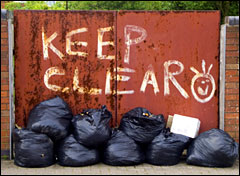
Clearly there's a better way.
Photo: iStockphoto
A few obvious ideas strike me: no trash bags, recycled plastic trash bags, biodegradable trash bags, reusing someone else's plastic bags.
No trash bags: Is this possible? It sounds disgusting, but if we reduce our garbage as we should, the grossness may ebb. We can reduce the mass and moisture of our garbage by recycling, composting, eating less or no meat, and frequently emptying the trash bin. We can wash the trash can often so it won't get stinky. Through serious whole-family commitment, the No Bag option may be feasible -- until the trash leaves our house.
Unfortunately, I can't put loose trash in my outdoor trash can for pickup. If you can, maybe this idea will work for you. Or the No Bag option could morph into a Fewer Bags option: Is it possible to line the outdoor trash can with one ginormous bag? Then we could empty our bagless household garbage into the giant bag and tie the giant bag shut just before pickup day. I still see holes in this plan. Maybe the garbage people limit the size of individual garbage bags. Only one way to find out: call your waste disposal company or city and learn the rules. There must be some way to use slightly less baggage.
Recycled plastic trash bags are completely possible. Until we find a no-bag trash option, we should be buying trash bags made with recycled plastic. Recycled plastic content replaces virgin plastic content and reduces our use of petroleum. Recycled plastic bags also keep plastic out of the waste stream. We all know this about recycled material, but it's worth pointing out every once in a while: buying products with recycled content is almost as important as sending material to be recycled. Biodegradable trash bags, on the other hand, will be a waste of money unless you know for sure that your landfill is designed to hasten decomposition, through aerobic or anaerobic means. Call your town government to find out where the garbage goes.
Our final idea of the day is to reuse someone else's plastic bags. At first, this will be easy and uncomplicated. You surely have friends with piles of used shopping bags. Offer to collect these bags, and you will have small garbage bags for months (yet more motivation to produce less trash, since you may need to find a smaller trash can to match the smaller bag). Unfortunately, if you continue to garnish their bags, you will become complicit in virgin bag use. The better path is to convert these people to reusable shopping bags, offer to take their old bags off their hands, and then have neighborly company in the trash bag dilemma. There are unavoidable and nonrecyclable bags, such as those coated-paper dog (and other) food bags, and these would make acceptable garbage bags upon occasion. Again, you'll need to check with the garbage guys to see if these pass muster.
Where does this leave us? I am not trying to slither out of the question, I just can't come up with a clean answer. Except: make less trash, use fewer garbage bags, have less of a dilemma.
Incineratorly,
Umbra

Comments
View as Flat
raychelle Posted 11:04 pm
25 Mar 2008
the way i see it, the plastic packaging my food comes in always ends up in the trash anyway, why not use them as my trash bags anyway? and yes, i try to pick bulk items and avoid food with too much packaging.
what do you think?
Permalink
realale Posted 1:13 am
26 Mar 2008
Once we get through our box of kitchen trash bags (at one a week it takes a while to get through the box of 100 we bought way back when), I very much like the idea of using the small plastic bags that are already headed to the waste stream as containers. Great idea!
Permalink
sunseeker Posted 3:05 am
26 Mar 2008
Permalink
sje333 Posted 4:16 am
26 Mar 2008
I get my trash bags for free by stealing them from the recycling collection bin in front of the store (in Florida, Publix and Albertson's both have bins that are easy to get into). This keeps the bags out of the recycling stream (a dirty process), and eliminates my need for expensive 100% post-consumer recycled bags. I look forward to the day when there aren't any free trash bags available! Then I'll switch to biodegradable corn-based bags.
BTW, a few people have given me strange looks over the years, but if anyone ever questions me, I'll say the bags are fuel for my time machine and run away cackling.
Permalink
estark Posted 5:43 am
26 Mar 2008
But we need to address the insidiously dangerous issue with plastic (polyethylene) bags in general: they are everywhere and they're a disaster to ecosystems. They're in landfills and in the oceans and other waterways; most are not recycled and they never go away. According to Californians Against Waste, 19 BILLION plastic bags are used annually in California alone and only 1-4% are recycled. Furthermore, recycling plastic bags is difficult and not energy efficient. Thousands of animals die every year due to bags. Wild birds get entangled in them and die deplorable deaths and it's estimated that 100,000 endangered sea turtles and marine mammals ingest them and die as well. The problem is atrocious. Resuing plastic bags is good, but they still end up in landfills and waterways and never disappear.
I was at Whole Foods the other day and had brought a biodegradable plastic shopping bag with me. Upon seeing the bag, the checker perked up and asked me where I got it. I told him it was from a vegan cafe on Kauai called Lotus Blossom where I had purchased a bamboo t-shirt. Then he started lamenting about the whole plastic bag quandry. I suggested he talk with his bosses. That unleashed more, with him telling me that they don't really care, the store just cares about what they appear to be, it's too expensive, etc. etc. After I left I wondered why, even if it's more expensive, that they don't even give folks the option of paying an extra 15 cents or whatever they cost, so that if we forget or choose not to bring our own bags, we can at least get a biodegradeable that will break down when in prolonged contact with water. It would help the store to appear 'greener,' as well. Sure, at this time biodegradable bags do require a petro-based form of polyester, but research is in the works to develop biodegradable plastics based on renewable feedstocks.
We all need to speak up and tell stores what we want. Targeting ubiquitous Whole Foods initially may help to consolidate our efforts. And because they're such a big company, they may set an example for other stores down the road. So here's what we need to do: Please contact Whole Foods and tell them that you want them to provide biodegradable plastic bags, both at checkout and in the produce aisles.
Whole Foods contact: http://www.wholefoodsmarket.com/contact/contact.html
Permalink
TrashTsar Posted 5:55 am
26 Mar 2008
As a landfill manager and recycler, I thank you for noting that biodegradable bags are generally a waste of money. This is a point on which many members of the public are very confused/deluded.
Bags that biodegrade (assuming they live up to their advertising claims) do little to assist us at the landfill. If I had my way, nothing in my landfill would degrade. That would spare me the cost of managing the landfill gas (methane) that results from decomposition. Decaying garbage causes the surface to settle and creates low spots that collect rain water and get me in trouble with the regulators.
Post-consumer plastic bags are very hard to recycle as it is. The few buyers that exist are very picky about contaminants like bread crumbs, moisture, paper receipts, price tags, and the like. The last thing they want to do is introduce biodegradable plastics into the mix and end up with a product that decomposes in the hands of a consumer who was looking to buy a durable product.
Biodegradability is a red herring when it comes to plastic bags.
Bottom line? Take a reusable bag to the store, and if you NEEd a bag for some use, buy one!
Permalink
karenc Posted 6:50 am
26 Mar 2008
Permalink
Gatta Posted 8:13 am
26 Mar 2008
I am fortunate enough to have a disposal unit in my sink, so most of my wet garbage goes down that. Paper garbage goes in the waste basket, and anything in between (mostly washed cans) goes in the garbage bag under the sink, which has nice little handles to hang it up by. Once it's full, out it goes. I know these bags biodegrade fairly quickly, because I've tried storing things in them outside, and they turn to shreds as soon as they get wet.
Permalink
jennconspiracy Posted 8:22 am
26 Mar 2008
Depending on where you live, you may be able to put all your food scraps (in the Bay Area we have a lot of resources, here's one for Oakland www.stopwaste.org) in the "yard waste" bin.
Fake Plastic Fish is a great blog devoted to reducing the amount of plastic one woman uses in her daily life - lots of great information here:
http://www.fakeplasticfish.com/labels/Issues%20-%20Plasti ...
Permalink
jennconspiracy Posted 8:23 am
26 Mar 2008
If you have a yard, you can at least bury all your raw veggies scraps. Check with your local waste management company to find out if you can put all food scraps in the "yard waste" bin - even if they don't collect it weekly, if it gets stinky, that's ok - it's composting!
Permalink
JimF Posted 10:27 am
26 Mar 2008
Permalink
swan Posted 11:45 am
26 Mar 2008
Permalink
weaselteeth Posted 12:02 pm
26 Mar 2008
Some good articles here: http://www.happydranch.com/index.html
Permalink
Gene Posted 12:54 pm
26 Mar 2008
thanks for great commentary. My husband also like to say when I complained...it's driving me crazy! That's a short drive. I have to hold myself back from grabbing the recyclables in the garbage.
Permalink
stp777 Posted 12:58 pm
26 Mar 2008
Permalink
fallchild Posted 1:20 pm
26 Mar 2008
Permalink
GreenScribe Posted 1:30 pm
26 Mar 2008
With regard to bioplastics: TrellisEarth bioplastics will biodegrade, and are strong. The company is also looking for new sources (maybe algae? ) to use in the future. But now, it will biodegrade, and leave no toxins behind.
We have to change our habits: just think of this term: throw it AWAY. WHERE is away, anyway? We must individually write to companies and tell them that we won't buy their overwrapped products - Even our prescription bottles come in plastic! The world as we know it cannot continue - and you know, that's not such a bad thing. Just think about how much more fit and healthy we were when we didn't use a garage door opener, clicker to get in your car, automatic windows, drive everwhere. And kids: they're getting fatter from their electronic and motorized toys - where's the kid power?
I'm actually looking forward to the end of oil- and the pollution and destruction, including wars, that it has created. Humans have created a monster, and now it's time for us to start working together, using our creativity and potential goodness to create a cleaner, safer world for ALL - not just human centered, but every living thing on earth. We can do it! But we MUST start now!
Permalink
tmakreider Posted 11:12 pm
26 Mar 2008
We need to get beyond the recycle,reuse,reduce concept and start demanding companies to produce products and packaging that are eco-friendly.
I have sent over a dozen letters (with their packaging) via snail mail, back to the companies requesting that they re-think the design and referencing the book below. I've sent letters via email to companies essentially saying the thing. It's my way of trying to make the statement: they created the waste so they should have to deal with it...or create something different!
The book Cradle to Cradlelinked text by McDonough & Baumgarten is a must read for anyone who cares about the state of our world and is looking for hope. My eyes have been opened to the realization that it is possible to turn the world around via a new industrial revolution. The world is in desperate need of biochemists, scientists that constantly research bio-nutrients and techno-nutrients for consumables and every product that is made for human use!
Permalink
Judi Morgan Fuller Posted 5:00 am
27 Mar 2008
She did wash everything so there was little or no odor and recycled everything else. It either went to a paper pile, can box, glass box or into the compost bin. But in her day stuff wasn't so over packaged. All this started during the WW2, but she continued to do it a long time after the war was over - thank goodness or I would never have seen how she did it at all.
Permalink
mads2 Posted 8:33 am
27 Mar 2008
It is made out of a renewable resource, which us environmentalists are training people to take better care of, so maybe we won't use up all the trees, but it sure does not produce a disposal problem.
If you compost,recycle , and then don't buy a lot of throwaway junk, you could be okay.
Permalink
industrata Posted 3:58 am
09 Apr 2008
Whole Foods is phasing out its plastic bags for their checkouts by April 22 (Earth Day) of this year.
They also give at least a 5 cent discount for every reusable bag you bring to the checkout counter, and have for years. Earlier this year, were giving away reusable bags to customers. They sell those reusable bags for a dollar.
That cashier knows this information. It sounds like he was being a Mr. Crankypants...
Permalink