From cow poop to cow power: A journey in photographs
See post-bovine methane generate clean electricity! 12
Read More About
Emily Gertz is a New York City-based freelance journalist and editor who has written on business, design, health, and other facets of the environment for Grist, Dwell, Plenty, Worldchanging, and other publications.
Add a Comment
You are not logged in. Thus, you cannot post a comment. If you have an account, log in. If you don't have an account, well, by all means go make one! Meet you back here in five.
Comments
View as Flat
Bart Anderson Posted 6:01 am
29 Oct 2006
As an energy person though, I keep having nagging doubts. Is this a techno-fix that we latch onto out of hope and desperation? What would an analysis say about the sustainability of the process?
Perhaps Tom Philpott or one of the other experts can comment.
Here are my doubts.
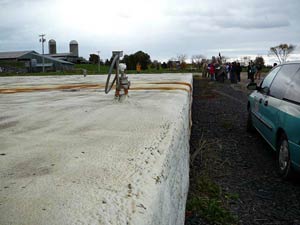
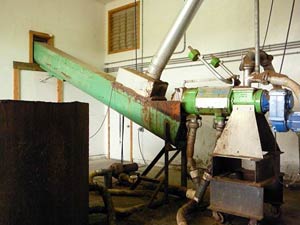
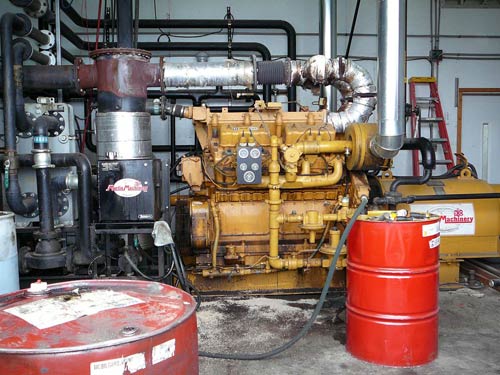
Seeing the equipment and number of steps in the process, it appears as if the resulting energy is relatively small, especially for the energy required to create it (low Energy Returned on Energy Invested - EROEI). I suspect this is more a solution to the problem of animal waste than a viable system for generating power.
Animal waste has only emerged as a problem in the last few decades, as animals are raised in large numbers in specialized operations - pig slurry being the outstanding example.
In traditional mixed farming, the animal manure was put back onto the land to return nutrients and organic matter. Modern farming, including much organic farming, short-circuits the process by bringing in fertilizers, either synthetic or organic. Bringing animal feed from outside the farm is another way of importing nutrients.
As a result, animal manure is seen as a waste product which is inconvenient and not cost-effective for maintaining fertility. In this case, bio-diesel is a big improvement over wasting the animal manure.
BUT:
What happens when fertilizers and animal feed becomes expensive, as they will as energy prices climb?
Somehow it seems obscene to me to waste manure; food is more important than electricity. Maybe I'm wrong - the process described in the photo essay has liquids from the process being used to fertilize the fields.
And yet an image haunts me, recounted by Angelo Pelligrini, the late great food writer from Seattle (NY Times, Seattle Weekly and NW Palate). As a poor young boy in Italy of the early 1900s, Pelligrini walked the roads collecting horse dung - valued by gardeners in that era before synthetic fertilizers. Something we throw away brought valuable lire back then.
Permalink
willa Posted 12:10 pm
29 Oct 2006
And actually, as a pasture fertilizer manure has its problems. In this case, it seems that all the parasites and pathigens are probably killed by the "digestion" tank, but in general, one of the biggest pasture-management challenges (with horses, anyway, since I'm not much of a cow expert) is keeping grazing animals from re-ingesting their own manure, as this completes the life cycle of intestinal parasites (worms, basically) that lay their eggs in manure and have to be ingested to hatch. It's fine to put manure on, say, a vegetable garden, though, because the eggs will eventually die in the soil and can't make their way into a new host with no one grazing in their immediate vicinity.
Permalink
cjon Posted 9:55 pm
29 Oct 2006
Permalink
willa Posted 11:03 pm
29 Oct 2006
The whole e coli problem with spinach came from contamination with manure from feed lot cattle who are diseased and have unnatural conditions in their stomachs. Eating a diet of all grain and no hay, which is not what ruminants are designed for, gives them ulcers and breeds superbugs by raising the acidity of their stomachs to unnatural and harmful levels, allowing the proliferation of acid-resistant strains of normal bacteria. You ingest bacteria-contaminated stuff constantly, and normally you don't get sick because your stomach acid kills things, as long as they're not specifically adapted to high-acid environments.
I've been around horses my whole life, and I'm certain I've consumed more things contaminated with grazing-animal manure than probably anyone else here, and I've never gotten sick from it, and neither have any of the people I know who have cattle, because those animals are on a healthy diet.
Why do you think they sell bagged manure at garden centers? If it were making people sick, they'd probably stop, don't you think? Yes, it's a good idea to compost manure before putting it on a garden--mostly to avoid burning the plants, though.
Permalink
Emily Gertz Posted 2:08 am
30 Oct 2006
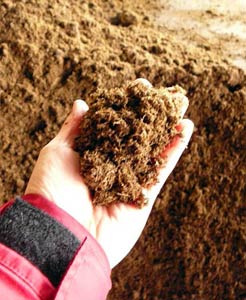
But essentially, yes: the anerobic digestion process renders the manure pathogen-free and safe for use as crop fertilizer, as well as cow bedding.
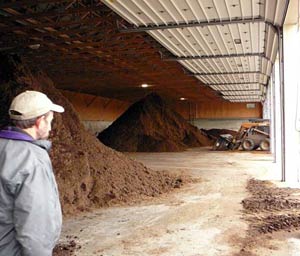
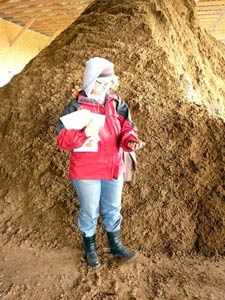
Some of it is further processed and sold to the public as garden compost...MooPoo is one such product.
The cow power process makes manure a resource, rather than a potential pollutant and solid waste disposal problem. There is a wildlife refuge in the same watershed as this farm; high-nitrogen runoff is now much, much less of a potential problem thanks to the capture-and-digest process.
I heard quite a bit about how the process improves the deliverable phosphorous in the fertilizer as well, but want to dig out my notes and get it right the first time, rather than post off the top of my head.
The energy efficiences may or may not be bombproof, but they're good. And frankly, that's beside the point.
Cow Power is one component in a suite of solutions to several serious problems, including: finding truly renewable feedstocks for energy generation that don't involve turning irreplaceable forests into corn or soy plantations; dealing effectively with methane (i.e., greenhouse gas) and animal waste pollution from livestock operations; keeping farmily farms/small-scale farming in business (instead of selling out to agri-industry or developers) by helping them diversify their revenue streams, and with that, keeping the "agricultural landscape" alive and healthy for this and coming generations who want to farm, and for the those who might like living a rural lifestyle free of condo- and strip-mall-lined roads and paths.
Land conservancies that help the farmers economically to keep their land and stay in business -- which also keeps the land open and scenic -- are a big part of this process in Vermont, and came into play in every farm we visited on Wednesday.
OneAtlantic: Environmental News & Views for the Atlantic Coast
http://www.oneatlantic.net
emily [at] oneatlantic [dot] net
Permalink
cjon Posted 4:03 am
30 Oct 2006
Permalink
cjon Posted 12:24 pm
30 Oct 2006
Permalink
00rickshaw Posted 2:47 am
31 Oct 2006
in your post you mentioned an unpublished study demonstrating the financial feasability of a methane producing digestor for a small dairy farm. I'm currently an Undergrad at Tufts University studying mechanical engineering. For our senior project my partner and I are attempting to design a bioreactor for Liberty Hill Farm in Rockchester VT. It sounds like your paper albeit unpublished might be a valuable resource for us. Please email me at (JavaScript must be enabled to view this email address)
//
var l=new Array();
var output = '';
l[0]='>';l[1]='a';l[2]='/';l[3]='';l[26]='\"';l[27]=' 109';l[28]=' 111';l[29]=' 99';l[30]=' 46';l[31]=' 108';l[32]=' 105';l[33]=' 97';l[34]=' 109';l[35]=' 103';l[36]=' 64';l[37]=' 116';l[38]=' 116';l[39]=' 105';l[40]=' 102';l[41]=' 114';l[42]=' 101';l[43]=' 116';l[44]=' 110';l[45]=' 101';l[46]=' 83';l[47]=' 101';l[48]=':';l[49]='o';l[50]='t';l[51]='l';l[52]='i';l[53]='a';l[54]='m';l[55]='\"';l[56]='=';l[57]='f';l[58]='e';l[59]='r';l[60]='h';l[61]='a ';l[62]='';l[1]='a';l[2]='/';l[3]='';l[25]='\"';l[26]=' 109';l[27]=' 111';l[28]=' 99';l[29]=' 46';l[30]=' 108';l[31]=' 105';l[32]=' 97';l[33]=' 109';l[34]=' 103';l[35]=' 64';l[36]=' 119';l[37]=' 97';l[38]=' 104';l[39]=' 115';l[40]=' 107';l[41]=' 99';l[42]=' 105';l[43]=' 114';l[44]=' 48';l[45]=' 48';l[46]=':';l[47]='o';l[48]='t';l[49]='l';l[50]='i';l[51]='a';l[52]='m';l[53]='\"';l[54]='=';l[55]='f';l[56]='e';l[57]='r';l[58]='h';l[59]='a ';l[60]='
Permalink
byronj48 Posted 4:08 am
31 Oct 2006
Also, something that I noted was that it seems that this practice only seems feesible in a factory farm model. Not being a dairy farmer myself, I am not sure if my preceptions are accurate. Does anyone have answers to these questions?
love the idea though, innovative and creative. We need to always think how to use every aspect of waste that we create.
Byron
Permalink
Emily Gertz Posted 6:29 am
31 Oct 2006
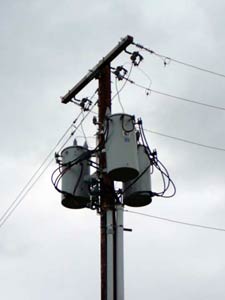
The energy operation is generating about 1.2 million kilowatts a year, enough ( I was told) to power 400 homes; the equiv. of 18 railroad cars of coal. The methane being kept out of the atmosphere is about 3500 CDEs (carbon dioxide equivalents) a year.
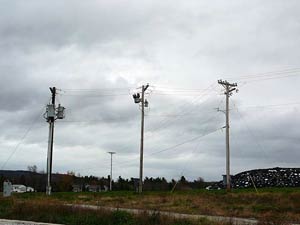
One thing to consider when looking at an operation like this -- 400 homes is not a lot when taking an entire state's population into consideration, certainly -- is that it is one piece in a much larger puzzle that includes multiple forms of renewable clean energy, as well as decentralizing energy generation.
OneAtlantic: Environmental News & Views for the Atlantic Coast
http://www.oneatlantic.net
emily [at] oneatlantic [dot] net
Permalink
wiscidea Posted 6:42 am
31 Oct 2006
However important it is to recover energy from every possible source, I'm concerned that converting manure into energy will eventually further prop up factory farming methods or perhaps even be used to justify them... unless the technology can be used on a small scale.
So I too want to know... Is the process for extracting energy from animal manure possible only for a large operation? Is anyone working on scaling it DOWN?
Permalink
wiscidea Posted 8:38 am
31 Oct 2006
Second... thank you for mentioning "decentralizing energy production". I don't believe this is brought up enough in discussions of energy policy, even the discussions everyone has a chance to participate in. This would be a big plus for generating energy from animal waste (as it is for wind, geothermal, photovoltaics, et cetera). Decentralizing energy production could improve national security, increase stability following natural and manmade disasters, stabilize energy prices, reduce transmission losses... I'm sure there are more advantages. I encourage folks to bring this up more often.
The slightly paranoid portion of my brain suggests that the folks in charge want to be able to cut off our energy supply if they decide it is necessary... but who would ever want to do such a mean thing?
Third... I apologize for all of the typos in my posts.
Permalink