

Exporting our greenhouse gases to China

China’s emissions aren’t really China’s 9

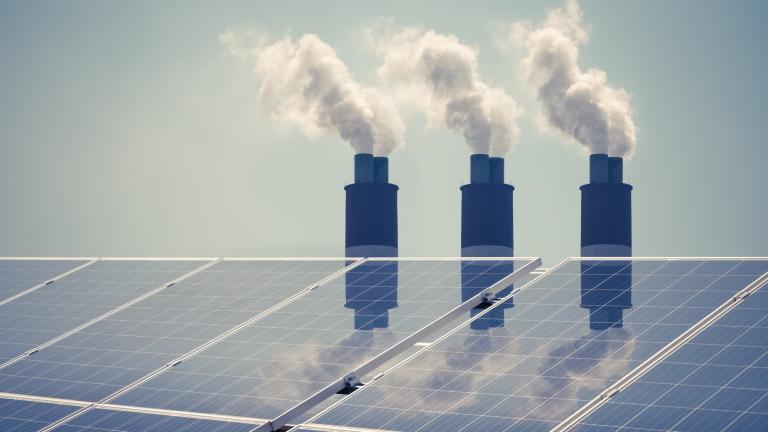
china-pollution.jpg

If you want a Chinese perspective on global warming, a good place to start is this China Daily opinion piece, "Climate change is reshaping global politics." Pang Zhongying, a research fellow with the Joint Program on Globalization under the CRF-Carnegie Endowment for International Peace, makes some points worth remembering, especially:

Western countries and industrialized Asian nations like Japan and the Republic of Korea have moved many of their factories to developing countries such as China and India, where cheap labor allows them to manufacture at lower costs than at home. This globalization of production has resulted in the discharge of much more waste in poor nations that otherwise would have been released in developed countries. As a matter of fact, not all of the greenhouse gases released "in China" or "from China" are really "China's".

Think of our large and growing trade deficit with China as the U.S. exporting industrial greenhouse-gas emissions. Worse still, China has a more coal-intensive industrial base, so producing things there generates far more pollution than if we had produced the same goods here.

This post was created for ClimateProgress.org, a project of the Center for American Progress Action Fund.

Joseph Romm is the editor of Climate Progress and a senior fellow at the Center for American Progress.

Advertisement
Advertisement
  1. Sean Casten's avatar

    Sean Casten Posted 4:05 am
    19 Jul 2007

    Good pointBut especially for what it implies given the potential to cost-effectively reduce carbon via industrial efficiency.  Notwithstanding the mental pretzels that we've gotten into on the regulatory side with respect to whether or not the developing world should pay to reduce carbon before us developed countries do so, the fact that the big opportunities to cost-effectively reduce are in industrial energy efficiency means that the developing world actually has an economic interest in moving first.
  2. GreyFlcn Posted 4:17 am
    19 Jul 2007

    Well franklyThe US should be the one to make the first step.
    We should design the tech which they can use to build their new infrastructure Green.
    Much in the same way that developing countries leap forward and start with cellphones.
  3. Sean Casten's avatar

    Sean Casten Posted 4:26 am
    19 Jul 2007

    No disagreement hereI certainly don't suggest that our own deindustrialization ought to give us a free pass.  I'm simply pointing out that the intellectal basis for the developing world moving second has always been predicated on the faulty idea that all carbon reductions cost money.  Because industrials invert that logic every time they invest in efficiency - and because those opportunities are so huge - it suggests that we could at least get rid of the whole chicken & egg depend and start acting.  
  4. GreyFlcn Posted 4:27 am
    19 Jul 2007

    One advantage to consider with ChinaPutting in new infrastructure is a lot cheaper than retrofitting old infrastructure.
    And China actually prefers command-and-control decission models.
    So make something which can scale, and work at China prices, and then you got yourself an easy way to reduce emmisions.
  5. SustainableGreen Posted 4:29 am
    19 Jul 2007

    Well, That Ain't All!Hey, all:
    There is even more to it.  The embodied Carbon and energy, the extra energy of transportation, the losses en route (they track Pacific currents using debris from lost containers bound from China to the U.S.) and the associated pollution all add to the total.  Not to mention loss of U.S. jobs, and the economic displacements that causes.
    I propose a 150-million-person-long spanking machine (both sides) to punish Wal-Mart for their ignorance, avarice and blind greed.  Of course I am afraid my idea would get little support, based on the number of cars in the Wal-Mart parking lots.  The living dead are in there, secure in whatever.  Of course, the ripples have spread everywhere, and now you have a hard buying anything not "Made in China".
    David

    Sustainability For Life
    Messages done with sustainable energy, with Wind and Sun!
  6. Sam Wells Posted 5:16 am
    19 Jul 2007

    LOL, funnyAll I can say is even though loads of air and water pollution occurs from Chinese industry, it is still cheaper to ship them to the US than make goods here in the US.  The fuel is pretty much the same cost. It is the labor that is cheaper.
    The part about China offshoring a bunch of industry is interesting.  But how about us?  Dell has plants and overseas suppliers all over, right?  Are those counted as "US" emissions or in Scotland and countries in the Orient?

    Onward through the fog
  7. Jon Rynn's avatar

    Jon Rynn Posted 5:35 am
    19 Jul 2007

    We should manufacture here......for a number of reasons, but add one more, that we can better control the industrial pollution and carbon emission here than there.  
    SustainableGreen, (or anybody else), do you know sources on how much oil goes into cargo shipping?  I thought I read somewhere that cargo shipping adds a significant amount of carbon emissions.  Also, as oil becomes more scarce, so will cargo shipping.
  8. Mark92675 Posted 7:33 am
    19 Jul 2007

    Wal-Mart Haters Unite and Broaden Your Scope...Since a high percentage of goods for retailers (large and small) are manufactured in China, although it seems superior to be an unabashed Wal-Mart hater, on this issue, virtually no major retailer is off the hook.  
    Costco, Target, Pottery Barn, Williams Sonoma, Nordstrom, Nieman Marcus, Abercrombie, HSM, Forever 21, Apple, Dell, Nike, Patagonia, Sundance, Columbia, and on and on, down to Big Lots, and all the Dollar Stores, plus every major beloved brand of pop culture and couture are guilty of offshore production of their goods.
    So the author makes a great point.  Not only American, but worldwide demand for lower prices on consumer products creates a cause. Fulfillment of that demand is the effect.
    The effect is shifted to an ever growing concentration of industrialization in greater Asia which now slates China as the #1 polluter in the world.
    For all the reasons one might dislike Wal-Mart, if you actually look at the facts, leadership on sustainability and environmental responsibility is not one of them.  No other company has challenged their suppliers and internal operations more on the subject.  
    Suppliers are now being challenged to calculate and work to reduce the carbon footprint of products they sell to Wal-Mart.  
    Measure it, so you can manage it.  This is one way  ALL large volume importers can begin to understand their impact and to challenge their suppliers' overseas factories to improve as well.
    Unfortuately, government-sponsored coal-fired powerplants are popping up all over greater Asia and they have vast supplies of cheap, sulfur-rich coal at their disposal.  
    So as a consuming middle class emerges in these developing countries, adding to existing consumer demand, and as industrialization expands to meet world demand, this becomes a many-headed smoke belching dragon that will not be easily tamed.
  9. farnishk Posted 8:17 pm
    19 Jul 2007

    For A Detailed Analysis......of the carbon exported to China, you might want to read "Whose Carbon Is It Anyway?".
    It's good to see that more people are picking up on this form of emission transfer.
    Keith

Add a Comment

You are not logged in. Thus, you cannot post a comment. If you have an account, log in. If you don't have an account, well, by all means go make one! Meet you back here in five.

Hello, Visitor!    Why not register?

Advertisement