EPRI: The secret to carbon reduction is more coal

Really? 8

The Electric Power Research Institute just released "The Power to Reduce CO2 Emissions" (PDF), its discussion paper to "provide stakeholders with a framework [to] develop a research, development, and demonstration (RD&D) Action Plan that will enable sustainable and substantial electricity sector CO2 emissions reductions over the coming decades."

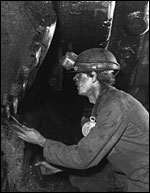
coal miner

It is crazy, mathematically bogus, economically disastrous, and generally inane ... but will reach an audience vastly larger than its rigor warrants.

First, a bit about EPRI. It is the research arm of the nation's regulated utilities. It has historically been funded by charges on electric bills, but with restructured markets, it's had to adapt its revenue model. Still, it has not strayed too far from its funding sources, and has been chronically unwilling to recommend any course of action that:

  • would be contrary to the interests of regulated utilities, or
  • requires anything other than massive technology R&D from which regulated utilities benefit.

That's all personal opinion, which readers may choose to ignore. Let's take a look at the facts -- what they recommend to control carbon. (I should note that they describe this path as "aggressive but feasible.")

  1. Increase the deployment of end-use efficiency by 1.1 percent per year. Since electricity consumption is growing at the same percentage, this target has the benefit of being quite safe for utility profit margins. While not aggressive, it certainly is feasible.
  2. Deploy 70 GW of renewables by 2030.
  3. Install 64 GW of new nuclear capacity by 2030 (compare this to the current installed base of 100 GW).
  4. Add 150 GW of "advanced coal" generation, with "up to 90%" carbon sequestration. They do not discuss efficiency, so I'll help here: coal with carbon sequestration is about 10-20 percent less efficient than coal without carbon sequestration. Which means that -- if carbon sequestration works -- it leads to a massive increase in our rate of coal consumption. So this one is really good for the coal lobby. Not so good for West Virginia mountaintops.
  5. Carbon capture and storage should be "widely deployed" after 2020.
  6. Ten percent of all new vehicle sales will be plug-in hybrids after 2017, then grow by 2 percent per year.
  7. Five percent of all power to come from distributed resources by 2030. For comparison, the U.S. grid currently draws 7-10 percent of its power from distributed generation, which makes this another big one for the "feasible, but not aggressive" budget.

That's it! If we follow EPRI's magic path, we will lower carbon emissions. Better yet, we can do so while increasing the rate at which we consume coal and electric power! What's not to love? (Please, don't talk about the costs.)

Let's parse what the report suggests. Growing efficiency merely at the rate of load growth is equivalent to saying that we should not increase the market penetration of more efficient appliances. That makes perfect sense, since we are already at the perfect level of efficiency deployment, right?

And we absolutely shouldn't extend the discussion of efficiency to the generation of power, which warrants zero mention in the report, in spite of the fact that the electric industry is only half as efficient today as it was in 1910.

As for renewable energy, it's about as important as nuclear power -- but only half as important as coal -- in a carbon-constrained future.

The logic is impeccable, and by "impeccable" I mean stupid. But here's the rub: this claptrap is sure to be distributed to politicians by the electric industry (the biggest industry in the country, let's not forget) as they consider carbon policies. Yuck.

Sean Casten is President & CEO of Recycled Energy Development, LLC, a company devoted to profitably reducing greenhouse emissions.

Advertisement
Advertisement
  1. The Cunctator Posted 4:06 am
    16 Aug 2007

    Lieberman-WarnerThis proposal looks like it's in line with the funding priorities and emissions targets of the Lieberman-Warner proposal that Joe Romm praised, including its call for a heavy bet on CCS.

    Hill Heat
  2. theBike45 Posted 5:03 am
    16 Aug 2007

    Will be far more nuclear  An additional 64 GW of nuclear is a large underestimation, especially if gas-pebble-bed generation proceeds as expected. Nuclear would completely trump inefficient and overly expensive wind, and doesn't require replication to boot, which boosts the actually costs of wind even more, although never admitted by wind proponents, who live in a dream world. Those West VA mountaintops and the flying wildlife would be better off with coal mines than with useless wind turbines. could    Solar tower looks to be the most efficient solar for quite some time to come, perhaps forever. Wave will eventually exceed

    wind power due to huge advantage in  power density - i.e. water contains 800 times the energy of wind.
  3. Sean Casten's avatar

    Sean Casten Posted 5:18 am
    16 Aug 2007

    Maybe, but...Bear in mind that the purpose of this report is not to make a recommendation, but to direct federal dollars.  If it's coming anyway, it arguably doesn't need EPRI singing it's praises.
    But the report is so bizarrely recursive that I barely know where to begin.  I too have heard good things about next generation nuclear technologies, but even if we solved all the political problems with nuclear today, we'd still be a decade away from the next MW of nuke capacity given construction times. Meantime, we've gotta do something on carbon.
    But the bigger bit of recursion is the implied cost.  The most conservative estimates I've seen for the cost of coal-fired power that is both compliant with the Clean Air Act (as all new coal must) AND can sequester carbon (as all new coal probably will have to be, although no one's placing bets yet on precisely when or how) is an all-in, delivered cost of around 16 cents/kWh.  In other words, the days of cheap coal are over.  And if it's not cheap, why the heck are we doing it?  And even if there are good reasons for expensive coal (national security, say), then you still have to explain how it is that a grid with 16 cent baseload power (surely we're not talking about running big, thermally-intensive coal plants as peakers?) doesn't have a massive economic incentive for a greater deployment of renewables, efficiency, nuclear, gas and local generation than they postulate.
    So even in the bizarro universe where EPRI's assumptions make sense, they are internally incoherent.  And yet, they have framed this as a strawman upon which we should start deploying research and subsidy dollars.  
    This makes no more sense than it would to subsidize R&D in dentures and steel toed boots because both will be required in a world where you want me to kick you in the teeth.  Idiotic underlying assumptions, no internal coherence... and yet it is being trumped as a smart policy idea.  
  4. Jonas Posted 1:55 am
    17 Aug 2007

    Sorry, it's called carbon-negative bioenergyThe coal people are right, but for the wrong reasons. They are developing CCS technologies. And why is this great? Because you can use biomass in these power plants.
    So what happens when you burn carbon-neutral biomass in a power plant, and sequester the carbon?
    You get: carbon-negative energy.
    This means you actually take historic CO2 emissions out of the atmosphere.
    No other energy system is carbon-negative (solar, wind, nuclear are all mildly carbon positive, 'clean-coal' is carbon neutral at best).
    Scientists call this 'BECS': Bio-energy with Carbon Storage. They see it as virtually the only system capable of reducing carbon emissions in case of abrupt climate change.
    BECS-systems allow societies to use energy, while at the same time taking their historic CO2 emissions out of the atmosphere.
    More info on BECS:
    Peter Read and Jonathan Lermit, "Bio-energy with carbon storage (BECS): A sequential decision approach to the threat of abrupt climate change", Energy, Volume 30, Issue 14, November 2005, Pages 2654-2671, DOI:10.1016/j.energy.2004.07.003
    Abrupt Climate Change and geo-engineering the planet with carbon-negative bioenergy
    Biopact to chair Sparks & Flames conference panel on carbon-negative biofuels
    Pre-combustion CO2 capture from biogas - the way forward?
    Euractiv: 'Carbon-capture trials safest way forward'
  5. Sean Casten's avatar

    Sean Casten Posted 2:06 am
    17 Aug 2007

    JonasSeveral comments:


    Notwithstanding whether or not carbon + biomass cofiring + coal sequestration is a good thing, that's not what EPRI is recommending.  Just coal + sequestration.
    It is utterly crazy to recommend a technology path that will massively drive up the price of electricity simply because other more competitive carbon reduction strategies aren't competitive with current prices of electricity.  If you - or anyone else - wants to do coal + biomass + carbon sequestration, that's fine.  But unless you get the public to guarantee your cost recovery, you'll never get any investors, because as soon as the electric prices rises in response to your operating costs, lots of other low/zero carbon technologies will come on line, outcompete you and force you to shut your plant down (or, more likely, take a massive haircut on the equity so that you can just recovery marginal costs and pay off your debt.)


    This latter point is crucial to understand, because EPRI's recommendation isn't founded in any reasonable consideration of policy or economics.  It is a request to get governments to guarantee stupid ideas - but dressed up in the guise of rational technology assessment, which it ain't.  
    Put this another way: if we're going to accept 15+ cent/kWh power, wouldn't we rather have the gov't say that they'll pay that to anyone who can lower carbon rather than simply throwing it at coal?  Because if coal isn't cheap (as future coal most certainly isn't without a complete roll back of the Clean Air Act), then what's the point?
  6. Jonas Posted 4:54 am
    17 Aug 2007

    Biomass is less expensive than coalSean, the point is that if we want to implement carbon-negative bioenergy systems, then we need CCS-technologies. Only the fat money from the oil and gas industry can develop these.
    The strategy should be: let the coal industry develop CCS, and if they have proved that it works, then we force them to switch to biomass.
    By the way: biomass co-firing is already less costly than pure coal, in Europe.
    Check here (a study by Imperial College):
    Quick comparison of renewable energy and fossil fuel prices.
  7. Sean Casten's avatar

    Sean Casten Posted 5:39 am
    17 Aug 2007

    Fine, butso are a lot of other carbon-control approaches.  Maybe we are in violent agreement here, at least with respect to your second point about biomass.  But doing CCS with coal simply because we'd rather not fund cheaper ways to reduce carbon is still dumb.
  8. joebhed Posted 3:42 am
    16 Jun 2008

    Inadequate CriticismThe gist is that we CAN'T need more coal if we do things right.

    The biggest criticism of the EPRI study is its findings of how fast we can implement nuclear power.

    If you believe we can do more efficiency than 1.1 percent, say how it is possible.

    Most of the increase in power needs in the EPRI study come from the PHEVs.

    We are solving our liquid carbon problem, and substituting for nuclear and advanced coal.

    But, I am running a theme here.

    It is not our coal.

    It is not our oil.

    It is owned before it comes out of the ground by folks who have bought the future rights to it.

    It will me mined and shipped SOMEWHERE.

    It will be burned either as CLEAN as we can, or as DIRTY as they can.

    Those are the real choices.

    We need carbon CCS solutions as soon as possible.

    And,  IF , the world economy continues to grow, at the level assumed in the EPRI forecast, then we will need more coal.

Add a Comment

You are not logged in. Thus, you cannot post a comment. If you have an account, log in. If you don't have an account, well, by all means go make one! Meet you back here in five.

Hello, Visitor!    Why not register?

Advertisement