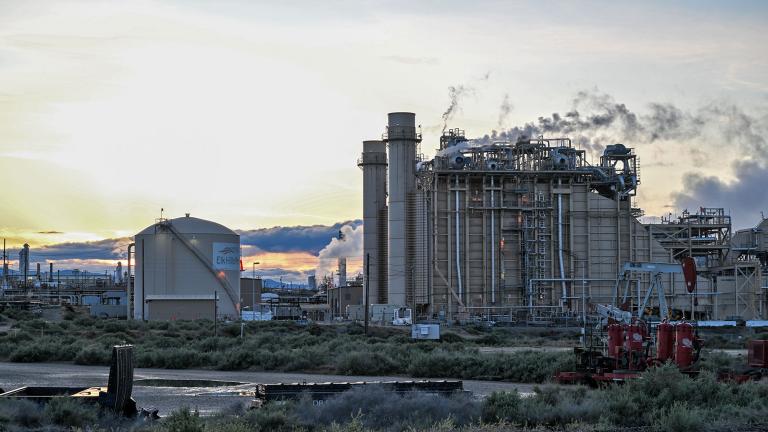
From the "Things Grist readers already knew" file comes this report from ClimateWire ($ub. req'd) that price shocks are looming for power plant operators, even before the costs of carbon are factored in.
A few excerpts below the fold:
[F]rom the utility industry's point of view, the coming price on a ton of carbon dioxide pollution couldn't have come at a worse time.
...
"There's one really basic, I think really important fact, which is that we don't really have full transparency between the prices you and I see in our monthly bills and the production costs of electricity," said Revis James, director of energy technology assessment at the Energy Policy Research Institute. "Where we are definitely seeing trends to higher and higher electricity costs is on the production side. What's not necessarily happening yet is whether or not you are seeing those increases fully or at all at the retail side."
...
"Obviously, at some point, the increase in production costs are going to have to be reflected in the retail price," James said in an interview. "It's just a question of when."
...
Construction cost increases are clearly causing pain. In a recent survey by the Edison Electrical Institute (EEI) of its industrial members, EEI found that companies are planning investments in transmission upgrades from 2006 to 2009 at levels 60 percent higher than the earlier investment cycle, from 2002 to 2005, or almost $38 billion. Billions more will have to be spent to meet rising demand.
Rising costs and steadily growing demand alone will increase electricity and heating bills throughout the country, with or without a price on carbon. At a recent industry conference in New York, one executive from the Midwest stood up to tell the audience of utility reps and government regulators that "you should start telling your customers that their utility bills will triple in the next three to five years." [my emphasis]
...
Not all utilities will be equally affected. The worst-affected sector will be coal generation, with natural gas feeling a much lighter impact and nuclear power not affected at all.
There is a critical need for policy to fix this. If we wait for prices to increase as we build expensive, dirty power, we will suddenly find it economically justifiable to build less-expensive clean power. But those same plants won't be built today in an era where -- as EPRI notes -- retail rates are artificially depressed. So do we build the right stuff first, or do we first build a lot of dumb stuff and hope that equity investors will roll over and take the loss as new stuff comes on line? We need good policy to ensure the former.
Comments
View as Flat
Kristina & Jason Makansi Posted 4:59 am
14 May 2008
Pearl Street::Jason and Kristina Makansi
Read Lights Out reviews
Permalink
Sean Casten Posted 5:13 am
14 May 2008
For example, industrials in West Virginia have retail rates of $30 - 50/MWh. That covers the cost of the coal that goes into the state's power plants, but not much else. Even with smart meters, that's still going to lead to very cheap electricity - and very little incentive for those industrials to conserve energy (or for other clean developers to build alternatives to coal.) Meanwhile, we see AEP getting approval to build a $3700/kW coal plant in the state, which is clearly going to require retail rates well north of $100/MWh to cover all the operating costs and capital recovery (before even considering CO2 abatement.)
But now look at what happens. AEP can build an expensive, dirty plant that will lop a few more meters off the average height of a mountain in WV even though doing so will require massive increases in electric rates. But if someone instead wants to build a cleaner plant that "only" costs $80/MWh (I'm sure we can all think of a few), you have no way to do so. You're not the utility, so you don't get commission-guaranteed returns. And the industrials - who are paying the aforementioned $30 - 50/MWh rates - don't have any incentive to sign a long-term contract with you for what looks like really expensive power.
And so we find ourselves in a situation where - as the article notes - we are very clearly facing massive increases in power prices. And yet we have no incentive to invest in precisely those technologies that would ameliorate those price spikes (and save a bit of GHG in the process.) Smart meters are clearly a good idea, and part of the solution, but fixing the underlying problem requires more structural regulatory reform.
Permalink
Erik Hoffner Posted 5:21 am
14 May 2008
Erik
The Orion Grassroots Network: 1,200+ grassroots groups working for conservation & more
Permalink
Sam Wells Posted 5:23 am
14 May 2008
Working against coal are rising costs of ... electricity! Coal mines not only require massive amounts of electricity but diesel as well. I find your conclusion that cheap coal may come out to be more expensive than cleaner alternatives such as natural gas and wind to be refreshing. I hadn't thought of that. Thanks for the new concept!
Onward through the fog
Permalink
Sean Casten Posted 6:23 am
14 May 2008
It took us 30 years to notice this simply because we had lots of spare capacity in the system. A 1980s-vintage nuclear plant only ran about 60% of the year. That same plant today runs 90% of the time. We've seen similar increases in the coal fleet, such that for the last three decades (conventional wisdom about natural gas notwithstanding), most of our new MWh has come from coal and nuke, as we've run those old plants harder. But that game is up, and so we now face the choice between building expensive coal, building expensive nuke or building (comparatively) cheap gas. (Or, of course, doing something way smarter, but such options lie outside of the regulatory paradigm.) Not surprisingly, gas is the only one that's being built to any significant degree.
Re: deregulation, I'd challenge your observation. The states that deregulated were - to a large degree - the states that ran into these capacity constraints first. (e.g., those that for environmental or other reasons didn't have a big installed base of coal & nuke). Thus, much of the price increase that has happened in those states was the result of the fact that they were exposed to natural gas price volatility (which has nothing to do with electric dereg) rather than deregulation per se - and for the same reason, those states had higher prices before they ever deregulated. Interestingly, when you look at how electric rates have changed over the last 20 years, you find that the states which didn't deregulate have actually seen much faster increases in power price on a percentage basis than those that didn't. Yes, the absolute price is lower, but that's only because it started lower. They are converging, and my expectation is that they will soon cross over, as those are also the states most prone to build really expensive coal. See here for more details.
Permalink
Kristina & Jason Makansi Posted 7:29 am
14 May 2008
We like to say that electricity is the one thing that is invisible until it's not there. The average Joe or Jane doesn't think about WHY we need structural reform and they won't care or advocate or push for it or demand it until they do. As you, and the rest of us who have spent decades in the industry know, the electricity industry doesn't move quickly and it often doesn't move at all unless prodded. We're all preaching to the choir when we acknowledge the need for structural reform to address long-term infrastructure requirements. But, if it's fast [relatively] action that we need, then everyone needs to know what's at stake--and not just on the CO2 front, but also on national security and economic growth, global competitiveness, and all aspects of environmental sustainability as well. Electricity underpins our modern lives in ways most people simply do not understand. That has to change if we are to gather enough support for true structural reform.
As far as the coming electric shock goes, we wrote a blog piece about this same time last year...you can check it out here: the looming electricity rate shock.
Pearl Street::Jason and Kristina Makansi
Read Lights Out reviews
Permalink
rsmith02 Posted 3:07 am
15 May 2008
"Thus, much of the price increase that has happened in those states was the result of the fact that they were exposed to natural gas price volatility (which has nothing to do with electric dereg) rather than deregulation per se - and for the same reason, those states had higher prices before they ever deregulated"
But isn't the exposure to natural gas prices the fault of the structure of dereg itself? Under ISO New England, the last and most expensive generator called for power sets the price for every other generator. As I understand it the spot market price also sets the backstop for what generators will bid in- the higher it goes, the higher contract prices go.
Instead of paying the average cost of a power portfolio in the old cost of service regime we end up paying spot market prices for gas and nuke and coal plants bid not at cost of production but high enough so that they'll get called to run.
New England is heavy on paid for or largely paid for nukes. Connecticut's kWh is about half nuclear but yet generation is about $.12/kWh and delivered residential rates are close to $.18/kWh.
The good news about dereg is that it brought a lot of new, efficient gas generation on line and ancient oil fired units are now only used for capacity and should get retired as new peaking capacity is built.
Permalink
Sean Casten Posted 4:27 am
15 May 2008
In other words, gas-dominance came first, followed by dereg. Blaiming dereg for gas-dominance and therefore for rising power prices in Texas, California and New England has the causality backwards.
Permalink
rsmith02 Posted 2:51 am
19 May 2008
Would you be willing to comment more on 1992 EPACT and FERC Order 888 and why utilities didn't build coal even though they could rate-base it? Why did the coal boom only start up in the past few years.
Permalink
Sean Casten Posted 4:05 am
19 May 2008
When those markets opened up, natural gas plants as compared to coal were:
a) cheaper to build (~$1000/kW as compared to $2500/kW+ for Clean Air Act-compliant coal)
b) easier to permit
c) quicker to build
d) At $3/MMBtu gas, good money makers
(d) is no longer true, but the first three still are. So a big part of the story is simply that coal didn't make sense in 1992 and it still doesn't make sense today - the only thing that's changed is that when you factor in all costs including capital recovery, coal went from being a much worse investment thesis than gas to being about a break-even with gas (due to higher NG prices) - but a break even that even still requires a smaller financial bet, and therefore the only thing that's being built. (e.g., if you have to make an investment that is contingent on a 40% rate increase, would you rather make a billion-dollar bet or a $400 million bet? Gas is the latter, coal the former, at todays capex and energy costs.)
What's also interesting is that the big push for combined cycle didn't really start until the independent power producers (IPPs) came along. This is consistent with the fact that a regulated utility doesn't have any incentive to control operating costs (=maximize energy efficiency), and many of the IPPs that came along in the early '90s had an investment thesis based on that disconnect. Essentially, they looked at a market that had long been regulated, saw that the established players were building foolish capital and saw that a technology existed to convert gas into power at 50%+ efficiency instead of the ~30% that the regulated folks were doing. That begat a flood of construction in combined cycle gas turbines, that made sense... so long as the price of gas didn't move too much. Then gas moved, going from $3/MMBtu in the mid-90s to $14 at it's peak a few years ago (today, it sits near $10). Thus, even with the 80% increase in efficiency, they still couldn't make the plants pencil out with the higher gas costs.
One other note: there really isn't a coal boom going on right now... yet. There is a lot of sound and fury trying to get coal plants permitted (and into utility "rate base"), but when you look at total GW of installed coal capacity, it isn't yet moving. This is in part because of retirements - many owners of small (e.g., <500 MW) coal plants are looking at the Clean Air Interstate Rule and Clean Air Mercury Rule and concluding that it is cheaper to shut those plants down than to bring them into compliance. (Indeed, this is a part of what is driving the current building boom, as we rush to replace these soon-to-be-shut-down assets.)
In other words, we still have time to do the right thing... but only if we move quickly. Note that the "right thing" can be defined in economic terms just as readily as it can be defined in environmental terms. On both measures, inefficient, central station coal is the wrong thing.
Permalink
MacAfrican Posted 5:42 am
21 May 2008
Down here in S.Africa we thought we had cheap and reliable electricity (residential retail about US 6 cent / kwh and industrial less than 4 US cent with wholesale municipal at less than 2 US cent!). Little thought was given to replacement capacity cost which for our coal-fired utility is about 6 cent / kwh fully loaded GENERATION cost.
So we now face what is politely termed load-shedding at about 40 hours per month and the utility is asking for 50% hikes in rates. Never before have so many people bought so many generators so quickly!
Here's another scary thought : we generate about half our petroleum from coal-to-liquid technology rather than crude oil. How long before it is more financially rewarding to make a gallon of petrol rather than making electricity...
There's only one solution : price electricity at its full replacement cost and that should include environmental and health cost PLUS a provision for capacity and coal reserve cost replacement. Consumers are not stupid (well yes that's maybe a stretch) and they will adapt. Most users could find ways to cut their electricity 40%, but they will only do it when the pain is sudden and severe, in their pockets!
the good news : PV and wind-power will without subsidies approach grid parity within 6 years or so. (clarification - TREC and carbon credits are not subsidies...)
Permalink