A Big Slice of Econ Pie

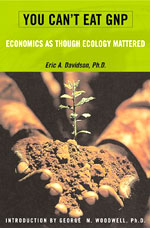
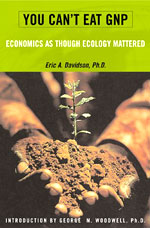
A review of You Can’t Eat GNP 0

You Can't Eat GNP:
Economics As Though
Ecology Mattered

By Eric A. Davidson
Perseus,
247 pages, 2000

"The more money we spend, according to the GNP ... the better off we are," explains Eric Davidson in You Can't Eat GNP. The Gross National Product, or GNP in common parlance, is the cumulative value of products and services created and traded by a nation, and the traditional measure of economic well-being. Yet in the past decade or so, the flaws in this measuring system have become increasingly clear to a growing number of economists, social scientists, and other observers. As Davidson learned during his time as a Peace Corps volunteer in Zaire, not only does the GNP fail to account for the state of a country's health-care, education, and welfare systems -- it also fails to recognize the overall and long-term costs, environmental and otherwise, of producing goods and services.

You Can't Eat GNP is a primer for a new school of economics in which the economy is considered "a wholly owned subsidiary of the environment," in the words of Earth Day founder Gaylord Nelson. Under this rubric, environmental impacts must be considered not only in the abstract, but tallied up along with more tangible costs of doing business. Within this scheme, "natural capital," those goods and services that nature provides and humans cannot create, must be added to the balance sheet and treated as a valuable endowment or nest egg too precious to be squandered.

A soil scientist by training, Davidson's current research focuses on the relationship between agricultural land and forests, so he approaches the GNP with an ecologist's perspective. His whirlwind but trenchant tour of ecological economics seems to be aimed at readers not already familiar with these discussions. Those who have read Herman Daly, Paul Hawken, Amory and Hunter Lovins, Jane Jacobs, Alan Durning, Lester Brown, Robert Frank, or Juliet Schor, to name but a few, will probably find little new in You Can't Eat GNP.

Still, Davidson provides a good perspective on the field for newcomers, and he does not shy away from any of the hard subjects. In his overview, he tackles population growth, biodiversity, discount rates, global warming, soil erosion, forest protection, sustainable agriculture, and technology. In his final and most provocative chapter, Davidson makes what he calls "some modest proposals for profound changes" in how the world does business. In addition to asking readers to examine their own ecological impacts, he calls for the elimination of tax deductions for more than two children, an increase in consumption taxes, an end to subsidies that encourage degradation of air, water, and soil, and the signing of international agreements to protect natural resources worldwide.

While You Can't Eat GNP probably does not break any new ground, it presents a clear and cogent case for rethinking our measures of economic well-being and a sturdy introduction to the the principle that a health economy depends on a healthy environment -- a notion we can't afford to ignore.

From his youth in Australia to career experiences in Europe, Africa and all parts of the United States, Terry has developed expertise in business, farming, education, non-profit, the environment, the arts, and government.

A United States Coast Guard-licensed ship captain, Terry has long been drawn to the undersea world, starting in the 1960s with a family-run tropical fish breeding business in Australia and continuing with studies on conch depletion in the Bahamas, manatee populations in Florida coastal waters, and mariculture in the Gulf States with Texas A&M University.

On land, Terry managed the largest sheep ranch east of the Mississippi, assisting the University of Minnesota in developing new methods of livestock disease control. Terry also managed a multi-million dollar real estate company, owned/operated a successful recreational services business, and assisted the west African nation of Nigeria with the creation of their first solid waste recycling program.

An accomplished author, Terry’s latest book, Lives Per Gallon: The True Cost of Our Oil Addiction (Island Press), is a timely examination of our dependence on oil and a strategy to evolve to more sustainable energy sources. He has also authored a series of best-selling “Ultimate Guides” to pools and spas (McGraw-Hill) and several theatrical works on the life of William Shakespeare. Terry is an avid airplane and helicopter pilot and speaks German, Dutch and Spanish.

In 1993, Terry founded the Santa Monica BayKeeper and served as its Executive Director for six years. He co-founded Waterkeeper programs in San Diego, Orange County, Ventura, and Santa Barbara. He also served for five years as Executive Director of the Environment Now Foundation in Santa Monica, CA and co-founded the Frank G. Wells Environmental Law Clinic at the School of Law, University of California Los Angeles.

In the summer of 2003, Terry helped Arnold Schwarzenegger win the historic recall election and become Governor of California. He was appointed as the Secretary of the California Environmental Protection Agency in November, 2003, and Cabinet Secretary, the Chief Policy Advisor to the Governor, in December, 2004. He continues to advise the Governor on energy and environmental policy. In April, 2007, he was named the Cullman Senior Fellow and Director of the Climate Policy Program of The New America Foundation, a non-profit, post-partisan, public policy institute. In September, 2007, he was appointed as an Operating Advisor to Pegasus Capital Advisors. Pegasus Capital Advisors, L.P., is a private equity fund manager that provides capital to middle market companies across a wide variety of industries.

Terry currently travels throughout the United States and the world, lecturing and providing private consulting services to a variety of clients, including several Governors and Canadian Premiers on climate and energy policy.

Advertisement
Advertisement

Add a Comment

You are not logged in. Thus, you cannot post a comment. If you have an account, log in. If you don't have an account, well, by all means go make one! Meet you back here in five.

Hello, Visitor!    Why not register?

Advertisement