Waxing Philosophical

Umbra on dripless candles 8

Dear Umbra,

My family is a big fan of dripless candles. They're beautiful and don't provide piles of wax that tempt fingers into creating little messes. Can you tell us how these candles work and if they are environmentally "safe"?

Anna Ruth
New York, N.Y.

Dearest Anna,

For me, playing with melted wax was a cherished childhood tradition -- right up there with daring to slice through the flame with my finger. But like so many activities of yore (see: playing with mercury), I suppose that's now out of the question. Kids, don't try this stuff at home.

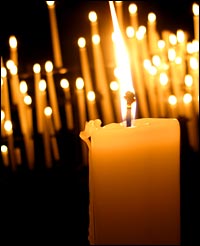
Is this burning an eternal flame?

Photo: iStockphoto

The driplessness of a candle, since you asked, has to do with two factors: a suitable combination of wick and wax (which, as near as I can tell, is a closely guarded industry secret), and the way the wax is layered. In most cases, dripless candles feature an outer coating that melts at a higher temperature (i.e., more slowly) than the core. When your candle starts burning, the outer layer forms a sort of cup or rim that keeps the melted wax from running all over your tablecloth, or candlestick, or bathtub, or what have you.

Whether they are environmentally safe depends on what kind of candles you're buying. In normal paraffin candles, the driplessness is achieved by adding a lot of stearic acid. What is stearic acid, you wonder? Well, it's a solid that's long been used to add hardness and opaqueness -- pardon me, opacity -- to candles and soaps. It's also used in cosmetics, rubber, and plastics. Derived from animal and vegetable fats, stearic acid has traditionally come to the candle industry courtesy of the meatpacking industry. Yuck.

If you'd prefer not to fill your home with the taint of slaughterhouses -- not to mention all the lead, petroleum, and other nasty additives that can be found in regular candles -- there are more-natural alternatives that will still offer you the drip-free delights to which you've become accustomed.

Beeswax candles are a lovely option. They don't need nasty artificial ingredients to make them smell good, just the sweet byproducts of industrious bees. They're non-toxic and non-allergenic, and it's relatively easy to find quality, local sources, like this one in New York state. Read the labels and look for 100 percent beeswax: these are, by nature, about as close to true driplessness as you can get.

If you're a strict vegan and don't want to benefit from the work of enslaved bees, try candles made from hydrogenated soybean oil or palm oil. (Again, be sure to read the labels, as some manufacturers add paraffin into the mix.) A soy candle will burn longer than paraffin -- 25 to 30 percent longer, some say -- and isn't as sooty. Since these materials are softer than paraffin and beeswax, the candles often come in glass jars or other heatproof containers.

You will notice, if you poke around, that candle manufacturers are quick to point out that even "dripless" candles drip, given the right (or wrong) conditions. Perhaps they've faced one too many angry customers. Anyhoo, any breeze or draft will do it, or even the odd angle or tilt. If you drip or spill somewhere, you can clean up with our old favorites vinegar and baking soda, and even those infernal dryer sheets. No, I don't like them, but you might have some in your house.

Daringly,
Umbra

 

Yours is to wonder why, hers is to answer (or try). Send your green-living questions to Umbra.

Umbra Fisk is Grist Research Associate II, Hardcover and Periodicals Unit, floors 2B-4B.

Advertisement
Advertisement
  1. Kathy Austin Posted 4:34 am
    01 Nov 2006

    Dripless LED "Candles"Just a suggestion, but now there are many attractive alternative "candles" that use a flickering LED light inside what appears to be a wax candle. Not sure what the candle is made of but the benifit is that it lasts a very long time, doesn't produce any by products, won't accidentally cause a fire in your home and no accidental burns or spills. I've seen these advertised in large pillar style and small votive sizes.
  2. plantface Posted 4:50 am
    01 Nov 2006

    Palm OilI wish that Umbra had elaborated on (or at least hinted at) the problems--mainly deforestation and associated loss of boidiversity--that large scale palm oil production poses.  They may be more   Both Friends of the Earth and Center for Science in the Public Interest have done research on palm oil's problems.
  3. wiscidea Posted 5:15 am
    01 Nov 2006

    oh the horror of it allA dripless candle is also an energy-efficient candle. If the wax is entirely consumed... no wasted fuel.
    But now for the horror that will leave everyone confused... I certainly don't know what to do...
    According to the recent post, palm oil is a problem.
    According to PETA, stearic acid not only comes from the meat industry, it also comes from the rendering of former pets found as strays or having died of natural causes.
    According to PETA, bees are abused and have their wax essentially stolen from them.
    We certainly don't want to used petroleum-based products.
    How about LEDs instead? Well, does the electricity come from nuclear power plants or coal or wind turbins chopping up birds or dams blocking salmon migration?
    I guess there is always whale blubber. But see the other discussion on this website regarding that matter.
    Are candles, those supposedly innocent sources of light and carbon dioxide, the true horror on display during Halloween.
    What are we to do?!
  4. SMLowry's avatar

    SMLowry Posted 6:10 am
    01 Nov 2006

    One for the beesBeeswax makes the best, most fragrant candles. I agree with PETA on certain things, like fur and factory farming and animal testing, etc., but really if a bee keeper takes too much wax isn't he harming the overall health of the hive? It's a renewable resouce, bees are not killed by the taking of wax. If PETA is against using beeswax, then they also must be against eating honey. Of course everyone draws their own lines. Soy candles are a great choice, too.
  5. wiscidea Posted 7:21 am
    01 Nov 2006

    Another vote for beeswax.I agree... beeswax is the way to go.
    And I forgot all about soy. I'd swear we can make anything from that plant.
    I'd say bees are essentially domesticated. We should, however, try to be nice to them when taking their wax... just like we should treat all other sources of materials with respect.
    Hey...
    What yields more wax...
    An acre of soy or bees supported by an acre of flowers?
    I suppose one can't really compare, since the acre of flowers, which might include an orchard, other insect habitat, aesthetic value, the actual flowers, the roots sequestering carbon, the lower energy input, et cetera provides many many additional returns beyond the beeswax.
    Yes... beeswax is the way to go.
    P.S., PETA should also be opposed to silk, since the caterpillars are killed before they break through the valuable cocoons and reduce the quality of the fiber.
  6. madmermaids Posted 9:32 am
    01 Nov 2006

    Waxing"Just when you thought you'd seen it all"

    I know it is going off on a lateral thinking tangent but a few days ago I passed a waxing studio advertising

    Brazilians women/men

    What on Earth does a male Brazilian look like?
  7. Delay And Deny's avatar

    Delay And Deny Posted 10:03 am
    01 Nov 2006

    Candles Are "Inconvenient" !

    What's all this then about lighten' up candles and emitting more CO2 into d'atmosphere?
    We'll have to run you in for makin' green 'ouse gasses like there was no tomorrow!  (And there won't be any tomorrow, if you keep melting the glaciers with your bleedin' candles.)
    --spoken by Al Gore, dressed as an eco-Bobby in Old Londontown.
  8. willa Posted 10:55 pm
    01 Nov 2006

    beeswax and silkPETA (and a lot of vegans) do in fact refuse to use honey, beeswax, and silk.
    I think in some cases the real cause is undermined by making a big deal out of these more minor issues, since it tends to cast the whole movement as a little nutty. Also, tea without honey just doesn't cut it (of course, tea without cows' milk doesn't cut it either, which os one of the reasons I'm not vegan).  I'm opposed to killing insects, but not as opposed as I am to killing higher animals.
    And as for efficiency and complete combustion--if the wick burns, and only a small amount of the wax does, you can melt it and make new candles.  So unless the dripless candle burns a whole lot longer than its drippy equivalent, it's actually less efficient.
    That said, I think this sort of issue is to environmentalism as the silkworm issue is to veganism, which is to say, maybe fun to discuss but possibly not the best thing to go around talking about in public, lest people think you're a nutcase and ignore everything else you have to say.

Add a Comment

You are not logged in. Thus, you cannot post a comment. If you have an account, log in. If you don't have an account, well, by all means go make one! Meet you back here in five.

Hello, Visitor!    Why not register?

Advertisement