At first glance, it was an open-and-shut case. In 1998, Mississippi farmer Homan McFarling bought soybean seeds with genetic traits owned by Monsanto, then as now the world’s dominant provider of genetically modified seeds — and also the biggest herbicide maker.
Like all farmers who buy GM seeds, McFarling signed a contract obliging him not to hold back any of the resulting harvest as seed for the next year’s planting. But McFarling saved his seeds anyway — and Monsanto busted him. Hot to protect its multibillion-dollar investment in genetic modification, Monsanto set loose a cadre of rent-a-cops into the farm belt in the late 1990s, in search of farmers who dared defy its patent claims.
According to a comprehensive 2005 study [PDF] by the Center For Food Safety, “Monsanto has an annual budget of $10 million and a staff of 75 devoted solely to investigating and prosecuting farmers.” By the time of the study, the company had launched 90 lawsuits involving 147 farmers and 39 small businesses, CFS reports.
McFarling was one of Monsanto’s first targets. The giant corporation sent the full weight of the law crashing down on the farmer’s head, suing him and winning a judgment of $780,000 (he had originally bought $24,000 in seeds, according to a New York Times account from 2003.
Preventing people from saving seeds and freely propagating crops has been tried before. In medieval times, merchants in the Levant strove mightily to corner the coffee market by refusing to export raw coffee beans that might be replanted. Their effort eventually failed, and coffee now flourishes in Latin America, South Asia, and southern Africa.
But Monsanto has patent law on its side. Monsanto has established for itself the right to claim ownership of genetic material — a revolutionary step in the history of property rights.
And McFarling trespassed on those rights. He signed a contract and then reneged on it. Case closed. Early this month, the Supreme Court upheld Monsanto’s claim against McFarling (through the appeals process, the fine has been whittled to $350,000). The seed giant’s case was so strong that the court made its ruling without comment.
Yet the logic behind Monsanto’s claim, so airtight on its own terms, has serious implications for broader society.
Seminal Logic
Desire to plant Roundup-Ready soybeans — engineered so that the plants can withstand infinite doses of Monsanto’s flagship herbicide — is what plunged McFarling into his legal mess.
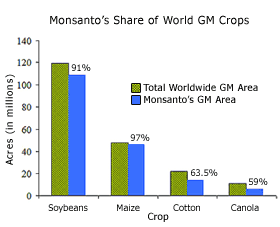
These statistics reflect 2004 data and are based on industry sources: Monsanto and ISAAA.
Source: Etc. Group
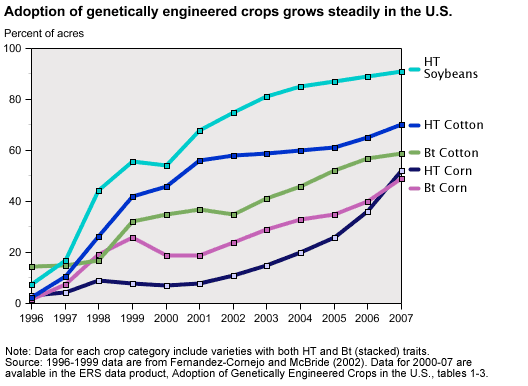
Herbicide-tolerant soy roared through the farm belt like a prairie fire in the 1990s. Introduced in 1995, it accounted for nearly 50 percent of all soy by 1998, the year that McFarling made the seed order he will rue for the rest of his life. Today, more than 90 percent of soy planted in the United States is herbicide-tolerant — and the great bulk of it contains Monsanto’s Roundup-Ready trait. Globally, 91 percent of genetically modified soy contains [PDF] Monsanto traits; the company’s market share in the United States is likely even higher.
To understand how this product conquered the farm belt so rapidly, you have to understand how large-scale commodity farmers make decisions. Your neighbor tries a new product, and suddenly boasts weed-free fields and yields that trump yours.
He reveals that he bought newfangled, high-dollar seeds — and more than made his money back with the higher yield. So you do the same. Trouble is, everyone else does, too — and the higher yields nationwide lead to lower prices for soy, erasing any advantage of the new seeds.
Indeed, USDA figures show that soybean production surged after the introduction of herbicide-tolerant varieties in 1995 — and prices dropped. Soy prices didn’t recover in any meaningful way until the great biofuel boom that started in 2006. All things being equal, technologies that increase yield end up lowering prices — erasing any net gain for farmers.
Thus in their rush to adapt new technologies, farmers aren’t working in their own interest, but rather in the interests of big corporate buyers like Archer Daniels Midland and Cargill — and, of course, in the interests of the companies that sell the new technologies, like Monsanto.
And once new technologies gain traction, they can be nearly impossible to resist. If soybean prices are dropping because all farmers are adopting a new technology, then holding out can seem insane. Say you’re trying to make a living growing soybeans, and you’d prefer not to use GM seeds. By holding out, you get low prices and subpar yields — a disastrous combination.
Devil’s Bargain
Even when prices are high — as they are now, because of the biofuel boom — there’s economic pressure to submit to GM seeds. Farmers know that good times don’t last forever; you have to “make hay while the sun shines.” To wring every penny out of the soy rally, you have to maximize yield. And that means planting Roundup Ready soy — and dousing it with Roundup, Monsanto’s flagship herbicide.
Thus farmers hardly enter into Monsanto’s “technology agreements” under completely free-market conditions. Their choice is essentially to submit to Monsanto’s terms, or live with lower yields.
Remember, 90 percent of U.S. soy — our second-biggest crop — is genetically modified to be herbicide-resistant; and more than 90 percent of that contains traits owned by Monsanto. For corn, our biggest crop, 60 percent is GM — and nearly all of it contains Monsanto genes.
Since the U.S. food system relies so heavily on these two crops, essentially our entire food supply is genetically modified, to the benefit of one company. Since the U.S. doesn’t require companies to label GM ingredients, it’s impossible to know how much of the U.S. diet contains genes owned by Monsanto. In a much-cited study from 2000, the Grocery Manufacturers of America estimated that 70 percent of food in the U.S. contains genetically modified traits. The proliferation of GM seeds has only grown since.
Somehow, a single corporation has managed to use patent law to gain de facto control of the nation’s two biggest crops — and managed to annul the age-old right of seed-saving over a broad swath of farm country. Monsanto may have airtight logic on its side for patent law, but it has clearly run afoul of a much less-enforced branch of legal code: antitrust law.
The time has come to bust up this giant seed trust.
A message from
Your support keeps our climate news free.
Grist is the only award-winning newsroom focused on exploring equitable solutions to climate change. It’s vital reporting made entirely possible by loyal readers like you.
At Grist, we don’t believe in paywalls. Instead, we rely on our readers to pitch in what they can so that we can continue bringing you our solution-based climate news. Donate today to keep our site free.