The following is a guest essay.
-----
Stabilizing concentrations of greenhouse gases in the Earth's atmosphere at a level that will fulfill the mandate of the UN Framework Concentration on Climate Change to avoid "dangerous anthropogenic interference with the climate system" will require drastic departures from business as usual. Here we introduce one attractive response to this challenge that may seem visionary or idealistic today but that could well become realistic once we reach a tipping point regarding climate change that opens a window of opportunity for embracing major changes.
No silver bullet exists capable of solving the complex and interdependent problems of climate change, sustainability, and economic development. A consensus is emerging, however, that solving these problems will require major changes in existing governance arrangements to eliminate or at least alleviate what the 2006 Stern Review (1) calls the "greatest and widest-ranging market failure ever seen" -- the failure of the market to send proper signals about the real costs of using the atmosphere as a repository for greenhouse gases. This case exhibits the defining features of market failures surrounding open-access resources (2-6). Because emitters allowed to use the atmospheric commons as a repository for the wastes associated with burning fossil fuels at no cost, they have every incentive to use as much of this free factor of production as possible. But the present and future costs to society of this practice are enormous. Estimates of these costs vary. But there is compelling evidence that the eventual costs will exceed the cost of changing our current practices to limit emissions of greenhouse gases by a large margin (1).
Analysts have proposed a variety of forms of carbon taxes and cap-and-trade systems as policy measures to deal with this problem (7, 8). A few measures, like the European Emission Trading Scheme, have been implemented to some degree. But the measures under consideration at present are deeply flawed. In this article, we present an alternative system that has several attractive features, including the capacity to deal fairly with the regressive nature of most carbon taxing systems, to protect the new governance arrangements from political manipulation or corruption, and to contribute to the alleviation of global poverty. Working out the details of the general plan will be an ambitious task, but we think it is important to take the first step and propose a broad strategy having the six principles laid out below.
The core of this system is the idea of a common asset trust (9, 10). Trusts are widely-used and well-developed legal mechanisms designed to protect and manage assets on behalf of specific beneficiaries (11). Extending this idea to the management and protection of a global commons, such as the atmosphere, whose owners/beneficiaries include all people alive today as well as future generations, is a new but straightforward extension of this idea. Because the atmosphere is global, the Earth Atmospheric Trust would be global in scope. Initial implementation at a regional or national scale may be necessary and appropriate, however, as we build toward a global system. We cannot examine in detail the path that implementation of the system might take, or how the many institutional, political, and administrative details would be addressed. Our purpose here is to present an integrative idea that has many positive features as the basis for further discussion in the post-Kyoto world.
The trust arrangement we envision has six basic features together with four special features and precautionary measures.
Basic features:
- Create a global cap-and-trade system for all greenhouse gas emissions (12). Although either a cap-and-trade system or a tax system could work, we believe a cap-and-trade system is preferable to a tax for this purpose, because the major goal is to cap and reduce the quantity of emissions in a predictable way. Caps set quantity and allow price to vary; taxes set price and allow quantity to vary.
- Auction off all emission permits -- and allow trading among permit holders. This is essential in order to send the right price signals to emitters. An "upstream" auction at the point of entry of greenhouse gases into the economy would require only a relatively small number of agents to participate in the auction, a fact that would facilitate the administration of such a system.
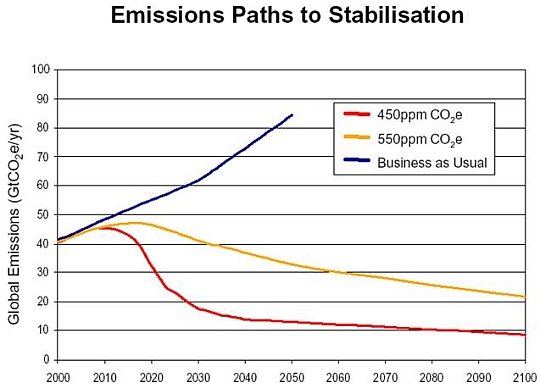
- Reduce the cap over time to stabilize concentrations of greenhouse gases in the atmosphere at a level equivalent to 450 ppm of carbon dioxide (or lower) as recommended in the Stern review (Figure 1). The price of permits will probably go up and total revenues will likely increase as the cap is reduced (see below).
- Deposit all the revenues into an Earth Atmospheric Trust, administered by trustees serving long terms and provided with a clear mandate to protect the asset (the Earth's climate system and atmosphere) for the benefit of current and future generations. The trust would be a separate, non-governmental organization similar in structure to the Alaska Permanent Fund or the Alberta Heritage Savings and Trust Fund (13).
- Return a fraction of the revenues derived from auctioning permits to all people on Earth in the form of an annual per capita payment. This dividend will be insignificant to the rich -- smaller than their per capita contribution to the fund -- but will be enough to be of real benefit to many of the world's poor people. At the current annual rate of global emissions of 45 Gigatons CO2 equivalent (Figure 1) and an auction price of $20-$80/ton (14), the Trust's total annual revenues would be $0.9 to $3.6 trillion. If half the revenues were returned equally to all 6.3 billion current inhabitants of the Earth, the payment would amount to $71- $285/capita/yr. Payments into the fund for the typical US resident producing 20 tons of CO2 equivalent per year would be $400-$1,600.
- Use the remainder of the revenues to enhance and restore the atmospheric asset, to encourage both social and technological innovations, and to administer the Trust. These funds could be used to fund renewable energy projects, research and development on new energy sources, payments for ecosystem services such as carbon sequestration, etc. If half the revenues were used for this purpose, this would amount to $400-$1,600 billion per year initially. Transaction and administrative costs would consume a small fraction of this.
Special features and precautionary measures:
- Do not allow revenues to go into the general fund of any government. The revenues would all go into a new, independent Trust organization with an exclusive mandate to manage the atmospheric commons for the benefit of current and future generations.
- Appoint trustees based on their understanding of the purposes and details of the Trust and dedication to the goals of the Trust, not their political affiliations, geographic origins, or other criteria.
- Make all operations and transactions of the Earth Atmospheric Trust transparent by posting them in an open access format on the internet.
- Make trustees accountable for their actions and decisions and subject to removal if they fail to mange the Trust to serve the needs of all the beneficiaries.
No system is perfect. A system designed on these general principles would be able, however, to achieve a global emissions cap capable of keeping CO2 concentrations at 450 ppm or less. It would be fair; it would be efficient and relatively immune to political manipulation, and it would help to alleviate global poverty. Both Jonathan Alter in Newsweek (15) and Robert Reich, former Secretary of Labor under Bill Clinton (16) have recently advocated the idea.
Could such a system ever be brought into being? The Alaska Permanent Fund (13) is a similar arrangement on a smaller scale that has been in operation for 30 years. Creating an Earth Atmospheric Trust, however, would obviously require overcoming huge political, administrative, and institutional barriers. While not diminishing the magnitude of these challenges, we believe that it is at least imaginable that such a system could be implemented, especially once we reach a tipping point regarding responses to climate change. The political will to make the necessary changes is increasing rapidly (17). Implementing the proposed Trust would obviously require a global political agreement -- a successor to the Kyoto protocol -- most likely negotiated under UN auspices.
Many details would need to be worked out in the international negotiations as well as over time to make the proposed Trust effective. Here we can only sketch the idea as a starting point and vision. Below we touch briefly on four important issues that would be among those to be resolved.
(1) Price dynamics. The price dynamics following the creation of the Trust would be something like the following (1, 8). The initial cap on emissions should be something close to current emissions, and the cap could then follow the trajectory shown in Figure 1 for the 450 ppm scenario. The initial auction price would probably be in the $20-$80/ton range (1). As the cap is reduced, two counterbalancing effects will come into play. First, the increasingly limited supply of permits will cause upward pressure on the price of permits. Second, the rising price of carbon-intensive goods and services will cause technological shifts toward less carbon-intensive goods and services, an overall lowering of emissions, and downward pressure on prices. In addition, the Trust can use part of its revenues for targeted investments in renewable energy and other technologies that reduce greenhouse gas emissions. It is hard to tell which of these forces would predominate. Our expectation is that prices would increase over time, but not as rapidly as one might expect due to supply constraints alone given the counterbalancing effects of induced technological change and targeted investment.
(2) The refund delivery mechanism. Is there a practical way to distribute small amounts of money to every person on the planet, without going through national governments? Such a mechanism would have to (a) have low transaction costs, (b) be relatively immune to fraud, and (c) have global reach. Ideally, it could be done electronically, with people everywhere being able to transfer funds from a global account to a local one. An obvious problem here is that billions of poor people do not have access to banks, much less electronic transfers. One possibility is to allow 'unbanked' people to receive their dividends through a micro-credit system. The global Trust would work through entities like the Grameen Bank; where such entities do not exist, it would help start or spread them. In order to receive their dividends, residents would have to join a micro-credit group. All members of the group would pool their dividends to create a loan fund that would supplement the banks' funds to be used for scholarships for local kids, etc. This would yield a double dividend: building community as well as individual wealth.
(3) The per capita formula. A straight per capita redistribution formula is the simplest, but it may not be the fairest or even the most politically satisfying. One possibility is to adjust the per capita distribution formula to account for past emissions. Thus, every person's base dividend, calculated on a per capita basis, would be adjusted by a factor representing his/her country's historic per capita carbon emissions. A U.S. citizen's dividend would then be reduced substantially, while an African's would be multiplied. While this might reduce the appeal of the plan within some wealthy countries like the U.S., most Americans would probably be willing to forego $40 or so if they knew it was being used efficiently to reduce poverty elsewhere.
(4) Who buys the permits? The simplest approach here is to require permits at the point carbon is introduced to the economy. Fossil fuel producers would have to buy permits for production at all mine-mouths and well-heads equal to the carbon content of the fuels they take out of the ground. Land owners would be required to buy permits for land clearing, burning, or other carbon or other greenhouse gas releasing activities (they may also get credits for sequestering carbon). These agents would pass on the cost of buying permits to consumers, adding them to the price of fossil energy and other carbon- intensive activities, thereby making non-carbon-intensive activities more attractive and generating incentives for rapid shifts toward low-carbon alternatives. The big advantage here is simplicity: a relatively small number of agents would have to buy permits and be monitored. While rich countries will always be able to buy more carbon fuel than poor countries -- an emission trading system can't change that -- the proposed system would require rich people to pay poor people for the right to emit carbon into the global commons. This transfer would both encourage rich people to use less and allow poor people to get enough.
We encourage those interested in adding their name to a growing list of supporters of this idea to visit this website.
-----
References and Notes:
- Stern review on the economics of climate change, 2006.
- Ostrom, E. 1990. Governing the commons: the evolution of institutions for collective action. Cambridge University Press, Cambridge, UK
- Ludwig, D., R. Hilborn, and C. Walters. 1993. Uncertainty, resource exploitation and conservation. Science 260:5104
- Costanza, R., B. Low, E. Ostrom, and J. Wilson (eds). 2001. Institutions, Ecosystems, and Sustainability. Lewis/CRC Press, Boca Raton, FL
- Dietz, T., E. Ostrom, and P. Stern. 2003. The Struggle to Govern the Commons Science. 302: 1907-12.
- National Research Council. 2002. The Drama of the Commons. Washington, D.C.: National Academies Press
- Helmut Breitmeier, Oran R. Young, and Michael Zürn, Analyzing International Environmental Regimes: From Case Study to Database. MIT Press 2006
- S. Paltsev, J. M. Reilly, H. D. Jacoby, A. C. Gurgel, G.E. Metcalf, A. P. Sokolov and J.F. Holak 2007. Assessment of U.S. Cap-and-Trade Proposals (PDF). MIT Joint Program on the Science and Policy of Global Change. Report No. 146.
- Barnes, P. 2003. Who owns the sky?: our common assets and the future of capitalism. Island Press, Washington, DC.
- Barnes, P. 2006. Capitalism 3.0: a guide to reclaiming the commons. Berrett-Koehler, New York.
- Souder J. A. and S. K. Fairfax. 1996. State Trust Lands: History, Management and Sustainable Use. Lawrence, KS: University Press of Kansas.
- For clarity, we present a simple outline of the system we recommend. Multiple and important details are involved in the establishment of any broad-scale policy proposal. Our aim here is to present a cohesive vision, not a detailed prescription.
- The Alaska Permanent Fund Corporation was established through a constitutional amendment approved by Alaska voters in 1976. Its structure and operation are explained here. The Alberta Heritage Savings Trust Fund was also established in 1976 and is similar in structure.
- The $20/ton price is what carbon credits were trading for in the European carbon exchange before the price collapse brought on by the issuance of too many free credits. The $80/ton estimate is from the Stern Review (1). We believe the initial auction price will probably be closer to the $80/ton estimate, but offer this range to bracket the possibilities.
- Alter, J. 2007. A clear blue-sky idea: forget about a gas tax; it's DOA. The most politically practical way to slash greenhouse emissions is a 'sky trust.' Newsweek, June 14.
- Reich, R. 2007. Interview on NPR's Marketplace.
- Krupp, F. 2007. Climate Change: Don't Forfeit the Game, Science. 317: 1864-5.
![]()
Figure 1. Emission paths necessary to create stable CO2 concentrations at the specified levels. Source: Stern review on the economics of climate change, 2006. Note that units are Gigatons (billions of tons) CO2 equivalent per year. Some sources provide emissions data in units of carbon (C) or carbon equivalents (Ce). Emissions reported in CO2 or CO2e units are 3.67 times emissions reported in C or Ce units due to the ratio of the mass of C to the mass of CO2. Also, some sources report only emissions of CO2 from fossil fuel energy sources, which are about 60% of total emissions, including other greenhouse gases, land use, and agriculture. Thus reported a global emission rate of 7 GtC/yr for fossil fuel burning only would correspond to a rate of approximately (7/.6)*3.67 or 43 GtCO2e/yr.
Comments
View as Flat
LegumeSam Posted 1:40 am
03 Jan 2008
http://www.dailykos.com/User/Cassiodorus
Permalink
stevenearlsalmony Posted 2:01 am
03 Jan 2008
Please know that I would like to be mistaken in suggesting that humanity may not have 20 to 25 years to figure things out with regard to what human being are perniciously doing to the Earth in our time, and to begin to move with all deliberate speed from soon to be seen as patently unsustainable ways of living in this world to alternate lifestyles that put the human community on a road toward sustainability.
At least to me, time is of the essence; it is in short supply; and there is no time whatever to waste. I expect that people here in this small community are going to play a large part in developing strategies and implementing able responses to the global challenges posed to humanity by human over-consumption, overproduction and overpopulation activities, inasmuch as these activities, when taken together, appear to be approaching a leviathan-like scale of unsustainability on a planet of the size and with the make-up of Earth.
Young people ask every day, "What needs to be done now?"
At least one of the correct responses to the children's good question could be astonishingly simple, so incredibly obvious and yet so difficult to so much as even acknowledge because too many wealthy people, their bought-and-paid-for politicians and their talking heads in the mass media willfully ignore it. For all of the super-rich and their minions, silence is golden.
All of the trillions of dollars of wealth, that are concentrated in the hands of a tiny minority of people within the family of humanity, have been derived from taking something of value from the Earth and doing something productive with it. For a long time, taking from the Earth in this way did not pose a clear and present danger to biodiversity, the environment, the integrity of Earth and, perhaps, humanity. For a moment, consider that the trillions of dollars comprising the global economy is wealth which has been "transferred" from Earth's body into the bank accounts of people we call "haves." Millions of "haves" hold almost all of the money. One problem with this distribution of Earth's resources, however, is that billions of less fortunate "have-nots" in the the human community are hungry and destitute. Even though the "have-nots" have ecological footprints, we know the impact of the "have-nots" on the Earth is a small one. On the other hand, the millions of "haves" who possess the lion's share of world's wealth have huge ecological footprints because they have extracted a great deal from the Earth and also have conspicuously consumed Earth's resources to the point of appearing obscene in our time.
The task at hand is evident. The "haves" who have almost all of the world's wealth, almost all of which has been accumulated at the expense of the Earth, need to return to the Earth a portion of that which they have commandeered from it. The wealthy and powerful among us are asked to help humanity transition from a perverse dedication to the endless accumulation of wealth and power that is effectively dissipating Earth's resources, degrading Earth's frangible ecosystems and recklessly consuming Earth's body, to a more fair and equitable sharing of wealth with the "have-nots" as well as to a willing commitment to protect of Earth's biodiversity, promote renewal of Earth's resources, and do whatsoever is required of us to save the Earth as a fit place for human habitation by our children and coming generations.
As has been noted in the Stern Report, the IPCC Report, and in many other reports, those who hold almost all the wealth are called upon to make effective reparations to a ravaged Earth from which almost all that they possess has been derived.
Sincerely,
Steve
Permalink
gmobus Posted 2:06 am
03 Jan 2008
By the time all of the parties who need to agree to this proposal did so, where would we be on that timeline? If we wait too long to implement, and if the effects take too long to be felt in actual reductions, and if the technological changes needed to permit economic activity (and development) to continue unabated do not come to fruition... how successful will this be?
I sincerely applaud the intellectual effort that went into this proposal. I marvel at the ingenuity and I deeply respect the contributers. I am a huge admirer of Dr. Costanza (whose name was mentioned on NPR's Market Place last night!)
But I think this is yet another attempt to do things in an orderly, essentially traditional way. The problems we are facing - overpopulation, peak energy production, and climate change due to global warming - are all interrelated in complex ways. And they are all driven by the complexities of individual and group psychological processes better suited to the Pleistocene. The solutions, if any exist, will not be gotten from traditional approaches. It will take a massive revolution of social organization thinking bolstered by a concerted systems science approach to the technical issues to even begin to address these issues.
The world, one hundred years from now, will be a very different place. Either humanity will have reorganized itself and its general thinking to recognize a steady-state system with balanced energy flows and material cycles, or it will be back in the Pleistocene again (if at all). It's a hard call.
Is there enough wisdom among enough individuals to lead such a revolution and a reorganization? I suppose time will tell.
I like to explore these kinds of out-of-the-box questions at:
http://www.questioneverything.typepad.com/
George Mobus,
Associate Professor, Institute of Technology,
University of Washington Tacoma,
and Professional Student for Life
Permalink
infp Posted 2:45 am
03 Jan 2008
Permalink
Pangolin Posted 3:46 am
03 Jan 2008
When proven methods of reducing emissions through retail energy efficiency programs exist and sit on the shelf unused while all politicians with any power blather about "clean coal" you can bet that this won't help you.
The problem the wealthy have is how do you replace centralized coal and oil power systems with centralized solar and wind power systems. It's a tricky problem as the sun shines everywhere. Geothermal power exists in a real form under every house in the world but you can hardly get politicians to utter the word. Why?
The solutions that will be proposed by the powers that be will always involve centralized control over power sources and continued retail waste of resources. Your leaky house and SUV are their guarantees of a profit margin. If it should somehow happen that you could efficiently manage your thermal regulation cheaply and charge your plug-in hybrid at home from your solar panels of combined-heat-and-power unit they are lost.
What we learned in California and what is very clear in Western Europe (thanks Putin) is that having your power supply in the hands of capitalists is akin to giving the car keys to your three year old. The kids are going to hide the keys until we give them the cookie jar.
Putting the entire sky in the hands of crony capitalists is going to create the biggest bribe market ever and YOU won't have the price of admission. Just as you can't get close to those G-8 or GATT meeting that have to be held behind armies of storm troopers those same armies of storm troopers will be put to use preventing you from affecting the outcome of climate change meetings.
It's a plan to sell the sky to the rich and YOU are not welcome to comment.
Put the Carbon Back
Permalink
GreyFlcn Posted 6:13 am
03 Jan 2008
I can bet this will be the controversial point for a lot of people.
Might have been better of leaving it for disaster relief, or further greenhouse abatement.
_
Also does this system include banking permits inbetween years?
Permalink
Delay And Deny Posted 2:11 pm
03 Jan 2008
I noticed this while checking out the polls for tonight at http://pollingreport.com/
It's a poll for how Americans feel about various institutions like the CIA, the Supreme Court...
http://pollingreport.com/institut.htm#Federal
Note the EPA comes in at a very nice 63 percent favorable rating.
It may give hope to ecologists that citizens who are often thought not to care about the enviroment, actually appreciate the work you do.
My Log
Permalink
bookerly Posted 3:27 pm
03 Jan 2008
Who will select the people who run the Trust and how will it be done?
The proposal suggests "2. Appoint trustees based on their understanding of the purposes and details of the Trust and dedication to the goals of the Trust, not their political affiliations, geographic origins, or other criteria."
Who appoints them? Who decides who is qualified? How many? How will they make decisions? What is the arbitration process for violations and/or disagreements?
This sounds a bit too much like the old Deux Ex Machina, the trumpets sound, wise women (men) descend, we turn the power and problem over to them, they save the world, we pay a little money and go back to sleep.
Folks, we can't even agree on a treaty (such as Kyoto), how are we ever going to agree on a group of people to run such a trust?
Sounds pretty, won't hunt.
Who will the governments of the world trust to run such a process in a fair and equitable way?
(And the US, which barely supports the UN, do you think it is likely to agree, the gun nuts will flood the streets looking for black helicopters).
patrick in Beijing
Permalink
Colin Wright Posted 6:12 pm
03 Jan 2008
Maybe it's the attempt to commodify nature (as the REM lyrics alludes to). Or the falling back to a "Plato's Republic" style of overbearing, and paternalistic "managerialism".
I suspect the real solutions to global warming will be much muckier and fought-out (and probably enforced by trade sanctions). But that could be a good thing. Because it could portend a deepening trend of democritization, as ordinary people take ownership of the problem.
I don't see how we can solve the myriad ecological problems we face with the current system of corporatism (and the greed, insecurity and consumerism it fosters). We need to find ways to inspire people that the Earth is worth saving. And tap all that unused creativity. IMHO, of course.
The Sky Trust reminds me too much of BF Skinner's behaviorism (and Pavlov's dogs): people don't respond authentically and fully to a system of rewards and punishments. Psychology has moved on. People are complex social beings who evolved in problem-solving groups. What we need are new ways to put that problem-solving ability to work.
Permalink
LegumeSam Posted 10:22 pm
03 Jan 2008
I would furthermore argue that the capitalist system is headed toward such "managerialism" anyway, for the sake of saving itself. Thus, for instance, the popular "solution" among the political classes, to the health-care crisis in the US, is to pass laws requiring everyone to carry health insurance, thus criminalizing large segments of the public for their refusal to subsidize HMOs.
The system seems to caught between an ever-increasing demand for investment opportunity and an ever-decreasing growth rate; capitalism has dealt with this problem over the past thirty years by becoming more and more "virtual," i.e. more and more businesses lie about what they've got in order to appear solvent. The resultant contradiction appears to be coming to a head, with the derivatives shakeout and the inertia in the housing market.
When confronted with ecological crisis and economic crisis, both at the same time, which one do you think the US government will deal with? In the end, then, we can expect government to defend capitalism, not nature.
http://www.dailykos.com/User/Cassiodorus
Permalink
stevenearlsalmony Posted 1:08 am
05 Jan 2008
Dear Friends,
Perhaps we can agree that global challenges, already visible on the far horizon, could soon be posed to humanity. Because economic globalization could be approaching a point in human history when it becomes patently unsustainable on a planet with the relatively small size and make-up of Earth, the current scale and unbridled growth of global consumption/production/propagation activities of the human species could produce a colossal wreckage of either the global economy or Earth's ecology, even in these early years of Century XXI.
If leaders are presented with a forced choice between protecting the global economy and preserving Earth's ecology, it seems crystal clear to me that the leadership of the kind we have today will reflexively choose the economy.....first, last and always.
What do you think?
Sincerely,
Steve
Steve Salmony
AWAREness Campaign on The Human Population, established 2001
Permalink
stevenearlsalmony Posted 8:43 am
05 Jan 2008
The human species appears to be in an "overshoot" situation relative to Earth's limited capacity to sustain life as we know it much longer.
In the course of history, I cannot find any evidence of a single species other than the human species that has precipitated such multi-faceted leviathan-like circumstances.
Inasmuch as human beings possess the attributes required to have induced the gigantic problem we see looming ominously before humanity in the offing, it seems to me that we also maintain the capabilities to take the measure of the problem, however colossal, and find a solution to it, one that is consonant with universally shared values.
Understanding population mathematics (i.e., the exponential function) and human creatureliness would make a big and helpful difference. Appreciating the limits of linear thinking will be another giant step forward.
Once we share an adequate enough understanding of the global problem of huge proportions, then it will become possible for the family of humanity to carefully and skillfully find a humane path toward a sustainable future, I believe.
Steven Earl Salmony
AWAREness Campaign on The Human Population, established 2001
http://sustainabilitysoutheast.org/
Permalink
stevenearlsalmony Posted 12:30 am
06 Jan 2008
The ruling politicians and economic brokers who maintain control over a lion's share of the world's wealth and military power in our time are in denial of reality. They want what they want and, as they tell us in demonstrable ways, they will have whatsoever they desire, come what may for our children, biodiversity, coming generations, global ecosystems and the integrity of Earth.
The leaders in my not-so-great generation apparently wish to live without having to accept limits to growth of seemingly endless economic globalization, increasing per capita consumption of scarce resources and skyrocketing human population numbers worldwide; their desires are evidently insatiable; they choose to believe anything that meet the `standards' for political convenience and economic expediency; and they act accordingly. But, despite all their widely shared and consensually validated specious ideas and soon to be unsustainable production, consumption and propagation activities, Earth exists in space-time, is relatively small and bounded, and has limited resources upon which the survival of life as we know it depends. Whatsoever is is, is it not?
What worries me is this: the elder guarantors of a good enough future for the children appear to be leading our kids down a "primrose path" along which the children could unexpectedly be confronted with sudden, potentially colossal threats to human and environmental health, threats that are directly derived from converging human-induced global challenges such as pernicious impacts of global warming and climate change, massive pollution of the air, water and land from microscopic particulates and solid waste, and the reckless dissipation of scarce natural resources. All the while, the leading elders remain willfully and foolishly in denial of the fulminating ecological degradation by declining to acknowledge, much less beginning to address, humanity's emerging, human-driven predicament. One day, perhaps sooner rather than later, our children could have extraordinary difficulties responding ably to that with which they could soon come face to face; that is to say, because their elders have so adamantly refused to so much as openly recognize God's great gift of good science of global warming and climate, our kids will not even know what "hit" them, much less why it is happening.
Permalink
stevenearlsalmony Posted 7:05 am
06 Jan 2008
It appears the predominant world culture and its rampantly expanding global economy is having pernicious, inadvertent impacts on the Earth. Would you agree that if our leaders keep choosing to grow in a business-as-usual manner the global economy as they are doing now, then the future for life as we know it on Earth could be put at risk soon?
The current organization and paternalistic management of the global economy's planful expansion, one that results in the relentless economic globalization we see today, also appears to give rise to something else that is unintended and potentially ruinous.
If you will, please examine how the hoarding of wealth by millions of people leaves billions of people in the family of humanity hungry.
For a fortunate few people with super riches to conspicuously consume resources, while millions of unlucky children go without adequate food to eat, is a structure worthy of modification in a timely fashion.
Inequity is sad enough; grotesque inequity will one day be intolerable, I suppose.
If leaders choose to modify the way the currently unbridled global economy is organzed and operates, and the unfair and inequitable way it distributes Earth's resources, then perhaps we will find reasonable and sensible ways to assure a good enough future for our children.
I am assuming that we can all agree that an endlessly growing economy in a finite world with make-up and size of Earth will eventually, perhaps sooner rather than later, reach a point in history when the leviathan-like scale of the economy produces some kind of unimaginable colossal wreckage.
Steve Salmony
AWAREness Campaign on The Human Population
http://sustainabilitysoutheast.org/
Permalink
stevenearlsalmony Posted 10:02 am
09 Jan 2008
My not-so-great generation of elders appears to be doing a woefully inadequate job of helping our children understand that the current, relentless, business-as-usual effort to grow the global economy without regard to Earth's limitations, given the gigantic scale and anticipated rate of the big-business expansion, could soon become patently unsustainable on a small, finite planet with the size and make-up of Earth.
Hopefully, our children will somehow find the political will and the courage not to follow my generation's example of denying reality, but instead will choose a new path to the future marked by restructuring the global economy and regulating its unchecked growth so that the world economy in their future functions in a sustainable way.
The human community includes more than 6.6 billion people now. By 2050, the UN Population Division projects a world population of over 9 billion people. That is an approximately 40% increase in absolute global human population numbers in the next 42 years. Can we reasonably and sensibly expect that Earth can sustain so many billions of people? What scientific evidence, sound reasoning or common sense explanation can provide a foundation for expanding unbridled economic globalization activities even one more day, for increasing unrestrained per capita consumption of limited resources beyond its present, conspicuously obscene level for one more week, and for condoning the projected addition of 70-80 million members to the human community in this year alone?
Sincerely,
Steve
Steve Salmony
AWAREness Campaign on The Human Population, established 2001
http://sustainabilitysoutheast.org/
Permalink
stevenearlsalmony Posted 12:16 am
12 Jan 2008
There can be no functioning global economy without adequate natural resources and global ecosystem services that only the Earth can provide. To believe that economic globalization can continue to expand much longer, let alone endlessly, in our relatively small, evidently finite and noticeably frangible planetary home is magical thinking of the first order. Such thinking is an embarrassment to anyone who values good science, sound reasoning and common sense.
The failure of the wealthy and politically powerful people in my not-so-great generation of elders to respond ably to the requirements of practical reality will soon be seen by our children as the worst example of a gross dereliction of duty in human history.
Steve Salmony
AWAREness Campaign on The Human Population, established 2001
http://sustainabilitysoutheast.org/
Permalink
amazingdrx Posted 3:41 pm
12 Jan 2008
Follow the theory laden terminmology back up the garden path to the actual start, corporatism, before proceeding down the path to the hedge fund traders new cash flow source.
Libertarian, really corporatarian, economics (real voodoo economics) is where the path starts.
http://amazngdrx.blogharbor.com/blog
Permalink
stevenearlsalmony Posted 10:32 pm
12 Jan 2008
http://break.com/index/how-we-got-into-the-subprime-mess. ...
Sincerely,
Steve
Steven Earl Salmony
AWAREness Campaign on The Human Population, establishe 2001
http://sustainabilitysoutheast.org/
Permalink
msandler Posted 4:10 am
29 Feb 2008
The Earth Atmospheric Trust could work.
I like the name "Sky Trust" too.
A group called FEASTA (http://www.feasta.org) in Europe is working on a system called "Cap and Share" that would send shares out to people. People cash the shares at banks or post offices, and the upstream fossil fuel companies have to buy the shares.
My website http://www.carbonshare.org describes a similar idea for California.
I think the Share could co-exist with a Dividend. There is a check box on your tax form that asks how would you like your climate entitlement? You can check: dividend, tax cut, or share. You could hold the share and sell it on a private market. Some people think the transaction costs are too high, and we should stick with a single government auction, but I think there may be benefits to allowing more citizen involvement in a carbon market.
Permalink