If there were an M.B.A. school for green executives, Joel Makower undoubtedly would be its dean, historian, and booster-in-chief.

Joel Makower.
During a 20-year career, Makower has chronicled the rise of the green movement in corporate America through books, hundreds of stories, and countless speeches. Along the way, he has carved out a mini green business empire for himself. He is executive editor and chairman of Greener World Media, which owns Greenbiz.com, a website that reports on the burgeoning industry. He also has marketing ties to green business groups and sits on the boards and advisory committees of various green associations and organizations.
The recent explosion in everything green has kept Makower in demand, and that no doubt partly accounts for his absence from the book-writing business. It’s been 14 years since his last book, but that dry spell came to an end earlier this year with the publication of Strategies for the Green Economy — a blend of cautionary tales and how-to’s for business leaders contemplating a green battle plan.
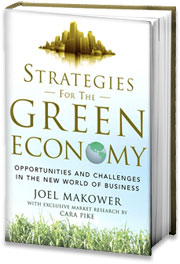
Strategies for the Green Economy, by Joel Makower.
Makower has produced a book that is, at turns, both panoramic and detailed. He navigates the reader through, around, and over a dizzying landscape of failed green marketing campaigns and business initiatives. He recounts more false starts and pileups than a NASCAR weekend in Dixie. And he does so with a practiced style that only someone with a reporter’s eye and a front-row seat can pull off.
It’s an informative, if not always breezy, reading experience. Makower has an impressive command of the major issues and key research in the field. The problem often is that he feels compelled to share all this knowledge with the reader, who is bombarded with eye-crossing green consumer classifications — “LOHAS” (Lifestyles of Health and Sustainability) Naturalists, Drifters, Radical Engagements, Cynical Pessimists, Green Hypocrites, and Dull Greens. And, of course, the author can’t resist presenting his own green market segmentations: Committed, Conflicted, Concerned, Confused and Cynical. (You bet!)
And what would a business book be without statistics?: U.S. home electricity use costs $233 billion per year; a 5 percent reduction in water would save $14 billion; 58 percent of U.S. population is “not green interested.”
And just when Makower comes perilously close to drowning the reader in jargon and numbers, he breaks free of the trade-book approach and sets course on a narrative that is enlightening and engaging.
The patient reader is rewarded with lively marketing insights from giant corporations and individual activists alike. One of my favorites: Blogger Green LA Girl.
In 2005, Starbucks boasted that it would, upon request, brew a cup of coffee made from fair-trade beans in any one of its stores in 21 countries. Green LA Girl took up the challenge and started blogging about it, and she asked her readers to go to their local Starbucks and order fair-trade coffee and report back on the experience. The blogosphere erupted with chatter and stories of unfilled or slow orders. What must have seemed like a harmless PR idea for Starbucks turned into an international incident.
Starbucks quickly recognized it could lose control of its messaging if it didn’t act quickly. Did it turn its advertising agency loose to create a clever marketing spin? No, company executives remained calm, picked up the phone, and talked directly to Green LA Girl about their objectives and promised to address any problems customers were reporting. Disaster averted.
Makower shares similar valuable experiences from Coca-Cola, Wal-Mart, and General Electric, to name just a few of the companies he writes knowingly about. He’s no fan of empty sloganeering and stresses three keys to business success: What do you know? What are you doing? And what are you saying?
There are a few mildly irritating aspects to Makower’s writing. He reflexively falls back on the literary equivalent of throwing his hands in the air and shrugging his shoulders when confronted with conflicting data or partial information. “Who knows?” “It depends,” and, my favorite, “Confused? I promised you would be,” are overused handholds and not particularly valuable.
And then there’s the question of Makower’s myriad business interests. To his credit, he discloses obvious conflicts when they arise. Case in point: When writing about Clorox’s Green Works cleaning product, he informs readers that he consulted with the company on the rollout. That’s helpful, but I would have preferred that Makower disclose all business dealings he’s had with companies mentioned in the book.
There’s no reason to expect anything untoward, and Makower is quick to condemn companies that try to cut corners. But if he’s received payment for giving a speech to General Electric executives, for example, and he writes about GE (as he does), he needs to disclose that. This easily could have been dispatched with a paragraph in the book’s forward.
Oh, and for those of you who are wondering, the book includes an environmental benefits statement. Since the publisher adhered to strict printing standards, the book saved 77 trees, reduced solid waste by 4,900 pounds, and conserved 46,000 gallons of water.
Like I said, what would a business book be without statistics?