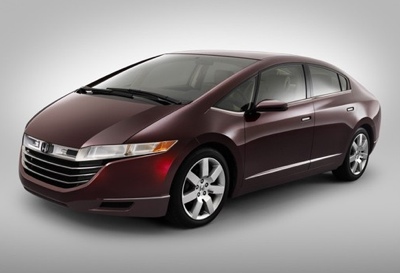
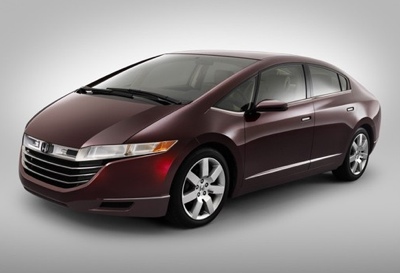
 Honda’s FCX Clarity hydrogen fuel cell car: yours for only $100,000!There are only three sure things in life — death, taxes, and you’re never going to buy a hydrogen fuel cell car. Congress should stop wasting your money pursuing Bush’s phony dream.
The fundamental problem with hydrogen as a transport fuel is one that no amount of federal R&D can solve: The absurdly expensive infrastructure will never be built.
Why would the oil companies build an infrastructure which would, at best, compete with their existing product, or, more likely, cause them to lose their entire investment? That leaves governments. But who has the kind of money needed for an infrastructure that — if built around natural gas, which currently produces 95 percent of hydrogen in this country — won’t even save significant greenhouse gases compared to the best hybrids today running on gasoline?
But a renewable-energy-based hydrogen fueling system capable of handling even half the cars and light trucks on the road would cost hundreds of billions of dollars. And it would have a cost of avoided carbon dioxide of more than $600 a metric ton, which is more than a factor of ten higher than most other strategies being considered today (see “Hydrogen fuel cell cars are a dead end from a technological, practical, and climate perspective“).
Even California — the big U.S. champion of hydrogen cars in the last decade — has all but abandoned efforts to build a major infrastructure (see “California Hydrogen Highway R.I.P.“). Thus, the absurdly expensive hydrogen cars themselves will never be more than a niche product and thus never achieve the economies of scale needed come close to being affordable.
Energy Secretary Chu wisely slashed the hydrogen budget back in May:
“We asked ourselves, ‘Is it likely in the next 10 or 15, 20 years that we will convert to a hydrogen car economy?’ The answer, we felt, was ‘no,'” Chu said in a briefing today. He cited several barriers, including infrastructure, development of long-lasting portable fuel cells and other problems.
Duh.
But now, as Jim Motavalli reports in the NYT‘s Wheels blog, Congress is putting that money back:
Congress appears close to restoring the $100 million in funding for hydrogen research that Steven Chu, the energy secretary, had cut from his budget in May.
The House of Representatives voted 320-97 last Friday to approve $26.9 billion for the Energy Department, including $153 million for hydrogen and fuel cells in the Energy Efficiency and Renewable Energy program, plus $40.45 million for hydrogen from coal.
The Senate Appropriations Committee was even more bullish on hydrogen, approving $190 million for the program. Reconciliation of the two budget figures (assuming the full Senate leaves the $190 million intact) could result in a final amount greater than the $168 million for fuel cells in the 2009 Energy Department budget.
Can anyone stop the madness?
The Bush Administration spent some $2 billion pushing the hydrogen fuel-cell car dream. Global car makers probably matched that.
Yet, the most advanced vehicle on the road, Honda’s new FCX Clarity, which the company optimistically calls “the world’s first hydrogen-powered fuel-cell vehicle intended for mass production” costs “several hundred thousand dollars each to produce,” although Honda’s president Takeo Fukui “said that should drop below $100,000 in less than a decade as production volumes increase” (see “The Last Car You Would Ever Buy – Literally“).
But how will production volumes increase if the cars are unaffordable and there’s no place to fuel them?!?
No wonder Dan Neil, the L.A. Times car guy, wrote “Honda’s striking, amazing hydrogen fuel-cell vehicle may be the most expensive, advanced and impractical car ever built” (see L.A. Times: “Hydrogen fuel-cell technology won’t work in cars.” Duh.).
Hydrogen advocate Greg Blencoe — who constantly disputes my analysis and who will owe me $1000 in a few years (see “The big hydrogen bet – your chance to get in on the action“) — brags on his website that the negative reaction people have to the true statement, “Large-scale hydrogen fueling stations cost $5 million each” becomes “much more positive” once they learn it means “Large-scale hydrogen fueling stations would cost $2500 per hydrogen car.”
Makes me feel warm and fuzzy inside — especially when you consider that we have a mere 200 million cars and light trucks on the road. But in fact, that “low” cost per H2 car requires the people who put up the money for those stations to assume a high level of vehicle penetration when they build it, which would be a staggering risk for them to take. That’s why most vehicle stations are much smaller (though still wildly underutilized), and much more expensive per vehicle.
Indeed, UCLA bragged in April that it is spending $2.1 million (42% of $5 million) on a fueling station with 14% (!) of the hydrogen output (see “One more reason you’ll be driving electric vehicles and plugs in soon – not hydrogen fuel cell cars“) — so it will have a per vehicle cost of $7500. And it makes hydrogen from natural gas. Are you much more positive yet?
This whole notion is so absurd that even former independent advocates of the idea now openly mock it. I’m going to reprint one from a year ago (see“The car of the perpetual future” – The Economist agrees with Climate Progress on hydrogen).
When the world’s uber-centrist magazine of choice runs a headline almost identical to mine (see “The Last Car You Would Ever Buy – Literally“), you know it’s all over. Especially when one of that magazine’s leading energy columnists, Vijay Vaitheeswaran, used to sing that technology’s praises (here). Here’s the bottom line:
Here’s the fatal flaw in the H2 economy:
…the logistical, technological and economic problems facing hydrogen fuel-cell cars mean that they are very unlikely to make it to market any time soon. One thing holding back hydrogen vehicles is a chicken-and-egg problem: why build cars if there is nowhere to fill them up, or hydrogen filling-stations if there are no cars to use them? Just around the corner, honest.
But wait, here’s another fatal flaw in the H2 economy:
How much more investment is needed to make mass-produced hydrogen cars a reality? According to a recent study by Oak Ridge National Laboratory, sponsored by America’s Department of Energy (DoE), public funding of $10 billion would be required to get 2m hydrogen fuel-cell cars onto America’s roads by 2025, rising to $45 billion for 10m cars. A report issued by America’s National Academy of Sciences in July was less optimistic, estimating that $55 billion of government investment would be needed to put just 2m hydrogen cars on the road by 2023. And both reports assume that the technology will get a lot cheaper: the Oak Ridge study assumes it will be possible to make fuel-cell vehicle systems in quantity at a cost of $45 per kilowatt of output by 2010, and $30 per kilowatt by 2015.
This is ambitious. Although fuel-cell costs have dropped by 65% since 2002, according to the CaFCP, today’s fuel cells cost around $107 per kilowatt. Are sudden cost reductions around the corner? Not according to one of the pioneers of fuel-cell technology, Ballard Power Systems, a Canadian supplier of fuel-cell systems to a range of carmakers. In November 2007 it sold its automotive fuel-cell division to Ford and Daimler after a decade of losses, citing the “realities of the high cost and long timeline for automotive fuel-cell commercialisation” for its exit from the business.
Actually, the CaFCP’s cost claim is laughable. You can’t buy a warranteeable fuel cell for a car for $107 per kw today. Try more than 10 times that, over $1000/kw. The CaFCP number is a projection based on the assumption of mass production, hundreds of thousands of units a year, with no explanation of how you’re ever going to get to those sales levels for cars whose best current generation models cost hundreds of thousands of dollars apiece.
As I wrote in Technology Review, one of the only car companies in the world still seriously pushing hydrogen cars, Honda, hopes that in a decade or so, production volume would drop the car cost to “below $100,000.” As if that price would make it attractive to anybody but the super-rich. But in any case, why would production volumes increase for a car that delivers no real value to the consumer and has no significant societal benefit to motivate government support? Answer: They wouldn’t, so prices may never drop below $100,000. That’s why Ballard left the business.
Hydrogen cars have no future, or, as The Economist‘s headline puts it, hydrogen cars, like fusion energy, have the same future they always had.
And here’s another bunch of fatal flaws:
Even if the network of hydrogen filling-stations can be built, and the technological advances needed to reduce the cost of fuel-cell vehicles can be made, a huge problem still remains: the production and delivery of hydrogen in large quantities. The Oak Ridge study says the two most promising ways to produce hydrogen cheaply in the near term are to make it from natural gas (through a process called “steam reforming”) at the filling stations themselves, or to make it from gas derived from biomass or coal at large, centralised plants, and then deliver it by lorry or pipeline.
Hydrogen sceptics point out not only the large capital costs associated with the production, transportation and storage of hydrogen, but also the availability of far more viable alternatives. Hydrogen is “just about the worst possible vehicle fuel”, says Robert Zubrin, a rocket scientist and the author of Energy Victory, a book on the post-petroleum future. Even if the requisite gains in fuel-cell technology are achieved, he says, the fuel-cell cars of the future should run instead on methanol, which has a higher energy-density than hydrogen and can be stored and transported much more easily.
Furthermore, steam reformation of natural gas is far from a zero-emissions solution, undermining the whole rationale of hydrogen cars in the first place. According to America’s National Renewable Energy Laboratory, producing a kilogram of hydrogen by steam reformation generates emissions equivalent to 11.9kg of CO2. Given that the Chevy Equinox fuel-cell vehicle can travel 39 miles on a kilogram of hydrogen, and the FCX Clarity can travel 68 miles, powering these cars using hydrogen produced by steam reformation would result in emissions of 305 and 175 grams of CO2 per mile respectively. By comparison, today’s petrol-electric Toyota Prius hybrid produces tailpipe emissions of around 167 grams per mile, and many small petrol cars achieve similar results.
Seriously — how many fatal flaws does the technology need? Hydrogen cars were apparently killed in the drawing room by the knife, revolver, lead pipe, rope and candlestick.
The magazine includes as an afterthought yet another major fatal flaw, one that I have written a lot about. Some say “the solution to large-scale hydrogen production lies in using renewable electricity to extract hydrogen from water via electrolysis” or using “nuclear power. But it would surely be easier simply to use this energy to charge the batteries of all-electric or plug-in hybrid vehicles.” Easier, hundreds of billions of dollars cheaper, and you don’t throw away 75 percent of the valuable carbon free electricity in the process!
Some people cling to the notion that hydrogen can be reanimated like Frankenstein’s monster (see here). But the Economist article ends more realistically:
In other words, claims that hydrogen will be the automotive fuel of the future are as true today as they ever have been.
Kudos to Chu and Obama for trying to kill this monster. Jeers to Congress for flushing taxpayer money down the toilet in a weak imitation of Bush-Cheney technology strategy.
A message from
Your support keeps our climate news free. All donations DOUBLED!
Grist is the only award-winning newsroom focused on exploring equitable solutions to climate change. It’s vital reporting made entirely possible by loyal readers like you.
At Grist, we don’t believe in paywalls. Instead, we rely on our readers to pitch in what they can so that we can continue bringing you our solution-based climate news. Donate today to keep our site free. All donations DOUBLED for a limited time.