Keep It Green

To fulfill its environmental promises, biofuel policy needs a kick in the pants 18

As war simmers in the Middle East and oil prices rise along with global temperatures, Midwestern farmers and politicians aren't the only ones banging the drums for biofuels. Now big-time investors, security hawks, environmentalists, and even George W. Bush have joined their ranks. But is environmentally responsible bioenergy a real possibility, or are we bio-fooling ourselves?
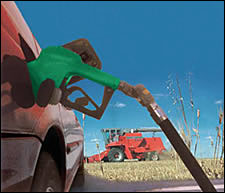
How green is your biofuel?

Photo: gov.mb.ca

The question is key, because current U.S. public policy is pushing biofuel production without giving much evident thought to sustainability. If present trends continue, the public could find itself funding environmentally ruinous projects in the name of "green" energy. Here's a strategy for avoiding that outcome.

Ready or Not, Here It Comes

Globally, biofuel production is booming. Since 2000, world fuel-ethanol production has more than doubled, and biodiesel production has expanded nearly fourfold, albeit from a much smaller base. In comparison, world oil production increased by only 7 percent in the same time period.

Recently adopted mandatory biofuel requirements in the United States and the European Union are increasing biofuels' domestic production and creating markets for imports. The developing world is pursuing biofuel production to offset oil imports, drive rural development, and earn foreign exchange through exports.

To understand the impact of oil imports on the developing world, look at some of Africa's poorest countries, where the recent increase in oil prices has all but wiped out their hard-won debt relief. Growing fuel at home rather than buying oil abroad means poor countries have more resources for development needs like health care and education.

With high oil prices and the perceived development opportunities, the incredible amount of political and financial momentum behind biofuels is not surprising. And as usual, environmental considerations, which don't fit easily into a system measured solely in barrels and bucks, struggle to find relevance in a rapidly expanding industry.

But without asking the hard "environmental" questions -- regarding greenhouse-gas reduction, soil conservation, biodiversity protection, etc. -- there is no chance of developing sustainable bioenergy.

Putting the Biofueled Cart Before the Horse

Historically, environmental action has been reactive, responding to crises already well underway. Bioenergy presents a unique opportunity to proactively guide a growing industry into the most sustainable practices.

For example, the U.S. ethanol industry is experimenting with new plant designs in response to higher natural-gas prices, the fuel's traditional power source. Some new plants are being built to burn coal, undermining claims of the environmental benefits of ethanol by creating more, not less, air pollution. But other innovators are figuring out how to reduce or replace their natural-gas needs in ways that improve the energy and greenhouse-gas balance of their ethanol product. Still others are designing their plants to utilize both corn starch and cellulose as feedstock. If biofuels are truly going to be part of a clean energy future, policy makers need to encourage these innovators and discourage regressive practices.

But from where I sit in Washington, D.C., the biofuels discussion is pretty simplistic: Either you're for 'em or you're against 'em. Although there are plenty in the biofuels camp who want to see new ways of growing crops and producing ethanol that further reduce greenhouse-gas emissions and protect water and land, so far the great bulk of biofuel subsidies have pushed brute production, environmental goals be damned.

In Europe, however, the question of sustainability dominates the bioenergy debate. The Netherlands has already established sustainability criteria for all biomass, whether domestic or imported, used for bioenergy. Their sustainability evaluation [PDF] includes greenhouse-gas balance, farming practices, biodiversity, and the economic and social well-being of the farming communities. Germany and other European countries are considering similar requirements.

The global dialogue on sustainable bioenergy is also beginning. The International Energy Agency has established a task force to help foster sustainable bioenergy trade, and representatives of eight European countries, Canada, and Brazil are participating in its activities. This past October in Bonn, the German NGO Forum and the U.N. Foundation sponsored a conference that brought together a wide range of government, industry, and NGO representatives from around the world to discuss the challenges and opportunities of sustainable bioenergy. The concern over destruction of tropical rainforests for palm oil plantations linked directly and indirectly to biodiesel demand has spurred the creation of the Roundtable on Sustainable Palm Oil, which is dedicated to developing a globally acceptable definition of sustainable palm oil and helping implement these practices.

The United States is not completely absent from the sustainability discussion and development of best practices. In response to a plan to increase electricity generation from wood waste, the Institute for Agriculture and Trade Policy and its partners facilitated the passage of a Minnesota statute requiring the development and implementation of best management practices for biomass harvesting forests and brush lands. To assess costs and environmental impacts, a variety of test harvests are now underway, which will provide crucial information on how to use biomass for energy in a sustainable way. Some parts of the industry are even tackling the issues: The Biotechnology Industry Organization recently released a report on sustainable production of biomass focused on crop residues that recommends, among other things, the development of a system to monetize greenhouse-gas credits for agricultural products and assistance for farmers to transition to no-till cropping and to better manage carbon in their soil.

Certifiably Green?

The two themes that consistently emerge from discussions of biomass sustainability are certification and linkage to carbon emissions. While not miracle cures, environmental certification programs, like the USDA organic label for food and the Forest Stewardship Council label for wood, have changed agriculture and forestry management practices and consumers' buying habits. Could such a program do the same for biofuels and other bio-products?

Possibly. Unlike food and wood, there is no real visible market for biofuels right now. In the United States, E85 (a blend of 85 percent ethanol and 15 percent gasoline) is still difficult to find outside of the Midwest. While small percentages of biofuels are increasingly blended with petroleum fuels sold across the nation, would an environmentally friendly seal for the 10 percent of the fuel that is ethanol make any sense on an ExxonMobil gas pump?

Certification does make sense as a way to enforce government standards, as in the Netherlands and Minnesota laws, or as the basis for government incentives. As the biofuel market matures and diversifies, individual consumers could support sustainable practices with their dollars.

But what will really empower a biomass certification scheme and drive bioenergy toward sustainability in the United States is integrating carbon emissions into the system. Although the recent elections have brought us closer to a national carbon cap-and-trade scheme than ever before, such a system is not imminent. In the meantime, Congress should make any new biofuel incentives performance-based, so that a farmer's success in improving her carbon balance is reflected in her bank balance.

It is time to get serious about a clean and sustainable energy future. The reauthorization of the Farm Bill next year offers an opportunity to promote biofuels in a way that maximizes environmental protection while creating new sources of revenue for farmers. To prevent biofuels from being an environmental bio-flop, we must confront their sustainability issues immediately.

Ana Unruh Cohen is the director of environmental policy at the Center for American Progress and a frequent Grist blogger.

Advertisement
Advertisement
  1. ethanoloverload Posted 8:02 am
    08 Dec 2006

    As much as I like to disagree with more ethanol...Pimental is wrong in his analysis because he does not apply it equally when he evaluates the petroleum industry.  The energy to make tankers, pipelines, drilling rigs, trucks to explore new regions for oil, clean up costs, etc. etc.  The reason you leave out the energy to make the combines, vehicles and other equipement in ethanol production because they are preexisting structures that would be utilized to produce other crops and are not single use items.  For example if a corn/bean farmer were not producing corn for ethanol he would still own all the same equipment so that he would produce soybeans and another crop such as wheat for food/feed consumption.  The energy would be used whether corn was produced or not.  I doubt the petroleum industry would stand up to the same magnifying glass of energy usage that pimental applies to the ethanol industry if the energy were tallied up to get a gallon of gas to the pumps.  
  2. Maywa Montenegro Posted 2:15 pm
    08 Dec 2006

    Pimentel ParsedI would just like to re-refer folks to an excellent ethanol analysis performed by Robert McElroy, an environmental studies professor at Harvard University (it's a chapter in an upcoming book but is available online at his faculty homepage). In this chapter, McElroy compares the assumptions of Pimentel & Patzek to those of Shapouri & McAloon (with props to an earlier study this year published by Farrell et al. at Berkeley). He disagrees with Pimentel/Patzek's high inputs for farm labor. Farmers must eat, for instance whether they are cultivating crops for corn ethanol or for cornbread, and yet P&P insist on counting farmers' caloric intake as an energy input.

       On the other hand, he sides with P&P on their criticism of the high credits many research teams assign to the co-products. Instead, he adopts the more modest "displacement method," which only gives co-products an energy savings equivalent to the most efficient conventional method of feed production.

       All told, McElroy's analysis still finds corn ethanol to be energy positive by "about 20 to 30 percent."
  3. Biodiversivist's avatar

    Biodiversivist Posted 2:18 pm
    08 Dec 2006

    Loved that interview, TomIt's telling us we're using too goddamn much fossil energy!
    Where would this world be without curmudgeons?
    Ethanolloverload,
    "I doubt the petroleum industry would stand up to the same magnifying glass of energy usage"
    Not to defend fossil fuel, but no biofuel can possibly hope to match the energy efficiency of pumping a highly energy dense liquid out of holes in the ground, cracking it into various forms and transporting it. The argument over energy used to make ethanol is moot in any case. It has enough environmental and economic negatives to bury it without that argument.
  4. Jason D Scorse's avatar

    Jason D Scorse Posted 4:55 am
    10 Dec 2006

    I love pimentel's work too...and a massive push for biofuels will have devastating environmental consequences- it is another case of a poor reasoning, the search for a quick fix, and so many layers of government subsidies that it's dizzying- let me repeat again- remove ALL NATURAL RESORUCE SUSIDIZES- price carbon, and let the market work!!!
    J.S.
  5. Delay And Deny's avatar

    Delay And Deny Posted 8:23 am
    11 Dec 2006

    Grist Gets It Right

    This guy makes sense!
  6. GreenEngineer Posted 9:30 am
    11 Dec 2006

    moot pointsThe argument about the detailed EROEI of corn ethanol is pretty much irrelevant.  Whether it's 0.8:1 or 1.5:1, it is not even close to being high enough to displace oil in any significant way.  In order to take the place of gasoline, in a functional sense, it would need to have an EROEI of at least the same order of magnitude as gasoline production, which is 10-20:1, depending on whose numbers you use.  Add in the environmental degredation of expanding monocrop corn production, and it's a clear loser for everyone who isn't ADM.
  7. millercs Posted 2:10 pm
    11 Dec 2006

    Making Biofuels WorkMy problem with Pimental is that he takes the present and says why it doesn't work rather than look at it as a challenge and say how can we make it work. Giving in to the status quo is no answer and conservation isn't enough.
    I lived in Ithaca, too, for 6 years and I understand the Luddite mentality of the place but that is no excuse for an Ag School scientist to put the skids to every attempt at progress to an industry that, up to now, has been a godsend to so many farmers.
    According to renown business and national security advocate James Woolsey switching to biofuels like cellulosic ethanol and biodiesel represent the fastest way out of the fossil fuel paradigm. Because our national security and environmental health is depending on successful deployment, how can we make it work?
    Cellulosic ethanol can be made from (negative cost) waste using syngas fermentation. Using gasification to break the lignin bonds is much more efficient than enzymatic hydrolysis Pimental talks about and uses very little water. BRI has a good description of the syngas process. It has been proven in the lab and plans for commercial-scale development should be finalized soon. It would be interesting to hear how the esteemed insect doctor from Cornell would argue the results of the work of the biotechnology chemical engineer from the U. of Arkansas.
    I lament the absence of a national conservation campaign as much as Pimental. But the campaign would have to be global to have much meaning - and Asia has too much invested in industrialization to make conservation here worth anything.
  8. jhoechst Posted 5:21 am
    21 Dec 2006

    We Are Drowning In Oil! And We Don't Know ItRecent news from the Prudhoe Bay oil fields highlights once again the United States reliance on importing oil, in this case from Alaska.  Together with insecure sources such as Iran, Venezuela, Senegal and volatile Middle Eastern countries, the imperative for a safe secure and absolutely reliable source of this commodity for our economy becomes of the highest priority.  It is long since past time for the United States to stop ignoring a homegrown solution which can provide the nation with sufficient oil to satisfy virtually all of its needs without ever importing another barrel of oil or having to waste literally hundreds of billions of dollars extracting oil from the earth. Within the boundaries of the United States we are literally and figuratively drowning in oil and don't know it.
    Each and every year the sun shines on the earth and transfers its energy to all growing things.  We humans plant and grow vegetation to feed both ourselves and the animals we husband and subsequently consume.  The result is an enormous quantity of waste, both animal and vegetable which becomes increasingly difficult to dispose of, but which is potentially a never ending source for the production of oil.
    The stated purpose of the government's search for alternative energy sources is to reduce or eliminate the need for importing oil.  Time and time again the President has stated that "technological innovation" will hopefully produce a solution to the energy "crisis".  Were it not for the obstinate refusal of the administration to recognize the existence of a currently readily available, technological innovative system, the nation could be three years down the road to real oil independence.  
    "Oil", as we all know has become a three letter dirty word in America's lexicon.  However we view it, good, bad or indifferent, oil will be with us for many years to come, for it is not untrue that America's economy is literally lubricated by oil.  Insofar as the future is concerned consider that the current population of the United States is roughly 300 million.  Demographers estimate that by 2040, the U. S. population will exceed 400 million souls.  That is a 33% increase in but 34 years.  Where in the name of all that's holy, will the necessary energy come from?  Other energy sources, hydrogen, solar, wind, nuclear and others have unique properties and will obviously fill certain energy requirements but they do not compare to the manifold uses we have found for oil   Oil will have a future for as long as we can see down the road for there is nothing else which can manifest itself in so many forms in our daily lives.  Given that oil is a necessary "evil", and given the generally accepted postulation that oil is finite, where will it come from?
    About a decade ago a patent was issued by the United States Patent Office for a process then called thermal depolymerization process (since changed for obvious reasons to thermal conversion process or (TCP) which can take any non-nuclear material containing carbon, which is anything which has ever grown, including you and me, and produce a diesel fuel quality oil in two short hours!  Additionally, the system produces a number of useful and viable byproducts and ultimately discharges potable water.  Everything emanating from this system is completely benign to the environment, and in fact, rather than creating environmental problems, resolves them.  In this scenario "waste" becomes an oxymoron.  As one small example, the city of Philadelphia is producing oil from its sewage.  The oil thus produced may be additionally refined into gasoline or other useful byproducts used to manufacture plastics, and as a feedstock is useful for many other products.  There currently exists in Carthage, MO, a pilot facility producing 500 barrels of oil per day from about 200 tons of turkey effluvia from a nearby Butterball turkey processing plant and the oil thus produced is sold as a heat producing fuel, demonstrating  the viability of the concept.  The efficiency of the TCP system runs in the range of 85%, meaning that 15% of the energy introduced is utilized to extract 85%.  These are extraordinary numbers.
        You might well ask why, if this system is so good, you have not heard of it and why it is producing a mere 500 barrels per day in this vast country with so much waste being produced.  There are good and sufficient reasons.
        First of all, as a fledgling industry, TCP encountered start up problems usually associated with any new development, and being relatively new, may still endure problems with different feedstocks.  Given time these will be overcome.  Feedstocks may vary from slaughterhouse effluvia to tires to discarded plastics, and each different feedstock requires a different processing modality, and the development of those methods takes time.
        Secondly, and more importantly, as a new industry, subsidies in the form of tax credits have not been forthcoming from the federal government to enable this industry to become established.  As an example of what is missing, ethanol, currently the darling of the energy and environmental policy wonks, has been granted subsidies (tax credits) running through 2012 resulting in a rush to construct new facilities which effectively guarantee profits. Ethanol is however a guaranteed loser in the long run, since its prohibitive cost together with less energy output than gasoline is actually counterproductive to its stated goals. (See http://www.taxpayer.net/energy/raceforsubsidies.html)   If similar support were extended to TCP, entrepreneurs would correspondingly react, and TCP plants would spring up all over the country where source material was most accessible.
      As examples of such conditions, a small town, Hereford, TX, has one of the largest stockyards in the country.  They are faced with the monumental task of disposing of some 6200 tons of manure each day.  If it can happen in Philadelphia, it can happen in Hereford.
    A recent television program was devoted to the garbage disposal problem of Los Angeles.  One of their dumps receives 2000 tons of garbage per hour to be deposited on a dump that is already deeper than the Statue of Liberty is high!
    These are but two isolated illustrations of what is happening across the entire nation in cities, towns and hamlets facing problems of disposal of their agricultural waste, industrial waste, their garbage and their sewage.   In many instances, dumps leak effluent such as PCP's and dioxin, into the groundwater contaminating it and endangering public health.  When one becomes aware of the possibilities of TCP to resolve not only the oil crisis but concomitantly also resolve environmental problems one wonders why the federal government continues to support an expensive ethanol boondoggle (scam is a better word) while ignoring a system which more quickly than any other can substantially reduce or eliminate our dependence on imported oil, which is, after all, the purported goal.  The deeper one looks onto the advantageous attending to this invention the more one uncovers.
    Following is an incomplete list of benefits to be derived from the introduction of the TCP system into our economy.  When reviewing his list, picture in your mind's eye these benefits working on behalf of the government and its citizens.

    .

    1.    All manner of cultivated agricultural waste can be processed into oil and other valuable byproducts.

    2.    Recapturable animal wastes can be processed into oil and byproducts.

    3.    Slaughterhouse waste from all animal types can be similarly processed into oil, as is currently being demonstrated by the Butterball turkey plant in Carthage, MO.

    4.    Bio-hazardous hospital waste can be safely processed for oil with the TCP system, with no hazardous output.

    5.    Bovine Spongiform Encephalitis (BSE) (mad cow disease) material may be safely processed as with all other types of animal byproducts, with no harmful output.  All prions are destroyed.

     6.  Unsightly landgrabbing garbage dumps are eliminated as all garbage is choice feedstock.

           7.   Tire dumps are eliminated because they already contain both oil and carbon.

    8.    Any community producing waste, including sewage, can produce its own oil and gas for use or sale as they see fit, therefore their waste becomes a source of income to the community.

     9.    Because the efficiency of the system is so high, (85%) the cost of production will

           drop to competitive rates when large scale production is reached.

    10.    With reduced oil costs, all industries dependent upon oil for their source material could produce and sell for less.  This could have enormous impact across  the entire spectrum of the economy.

     11.  A whole new industry would be born with consequent creation of jobs and a whole    

           new tax base and revenue source for government.

    12.    Within ten years the U. S. could be independent of foreign (read Saudi) oil.

    13.    With all oil production entirely confined within the U. S., container ships could be virtually obsolete, and thus remove future oil spills.  This has tremendous environmental impact.

    14.    Totally reliable, steady oil prices.   This could become the bedrock for a more stable economy.

    15.    The beneficial impact of this development on the environment, including possible (probable?) reduction on carbon dioxide into the atmosphere, and consequent global warning.

    16.    The creation of means to assist poorer nations to develop and sustain their own never-ending source of energy.  For each nation, large or small, which utilizes this system to create its own source of oil, the pressure on the international oil market would be diminished to the point where oil could become one of the least expensive commodities on the international market.

    17.    The elimination of international charges that the United States' efforts in the Middle East and other regions is dictated by their need for oil.

    18.    Should the President announce that the Administration is supporting this new development, OPEC could respond by immediately dropping the price of its oil to protect market share.

     19. Given a reliable never ending source of oil, the U. S. might well find the Strategic Petroleum                                         Reserve an unnecessary luxury.

    20. Since a facility may be rapidly constructed with off the shelf equipment currently employed in the

         oil refinery field, new facilities may be rapidly constructed and the ten year dream of freedom from

         imported oil becomes a reality not a pipe dream.

    21.An entire new industry will supply the Treasury with a huge new source of revenue, as will the      

         thousands of new workers employed in the field.

    22. Manufacturing oil within the U. S. will deny Iran, Saudi Arabia and other middle eastern oil rich  

          countries the petro dollars they use to support anti-American terrorist groups    

    23. Last, but far from least, the reduction of oil imports will have an enormous effect on reducing the    

         trade deficit.
    Further information concerning the process may be found at: http://www.discover.com/issues/may-03/features/featoil/

                     And

    http://www.discover.com/issues/apr-06/features/anything-oil

                    And at

    CWT's web site at Changing World Technologies, Inc.and from Renewable Environmental Solutions (RES).        
    http://www.news.cornell.edu/stories/July05/ethanol.toocos...                                                                                                                                                                                                                                                                  
        Public ignorance of this remarkable development is an overriding reason why Congress and the administration give it such short shrift.  Most assuredly if the general public knew of this system and the potential it contains to alleviate the reliance on imported oil and the resultant ultimate reduction in the price of all things dependent on oil, there would develop a huge hue and cry for the government to get off its duff and support this concept.  Without the dissemination of that knowledge, the country will continue to rely on unreliable, insecure sources resulting in ever escalating oil prices.  
        If, after reviewing the above sources you are convinced that this system is worthy of implementation into our economy, pass the word to friends, family, colleagues, whomever, to join with us in not only spreading the word, but inundating Congress with the requirement that if they wish you to vote for them, they must support this invention.  As Jack Kennedy once so famously said, "Ask not what your country can do for you.  Ask what you can do for your country."
       ADDENDUM
        With the current cessation of hostilities in Lebanon, Hezbollah has reclaimed the streets of Behrut and proclaimed victory.  They have informed the public not to accept aid for rebuilding from any organization but Hezbollah.  Given the hundreds of millions if not billions of dollars required for such an effort, where does the money come from if not from Iran?  And where does Iran get its riches?  From oil!

    It requires no great leap of imagination to recognize that if petro dollars were denied Iran, their enormous expenditures for terrorist support and nuclear experimentation would require some rethinking of their priorities.  The rapid development of this system into our economy is one type of "sanction", if one wishes to call it that, which can be benign, peaceful, far reaching and very effective.
        The announcement by the United States government that one of their highest priorities would be the rapid implementation of the TCP system into our economy, would have not only national, but global  significance as well..
                                        J. W. Hoechst

  9. Feiner Posted 4:45 am
    06 Feb 2007

    Shattering the 'Royal Deception'As one of the "well-intentioned" or not so "well-intentioned commentators" piling on the scorn, you decide which, here is yet another steaming shovel-full.
    Though the crux of Morris' well-intentioned piece is to celebrate the viability of an autonomous biofuel industry free from the serfdom of corporate globalization, as he points out, you may in fact be able to get there from here, but where exactly do you think you are going, and is there anyway to come back home?
    An initiative based on government subsidies will get us nowhere fast. Off the top of my head, keep it much more local at the start if that is where you want to end up. State initiatives that fund locally owned production and distribution facilities from coffers filled by conservation and reduction efforts across the state cutting financial inputs into the energy grid as it operates currently. Citizens that want to see the potential benefit of a local, directly democratic biofuel 'industry,' will have to rise to the occasion, cutting need and overall use thus generating excess state and local funds to then 'subsidize' state and local alternative energy projects.
    The last thing we need is the feds pulling more money out of health care and such for research and development into biotechfuels and deforestation, padding the same dirty lobbyist and industry accounts already getting rich in the agribusiness, biotech and energy sectors.
    Please read my recent article, "Shattering the 'Royal Decption,' online at http://www.gefreemaine.org/article.php?story=200609261613 ... or in print in the January 2007 issue of Acres USA magazine, for more well-intentioned grease lightning.

  10. kgpc Posted 7:20 pm
    30 May 2007

    Bioenergyfor daily updated news on bioenergy, ethanol and climate issues, please visit:

    http://www.ethanol-news.de
  11. peter lauce Posted 1:17 pm
    30 Jul 2007

    GoodGood reply!
  12. bailsout Posted 3:58 am
    20 Aug 2007

    dying of pollutionGood news! At last the symptoms- pollution- are taking care of the problem-OVERPOPULATION.
  13. vismart Posted 12:21 am
    05 Jun 2008

    Loved that interview.I doubt the petroleum industry would stand up to the same magnifying glass of energy usage.
    減肥, 成立公司, 鋼琴搬運, 搬屋公司, 運輸公司, 物流公司

  14. roywatson Posted 3:46 pm
    06 Sep 2008

    Oil Industry MythTwenty-five year ago, America and the rest of the world could have solved its gasoline problem once and for all. But PBS and Chevron had other ideas. A multi-trillion dollar fraud that hooked the modern world on gasoline and methodically buried all evidence that a better, safer, cheaper, LOCALLY made fuel exists to power our cars - and has since the 19th century.  Check out how the  oil industry continues to censor the science of alcohol as fuel: http://www.brasschecktv.com/page/422.html
  15. roywatson Posted 4:01 pm
    06 Sep 2008

    Science for saleThere are a few lessons to take away from this. First, there are scientists who are for sale to the highest bidder. They will say whatever their corporate paymasters tell them to say, valid or not. Second, the news media rarely questions bogus science when it comes from corporations and corporate-funded "institutes" and usually reports it as true. Third, the oil industry "science" that claims alcohol is an inefficient energy source is not only false, it's phenomenally false. Fourth, growing plants to make fuel (as opposed to getting fuel from mining petroleum), takes more carbon dioxide out the air than alcohol fuel produces. Fifth, "survival of the fittest" is not only a moral fraud, it has no basis in the science of biology.

     
    Well conceived alcohol plants generate exponentially more energy than the non-renewable inputs required to operate them. What doesn't make sense is running alcohol plants with natural gas or coal...operating these plants on a massive, centralized scale...and turning the ethanol over the the oil companies to mix with gasoline. It's interesting that this is how they are being run now. It's almost as if they are being set up to fail spectacularly - and very publicly.


    Alcohol for fuel can be produced locally and in a de-centralized way, very close to the fields where the crop inputs are grown, and distributed gasoline-style at local pumps. A system like this is massively efficient and sustainable, cuts the oil companies out the picture completely, and will substantially strengthen the farming economy in the US and in any other nation that converts to alcohol as fuel. You can see why oil companies and their allies who prefer centralized control (and with it the ability to turn energy on and off and raise prices at will) don't want you to know these basic facts.


    Read David Blume-Author Alcohol Can Be A Gas: http://www.permaculture.com/  


    Featured on a series of videos at:

    http://www.brasschecktv.com/page/422.html

Add a Comment

You are not logged in. Thus, you cannot post a comment. If you have an account, log in. If you don't have an account, well, by all means go make one! Meet you back here in five.

Hello, Visitor!    Why not register?

Series Intro
A Grist special series on biofuels 28
How the world got addicted to oil, and where biofuels will take us 28
A lighthearted look at biofuels through time 28
The numbers behind ethanol, cellulosic ethanol, and biodiesel in the U.S. 28
All the resources you need to hop on the biofuels bandwagon 5
Find out which cars can run on ethanol and biodiesel 13
A look at the impacts of biofuels production, in the U.S. and the world 13
The what, where, and why of E85 ethanol 5
How cash and corporate pressure pushed ethanol to the fore 5
Using grease and other goodies, small biodiesel producers are making a big difference 3
An interview with Seattle biodiesel distributor Dan Freeman 3
Richard Branson chats about embracing ethanol and slashing airplane emissions 6
A handy biofuels glossary, and videos to boot 5
An interview with David Pimentel 18
Three perspectives on the biofuels debate 18
Silicon Valley investor Vinod Khosla chats about the promise of ethanol 12
To fulfill its environmental promises, biofuel policy needs a kick in the pants 18
Toward a community-owned, decentralized biofuel future 18
An interview with Greasecar founder Justin Carven 12
An environmental-justice advocate responds to the biofuels boom 12
Not quite, but cellulosic ethanol may be coming sooner than you think 12
Grains become fuel at the world's first cellulosic ethanol demo plant 2
Biofuel pioneer Lee Lynd points the way toward a "carbohydrate economy" 2
An interview with Missouri farmer and ethanol co-op member Brian Miles 3
Check out the latest entries in the celeb-biofuels biz 3
It's time for a real "food vs. fuel" debate 3
As its neighbors back biofuels, Central America gears up for business 0
A biodiesel entrepreneur in Argentina spreads seeds of wisdom 5
What Brazil can teach the U.S. about energy and ethanol 5
The strangest biofuel sources you've never heard of 5
The top 10 reasons to give a hoot about biofuels 6
How a grassroots biodiesel group can show the way for others 6
An interview with Mary Beth Stanek, General Motors energy director 6
What we've learned from the biofuels series 6
Advertisement