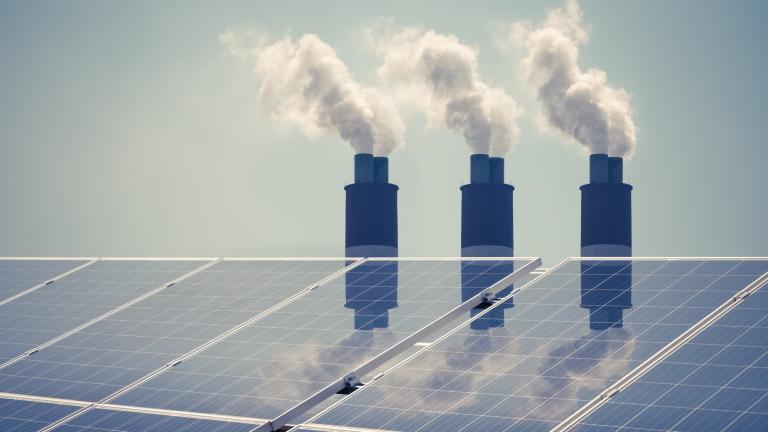
Energy analyst Richard Heinberg is working on a book about coal, tentatively titled Coal's Future/Earth's Fate, to be published by Post Carbon Press in spring 2009. It's sure to be vital reading for anyone interested in tracking, understanding, and battling the enemy of the human race.
Happily, Heinberg is publishing working drafts of various parts of the book on his website. A few months ago he ran the introduction: "The Great Coal Rush (and Why It Will Fail)." This week, he's got another great one up: "Coal in the United States." It's about coal reserve estimates and how they've been revised downward over time.
While the total quantity of coal produced continues to rise, the amount of energy it feeds into the economy peaked in 1998. That's because the quality of U.S. coal has been declining for a while, as we burn through the good stuff (anthracite and bituminous) and get into the softer, dirtier stuff (sub-bituminous and lignite).
It now appears fairly clear that, depending on whose estimates you believe, production of U.S. coal will peak some time in the next several decades. And if we turn to coal for liquid fuel, or require carbon capture and sequestration (which reduces conversion efficiency), that peak could come much sooner.
What's it all mean? Here's Heinberg's conclusion:
It may be tempting to think of coal as a transitional energy source for the next few decades, while a longer-term energy strategy emerges. But in that case, an important question arises: Will there be sufficient investment capital and technical resources in three or four decades to fund the transition to the next energy source, whatever it may be? By that time (assuming EIA projections are reasonably accurate), demand for energy will be higher. The price of oil, gas, and coal will be higher -- perhaps much higher -- and so the nation will be spending proportionally much more of its GDP on energy than it does now. Meanwhile, the energy cost of building new infrastructure of any kind will be higher. Therefore it is likely that insufficient investment capital will be available for the large number of new energy projects required. The transition if deferred will thus be more expensive and difficult than it would be now. Indeed, the longer a transition to an ultimate (and sustainable) energy regime is put off, the harder that transition becomes.
Coal currently looks like a solution to many of America's fast-growing energy problems. However, this is a solution that, if applied on a broad scale, seems certain only to exacerbate the nation's energy dilemma in the long run, as well as contributing to an impending global climate catastrophe.
The piece is also reprinted on The Oil Drum, where the comment thread is characteristically educational.
I'll keep you posted on Heinberg's book.
Comments
View as Threaded
Biodiversivist Posted 1:42 am
30 May 2008
It may be tempting to think of coal as a transitional energy source for the next few decades...
In the end, it all comes down to biodiversity. Poison Darts--Protecting the biodiversity of our world
Permalink
Sean Casten Posted 1:55 am
30 May 2008
the nation will be spending proportionally much more of its GDP on energy than it does now. Meanwhile, the energy cost of building new infrastructure of any kind will be higher. Therefore it is likely that insufficient investment capital will be available for the large number of new energy projects required.
That strikes me as an awfully naive view of capital markets, only true if (a) total capital available for investment is fixed; (b) total capital available for investment in energy assets are fixed and/or (c) total capital available for investment in energy assets is unresponsive to the price of energy.
None of those are true. There are good reasons why the coal as a transition fuel argument is bogus, but this isn't one of them.
Permalink
amazingdrx Posted 2:01 am
30 May 2008
But not boost energy prices quickly enough to make alternative energy sources cost competitive.
It's easier to understand the diversion strategery of "clean" coal and "clean" gas guzzling in this light. They want their earnings to increase every quarter, forever.
Beat the competition and that is possible? Beat them anyway you can. "Winning is not the main thing in life, it is the only thing."
If renewable energy and conservation actually reduce energy prices? It's 66 cents per gallon to replace gasoline/ethanol with electricity in a plugin hybrid, and wind power is surpassing every other source in terms of low cost grid power.
Maybe then the ever rising price strategery would backfire on the old energy economy barons. Low cost distributed power to counter their oil wars and MTR and tar sand cookery. Solar panels on your roof charging your plugin vehicle, hybrid car or bikes. Or powering electric mass transit through the grid.
http://amazngdrx.blogharbor.com/blog
Permalink
Jon Rynn Posted 2:13 am
30 May 2008
By the way, when my family was in Norfolk VA recently, we discovered that Newport News Virginia is the country's largest coal exporting port, it's where the high-quality coal goes from West Virginia, etc., all over the world.
Permalink
Delay And Deny Posted 3:14 am
30 May 2008
You talk about diversity -- how about energy diversity. You only want an energy bi-culture: wind and solar.
Maybe coal can be clean. Maybe it should be 10 percent of energy along with nukes, solar, wind, gas.
Let's have energy diversity!
Oil Is So Hot!
http://oilismastery.blogspot.com
Permalink
KenG Posted 3:38 am
30 May 2008
Permalink
Paul Hunt Posted 6:07 am
30 May 2008
Permalink