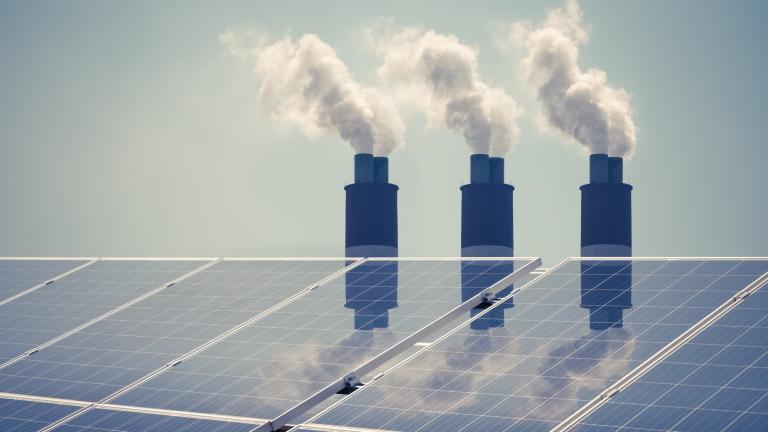
An extensive Christian Science Monitor analysis reveals that "nations will add enough coal-fired capacity in the next five years to create an extra 1.2 billion tons of CO2 per year."
In all, at least 37 nations plan to add coal-fired capacity in the next five years -- up from the 26 nations that added capacity during the past five years. With Sri Lanka, Laos, and even oil-producing nations like Iran getting set to join the coal-power pack, the world faces the prospect five years from now of having 7,474 coal-fired power plants in 79 countries pumping out 9 billion tons of CO2 emissions annually -- out of 31 billion tons from all sources in 2012.
We are screwed, yes?
A glimmer of hope, supposedly:
But the cliff can be avoided, some researchers say, without having to reduce the world's energy consumption.
If carbon dioxide gas could be captured at power plants and then pumped underground and permanently "sequestered" in layers of rock, then coal might continue to be used without damaging the climate, concluded a major report by the Massachusetts Institute of Technology released last week.
Here's the thing, though: coal gasification and sequestration (CCS) projects involve enormous, incredibly expensive centralized generation plants with unproven technology. I suspect that no reasonable, politically possible price on carbon (via tax or cap-and-trade) will be high enough to make CCS economically viable. No company will build these plants unless they are forced to do so by their respective governments. That, in essence, is what Al Gore proposed -- ban dirty coal plants, thereby forcing coal companies' hands.
What are the chances that all the relevant national governments are going to force their coal industries to do this, especially since the more governments do it, the more competitive advantage any given country can get by not doing it? Color me skeptical.
Ultimately, the only thing that will save us is an alternative to dirty coal that's -- given some modest price on carbon -- cheaper and easier than dirty coal. With the proper technological and regulatory tweaks, I believe R&E (distributed renewable generation coupled with efficiency and conservation) is that alternative.
I also believe that if it's not, we're f**ked. Full stop.
Comments
View as Threaded
GreenEngineer Posted 3:33 am
26 Mar 2007
I also believe that if it's not, we're f**ked. Full stop.
What the wonk said...
Permalink
sunflower Posted 4:16 am
26 Mar 2007
One-third of the heat is converted to power so the coal boiler costs $0.58/W(t) {thermal energy}. The capacity factor {percentage of maximum boiler plate actually used per year} is about 80% for coal power.
A high temperature solar system costs $100/m2, 680 W(t)/m2, $0.15/W(t), capacity factor is about 26% for sunny areas.
Triple solar deployment to equal coal's capacity factor and the numbers become $0.45/W(t) solar collector v. $0.58/W(t) coal boiler.
All that remains is the comparison of the cost of sunshine verses the cost of buying and burning coal (plus externalities such as the destruction of civilization).
Bottom line is that high quality solar energy is cheaper than coal in the US, China, India,...
Are we spitting into the wind? Yes. There is the factor of old lazy routines. Coal must be irreparably broken before the analysis of alternatives will carry any currency with institutional investors.
Permalink
Laurence Aurbach Posted 4:27 am
26 Mar 2007
Given the vast scope of the coal industry, progress on this front seems half-hearted and very slow. The industry is based on digging up stuff, shipping it to a furnace, and burning it. To date, environmental controls consist of bolting a filter onto the smokestack (a simplification, but correct from the plant manager's point of view).
Unfortunately, carbon capture is probably beyond the institutional capacity of the coal industry. Assuming there is any progress, it will be a constant battle and with constant pressure -- political, financial, administrative -- to cheat and backslide. The folks who are truly interested in clean energy are not, by and large, devoting their efforts to coal.
Even with 90% carbon capture, coal plants will emit more than renewable sources. (Renewables have emissions during the fabrication and construction phases.) Let's see some real analysis by engineers and economists. Right now, the national debate is hugely biased. As Kelpie Wilson points out,
"While the EPRI study [favoring nuclear and coal] was covered in the New York Times and elsewhere, the ASES study [favoring renewables] was covered by only two news organizations, The Daily Camera out of Boulder, Colorado, and Truthout."
Permalink
GRLCowan Posted 7:35 am
26 Mar 2007
The CO2 affinity of the mineral serpentinite turns out to be enough to do this concentration. It might be dug up and pulverized on a 100-GW scale and thrown onto the wind. Long plumes of suspended dust turning from MgSiO3 into MgCO3 and SiO2 seem like something that the Earth might have places for where they would be fairly harmless; or otherwise said, if those plumes, judiciously sited, would be worse than AGW, then AGW must not be very bad.
The economy-of-scale advantages of centralized capture on a much larger scale than one coal-burner would be able to do with its own flue gas may more than compensate. Also, the rich countries can do in a spirit of making sure their end of the lifeboat doesn't sink, even if it means the poor countries at the other end of the boat get a free ride.
Anything cheaper and easier than dirty coal will have a rough ride from the fossil fuel interests, especially the fossil fuel tax interests; that is one sign that nuclear is the real deal, and is opposed only by fossil fuel interests.
--- G. R. L. Cowan, former hydrogen-energy fan
Oxygen expands around boron fire, car goes
Permalink
Nucbuddy Posted 8:04 am
26 Mar 2007
[...]
Bottom line is that high quality solar energy is cheaper than coal in the US, China, India,....
world-nuclear.org/info/inf10.html
A solar thermal power plant has a system of mirrors to concentrate the sunlight on to an absorber, the energy then being used to drive turbines. The concentrator is usually a parabolic mirror trough oriented north-south, which tracks the sun's path through the day. The absorber is located at the focal point and converts the solar radiation to heat (about 400oC) which is transferred into a fluid such as synthetic oil. The fluid drives a conventional turbine and generator. Several such installations in modules of 80 MW are now operating. Each module requires about 50 hectares of land and needs very precise engineering and control. These plants are supplemented by a gas-fired boiler which generates about a quarter of the overall power output and keeps them warm overnight. Over 350 MWe capacity worldwide has supplied about 80% of the total solar electricity so far. Power costs are two to three times that of conventional sources..
Permalink
Nucbuddy Posted 8:40 am
26 Mar 2007
...Or half the heat is converted to power, depending upon how hot the coolant water is.
worldcoal.org/pages/content/index.asp?PageID=421
Supercritical (SC) and ultra-supercritical (USC) power plants operate at temperatures and pressures above the critical point*. This results in higher efficiencies - up to 46% for supercritical and 50% for ultra-supercritical.
Permalink
Laurence Aurbach Posted 9:13 am
26 Mar 2007
The figure and table below highlight these results, with initial electricity costs in the range of 10 to 12.6 ¢/kWh and eventually achieving costs in the range of 3.5 to 6.2 ¢/kWh.
The cost reductions will come from volume production, plant scale-up, and technology advances (such as the Schott receiver, which is already in mass production).
Natural gas assist may or may not be employed with solar thermal. It is not required and solar thermal plants can function well with 100% solar input.
Permalink
Zarkov Posted 10:34 am
26 Mar 2007
NO !..........New coal plants will help to save us
>> we're f**ked. Full stop >>
well y'all maybe, but some of us are wise and don't live in the Northern hemisphere.
Coal should be your friend until new no-footprint energy technology is brought on line.
Oil is the enemy,,,, YES!
LOL, no?
luv ya car too much ?
can't see the exhaust for the bumpers ?
Can't live on the sea but got a pool ?
so business as usual OK.
omegafour.com
Permalink