A week or so back, climate scientist James Hansen passed this essay along to a few folks. It's about the need to rein in coal, and the puzzling lack of involvement from young people on the issue. I thought I'd pass it along.
-----
Scientific data reveal that the Earth is close to dangerous climate change, to tipping points that could produce irreversible effects. Global warming of 0.6°C in the past 30 years has brought the Earth's temperature back to about the peak level of the Holocene -- the current period of climate stability, now of nearly 12,000 year duration -- and more warming is "in the pipeline" due to human-made greenhouse gases already in the air. The Earth's history tells us that the world is approaching a dangerous level of greenhouse gases, a level that would produce accelerating sea level rise, extermination of many animal and plant species, and intensification of regional climate extremes, including floods, storms, droughts and forest fires. It is urgent to slow emissions, as another decade of increasing emissions would practically guarantee elimination of Arctic sea ice, accelerating disintegration of the West Antarctic ice sheet, and regional climate deterioration during coming decades.
The most important time-critical action needed to avert climate disasters concerns coal. Consider:
- one-quarter of fossil fuel CO2 emission remains in the air for more than 500 years,
- conventional oil and gas reserves are sufficient to take atmospheric CO2 at least to the vicinity of the "dangerous" level, and it is impractical to capture their CO2 emission as it is mostly from small sources (vehicles),
- coal reserves are far greater than oil and gas reserves, and most coal use is at power plants, where it is feasible to capture and permanently sequester the CO2 underground (CCS = carbon capture and sequestration).
Clear implication: the only practical way to keep CO2 below or close to the “dangerous level” is to phase out coal use during the next few decades, except where CO2 is captured and sequestered.
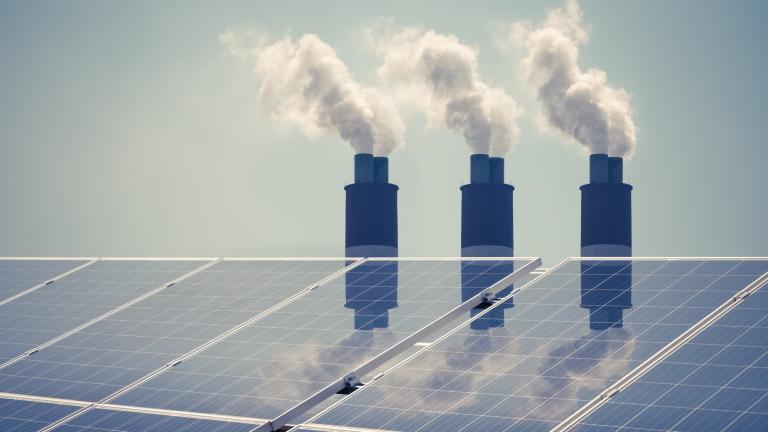
The resulting imperative is an immediate moratorium on additional coal-fired power plants without CCS. A surge in global coal use in the last few years has converted a potential slowdown of CO2 emissions into a more rapid increase. But the main reason for the proposed moratorium is that a CO2 molecule from coal, in effect, is more damaging than a CO2 molecule from oil. CO2 in readily available oil almost surely will end up in the atmosphere -- it is only a question of when, and when does not matter much, given its long lifetime. CO2 in coal does not need to be released to the atmosphere, but if it is, it cannot be recovered and will make disastrous climate change a near certainty.
The moratorium must begin in the West, which is responsible for three-quarters of climate change (via 75% of the present atmospheric CO2 excess, above the pre-industrial level), despite large present CO2 emissions in developing countries. The moratorium must extend to developing countries within a decade, but that will not happen unless developed countries fulfill their moral obligation to lead this moratorium. If Britain should initiate this moratorium, there is a strong possibility of positive feedback, a domino effect, with Germany, Europe, and the United States following, and then, probably with technical assistance, developing countries.
A spreading moratorium on construction of dirty (no CCS) coal plants is the sine qua non for stabilizing climate and preserving creation. It would need to be followed by phase-out of existing dirty coal plants in the next few decades, but would that be so difficult? Consider the other benefits: cleanup of local pollution, conditions in China and India now that greatly damage human health and agriculture, and present global export of pollution, including mercury that is accumulating in fish stock throughout the ocean.
There are long lists of things that people can do to help mitigate climate change. But for reasons quantified in my most recent publication, a moratorium on coal-fired power plants without CCS is by far the most important action that needs to be pursued. It should be the rallying issue for young people. The future of the planet in their lifetime is at stake. This is not an issue for only Bangladesh and the island nations, but for all humanity and other life on the planet. It seems to me that young people, especially, should be doing whatever is necessary to block construction of dirty (no CCS) coal-fired power plants. No doubt our poor communication of the matter deserves much of the blame. Suggestions for how to improve that communication are needed.
Comments
View as Threaded
JMG Posted 7:49 am
12 Jul 2007
(Meet my cat, Peeve.)
Save the world: Reduce greenhouse gas emissions 5% annually.
Permalink
katwink Posted 8:48 am
12 Jul 2007
Without serious, immediate changes in energy consumption - well, you all know the potential consequences.
I'm grateful James Hanson persists in broadcasting the science and its implications.
Permalink
SustainableGreen Posted 9:08 am
12 Jul 2007
Yes, this is not a "birth" issue but a "death" issue. Coal is highly destructive TO START WITH, ignoring CO2 as an end product. Huge production subsidies, externalized costs of all kinds: pollution, health, loss of habitat, goddam stinking mountain top removal, all STILL STRONGLY indicate what the title states, but which is then ignored.
COAL is the ENEMY of the PEOPLE. Sequestration is an attempt at dragging out Big Coal's hold on energy. 'Clean Coal' is pure marketing PR bullshit hype. Hire people in the Coal Belt to assemble PV panels and wind turbines.
NO COAL. WE must do better. We must go further.
David
Sustainability For Life
Messages done with sustainable energy, with Wind and Sun!
Permalink
GreyFlcn Posted 11:12 am
12 Jul 2007
Yearly, and Decadaly.
Permalink
Kelly Posted 4:38 am
13 Jul 2007
1. There are young people, some of them very young, who do care about global warming and are trying to take action. Here's a link to a picture of one.
http://kdfuller.blogspot.com/2007/04/global-warming-day-o ...
I've found it helpful to acknowledge them so they don't feel ignored when older people talk about trying to get more young people to take action.
No one likes being told what their rallying issue should be. People like to figure that out for themselves. They respond better if you tell them that you want to give them information about something that is a threat to them. Most people need time before becoming activists, and there is no getting around that, no matter the urgency of the cause.
Use the narrow focus most people have to the advantage of the cause. I think it would be more effective to state the threat in local terms, not just planetary terms. A lot more people care about what will happen to specific places they love in their own area and their ability to buy themselves and their future children food than about the planet in general.
Granted, that's difficult for generalists such as Hansen, but others working with him could go that route.
Permalink
norsk Posted 10:03 am
13 Jul 2007
I put up my own money and built my own solar generator and now produce 25% of my electric needs. In time I will produce more, but it still takes a lot of oil and coal to build those solar panels I need to buy.
Who will cut their OWN power consumption of coal fed electricity right now to help stop the burning of coal?
I don't see many hands
Permalink
SustainableGreen Posted 10:42 am
13 Jul 2007
Hey, Norsk: I applaud your solar generator. It has been pointed out in other threads that we need to brag when we have done good, like I gotta be told, as I am one who lives off-grid with Wind and Sun for electricity and sun for water heat. Combined, ~98% of my home energy needs are sustainably produced.
I have never, nor will I do so now, say that this is the solution for all. But millions can purchase PV panels and have them installed, plus solar domestic water heat is also and easy step. In fact, domestic solar water heat is maybe one of the most cost effective. Water heat not coal? Odds are high it still isn't sustainable, anyway.
Many states have incentives, there are federal tax rebates, and utilities have policies for sustainables.
If this is not practical, look for a utility provider who certifies availability of sustainable energy. Shop around.
You do bring up the single best thing each of us can do: direct individual action to change our lifestyles. Very good.
David
Sustainability For Life
Messages done with sustainable energy, with Wind and Sun!
Permalink