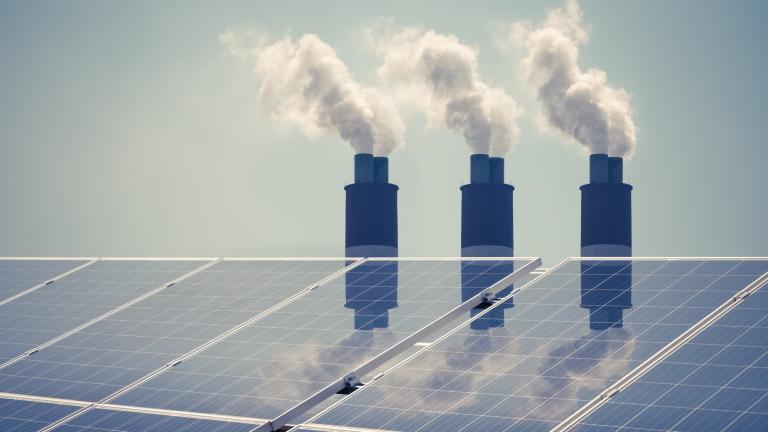
The goal of carbon capture and storage (CCS), also called carbon sequestration, is to take carbon dioxide that would have been emitted into the atmosphere from new or existing power plants (usually coal) and instead store it someplace, hopefully forever. It is an attractive idea across the political spectrum because it might allow us to continue using a major fossil fuel, but in a way that does not destroy the climate.
Unfortunately, CCS has four fundamental problems that have reduced enthusiasm for it recently and limited its likely role:
- Cost: Coal plants with CCS are very expensive today. The total extra cost for this process, including geological storage in sealed underground sites, is currently quite high, $30 to $80 a ton of carbon dioxide, according to the Department of Energy's Office of Fossil Energy, "Carbon Sequestration R&D Overview." And that is on top of the cost of new coal plants, which have become very expensive. In the future, it seems rather unlikely that CCS would be a low-cost solution. The modeling work done for the California Public Utility Commission on how to comply with the AB32 law (California's Global Warming Solutions Act), online here, puts the cost of coal gasification with carbon capture and storage at a staggering 16.9 cents per kWh. Energy efficiency along with lots of low-carbon generation sources beat that easily now or will very soon.
- Timing: The world does not even have a single large-scale (300+ MW) coal plant with CCS anywhere in the world. The first moderate-sized (30 MW) pilot plant with CCS just started up this month in Germany. Earlier this year, President Bush dropped the mismanaged 'NeverGen' clean coal project. In the past year, most governments and most U.S. utilities have scaled back, delayed, or cancel their planned CCS projects (see below). As Howard Herzog of MIT's Laboratory for Energy and the Environment said in February, "How can we expect to build hundreds of these plants when we're having so much trouble building the first one?"
- Scale: We need to put in place a dozen or so clean energy "stabilization wedges" by mid-century to avoid catastrophic climate outcomes. For CCS to be even one of those would require a flow of CO2 into the ground equal to the current flow of oil out of the ground. That would require, by itself, re-creating the equivalent of the planet's entire oil delivery infrastructure, no mean feat.
- Permanence and transparency: If Putin's Russia said it was sequestering 100 million tons of CO2 in the ground permanently, and wanted other countries to pay it billions of dollars to do so, would anyone trust them? No. The potential for fraud and bribery are simply too enormous. But would anyone trust China? Would anyone trust a U.S. utility, for that matter? We need to set up some sort of international regime for certifying, monitoring, verifying, and inspecting geologic repositories of carbon -- like the U.N. weapons inspections systems. The problem is, this country hasn't been able to certify a single storage facility for a high-level radioactive waste after two decades of trying and nobody knows how to monitor and verify underground CO2 storage. It could take a decade just to set up this system.
The bottom line is that we should continue to pursue CCS research, development, and demonstration in a serious effort to turn this long-term strategy into a medium-term one. But efficiency, wind, solar PV, and baseload solar are where we should be placing the big deployment dollars right now.
For those who want to become more knowledgeable on CCS, the rest of this post will cite and excerpt a dozen or so of the recent articles and studies on the subject below.
The Massachusetts Institute of Technology published a very thorough, interdisciplinary report on "The Future of Coal" in March 2007. This study was quite skeptical about the near-term possibility of CCS, mocked the notion of "capture ready" coal plants, and harshly criticized U.S. government CCS policy -- a key reason that many, including journalists, became more pessimistic about CCS. Findings include:
- A significant charge on carbon emissions is needed in the relatively near term to increase the economic attractiveness of new technologies that avoid carbon emissions and specifically to lead to large-scale CCS in the coming decades. We need large-scale demonstration projects of the technical, economic and environmental performance of an integrated CCS system.
- Congress should remove any expectation that construction of new coal plants without CO2 capture will be "grandfathered" and granted emission allowances in the event of future regulation. This is a perverse incentive to build coal plants without CO2 capture today.
- Coal plants will not be cheap to retrofit for CO2 capture. Our analysis confirms that the cost to retrofit an air-driven SCPC plant for significant CO2 capture, say 90 percent, will be greater than the cost to retrofit an Integrated Gasification Combined Cycle plant. However, as stressed in Chapter 3, the modifications needed to retrofit an IGCC plant for appreciable CCS are extensive and not a matter of simply adding a single simple and inexpensive process step to an existing IGCC plant.
- The concept of a "capture ready" IGCC or pulverized coal plant is as yet unproven and unlikely to be fruitful.
In May 2007, the Center for American Progress released an excellent report on "Global Warming and the Future of Coal," by Ken Berlin and Robert Sussman. It looked at a variety of policy measures that might allow new coal to contribute to our energy mix without destroying the climate and recommended the crucial policy:
Requiring all new coal power plants to meet an "emission performance" standard that limits CO2 emissions to levels achievable with CCS systems.
That is the best way to maintain coal's viability in a carbon-constrained world.
The U.K. Guardian reported in February 2008, "Firms will act on CO2 only if its cost triples," says oil giant Royal Dutch/Shell:
A carbon price close to $100 per tonne of CO2 -- more than three times higher than it is today -- is needed before industry will invest in the thousands of carbon-capture-and-storage (CCS) schemes needed for reducing greenhouse gas emissions, Shell warned yesterday.
In April, a major article in Environmental science and technology, "Regulating the Geological Sequestration [GS] of CO2," argued
As greenhouse gas emissions rise and the impacts of climate change grow, the need for safe and effective CO2 capture and sequestration becomes ever more urgent ...
For countries such as the U.S. and Germany, which today produce more than half of their electricity from coal, or China and India, where a large majority of the electricity is generated from coal, it is difficult to see how cost-effective and politically viable emission reductions can be achieved during the next several decades without at least some continued use of coal ...
Governments worldwide should provide incentives for initial large-scale GS projects to help build the knowledge base for a mature, internationally harmonized GS regulatory framework. Health, safety, and environmental risks of these early projects can be managed through modifications of existing regulations in the EU, Australia, Canada, and the U.S. An institutional mechanism, such as the proposed Federal Carbon Sequestration Commission in the U.S., should gather data from these early projects and combine them with factors such as GS industrial organization and climate regime requirements to create an efficient and adaptive regulatory framework suited to large-scale deployment. Mechanisms to structure long-term liability and fund long-term postclosure care must be developed, most likely at the national level, to equitably balance the risks and benefits of this important climate change mitigation technology.
We need to do this right. During the initial field experiences, a single major accident, resulting from inadequate regulatory oversight, anywhere in the world, could seriously endanger the future viability of GS. That, in turn, could make it next to impossible to achieve the needed dramatic global reductions in CO2 emissions over the next several decades. We also need to do it quickly. Emissions are going up, the climate is changing, and impacts are growing. The need for safe and effective CO2 capture with deep GS is urgent.
In April, Reuters reported:
Governments and the private sector are balking at the expense of kick-starting a technology to bury planet-warming gases underground, casting doubts on "clean coal" plans seen vital to help fight climate change.
In May, Matt Wald wrote in the NYT, "Mounting Costs Slow the Push for Clean Coal,"
... It has become clear in recent months that the nation's effort to develop the technique is lagging badly.
In January, the government canceled its support for what was supposed to be a showcase project, a plant at a carefully chosen site in Illinois where there was coal, access to the power grid, and soil underfoot that backers said could hold the carbon dioxide for eons.
Perhaps worse, in the last few months, utility projects in Florida, West Virginia, Ohio, Minnesota and Washington State that would have made it easier to capture carbon dioxide have all been canceled or thrown into regulatory limbo.
Coal is abundant and cheap, assuring that it will continue to be used. But the failure to start building, testing, tweaking and perfecting carbon capture and storage means that developing the technology may come too late to make coal compatible with limiting global warming.
"It's a total mess," said Daniel M. Kammen, director of the Renewable and Appropriate Energy Laboratory at the University of California, Berkeley.
... it remains an open question whether techniques for capturing and storing carbon dioxide will be available by the time they are critically needed.
The Electric Power Research Institute, a utility consortium, estimated that it would take as long as 15 years to go from starting a pilot plant to proving the technology will work. The institute has set a goal of having large-scale tests completed by 2020.
"A year ago, that was an aggressive target," said Steven R. Specker, the president of the institute. "A year has gone by, and now it's a very aggressive target."
The Australian reported in May, "Chimneys sweep BP clean coal plan away":
WHAT was touted as Australia's biggest contribution to developing clean coal technology for use around the world in reducing greenhouse gas emissions has been scrapped even before it got to first base.
BP confirmed yesterday the $2 billion "hydrogen energy" coal-to-gas plant at Kwinana, south of Perth, would not proceed ...
But after more than two years of investigations and several million dollars of research, BP has now admitted that the geological formations off Perth contain gas "chimneys" that mean it is next to impossible to establish a seal in the strata that could contain the CO2.
In May, Greenpeace issued a report, False Hope: Why carbon capture and storage won't save the climate that argued "the technology is largely unproven and will not be ready in time to save the climate."
And Matt Wald again in June, "Running in Circles Over Carbon":
... A recent decision by the Virginia State Corporation Commission, which regulates utilities, to turn down an application by the Appalachian Power Company to build a plant that would have captured 90 percent of its carbon and deposited it nearly two miles underground, at a well that it dug in 2003. The applicant's parent was American Electric Power, one of the nation's largest coal users, and perhaps the most technically able. But the company is a regulated utility and spends money only when it can be reimbursed.
The Virginia commission said that it was "neither reasonable nor prudent" for the company to build the plant, and the risks for ratepayers were too great, because costs were uncertain, perhaps double that of a standard coal plant. And in a Catch-22 that plagues the whole effort, the commission said A.E.P. should not build a commercial-scale plant because no one had demonstrated the technology on a commercial scale.
Vaclav Smil, wrote in Energy at the Crossroads [PDF]:
A key comparison illustrates the daunting scale of the challenge. In 2005 worldwide CO2 emissions amounted to nearly 28 Gt; even if were to set out only a modest goal of sequestering just 10% of this volume we would have to put away annually about 6 Gm3 (assuming that all of the gas is compressed at least to its critical point where its density is 0.47 g/mL). The current extraction of crude oil (nearly 4 Gt in 2005) translates to less than 5 Gm3. Sequestering a mere 1/10 of today's global CO2 emissions (less than 3 Gt CO2) would thus call for putting in place an industry that would have to force underground every year the volume of compressed gas larger than or (with higher compression) equal to the volume of crude oil extracted globally by petroleum industry whose infrastructures and capacities have been put in place over a century of development. Needless to say, such a technical feat could not be accomplished within a single generation.
(Note to Smil: Well of course it "could" be accomplished within a single generation if we had a WWII mentality for dealing with the climate problem. But since we don't, my point is moot.)
In June, BusinessWeek's "The Dirty Truth About Clean Coal" concluded:
The catch is that for now -- and for years to come -- "clean coal" will remain more a catchphrase than a reality ...
Corporations and the federal government have tried for years to accomplish "carbon capture and sequestration." So far they haven't had much luck. The method is widely viewed as being decades away from commercial viability. Even then, the cost could be prohibitive: by a conservative estimate, several trillion dollars to switch to clean coal in the U.S. alone.
Then there are the safety questions. One large, coal-fired plant generates the equivalent of 3 billion barrels of CO2 over a 60-year lifetime. That would require a space the size of a major oil field to contain. The pressure could cause leaks or earthquakes, says Curt M. White, who ran the U.S. Energy Dept.'s carbon sequestration group until 2005 and served as an adviser until earlier this year. "Red flags should be going up everywhere when you talk about this amount of liquid being put underground."
E&E News reported in June ($ub. req'd), " Carbon storage technology is far from ready, utility execs warn":
Efforts to characterize carbon capture and sequestration (CCS) technology as a viable short-term "cure-all" for coal-burning power plants' greenhouse emissions have been "way overblown," the outgoing chairman of the leading utility industry group said today.
"It is a technology that [scientists] are comfortable can work," said Jeff Sterba, the Edison Electric Institute's outgoing chairman and chief executive of Albuquerque-based PNM Resources. "But is it commercially deployable in 10 years? No."
... Added Jim Rogers, Duke Energy's CEO and a former institute chairman, "CCS as a magical technology that solves the carbon problem for coal plants is oversold ... I think there is a lot to learn, and it is going to take us a lot longer for us to figure it out than a lot of us think."
Ben Yamagata, director of the Coal Utilization Research Council, was interviewed by E&E News in June and said:
I think there is a tendency for both sides to over-exaggerate what's possible from a technical perspective. Our view is that it's important for political leaders to think about technology about development as a process of crawling, then walking, then running. And on the one side, I think in context of what Jim Rogers has said, there's too much focus on the running at this point. And we really need to think about taking the first baby steps before we lope into a full-charge gallop on this stuff. And so I would say, yeah, I would agree that at least certain elements of it who want to have this happen very quickly have overblown the possibility of when all of this can happen, not can it happen, which is an important distinction here, but when it's going to happen ...
We have a plan that is a two-part program and it says we should have a much, much more robust, research, development, demonstration program, really on the order of magnitude of $17 to $20 billion dollars over the next 18 or 19 years.
In July, Coal journalist Jeff Goodell wrote in "Coal's New Technology: Panacea or Risky Gamble?":
Unfortunately, CCS is more fantasy than reality at the moment ...
... given how quickly the price of renewable energy is falling (wind and large-scale concentrated solar power are already competitive with coal in some parts of the country), you have to wonder why anyone would go to the trouble of building a coal plant at all.
Jeff Goodell on Coal-is-Dirty.com,"How Clean Coal Cooks Your Brain":
"Clean coal" is not an actual invention, a physical thing -- it is an advertising slogan. Like "fat-free donuts" or "interest-free loans."
... mining and burning coal remains one of the most destructive things human beings do on this earth. It destroys mountains, poisons water, pollutes the air, and warms the atmosphere. True, if you look at it strictly from the point of view smog-producing chemicals like sulfur dioxide, new coal plants are cleaner than the old coal burners of yore. But going from four bottles of whiskey a week down to three does not make you clean and sober.
The U.S. Department of Energy's Office of Fossil Energy resources on Carbon Capture Research can be found here.
Finally, I have been assuming one wedge of CCS by 2050 in my full climate solution, but I think the next version will likely drop that down to half a wedge, or perhaps 0.5 +/- 0.5 -- 0 to 1 wedge for CCS.
This post was created for ClimateProgress.org, a project of the Center for American Progress Action Fund.
Comments
View as Threaded
HLJaeger Posted 12:52 pm
30 Sep 2008
This is not the case, and the industry should be rethinking such a requirement as it places an inordinate cost burden on the process.
Since natural gas fired plants are typically considered as being "clean and green", it would seem that the more appropriate target for carbon capture would be to achieve CO2 emissions that are the equivalent to natural gas combined cycle on a lb per kWh basis.
Not only is the cost of removal greatly reduced, especially if pre-combustion removal is employed as is made possible in an Integrated Gasification Combined Cycle (IGCC) plant, but also the cost of transport and sequestration is proportionately reduced.
About a year ago, we posted a blog on the subject which could be read at: http://gasification-igcc.blogspot.com/2007/10/natural-gas ...
Harry Jaeger
Gasification Editor
Gas Turbine World Magazine
Permalink
ThomC Posted 1:59 pm
30 Sep 2008
Permalink
BILL HANNAHAN Posted 2:51 pm
30 Sep 2008
We would have to bury thousands of pounds of solid toxic waste and pump 30,600 pounds of CO2 into the ground each year for each person.
Over an 80 year life the totals are; coal 1,140,000 lb, and carbon dioxide 2,440,000 lb. coal prices have roughly doubled in the last 5 years and we have no idea what they will be in 10, 30, 60 years.
Conventional nuclear power plants can do it on 0.72 pounds of uranium per year per person, resulting in about 10 lb of spent fuel per 80 year lifetime.
Seawater uranium caps the maximum sustainable uranium price at $108 per pound, corrected for inflation, for several hundred years, much less per kWh than the current cost of coal.
http://europe.theoildrum.com/node/4558#comment-413193
Spent fuel becomes less radioactive than uranium ore in 0.13 million years. See page 5 of this document, page 18 of the pdf.
http://www-pub.iaea.org/MTCD/publications/PDF/TRS435_web. ...
Notice that fresh spent fuel is only about 1000 times more radiotoxic than uranium ore. Ore is scattered throughout the earths crust with no engineered containment at all and may cause over 20,000 deaths per year from radon exposure. If engineered barriers provide 1000 times more reliable isolation than nature, the risk of spent fuel is less than the risk of ore right from the start and diminishes from then on.
The nuclear waste problem is political, educational and emotional, but it is not a difficult engineering problem. The best place to put it is under deep seabed mud. That is where the uranium ore will end up by erosion if we do not use it.
http://gristmill.grist.org/story/2008/8/10/83934/8341#com ...
Breeder reactors like the integral fast reactor can generate an 80 year lifetime supply of electricity on 6 ounces of uranium and produce waste that is less toxic than ore in 300 years.
Denmark has made wind a proven technology. They have proven that after 30 years of enormous subsidy we can ramp it up to 150 watts of windpower per person, less than 10% of U.S. consumption. We can jack electric prices up to 38 cents per kWh, and sell half to our neighbors because it is so erratic.
http://news.bbc.co.uk/2/hi/uk_news/magazine/7598212.stm
Wind is the next huge energy boondoggle after corn ethanol.
Solar actually has great potential, but we need big improvements in storage and transmission technology for it to become a major player. If solar cells were available free in unlimited amounts solar would be hard pressed to supply more than 20% of our electricity.
We should be mass producing floating nuclear power plants.
http://www.atomicinsights.com/aug96/Offshore.html
Things Everybody Should Know About Energy
Permalink
GRLCowan Posted 11:17 pm
30 Sep 2008
Why would any such measure be required to make an all-coal electricity system carbon-neutral, Bill?
--- G.R.L. Cowan, author of How fire can be tamed
Permalink
Jonas Posted 12:53 am
01 Oct 2008
No other technology is capable of doing this.
Renewables like solar or wind are okay, but they are merely 'carbon neutral' (in practise they are quite carbon positive, though). They will push us to catastrophic 450ppm, whereas we need to go to 350ppm.
This is why CCS research is very important, because it prepares the development of the only core climate solution, which is carbon-negative bioenergy.
Many coal plants are already being converted to run on biomass (today Xcel Energy in Wisconsin announced yet another such project). If you couple CCS to these plants, you actively remove CO2 from the atmosphere.
There will be a time when "not producing emissions" ("zero emissions") is seen as a weak offer, because climate change will require active removal of CO2 from the atmosphere. Special "negative emissions credits" will be created, which make bioenergy + CCS highly competitive.
So yes, let the coal industry develop CCS, and then force it to switch to biomass.
Permalink
kellermfk Posted 1:00 am
01 Oct 2008
Permalink
RDMiller Posted 2:32 am
01 Oct 2008
But it is quite possible to go far beyond this by increasing the productivity of current forests (through sustainable forestry practices) to store larger volumes of CO2, and growing new forests... lots of them. Combine all of these elements and you've got the path forward to dramatically reduce current CO2 levels, while simultaneously producing large volumes of low cost energy.
And, as I've mentioned elsewhere, the technology exists to use this biomass directly in coal-fired plants with virtually no cost to retrofit. In other words, the facilities to produce much of this energy are already built.
Permalink
BILL HANNAHAN Posted 4:22 am
01 Oct 2008
In the U.S. we consume about 200 watts of biomass per person in the form of food. In addition we use 11,300 watts of energy per person from other sources.
How much land will it take to produce 11,300 watts of biomass energy for 300,000,000 people, how much water, how much potash? Where are all these resources sitting just waiting to be tapped?
Things Everybody Should Know About Energy
Permalink
RDMiller Posted 5:11 am
01 Oct 2008
I don't believe I ever suggested biomass would supply all the power needs of the US. It wouldn't and shouldn't. But I have explained before (on two other posts) how it could produce the equivalent energy of 1,000 - 2,000 nuclear power plants (1 GW each). Water requirements are not significant. Any residual materials would either be used to make products or enrich soils. This isn't rocket science. It's based on existing technology, much of which has been in use for 30 years or more. It's just a matter of deciding to do it.
Put simply, the approach combines sustainable management of existing forests along with planting 200 million acres of unused land to fast growing trees and grasses. Either gasify or liquify the biomass after that, depending on just which energy products make the most sense to produce.
This should be used with all other renewables to solve our energy problems. The biggest advantage of biomass, though, (as Jonas mentioned) is that you can create a carbon negative system.
Richard
Permalink
BILL HANNAHAN Posted 7:29 am
01 Oct 2008
I have explained before (on two other posts) how it could produce the equivalent energy of 1,000 - 2,000 nuclear power plants (1 GW each). Water requirements are not significant. Any residual materials would either be used to make products or enrich soils. ...
Put simply, the approach combines sustainable management of existing forests along with planting 200 million acres of unused land to fast growing trees and grasses.
These are unsubstantiated claims not references. Provide reputable references that show;
How much biomass is required per year to produce this much energy.
We have 200 million acres of suitable land standing idle with sufficient water to support fast growing plants.
The land can produce this much biomass continuously without being depleted of nutrients or topsoil.
How this quantity of mass will be harvested, dried and transported to power plants, and how much energy these functions will consume.
Things Everybody Should Know About Energy
Permalink
RDMiller Posted 8:58 am
01 Oct 2008
Actually, I'm not that motivated to go through this exercise in detail to prove my points. Why would I want to? What's to gain?
I'll provide this much information in response to your questions. Anyone can google this info to document it.
It takes 10,000 tons of green wood chips to produce 10 MW of power. This is a standard figure that's been documented hundreds of times in existing facilities over the past 30 years. This number can be substantially improved with better technology, but it's a sound figure to start with.
Hybrid poplars and willows consistently produce 10 tons of biomass per acre per year. Researchers believe this could double within 10 years. Several grasses exceed this level. All of these can be established with little or no fertilizer or added water.
Existing forests (some 750 million acres) typically carry 100-200 tons of biomass. A proper thinning of these forests would remove 30-50% of the biomass to help move these forests back to optimum health. This would be a one-time shot, though (you could repeat it in 10-25 years), but more than adequate to "kick start" this initiative while the biomass energy plantations came on line.
There is at least 500 million acres of land we could choose from to establish these plantations. Some of this could be unproductive forests. Most of it would be abandoned cropland and degraded land.
Depletion of nutrients is not an issue. It is addressed by the mixture of trees and grasses being planted, the nature of the harvest cycle, and by returning nutrients to the soil which are yielded through the energy production process (for example, biochar).
Wood for energy is harvested in large quantities every day, and competes successfully with nuclear and coal. The issue of energy-in to energy-out is not a consideration. I've gone through the numbers before. An inconsequential amount of energy is needed to harvest, dry and transport this biomass.
You can work through the numbers yourself to confirm my origin statement regarding the potential energy contribution from biomass.
If we so chose, we could double the land area to 400 million acres... doubling the potential. The land is there. The technology is well known. It's simply not that complicated.
All it took was a substantial rise in oil prices and concerns over GHG's to set this path in motion. The use of biomass for energy is increasing rapidly, but we've only just scratched the surface.
If you or others have specific questions, I'll do my best to answer them. And if anyone finds compelling evidence to substantially argue against any claim above, I'll respond with specific references to document my points.
Richard
Permalink
christophersj Posted 2:09 pm
01 Oct 2008
Permalink
RDMiller Posted 8:43 pm
01 Oct 2008
Permalink
BILL HANNAHAN Posted 7:44 am
02 Oct 2008
My comment is laced with links that backup my claim that the uranium supply is effectively unlimited at a cost far lower than our cheapest fossil fuel, and that the disposal of nuclear waste is not a difficult engineering problem.
You continue to list a bunch of unsubstantiated claims. You didn't even bother to hand wave this question;
Explain how this quantity of mass will be harvested, dried and transported to power plants, and how much energy these functions will consume.
I got the facts before forming my opinion. Obviously you have the process reversed.
Things Everybody Should Know About Energy
Permalink
RDMiller Posted 8:53 am
02 Oct 2008
Now I get the picture. You seem interested in debating the nuclear vs. biomass paths. But I have no interest in that... nor do I have any interest in countering your so-called "facts".
I know my sector. I don't know yours. I don't know enough about nuclear to argue with your facts (but I know others here do and would certainly not agree with many of your conclusions).
I've said before I have not reached a conclusion about nuclear. Intuitively, I have great concerns with any power source that leaves behind extremely toxic waste for generations, can be converted into a high-intensity bomb, can result in the death of huge numbers of people if something unforeseen goes wrong, and may emit low levels of radioactivity dangerous to human life. But I leave open the possibility those issues (and others) can be resolved, resulting in a low-cost, clean source of energy.
I happen to be one of those folks who likes the idea of an energy production system with huge potential that requires establishing more forests, can increase wildlife habitat, creates decentralized energy that supports rural jobs, can reverse global warming, improve soil and water quality, and can't be used to kill people.
But heck... that's just me.
Richard
Permalink
BILL HANNAHAN Posted 9:49 am
02 Oct 2008
No, I just used that as an example of a documented position.
I know my sector.
Educate us, share the references and calculations through which you were educated, provide the analysis that convinced you this plan is practical and affordable.
I have great concerns with any power source that leaves behind extremely toxic waste for generations, can be converted into a high-intensity bomb, can result in the death of huge numbers of people if something unforeseen goes wrong, and may emit low levels of radioactivity dangerous to human life.
I see it is you who would rather debate nuclear than biomass. I addressed the waste issue previously. Which nations use commercial power plants to make bombs, I know of none. It is much cheaper and faster with a simple plutonium production reactor. The Chernobyl reactor had a positive temperature coefficient of reactivity and no containment building. How can a modern plant kill huge numbers of people?
There is a growing body of evidence that low level radiation may be good for you.
http://www.jpands.org/vol13no2/luckey.pdf
http://www.ajronline.org/cgi/content/full/179/5/1137
The firebombing of Dresden killed more people than the Hiroshima bomb, do you forgo the usefulness of fire also?
On the other hand, under your system, the failure of the biomass crop could lead to massive power failure and widespread death to millions of Americans during a heat wave or cold spell.
Explain how this quantity of mass will be harvested, dried and transported to power plants, and how much energy these functions will consume. What will it cost?
Things Everybody Should Know About Energy
Permalink
RDMiller Posted 10:42 am
02 Oct 2008
The simple fact you would try to defend nuclear by arguing that all the potential problems either have been, or could easily be, addressed, indicates to me you have a mindset I'd rather not debate with. It's just not worth my time.
When you state that "failure of the biomass crop could lead to...", you apparently didn't read that the heart of what I presented is based on forests. Simple forests... whether planted or natural. I'll tell you this... if we experience wide spread failure of forests, there ain't no nuclear plant anywhere that's going to make a bit of difference. It'd be fair to say we had crossed the tipping point a long time before that and are pretty well cooked.
As far as answering the specific question you asked, you need to understand that millions of tons of biomass are harvested, transported, dried (when necessary) and converted into energy every year. It's been going on for a long time, with the energy competing with nuclear and coal since the 70's. There's no mystery in this. I have no idea what point you're trying to make.
Here's a few rough figures for you. Biomass typically costs $10-$20 per ton to harvest; perhaps $2-$5 per ton to transport; and generally nothing to dry (it's often burned green in large power plants). Delivered costs of green wood chips is typically $30-$40 per ton these days. I hope that answers your question.
Richard
Permalink
BILL HANNAHAN Posted 3:53 pm
02 Oct 2008
But I have explained before (on two other posts) how it could produce the equivalent energy of 1,000 - 2,000 nuclear power plants (1 GW each).
More like 200. Your off by a factor of 10.
It takes 10,000 tons of green wood chips to produce 10 MW of power. This is a standard figure that's been documented hundreds of times in existing facilities over the past 30 years.
From page 8 of this pdf
http://www.nafi.com.au/Report%204.pdf
"To be
truly competitive with the electricity produced from coal-fired power stations, the
wood-fired power stations would need to have a capacity of at least 100 MW. A mill
of this size would require 0.9-1.0 million tonnes of green wood waste each year. It is
unlikely that a facility of this size could be economically supplied with wood waste, as
the transport costs would make it too expensive to collect such a dispersed resource."
1 million tons / 100 MW = 100,000 tons/ 10 MW =10,000 ton = 1 MW Your off by a factor of 10.
The mass to replace 200 GW = 10,000 x 200,000 = 2 billion tons/year
From page 16 of this pdf
http://www.fpl.fs.fed.us/tmu/wood_for_energy/primer_on_wo ...
U.S. forests can sustainable produce only 368 million dry tons per year
Only about 20% of your requirement. The ethanol people want to use it all to make liquid transportation fuel. The grand solar plan published in Scientific American wants to use it all to drive their compressed air storage system, and it is only 20% of their need too. We need about 20 times more forest land to sacrifice to make all the renewable fans happy.
Hybrid poplars and willows consistently produce 10 tons of biomass per acre per year. Researchers believe this could double within 10 years.
Do you think dry western forests will support fast growing trees?
Put simply, the approach combines sustainable management of existing forests along with planting 200 million acres of unused land to fast growing trees and grasses. Either gasify or liquify the biomass after that, depending on just which energy products make the most sense to produce....
When you state that "failure of the biomass crop could lead to...", you apparently didn't read that the heart of what I presented is based on forests. Simple forests... whether planted or natural.
Which is it? Do you really want to convert all our forests into tree farms? What fraction of our forests should be old growth forests in natural condition?
If you or others have specific questions, I'll do my best to answer them. And if anyone finds compelling evidence to substantially argue against any claim above, I'll respond with specific references to document my points.
Please do.
Things Everybody Should Know About Energy
Permalink
RDMiller Posted 9:18 pm
02 Oct 2008
Yes, the conversion figure is 10,000 tons per MW. That was a typo on my part. Thanks for pointing that out.
My estimate for producing the equivalent of 1000-2000 GW of power from biomass was a global figure based on 1 billion acres of land. I have been using the figure of 200 GW of power in the US in all my other posts here at Grist.
As far as the 368 million dry tons of sustainable fiber is concerned, you're confusing a few things (which typically happens when folks not familiar with this sector jump in and grab a line here or there). First, this is a dry ton figure, compared to the wet ton number of 10,000 tons per MW. You have to double this 368 to get green tons, making the sustainable harvest (according to FPL) approximately 750 million green tons. Other researchers use a considerably higher figure... more in the range of 1-1.5 billion green tons.
But I was clear in talking about using energy plantations to supply this 200 GW (in the US or 1000-2000 GW worldwide) on a sustainable basis, while using existing forests in the first 5-20 years. The difference is that current forests produce, on average, 1-2 green tons per acre, while fast growing plantations produce 10 or more green tons per acre per year. However, current forests hold 100-200 green tons (or more) and most should be sustainably thinned to move them back to more optimum growing conditions. This harvest would yield, on average, 40-70 green tons per acre. Using 50 as a figure, you'd need 40 million acres per year (in the US) to supply the 200 GW (the 2 billion tons). Doing this for 10 years would require 400 million acres (there are 750 million acres of forests in the US).
On a long term basis (I know I said this before, but I'm just making the numbers clearer to you), the plan is to produce the 2 billion tons from 200 million acres yielding 10 green tons per acre per year (increasing to 20 tons over time). If we wanted, we could double this 200 million acres to 400 million (because we have the available land area here), yielding 400 GW of power in the US. And if the researchers are successful in getting to the 20 tons per acre per year figure, this could go to as much as 800 GW of power here in the US.
Western lands (obviously a very general statement) can support all kinds of fast growing trees and grasses. Many of these species are specfically designed for dry land, requiring very little water.
I hope this clears up the discussion, but feel free to point out any other items you think might contrast with what I've said. Bottom line, the potential for biomass remains as I've said: at least 200 GW in the US, 1000-2000 GW wordlwide.
Richard
Permalink
BILL HANNAHAN Posted 4:11 am
03 Oct 2008
Now you're dealing with some facts, but you need references. I see a few problems.
Most coal plants are far from most forests. As indicated in my previous reference, transportation is a killer.
It will take a huge army of people and specialized equipment to collect this rate of material without destroying the forest. The equipment will run on diesel fuel due to its high energy density. Trying to haul huge amounts of ethanol into remote forests is impractical. The fuel requirements and emissions will be huge.
People will put up huge resistance to having their forests ravaged by this army, with its noise, air pollution and roads clogged with trucks and heavy equipment.
I need a well respected reference showing that 10 tons per year is possible on dry land.
What are the 200 million acres doing now, wildlife habitat, wetland, food production, natural forest? Who owns the land? Show me a map of 200 million acres of potentially productive land standing idle.
Restoring nutrients to level farmland is possible, but I would need a highly respected reference showing that it can be reliably and sustainably done on rocky hills and mountainsides with thin fragile topsoil subject to occasional heavy thunderstorms.
The biomass would better serve us making liquid fuel to displace imports from people who do not like us.
Things Everybody Should Know About Energy
Permalink
Backcut Posted 4:24 am
03 Oct 2008
OOPS, supposed to be lurking! 8^X
Scenic pics at http://Lhfotoware.blogspot.com
Permalink
RDMiller Posted 4:41 am
03 Oct 2008
I believe you are somewhat of an expert on nuclear issues. Remember what it feels like trying to educate people who know nothing about nuclear... especially when they come into it with certain conclusions already in mind? This is what I'm going through now with you. This isn't any fun at all.
Transportation is a non-issue. Actually, millions of acres of forests are very close to coal plants... not to mention the millions of acres of "unused" land to grow new plantations. But that's secondary anyway, as advanced technologies allow the biomass to be converted into a coal substitute which can be transported hundreds of miles, if necessary... no differently than coal is moved long distances today.
Your second and third points are not valid. Again (and for the last time) millions and millions of acres of forest are harvested continually to produce the wood products which form the backbone of our construction industry. Everyone accepts this as part of normal commerce. Creating more forests specifically to grow energy (instead of building products) is simply more of the same.
Your other points about the yields from fast growing biomass and availability of land for it are also not significant. Here are the facts. There's around 750 million acres of forests in the US, 600 million acres of grasslands, pastures and range, 300 million of "special use" lands (including most national and state park lands), and 450 million acres of cropland... any portions of which could be used to dedicate to the 200 million acres I have talked about. Take your pick of this lot. If we can pull out 200 million of it and use it to produce 200 GW of renewable, carbon negative energy, it sounds like a good choice to me.
The issue of whether or not to create electricity, transport fuels, plastics and/or chemicals from this material is being hotly debated.
Richard
Permalink
BILL HANNAHAN Posted 6:58 am
03 Oct 2008
Oh yes, I remember. That is why I provide them with references and calculations to back up my point, not the other way around.
as advanced technologies allow the biomass to be converted into a coal substitute which can be transported hundreds of miles, if necessary... no differently than coal is moved long distances today.
Where is the reference? How do you get biomass to the same energy density as coal? By the way, transportation is a big problem for coal. Transportation costs are more than the cost of the coal itself, and releases a lot of CO2.
Each time you dismiss my questions with hand waving. No calculations, no references, no cost estimate. You have convinced me that your plan is impractical, thank you.
Things Everybody Should Know About Energy
Permalink
RDMiller Posted 8:46 am
03 Oct 2008
Apparently, you're not paying attention at all. But that's what I expected.. which is why I didn't want to engage with you.
"The plan is impractical"? Well, it's actually well under way, with new biomass facilities being built every month. In case you haven't noticed as well, there's been far more money going into biomass research than nuclear. But I guess we're all just impractical dreamers.
Every statement I made to you can be documented factually. But like I said, it's not worth the effort.
Richard
Permalink