Coal cant

‘Clean coal’ proposals are getting canceled right and left 1

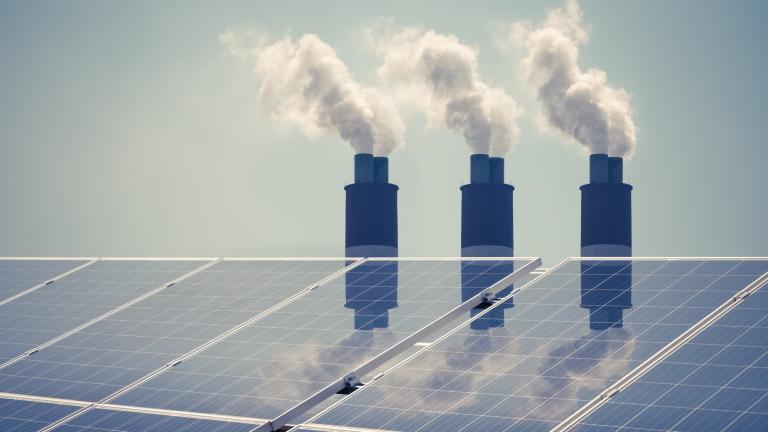
Remember clean coal, vaunted savior of, um, coal? Turns out cost, unproven technology, and rising opposition to carbon emissions are conspiring to nip a lot of clean coal projects in the bud. This, of course, is just the latest piece of evidence that coal can't hack it in a carbon-constrained market needs more subsidies.

David Roberts is staff writer for Grist. You can follow his Twitter feed at twitter.com/drgrist.

Advertisement
Advertisement
  1. elbarto Posted 11:44 am
    05 Nov 2007

    Clean Coal, A Dirty LieI've been running some rough numbers for my own interest to understand whether clean coal is a reality or not.
    In summary, the sequestration of carbon dioxide produced every year by the burning of coal would require roughly the same volume of material to be moved as all of the earth moved by humans in same time period based on the following calculations:
    Total world annual carbon dioxide production from from the consumption and flaring of fossil fuels ammounted to 28.2 billion metric tonnes in 2005.  Of this, 40.3% or 11.4 billion metric tonnes (11,400 billion kilograms) was carbon dioxide production from the burning of coal. DATA SOURCE: http://www.eia.doe.gov/iea/overview.html
    The conditions under which carbon dioxide would be sequestered, either in ocean trenches, deep caverns, porous rock resevoirs etc would vary somewhat. However assuming it is liquified and stored at a temperature of 0ºC / 32F and a pressure of 200 atmospheres / 2940 psi it would have a density of 1050 kg/m3  (kilograms per cubic meter). This is slightly more dense than water at 1000 kg/m3.
    Therefore, the volume of liquid carbon dioxide that would need to be buried every year is equal to (11,400 billion kg) ÷ (1050 kg/m3) = 10.9 billion m3. This is is 10.8 km3 (cubic kilometers).
    To visualise, 10.8 km3 is a cube 2.2 km high x 2.2 km wide x 2.2 km deep. (1.4mi x 1.4mi x 1.4mi if you prefer miles).
    So, for carbon capture and storage to work, an almost incomprehensible volume of material needs to be buried/pumped deep underground every year.
    To put this in perspective:


    World annual coal production is about 5 billion metric tonnes (http://www.worldcoal.org/pages/content/index.asp?PageID=1 ...). This equates to roughly 4 km3
    World annual total ore mined in all mining operations is 17 billion tonnes (http://www.mining-journal.com/html/Mining_Explained.html).
    World annual total earth moved (for mining and construction etc,etc) is estimated at 30-35 billion tonnes (http://www.climatechange.umaine.edu/Research/Contrib/html ...).


    Now, assuming the average density of the earth moved was say 2500 kg/m3, this equates to (30,000 billion kg) ÷ (2500 kg/m3) = 12 billion m3 or 12 km3 (vs. 10.8 km3 for CO2).
    For me, this puts things in a perspective that much easier to visualise than economic models talking about $/t or $kW/h costs. When I look at the gargantuan scale of operation required, I think clean coal is a big lie from a dying industry. Renewables and efficiency improvement will beat it on cost and effort and carry far less risk - ie there's no guarantee that the CO2 stays buried for the length of time required even if it could be done.

Add a Comment

You are not logged in. Thus, you cannot post a comment. If you have an account, log in. If you don't have an account, well, by all means go make one! Meet you back here in five.

Hello, Visitor!    Why not register?

Advertisement