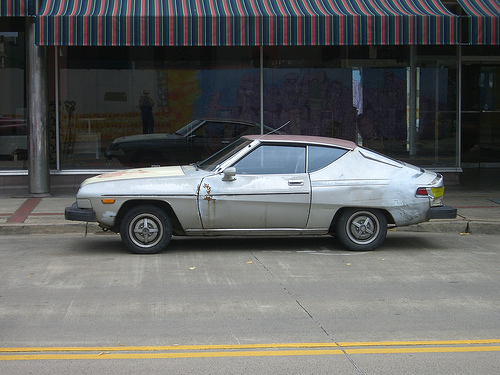
The unexpected popularity of the cash-for-clunkers program has sent congress scrambling to find more funding. About 250,000 people have taken advantage of the incentives to trade older cars for ones with better fuel efficiency, burning through the first billion dollars in about a week.
The price tag of the program has given politicians something to argue about, but I’m interested in a more basic question: does it work? The last time I looked at this question, I came up with a somewhat equivocal answer: cash-for-clunkers is an interesting experiment, but it’s tough to pass judgment without some hard data.
Hard data has arrived, and Geoffrey Styles beats me to the punch on crunching numbers. The average trade-in resulted in a better-than-feared 10 mile-per-gallon increase in fuel efficiency:
The corresponding CO2 reduction would be around 700,000 tons per year, which if you figure the cars removed from the road by this program likely only had a few more years of high-intensity usage left in them yields a CO2 abatement cost in the region of $475/ton. As climate policy, this wins no prizes.
He also beats me to the punchline: cash-for-clunkers isn’t strictly an environmental program, it’s a stimulus effort, and on that score it looks to be pretty successful. Nevertheless, given that demand for the rebates has outstripped supply, one obvious way to ratchet up the green value of the program while still pumping money into the economy would be to require even greater fuel efficiency gains. Right now, you can qualify for a rebate by buying a car that gets only 4 miles-per-gallon better fuel efficiency than your clunker. Given that the average fuel efficiency gain has been far higher than this, why not raise the threshold for participation?
In semi-related news, here’s a cash-for-clunker program environmentalists can really get behind: all across the country, states are offering rebates to residents who trade their ancient refrigerators in for more energy-efficient models. Fridges are often the most energy-hogging appliances in your house, and new Energy Star models are vastly more efficient than ones from a decade ago. The rebate programs ease load on the electrical grid, and, in the case of really old fridges, help to clean up ozone-destroying CFCs. In a nice touch, about 95% of the material in the old fridges can be recycled.
A message from
Your support keeps our climate news free.
Grist is the only award-winning newsroom focused on exploring equitable solutions to climate change. It’s vital reporting made entirely possible by loyal readers like you.
At Grist, we don’t believe in paywalls. Instead, we rely on our readers to pitch in what they can so that we can continue bringing you our solution-based climate news. Donate today to keep our site free.