In case you missed it, the Dow Jones Industrial Average experienced a violent and exhausting 1,000-point swing the past week, down 450 points on Tuesday before trimming its losses and then tumbling 330 points on Wednesday before rebounding with a 299-point gain.
It's not the only financial freefall of late. The housing market bubble was punctured last fall and has been leaking like the Hindenburg ever since. (And long before that, the economy experienced the dual dot-com and technology implosions in the spring of 2000.)

All of which is to say, it's probably safe to assume most Americans are familiar with what a financial bubble looks like when it bursts. But how many of us could spot a bubble in the making?
Eric Janszen believes he can. In fact, the president of iTulip.com predicts the next bubble is going to be green -- not as in the color of money, but as in alternative energy companies, suppliers, and technologies. If Janszen's right (and he's got a pretty good pedigree in all things bubbles, having had a front-row seat at the dot-com debacle and now as founder of a website that tracks financial dislocations), it could be the mother of all bubbles.
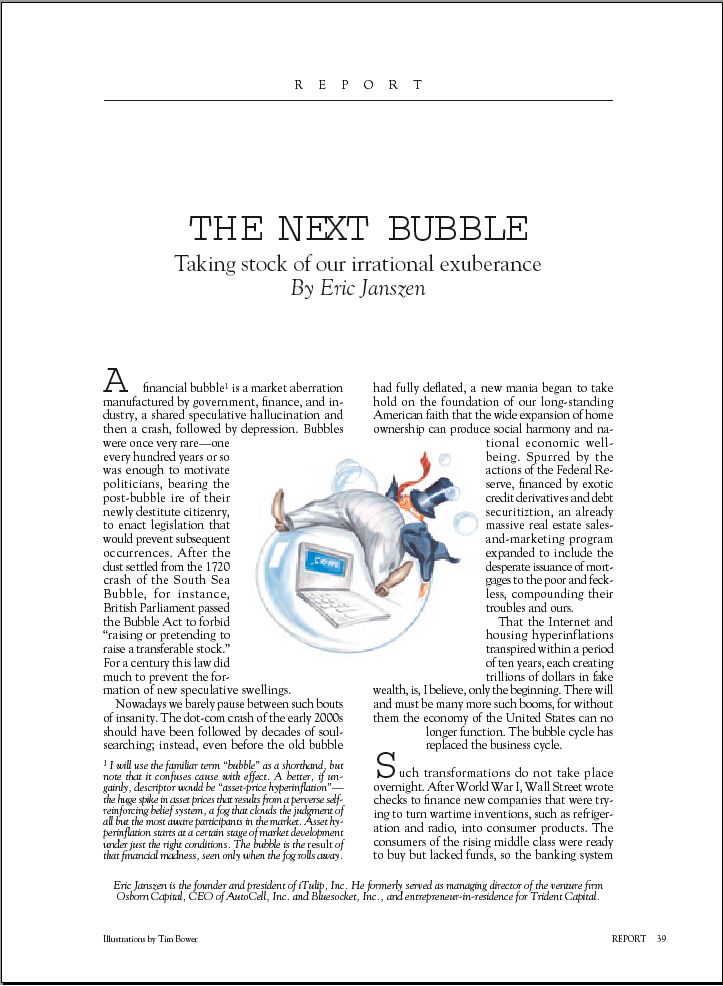
Bubbles are "a market aberration manufactured by government, finance, and industry," Janszen postulates in the February issue of Harper's Magazine (here's the first page of the article; the rest isn't online). Once one bubble is formed and punctured, the co-conspirators are motivated to create new bubbles to maintain a financial illusion of prosperity, and fresh capital is the mother's milk that sustains the illusion. Without a follow-on bubble, the economy would, according to Janszen, crater like a cheap pyramid scheme.
Whether it's technology, housing, or clean tech, what all bubbles have in common is that they create vast fathom values that can evaporate instantaneously. Values are not driven by the underlying worth of the asset -- a share of stock -- but by hyperinflated estimates that are unrealistic and thus unsustainable.
Janszen projects the alternative-energy bubble could outstrip both the dot-com and housing bubbles combined, generating in excess of $20 trillion in speculative wealth -- "money that will be employed to increase share prices rather than to deliver 'energy security.'" At their peaks, the tech bubble had a speculative value of $7 trillion and the housing bubble $12 trillion.
Financial bubbles were once rare and feared. And for good reason. The 1929 stock market crash was so devastating that no one in their right mind dared tempt that fate again, and regulatory safeguards were put in place to make sure it wasn't repeated. That was pretty much the status quo until the late 1980s and early 1990s, when a new wind blew through the financial world: banking and financial industries were deregulated and deficits, once the bane of governments and institutions, were celebrated. Add in a dash of liberal interest-rate policies, and a "new generation" of cheering politicians, financial journalists, and economists, and presto: you have tinder for a wild fire.
But you need a spark, or as Janszen contends, a new invention or discovery that's both plausible and in vogue. In the '90s, that invention was the web browser, which ushered in a user-friendly internet and a revolution in digital programming. In '00s, that spark is alternative energy, which promises to reduce our greenhouse-gas emissions and increase our national security by limiting our reliance on foreign oil.
You can already see a froth in the stocks of some of these companies.
First Solar, which designs and manufactures solar modules using thin film semiconductor technology, is one such Wall Street darling. Its stock climbed to $268-a-share from $50-a-share in the span of 12 months, before dropping back to its current, still-lofty $170-a-share range.
First Solar, which actually has real revenues and a widely praised product line, is by no means the only stock that's gone hyperbolic. It doesn't take much poking around on Yahoo Finance message boards to find other high fliers.
As kids we used to cram handfuls of Bazooka gum into our mouths and have bubble-blowing contests. My cousin Pete was the champ, blowing pink orbs twice the size of his head. Inevitably, the bubble would burst and he'd be left with a thin film over his face.
It was harmless fun. Not so financial bubbles.
Comments
View as Flat
ids Posted 8:28 am
26 Jan 2008
I find a better view here:
http://www.tomdispatch.com/post/174884/chalmers_johnson_h ...
Going Bankrupt
Why the Debt Crisis Is Now the Greatest Threat to the American Republic
by Chalmers Johnson
http://www.commondreams.org/archive/2008/01/23/6553/
Permalink
Jon Rynn Posted 8:54 am
26 Jan 2008
But the bit about alternative energy and infrastructure driving another bubble - an even bigger one -- was one of the most bizarre ideas I've ever read in a mainstream magazine. Mark doesn't mention that Janszen thinks that the physical infrastructure -- roads, water, grid, bridges, etc -- would be part of this alleged next bubble, and he quotes the American Society of Civil Engineers to the effect that we need to spend over $1.6 trillion in the next five years in order to get the physical infrastructure up to an "adequate" level. But look at what has happened after the Minneapolis collapse -- virtually nothing -- and according according to this N.Y. Times article , localities are in even worse shape now.
As for alternative energy, the investment in it is pathetic next to even the Federal dollars for oil industry research.
So not only are alternative energy and infrastructure being ignored, now they are being blamed for a nonexistent future financial bubble! I think what happened was this: the main headline for Harper's was "The next bubble", and Janzsen had to come up with a bubble to fulfill the "tease", and that was the best he could come up with. But it's a strange way to argue against alternative energy and infrastructure spending, which is what I think it amounts to.
Permalink
ids Posted 9:37 am
26 Jan 2008
"The alternate title for the Harper's piece was `The Good Bubble.' These are changes we need but lack the political ability to make due to the inertia of entrenched interests...Employment of the bubble system that was responsible for the tech and housing bubbles may be the only means available both to fight the impact of the debt deflation recession that started in Q4 2007 and also to deploy resources on the scale required."
In this scenario, the big losers will likely be the investors or taxpayers, as in the housing collapse."
So he might not be so against alternative energy as in Harpers. More likely he is out to protect investors over taxpayers. Though, not sure what the "debt deflation recession started in Q4 2007" is. He might simply be missing the forest for the trees, not uncommon among economists.
Permalink
Sean Casten Posted 1:43 am
27 Jan 2008
Harpers may be right. Having just completed the fund raise process for a clean energy company, I can attest that there is a lot of sex-appeal around clean energy investments nowadays. In our case of course, the sex-appeal is entirely justified.
But it can't possibly for everyone. (Indeed, while our company is open to acquisitions, we find that there are few, if any acquisition opportunities that can justify the price being asked right now - proof positive of a bubble, in my book.)
And in some level, this is healthy, purely from a macro-economic perspective. For the beneficiaries of bubble-nomics, one finds that normally short-term focus of equity markets is suddenly willing to put capital into longer time-horizon investments. We saw this during the dot-com era when investors suddenly came up with the "multiple of revenue" metric to justify crazy valuations on companies with negative earnings (and therefore negative valuations under more traditional multiple-of-earnings methodologies). The idea, of course was that these companies would eventually generate earnings and regardless of whether or not this was sensible from an investment perspective, it necessary meant that investors time horizons had grown. My guess is that most folks in the clean energy world would welcome a bit of a long-term focus.
But the downside of bubbles is that they pop. And when they pop, the same irrationality tends to drive investment. Right now, if your company has the word "energy" in the title, it may well be worth more than your strategy otherwise allows. But when that bubble pops, blessings turn to curses and you will find that your access to capital suddenly falls for reasons that (still) have nothing to do with fundamentals.
Note that energy markets broadly have already been through this cycle. After (limited) electric market access was introduced in the 1992 Energy Act (and subsequently, through FERC order 888), there was a flood of capital into the merchant power space, as investors sought to get in on the ground floor of whatever turned into the energy world's version of MCI. A few years later, when the gas price spiked, the CA dereg disaster hit and Calpine declared bankruptcy, the money ran out of the industry and hurt lots of folks in the process who had good strategies, but had the misfortune to be associated with the bubble. Those same companies are now on the uptick again...
Bottom line is to think like Warren Buffet. If everyone's buying, sell. And if everyone's selling, buy. And if you happen to be one of those companies subject to bubblnomics, ignore it as much as you can. If your strategy makes sense, you'll still be standing. But don't infer too much about how much other folks are willing to invest in you as any long-term statement on the quality of your strategy.
Permalink
Pompey Road Posted 2:32 am
27 Jan 2008
The eons of time and nature was good to us down here. It was not until we become civilized that destroying our habitat become fathomable or fashionable.
Permalink
Tasermons Partner Posted 3:45 am
27 Jan 2008
...I think it'd be wonderful thing!! Just think of all the money that'd haveta be invested just to get to that level! All the advances that could come outta it, and all the projects started and all the energy and resources saved!
Sure, the bubble would burst and there'd be some worries, but even in the aftermath the green industry would still be far larger than what it is now and the green impact would also be larger.
A steady growth would probably be better from an economic standpoint, though. But to call so much attention to green tech in such a short amount of time as to create so large a bubble...well, then suddenly the environment is on alot more people's mind than it was before...even if it is for economic reasons.
Permalink
David Sassoon Posted 4:06 am
27 Jan 2008
But it doesn't work as an image about the clean tech sector which already is, and will continue to be, a booming sector -- a source of jobs, manufacturing, economic development and transformation. The dotcom bubble may have burst, but it's real underlying content continues to shape the way we live.
The housing bubble -- though also called a bubble -- is an entirely different animal. It was almost completely speculative, built on a dishonest product -- the sub-prime mortgage. Imagine, the financial sector propping itself up on the backs of imprudent loans to the nation's poor.
If we separate the content of the sector itself from the gambling instincts of the investment crowd, the clean tech story itself is nothing to be afraid of, but something to be greatly welcomed.
David Sassoon, http://www.solveclimate.com
Permalink
sunflower Posted 5:07 am
27 Jan 2008
The shake-out will happen leaving 99% with worthless paper and 1% with a big win. Only the losers will call it green bubbles. Place your bets.
Oh, BTW, solar is cheaper than coal.
Permalink
Sean Casten Posted 5:11 am
27 Jan 2008
Frankly, if we don't like the word bubble, call it a pendulum. Markets are like politics, and have been so long before Reagan: they swing too far in one direction, and then over-correct to swing too far back in the other direction. In politics, we swing from excessively libertarian, laissez faire company regulation back to protectionism, with relatively little time spent on competitive markets with sufficient gov't oversight to protect consumers in the middle (and too easily stereotype the extremes in the process, without realizing that the extreme positions are... extremes.) Markets do the same. They love energy/telecoms/dot-coms/real estate/etc. too much, inflating values, then run away too quickly. On average, they do a great job - but the extremes are never justified. And clean tech is no less prone to those extremes than anything else.
Permalink
ids Posted 5:56 am
27 Jan 2008
The most important grist from Harpers piece is journalisms role in creating the hallucination and fog fueling the recent bubbles, and how the lack of regulation fueled them. To see it happening here, Obama will use his proposed $1/lb co2 auction cap&tax and invest the proceed in nuke and coal and corn, as Janszen wishes, and the American green al-queada camp will praise him for being one of them, like Lieberman-Warner, for helping the environment, forming the bursing bubble.
Economists and Sean refer to averages like it's the same old world, business as usual, let the market decide. Ech.
Permalink
David Sassoon Posted 6:01 am
27 Jan 2008
NYT today:
Loan Reviewer Aiding Inquiry Into Big Banks
"Clayton Holdings, a company based in Connecticut that vetted home loans for many investment banks, has agreed to provide important documents and the testimony of its officials to the New York attorney general, Andrew M. Cuomo, in exchange for immunity from civil and criminal prosecution in the state."
It's a very different kind of bubble, and I caution against allowing sloppy application of the term to both housing and clean tech in the same breath.
David Sassoon, http://www.solveclimate.com
Permalink
Sean Casten Posted 6:29 am
27 Jan 2008
My point is about the nature of bubbles, where there are universal truths, the majority of which serve little benefit for anyone other than traders. And to that end, we should not get excited about the presence of a bubble in industries that we like. Equity investment, at core is about buying things that you think are undervalued and then selling them when markets catch up to your wisdom. "Rational" behavior gives way to bubbles when one is no longer buying and selling based on fundamentals, but rather on the belief that someone else is going to pay more irrespective of fundamentals (e.g., the "greater fool" theory). The craziness in debt markets that emerged from the housing bubble is no different from the dot-com bubble in that regard: if you were a bank holding lots of subprime debt, but had found that people were consistently paying lots of money to people who could package 20 crappy mortgages into a single collateralized debt obligation and suddenly make the risk disappear, it's in your interest to collateralize lots of crappy debt. At that point, the musical chairs game starts, and everyone hopes not to be holding the junk when the music stops.
This is not some "business as usual" simplification: its the way things get bought and sold, and has ever been thus. Markets may be more complicated today, but at core it is still just people buying and selling stuff. And while some elements of the economy (e.g., manufacturers, consumers) buy things to use them and therefore are not prone to bubblish behavior, significant elements of the economy (e.g., traders) buy things only to resell them. So when we talk of bubbles, we are fundamentally talking about traders getting carried away, not anything that reflects the fundamentals of the good being traded. From 1700 Dutch tulips to 2005 mortgages, we have a long history of traders creating a churn that drives a bubble - and in all cases, there has been a collapse post-bubble. A bubble in clean tech will be no different.
And realize that we don't want different things. I desperately want to see lots of money flowing to good clean energy companies, for reasons that are as much due to my environmental concerns as my selfish ones as a potential recipient of that cash. My point is simply that we are best served by having cash that flows to businesses based on the soundness of their business plans rather than because they happen to be the sexy flavor du jour. The former creates long term value, but the latter is... just a bubble. And even worse, it is dangerous for the good ideas that are out there, who (on the back-side of that collapse) find themselves tarnished by the foibles of the sexy.
Permalink
Delay And Deny Posted 7:22 am
27 Jan 2008
In the late Nineties we needed to create the Internet Economy. We needed startups. We needed investment and we got it. The result was Yahoo, Amazon, Google, eBay -- the Big Four who employ thousands and who have allowed millions of small busineses and individual e-commerce transactions to occur on the web. (One of my best friends in Portland runs a thriving business selling collectable postcards over e-Bay..a business that measures its sales in pennies and dollars...but which can only exist with the inventions of PayPal and online auctions.)
In the bubble there are winners and losers. The winners have recovered to their pre-bubble highs -- indicating they were good investments. The losers lost money...that's called business!
Housing. America has had a housing shortage since 1970. The bubble allowed supply to finally catch up to demand. Now houses are poised to be available for a reasonable price...and I define reasonable as something that a typical person could afford in 5 or 7 years -- not in 30 years or 50 years...a lifetime!
We are on the verge of a new bubble...but it's not so much green as Tiny. The new technologies are the microscopic. Bacteria that convert wood to ethanol. Nanofibers that make batteries have 10 times the surface area and 10 times the capacity. Microprograms that let us build the Service Oriented Architecture (SOA). Materials that are built atom by atom for fuel cell membranes, hydrogen storage, and yes...clean coal.
These Tiny Technologies are where the money needs to go now. Not to oil. Not to gold. Not to houses...those things are plummeting and letting people have the freedom to build and create the 21st Century in freedom.
Viva la Climate Resistance!
Permalink
Pompey Road Posted 12:47 pm
27 Jan 2008
It seems Sun Tzu is a must read for most successful CEO's and even MBA graduates make it a part of their business education. A quote of old Sun Tzu comes to mind that may help in the fight against Coal Corporations who are conspiring to make coal an alternative to oil, especially in power generation. "So in war the way is to avoid what is strong and strike at what is weak". Direct frontal attacks against the coal industry even if somewhat gratifying at the moment will do little to pacify market forces. A capitalist economy will gravitate toward the cheapest anything, labor, product, or energy source. An environmental purist will say no coal under any circumstances and launch headlong attacks against strong market forces. For the most part the power plants that have been stopped in the courts are but temporary injunctions, well placed federal judges will overturn half of the suits on appeal. But coal has a weakness, the weakness the coal company's identified them selves when they quit doing original contour mining and started doing Mountain Top Removal & Hollow Fills.
The price of coal jumped to about $65 dollars for a short ton in 2006 at its high point from a low of about $34 dollars a short ton in 2005. I am talking about coal used for power generation not export coal which was about $74 dollars a ton. In 1998 482 mines were producing 150 million tons of coal in the Eastern Ky. Coal fields. 93 million tons or about 61% of the total come from drift shaft mines. 57 million tons or about 39% of the total tonnage come from Contour strip mines. It was mostly contour stripping in 1998 as the term mountain top removal and hollow fill was not in most of the coal statistical books yet. Contour stripping was done because of the mountainous terrain and was the practice of putting the mountain back on its original contour. It was not until the last 7 to 8 years that mountain top removal has exploded literally upon the scene, the present administration relaxed rules or changed the law from having to put the mountain back on the original contour. The number of drift mines "horizontal shaft" mines have been reduced exponentially with the increase in Mountain Top Removal operations. Coal jobs in the region have dropped 61%.
When coal hit its peak of around $65 dollars a ton, several drift mines either reopened or new ones come on the scene only to shut back down when coal dropped back below the $45.00 a ton range. The cost of drift shaft mining is about 1/3 higher that the cost of contour strip mining and 40% more expensive than Mountain Top Removal. The new safety regulations for underground mining brought on because of the spectacular mine accidents of the last two years has made underground coal mining even more expensive. There in lays the weakness in the coal industry and this is where all concerned agencies and individuals on the environmental side should attack it. Social Security is the third rail of politics and no one addresses it because it is supposed to fail somewhere off in the future. Global warming brought about by Co2 emissions will raise the earth's average temperature by 2 degrees and raise sea levels by 30 to 90 feet by the end of this century. Way off in the future for someone else to have to deal with and besides the coal and oil industry has one scientist saying the Co2 levels are the result of natural phenomenon and not harmful for each scientist who supports our cause.
I can see mountains being reduced by hundreds of feet every year right now and whole valleys being filled. It's a real and present danger and observable in real time. The thing is everybody that sees it is repulsed by it and a concentrated effort on all fronts will have a better chance of getting results than the Co2 battles in the courts. Even when you bring a power plant off line you do not affect the price of a ton of coal. If we can stop Mountain Top Removal and force the coal companies back underground you will effectively doubled the price of a coal of ton. The alternative energy sources will have a more level playing field when it comes to competing with coal in the market place. The closer you get a short ton of coal to the price of a barrel of oil you give the alternative energy sources an edge or at least an even break in the free market. We have just got our first coal orders for China, yes exporting coal to China now. You may have some leverage in the U.S. with our environmental laws weak as they may be, it will be a useless effort trying to control the Co2 emissions on that coal when it reaches China.
Attack coal on its weak side and win and you will have won an important psychological battle as well. It will give us the momentum to hit the other weaknesses in the coal business such as the sludge ponds and the damage preparation or the cleaning process of coal does to the environment. We had a sludge pond break in East Kentucky that caused more environmental damage to a river system than the Exxon Valdez did in Alaska. Back to Mountain Top Removal if you stop it you have crippled the coal industry in the market place. You will drive them back underground in the Eastern Coal fields where the cost of mining is double. The loss of the drift mines over the last 15 years has cost them a labor force; you can't get enough qualified people to open up enough drift and shaft mines to run them. It is not within the scope of this article to go into the training and testing for the personnel who drift or shaft mine but believe me the bar is set kind of high. Even if it is a job that most Americans don't want to do you can't fill these jobs with anybody but highly trained and certified personnel. The effect of Mountain Top Removal is real and present not some far off in the future maybe, its emotional impact on about anyone that sees it will sway juries or competent judges. It is easier to show than an odorless gas that is invisible and you are not preventing them from mining coal because of it. You are just stopping them from using one type of mining that is destroying waterways and the environment.
I'm just throwing it out there, come on here and pick it apart, I am not an economist. I just watched them leave the shaft mines down here like well, rats in a mine. They did it for one reason, cost. Cost is what drives the price of coal the price of coal is what drives the market. Cost is what will drive coal back off the market if you can put them back underground or even back to having to put the mountains back on the original contour. Give the alternative energy sources a level playing field and some time to catch up.
The eons of time and nature was good to us down here. It was not until we become civilized that destroying our habitat become fathomable or fashionable.
Permalink
ids Posted 2:05 pm
27 Jan 2008
Thanks for the info, it seems to fit. BTW, there should be a carbon tax on the coal exported to China to begin with.
Permalink
Colin Wright Posted 4:49 pm
27 Jan 2008
Answer: Well, we relied on a bubble to support growth in the 1990s and in the current decade, but I don't think that this is the only route. We have to adopt different policies... Most importantly, we should be willing to consciously use the public sector to build the sort of physical and social infrastructure that is most consistent with a strong economy and healthy society. We should be thinking broadly on this score.
Permalink
Pompey Road Posted 9:51 pm
27 Jan 2008
The eons of time and nature was good to us down here. It was not until we become civilized that destroying our habitat become fathomable or fashionable.
Permalink
Sean Casten Posted 10:54 pm
27 Jan 2008
See a few of my posts to that effect here , here, and here.
But the biggest proof is in the way capital dollars have been allocated in the past 30 years. There has been no capital of any significance dedicated to coal plant construction since 1990. Nor nuke. Indeed, when you look at grid capacity additions since 1990, it has been essentially 100% gas - even after the spike in gas prices. You're absolutely right that we're still digging new mines to serve those existing coal plants (and those existing plants make up 50% of our power). But lost within the noise about coal is cheap is the rather awkward question: if it's so cheap, how come no one's building it? (Answer: because it isn't cheap.) Indeed, while there is a lot of noise being made about coal plant construction, it primarily comes from people who are hoping to convince utility regulators and legislators to guarantee their equity returns - not from people who are actually willing to put their own capital at risk.
So while I completely agree with you that the environmental consequences of coal need to be trumpeted, I would argue that the economic fallacy of cheap coal is even more important: take that away and the only reason to support coal is so that we can ruin the environment. And the great news is that all the data is there to prove it...
Also a minor quibble: the price of coal and the price of oil don't have much direct linkage, as the former is primarily a power plant fuel while the latter is primarily a transportation fuel.
Permalink
Sean Casten Posted 10:58 pm
27 Jan 2008
But the reason no one's building coal plants isn't because they are cheap to run on the margin. They are. It's because they're so damn expensive to build. $8 gas in a $1000/kW gas-fired power plant needs retail rates of 10 - 11 cents to recover it's costs. $2 coal in a $2500/kW coal-fired power plant also needs retail rates of 10 - 11 cents to recover it's costs. If you own both, you will clearly run your coal plant harder, since it has lower marginal costs. But if you have to build one, you tend to be biased towards the gas because you have less equity at risk on what is essentially the same bet (namely, that power prices will rise by ~17% from their current 8.5 cent/kWh average to allow you to run the plant.)
Permalink
sunflower Posted 11:55 pm
27 Jan 2008
"the notion of coal as the solution to America's energy problems is a technological fantasy on par with the dream of a manned mission to Mars."
Permalink
Pompey Road Posted 1:31 am
28 Jan 2008
The eons of time and nature was good to us down here. It was not until we become civilized that destroying our habitat become fathomable or fashionable.
Permalink
kenb Posted 4:48 am
28 Jan 2008
So when we look at alternative energy, there is a very strong hunch that solar and wind stocks will grow; we may see some serious bubble blowing and a burst, but if you can find the companies that will buil good business models and can sustain sales and profits then you will make $$. I am thrilled I bought cisco in 1995. 8-)
Permalink
Pompey Road Posted 6:00 am
28 Jan 2008
West Virginia plant will come on line first and the Pike County gasification project is back on the burner and gathering steam. I know that 30,000 gallon a day plants are not even 1/100 of 1 per cent of our daily liquid fuel consumption requirements but when the prototypes come on line how long is it before they start popping up everywhere? I know about the expense of these operations also but I am not looking at 100 dollar a barrel oil, I am looking at oil at $150 and you know that synthetic fuel is old technology, its just a matter of making it environmentally clean that is holding it up now. As Barney Fife used to say, nip it in the bud. The coal corporations from the simple act of going surface and losing their underground workforce have created an inherent weakness in the system that can be taken advantage of. We lost thousands of underground miners when coal hit $19.00 a ton in the early 80's. It would be a lengthy and boring exersise to go into the training component of getting an underground employee trained and certified. The big corporations had to have a safety department headed by BS degree or higher safety official and the training and constant recertification process is a cumbersome expensive burden on coal companies. There is no seperate entity out there to go to for the training, they have to do it themselves. Even the underground equipment is unique to its application, expensive, complicated and the electrical certifications and training here is a nightmare. You add to the fact that the 3rd generation Appalachian worker out of high school is not following his father into the mines as in times past. When they made the great I-75 Exodus thousands of years of coal mining expertise and tradition went with them. You can't find nearly enough young people down here now to go into the mines and the one's you find can't pass the pee test. The responsibility of an underground mine foreman is awsome, you have actual jail time written into your neglect violations that cause loss of life or serious injury. The requiremnets are hard to meet, and the constant demand for production makes that job one of the most stressful in any industry right now. Underground supervision and maintenance people are getting as hard to get as Air Traffic Controllers. The Federal Mine Inspectors don't play games anymore. The spectacular mine accidents of late has put the spotlight on the underground mining of coal. The requirements are strict and they are being enforced. George Bush just made them tougher of course thinking that most of it is going to be mined surface anyway. When coal started hitting around $80 a ton, we had a few drift shaft mines go in and right back out. The consumable supplies went right up with the price of coal and many were stuck in long term contracts having to provide coal for $40 a ton. I will do some research into it but I feel mining coal by the underground method right now will get you closer to the 8 MMBtu sweet spot. The thing is, with their specific labor situation being what it is I don't feel they could convert fully back to underground mining even at that, even if they could meet the new MSHA guidelines. If at all it would take years to build that training and certification infrastructure. I don't know how long it will take to get a ready and willing work force back in place for underground mining. You can get a better understanding of the economics when asking yourself how much would they have to pay you to go underground. They would never diversify down here in order to keep a readily available workforce starved into going underground. They messed up by now by having a fairly decent education system and four lane Highways out of here. Earlier it was reading, writing and Route 23, now it is staying alive on I-75. They don't have the workforce even if they could put the training and certification conponent back together. If you take out MTR and force them back underground you virtually will take out the Appalachian Coal market or make it so expensive as to make alternative energy more attractive, especially if its cleaner.
The eons of time and nature was good to us down here. It was not until we become civilized that destroying our habitat become fathomable or fashionable.
Permalink