Dear Umbra,
I recently moved into a studio apartment in an urban area. I used to compost in my backyard but don't have that option anymore. I looked into getting a worm bin to use inside my apartment, but the cheapest ones seem to run around $200 and don't hold very much. Can you recommend something for someone in a tight space, on a tight budget, that holds a lot of food scraps?
Lauren L.
St. Louis, Mo.
Dearest Lauren,
Red wiggler worms and their decompository companions make excellent compost, and a worm bin is pretty much the only choice for a snug, yardless apartment situation. Whether you can find one that both fits your apartment and accommodates oodles of food scraps remains to be seen. Cost, however, we can get around. A few plastic bins will do you just fine.
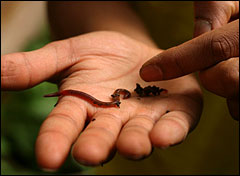
A worm bin is a shallow box filled with worm bedding, Eisenia foetida worms and other organisms, and unwanted human food. We put our food scraps into the bin, burying them in the bedding a little, and the micro- and macro-organisms scurry about, turning them into a lovely compost (detail on worm care can be found here). A well-managed worm bin will have almost no odor, because there is no anaerobic rot. There will be rot if the human adds more food than the worms can handle, and this limited capacity must be why worm bins have not taken the world by storm. There can be no other explanation.
The bin needs to be about a foot or two deep, dark, with drainage holes for the liquid compost and a lid. Plastic tubs from the hardware store are perfect -- they come in various sizes, they're cheap, and it's easy to make holes in them. (But remember, no vinyl, that's final!) You will need some way to catch the liquid as it emerges from the holes. Check out Seattle Tilth's excellent, detailed "Off-the-shelf Worm Bin Plans" for a closed system consisting of two stacked plastic tubs and a spigot. It does require a shopping trip to the hardware store and a bit of assembly. If you just want to slap two tubs together, drill holes in the top one, and remember to regularly pour off the liquid from the bottom one, that will probably work.
Those of you with carpentry skills could also build a wooden worm bin (see Seattle Tilth's "Worm Bin Plans"), or a trip to the thrift store might turn up a lidded wooden box that would be easily adapted. Don't use a cedar box or any pressure-treated wood; both will be toxic to the wormies.
As to the size of the bin: A two foot-by-two foot box is supposedly big enough to handle about three and a half pounds of food scraps per week. I know, who weighs their food scraps? But give it a guess.
I don't have the space to go into detail about worm bin care, so any readers setting out on their first wormy journey should read up about the bin, the bedding, feeding the worms, and extracting the compost. The internet is filled with excellent information, or read the classic book Worms Eat My Garbage, by Mary Appelhof. Start them out slow, give them time to build their numbers, and soon they will be merrily chomping along.
Foetidaly,
Umbra
Comments
View as Flat
cricketbird Posted 11:28 pm
02 Nov 2008
Everyone I know who's worm-composted has had that dreaded week when they put too much food in and it killed all or most of the worms and created a smelly mess. You can avoid this (and I've avoided it for three years now) if you just go slow, put in a little, and see how quickly it disappears, then put in a little more, etc., until you find the limit of your bin. The worms can go a LONG time without food, so even if you go on vacation, don't load them up beforehand thinking they will starve.
Worms eat more when it's warm, and less when they're cold, so think about that when you plan where they will go.
Permalink
MoxiePixie Posted 6:10 am
03 Nov 2008
Permalink
oddtree Posted 6:37 am
03 Nov 2008
You may not be able to find a sturdy alternative though.
Permalink
JL Posted 10:32 am
03 Nov 2008
I started with the Off-the-shelf design Umbra referred to but made the following modifications
- bin was smaller W:15" x L:18" x H:15". Bought two of those rubberneck ones... cheap.
- made about 12 1" holes in the bottom.
- covered bottom with screen netting and hot glued with a few glue spots
- forget about the top vents, impossible to find. Just drill 8 2" holes on the sides close to the top and hot-glue (all round) some moskito netting to prevent flies from getting in.
- put the prepared bin into the other one. Use something as a spacer to raise your bin inside ther other one so that the worms don't soak.
- Forget about the spigot. Hard to find and you can just take the bin out of the drainage bin and pour the liquid out.
This system can be stacked . I've got two of these bins at home, stacked. No one in the house knew about my first one for months. I even had it at work for a few months without anyone noticing.
Don't worry too much about bedding and all that. Once they get started... gradually... they'll take whatever you give them even if it's not balanced carbon vs. nitrogen. Stay away from meats and the other obvious things you'll read about in books and web pages. Also, I found that onions never decompose that that broccoli stinks it up so I leave that out.
You may have problems with flies occasionally. If it becomes a problem, vacuum them up and then start wrapping your food scraps in non-colored newspaper (color is toxc) before you put into the bin. After a week or two, that should solve it.
Another thing I learned the hard way, is to keep their diet a little balanced. Like once I put a pile of coffee grinds... stank up the place from the mold. Another time I put a whole rotten cantilope... the vermicompost tea was putrid! They benefit from variety, just like us :)
Books: I highly recommend either "Worms eat my garbage" (layman) or "the worm book" (a bit more detailed info about worms, cool).
If you ask around, you might find someone that has some worms to get you started. Don't need much, they'll build up.
Currently have a demo bin at my desk made of 2 peanut butter pastic tubs, 1 month and no smells. ;)
Permalink
ecotyro Posted 10:33 am
03 Nov 2008
Permalink
wormmainea Posted 11:24 am
03 Nov 2008
Check it out: http://www.wormmainea.com/Bins.html
You don't need anything fancy!
Mark
Permalink
DenaOdell Posted 11:47 pm
03 Nov 2008
It sounds like a lot of work, but it's really not, especially when you get into the habit. I use an old blender with a glass pitcher. During the week, I put scraps straight into the blender I keep on my counter (you can keep it under the sink, if you want). When it is full enough, it takes about 20-30 seconds to blend it with some liquid, and then I pour it into the worm bin. It hardly takes any more time, and the results are fantastic. I believe I have the happiest worms in the world!
Permalink
Bokashi Boy Posted 3:50 am
04 Nov 2008
Permalink
dancingwolfgrrl Posted 9:32 am
08 Nov 2008
One thing I've learned since then: the $8 tupperware bins work fine! The ones to stay away from are the $3 ones made by Sterlite. Also, I've had the most success with wetting only about half of the newspaper I put in. If they're climbing for the top, it's too wet!
Permalink