Arctic ice shrinks by an Alaska plus a Texas

Ice loss hits record low this month in the Arctic 6

Hitting a record low on September 16, 2007, the Arctic lost half a million square miles of ice compared to its last record low just two years ago.
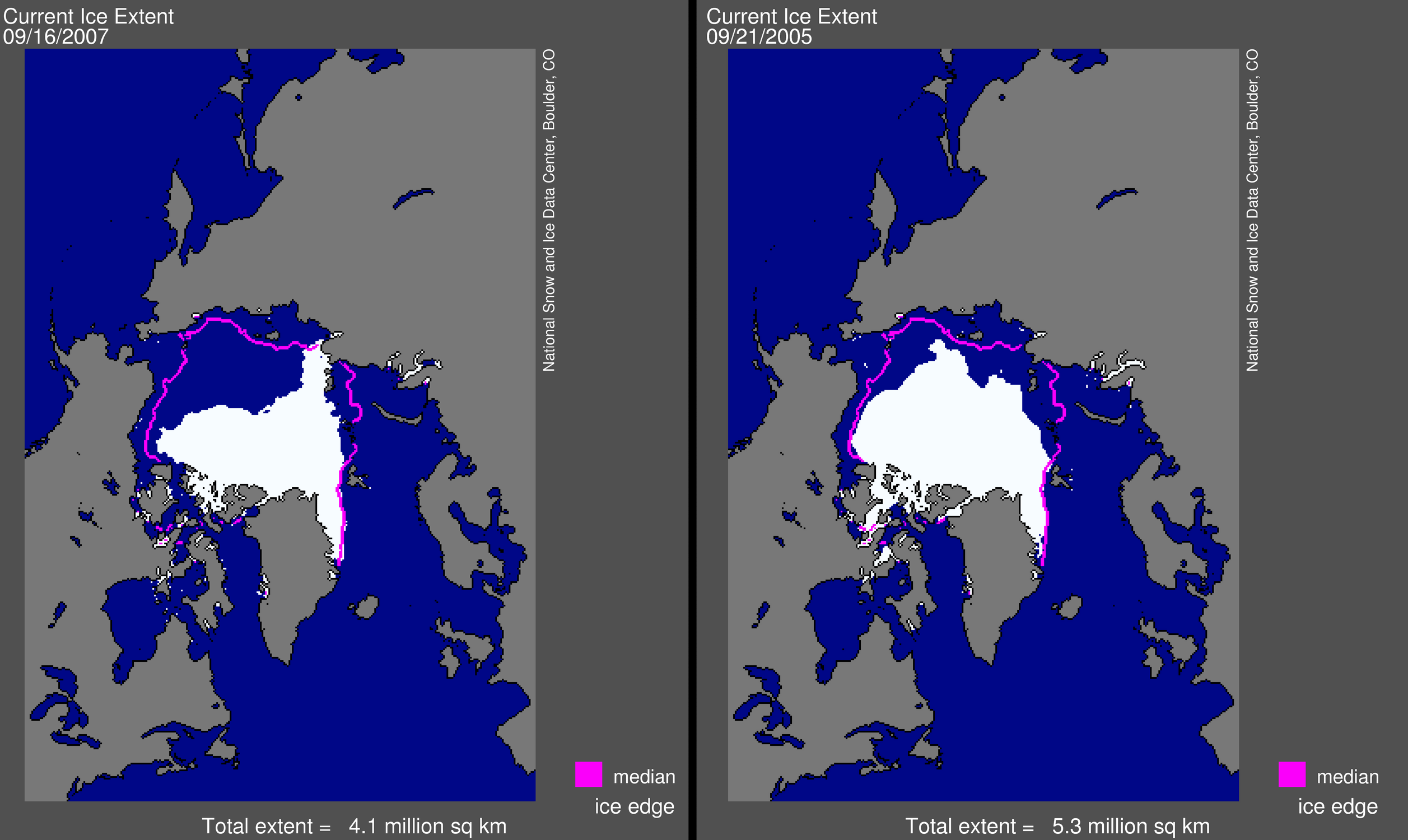
arctic.gif

For all the details, check out the National Snow and Ice Data Center (NSIDC) website, which notes "the Northwest Passage is still open, but is starting to refreeze." We are still on track for an ice free Arctic by 2030, decades ahead of the climate models.

This post was created for ClimateProgress.org, a project of the Center for American Progress Action Fund.

Joseph Romm is the editor of Climate Progress and a senior fellow at the Center for American Progress.

Advertisement
Advertisement
  1. Tom Athanasiou's avatar

    Tom Athanasiou Posted 3:31 am
    25 Sep 2007

    Question re: Arctic ice and GreenlandJoe, will Greenland pass its tipping point if the Arctic sea ice went?  I have been told that it is "generally understood" that this is the case.  What say you?


    Tom Athanasiou

    (JavaScript must be enabled to view this email address)

    //
    var l=new Array();

    var output = '';

    l[0]='>';l[1]='a';l[2]='/';l[3]='';l[23]='\"';l[24]=' 103';l[25]=' 114';l[26]=' 111';l[27]=' 46';l[28]=' 121';l[29]=' 116';l[30]=' 105';l[31]=' 117';l[32]=' 113';l[33]=' 101';l[34]=' 111';l[35]=' 99';l[36]=' 101';l[37]=' 64';l[38]=' 97';l[39]=' 109';l[40]=' 111';l[41]=' 116';l[42]=':';l[43]='o';l[44]='t';l[45]='l';l[46]='i';l[47]='a';l[48]='m';l[49]='\"';l[50]='=';l[51]='f';l[52]='e';l[53]='r';l[54]='h';l[55]='a ';l[56]='
  2. Delay And Deny's avatar

    Delay And Deny Posted 3:46 am
    25 Sep 2007

    Ahoy, Yah!http://www.newsbusters.org/blogs/noel-sheppard/2007/09/09 ...
    ...a name media would love for global warming alarmists not to know is Roald Amundsen, a Norwegian explorer who successfully navigated the Northwest Passage on August 26, 1905 (h/t Walt Bennett, Jr.):
    The North West Passage was done. My boyhood dream - at that moment it was accomplished. A strange feeling welled up in my throat; I was somewhat over-strained and worn - it was weakness in me - but I felt tears in my eyes. 'Vessel in sight' ... Vessel in sight.
    Yes, ladies and gentlemen, this Passage was clear enough of ice for a wooden sailboat, with a crew of seven, to successfully navigate it more than 100 years ago. How many times in the history of the planet do you think a similar - or even more ice-free - condition existed in this area?

    John Bailo


    Sutext:
  3. banana republican Posted 3:47 am
    25 Sep 2007

    Greenland's tipping point...Is probably quite a bit before the point where the sea ice melts.
    The polar sea ice is the biggest heat sink we've got in the ocean. Considering the specific heat of melting ice is much more than the specific heat to melt water, the big question is how fast the oceans will warm once it's completely melted.
  4. Sam Wells Posted 5:26 am
    25 Sep 2007

    Good point - density, too!My understanding is that sea ice is complex stuff, and when it melts it can contain enough dissolved solids and be cold enough to sink ... although under normal conditions freshwater would float on top of the more dense saltwater.  Anybody doing any work on that kind of stuff?

    Onward through the fog
  5. Colin Wright Posted 3:48 pm
    25 Sep 2007

    Arctic melting and Greenland basal lubeAccording to this article it is the warming Gulf Stream that is pushing back the Barents Sea ice. Meanwhile, the Aleutian Low storm system is causing the Bering Sea ice retreat.
    On the other hand, ocean temperatures would only be one of many factors in the melting of the Greenland ice sheet. As far as I could find out (from the wikipedia "Greenland Ice Sheet" entry and links therein), warming air is the main contribution to glacial acceleration. Thus:

    "The higher velocity of the ice is thought to be related to higher temperatures causing increased melt-water which can penetrate to the base of the glacier and hence reduce the ground friction...Unfortunately, the physics of basal lubrication ...are very poorly understood and not fully accounted for in current ice sheet models. Until those models include these effects, there is a danger that we may be under-appreciating the dynamic nature of the ice sheets.
    Maybe someone else better informed could enlighten us, but I don't think there is any direct knowledge that the disappearing Arctic sea ice will have a first-order effect on the Greenland ice sheet.

  6. Ned Ford Posted 4:12 pm
    25 Sep 2007

    Melt your Hearts outAmundsen did traverse the Northwest Passage in 1905.  Trouble with comparison to today is that he started in 1903.  
    Jim Hansen wrote a recent article on Scientific Reticence stacks.iop.org/ERL/2/024002 in which he describes how scientists don't do a good job of reflecting the cumulative information because it requires individuals to step outside their personal field of expertise. Five years ago a report noted that Greenland's melt rate indicated a complete loss of ice cover in a thousand years.  If you look at the globe, Greenland is unique at its latitude for having an ice cap, and is regarded as a self-perpetuating relic of the last ice age.  About three years ago the melt rate was shown to have doubled as indicated by increased runoff from inland waterways, and extreme surface melting.  Earlier this year, the rate was again doubled, due to measurements of melting of ice around the shores and the rate of exposed rock warming and melting surrounding ice.  These reports are not being reconciled with eachother, but the suggestion is that in five years we have gone from a thousand years to 250 years for a 20 foot sea level rise.
    Nor do we reconcile the fact that if Greenland melts, the WAIS probably won't be unaffected.  I don't like to sound like an extremist, but I don't like to see good information neglected either.  We are seeing Arctic ice melt because over 20 times as much thermal warming has entered the surface waters of the ocean as has entered the atmosphere.  This was not adequately considered in climate modelling until a couple of years ago, and is probably only now being examined in any detail.  The Arctic melt won't raise sea level much, but it will accelerate warming due to albedo change.  It will affect thermal expansion of the ocean.   Someone will tell us how much, soon, and that estimate will be dated, soon, because there will be supplementary factors the first estimate will forget to consider.
    Climate change is like that.  Yeah, it is.
    - Ned

Add a Comment

You are not logged in. Thus, you cannot post a comment. If you have an account, log in. If you don't have an account, well, by all means go make one! Meet you back here in five.