Is the sustainable-agriculture movement essentially Luddite?
It’s a common charge — and a fair enough question. The Nobel Laureate Norman Borlaug, perhaps industrial agriculture’s greatest living apologist, deplores at every opportunity the organic movement’s supposedly technophobic ways. Addressing a graduating class a few years ago at Texas A&M — that factory for future big-ag farmers and execs — the octogenarian fulminated against “anti-technology critics [who] argue that humankind is being poisoned by modern high-yield agriculture and should return to traditional organic methods.” The great man went on: “These anti-science and -technology zealots are trying to retard — and even stop — the application of new science and technology.”
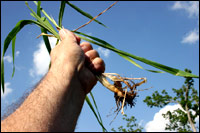
Weed it and reap.
Photo: iStockphoto
To be sure, conventional agriculture has utilized technology to awesome effect. The USDA tells us that U.S. farms in 2002 produced 2.6 times more food and fiber than they did in 1948, even as the number of farmers has fallen steadily. (I’ll not comment on the quality of that food.) More than once, hunched over in the field picking from a long row of green beans on a hot day, I’ve wondered what it must feel like to tower above the earth in one of those tremendous, climate-controlled combines, harvesting great gulps of corn at a button’s push.
I’ve never met a farmer who didn’t appreciate labor-saving tools — even those who do the handwork involved in small-scale, locally oriented organic production. What we require isn’t just any technology, but rather what the British economist E.F. Schumacher called “appropriate technology.” Dropping $100,000 for a gas-guzzling combine might make me feel like a million bucks, but it probably wouldn’t help me harvest that row of beans. So don’t call us Luddites, Mr. Borlaug; call us technology snobs.
Rather than scale up to fit in with modern agricultural technology, we want technology to scale down to our particular needs. Perhaps the leading innovator in creating appropriate technology for small-scale organic growers is the famed Maine farmer Eliot Coleman, who designs and markets ingenious little hoes and seeders catered to small growers. But that’s not all he does — which brings me to the real meat of this week’s column.
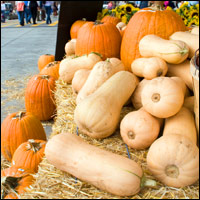
Smart investment could mean more than squash at the winter farmers’ market.
Photo: iStockphoto
Already tired of being harangued to “buy local” after the very first Victual Reality, one reader wrote to vent. She lives in South Dakota, “which has, as you might have heard, extremely long, cold winters.” She went on: “if all I bought was local production in the wintertime, I wouldn’t be buying anything but meat. I would have the same vitamin-deficient, fruit-deficient, vegetable-deficient diet that people had in the 1800s, when they lived on bread, beans, bacon, and potatoes for 6 months out of the year, and died in their 50s. A flu germ would kill me. If you want vitamin C, you’re gonna have to import.”
Well put. The winters here in western North Carolina’s high country don’t rival those in the Midwest, but they are too cold for most vegetables to thrive. I’ve bought more than my share of greens trucked in from California during the winter months. To be frank, and no offense to the mega-organic farms out West, those greens have little more flavor than iceberg lettuce by the time they get to the Appalachians.
That’s where appropriate technology enters the picture. Technology generally works to meet the challenges set for it. Borlaug and his associates sought technology that would dramatically increase grain yields, which they achieved. There’s no reason that any area’s farmers and consumers can’t combine efforts to extend the growing season into the winter months.
But where industrial agriculture’s solutions are by nature large, general, and capital-intensive, sustainable agriculture must seek small and particular answers to the challenges set for it. In my area, most farm fields are bordered by steep-sloping hills. Terry Carroll, a professor at Appalachian State University in nearby Boone, has been pushing a method for using those hillsides to extend our growing season here. Known as “passive-solar design,” Carroll’s work involves building greenhouses directly into south-facing hillsides. Along the rear wall — backed by a hillside’s robust insulating power — Carroll packs steel drums filled with water. As the sun streams in by day in the winter months, those drums store heat, which is released as temperatures fall at night.
Carroll’s test projects have proved that his design can support vegetable production all winter, with little or no fossil-fuel energy burned and no costly solar panels. But though the design is thus cheap in the long term, it’s more expensive to build than conventional propane-heated greenhouses. And as you might recall from the column that so incensed my South Dakota reader, small farms don’t generate enough cash for sufficient capital investment.
Even when we get a break, it’s sometimes still tough going. Early this year, we wrote a grant to a North Carolina foundation to build a passive-solar greenhouse on my own Maverick Farms. We used a budget for the project based on construction estimates from the year before. We got the grant, but the project remains unfinished. Why? In the year between the estimates and the groundbreaking, the price of concrete skyrocketed, pushed up by the Chinese construction boom. The grant suddenly wasn’t sufficient, and our own farm revenues couldn’t make up the difference. (Nothing, not even small-scale farming, can escape globalization’s effects.) Happily, Carroll came up with money to construct a much smaller, cheaper experimental passive-solar structure on our property, and this year we’ll have a go at growing greens throughout the long, cold winter.
Which is what Eliot Coleman, up in Maine, is famous for. He describes his bag of tricks in his classic Four Season Harvest, and has written elsewhere that “to make a real difference in creating a local food system, local growers need to be able to continue supplying ‘fresh’ food through the winter months … [and] to do that without markedly increasing our expenses or our consumption of non-renewable resources.”
If we wanted to make that vision come true for the nation’s northern climes, all it would take is research tailored to particular regions and investment capital. According to the Union of Concerned Scientists, the USDA spews out $1.5 billion per year for conventional-ag research and extension. Its excellent Sustainable Agriculture Research and Education program, by contrast, draws just $14 million. The research money is there; all we lack is the political clout.