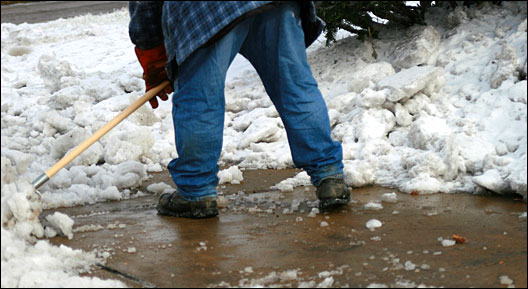
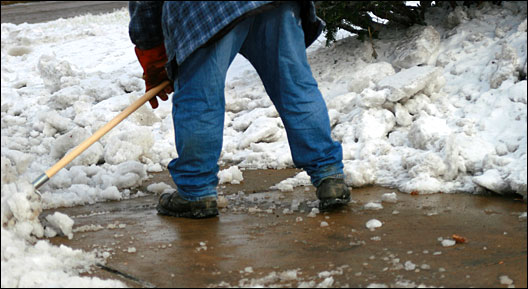
Shovel more, salt less.
In my family, perhaps in every family, there are stories so apocryphal that a simple phrase becomes a stand-in for the whole tale. One of ours is “salting the plants.” That refers to the time my mother, a high-school student prone to merry pranks, snuck in to her school dining hall at night and, well, salted the plants. Needless to say, the plants did not respond well to said prank; nor did my mother’s teachers, and her punishment was swift.
If there’s one lesson I took from that story, it’s this: Man, the ’50s were a different time, weren’t they? Oh no, sorry, it’s this: salt and vegetation do not mix. Which is why it seems a no-brainer that the huge amounts of salt spread on U.S. roadways each winter — an average of 8 to 12 million tons, according to the National Research Council, and more in snowy winters like this one — is not so eco-friendly.
Grist’s Pick
Give ice melt a miss. If you must use it, avoid sodium chloride.
As awareness grows about the drawbacks of wanton salt spreading — including not only damage to roadside vegetation but pollution of water supplies and corrosion of cars and bridges — consumers are beginning to search for alternatives. While municipalities study the best approach (and test creative alternatives), homeowners are left to their own devices. I decided to investigate the options. I’ll lay out three useful lessons I learned, then review three of the products I found.
Read the ingredients, not the claims. As is the case with food and beauty products, the ice-melt industry has cottoned on to the fact that people want green. Which means eco-claims abound. Read ingredient lists. If there’s no ingredient list on the package, don’t buy the stuff. And avoid sodium chloride; that common concoction is the worst of all the salts (and also, of course, the cheapest). For more details on alternative ingredients, see products below.
“Pet-friendly” means eco-friendly. Some brands may be more focused on safety to dogs, cats, and horses than safety to the landscape or water supply, but it’s a pretty good bet that if they advertise as pet-friendly, they’re better for your plants, your kids, and you.
Sometimes traction is enough. Do you really need to melt the ice, or can you just make it walkable? Everyday products like sand, sawdust, kitty litter (non-clumping), and ashes are proven ways to add traction to a slippery surface. They’re better for you, comparatively better for your immediate environment, and often cheaper too.
Now back to our regularly scheduled testing. Note: The products below represent just a few of the eco-options out there; availability will vary based on location. This list is not intended as an endorsement.
Earth Friendly Products Ice Melt
Eco-claims: Safe for pets and vegetation
Active ingredients: Magnesium chloride hexahydrate, calcium chloride (2-3%), potassium chloride (0.5-1%), sodium chloride (0.5-1%)
Price paid: $12/6.5 lbs.
Translated into English, this ingredient list reads, “salt, salt, salt, and salt.” Still, the bulk of the product is magnesium chloride, a safer and less corrosive salt than the more common sodium chloride. The melt’s white color can make it hard to see, which is both a plus (if you don’t want your driveway to look dirty) and a minus (if you’re trying to see where you’ve already spread). Performance was solid.
Paws Applause Ice Melt ‘n’ Traction Crystals
Eco-claims: Paws down, the pet-friendliest ice-melt formula
Active ingredients: Magnesium chloride hexahydrate, urea, Dolomitic limestone
Price paid: $15.32/20 lbs.
This pet-safe brand relies on magnesium chloride too, and includes urea, a fertilizer component whose use in deicers is controversial: it works, yes, but is damaging to waterways. This gray-black blend looks a bit like birdseed when spread, and just made things look dirty after a few hours. Of the three I tested, it was slowest to take effect, although it eventually did the job.
Inferno Ice Melter
Eco-claims: Melt the ice … protect your landscape
Active ingredients: Calcium magnesium acetate, potassium acetate, pure sea sodium, urea
Price paid: $19.90/50 lbs.
This blend contains two acetates, widely hailed for being less corrosive and damaging than salts (though recent research shows that potassium acetate, adopted by a majority of airports as a deicing agent, may damage aquatic life). Products containing CMA tend to be more expensive — sometimes 10 to 20 times more than salt — though in this case the price was good. And while Inferno’s lurid aqua hue (a tint intended for ease of use) makes your driveway look like a fishbowl, the stuff does work.
The Bottom Line: While all three of the ice melts I tested were effective, each contains at least one controversial ingredient. In fact, there is no perfect ice melt out there — so the best step on this slippery topic may be to avoid the stuff altogether.