The following is a guest post from Tom Casten, chairman of Recycled Energy Development LLC.
——-
Rep. Edward Markey (D-Mass.), chair of the House Subcommittee on Energy and Environment, along with Rep. Todd Platts (R-Pa.), has introduced legislation calling for 25 percent of U.S. electricity to come from clean energy by 2025. What will such legislation do to electricity costs?
Most pundits assume the current system is optimal, and thus claim that any mandate to change this “best of all possible worlds” will raise the price of delivered electricity. It is hilarious to think the protected and regulated electric system is optimal, but depressing to realize no one is laughing. Consider two questions:
- Do market forces drive electricity suppliers to lowest-delivered-cost solutions?
- What is the delivered cost of clean energy from various generation options?
What market forces? All electricity distribution systems and many generation plants enjoy monopoly protection. Subsidies abound. Profits are guaranteed. Old plants can legally emit up to 100 times the pollution of a new plant. A century of rules reward and protect yesterday’s approaches and the resulting vested interests.
Congressman Markey has never seen current generation as optimal, and now that he chairs the relevant subcommittee, he proposes to mandate cleaner and, in our view, cheaper electricity generation. Yes, we said cheaper. Anyone interested in some facts?
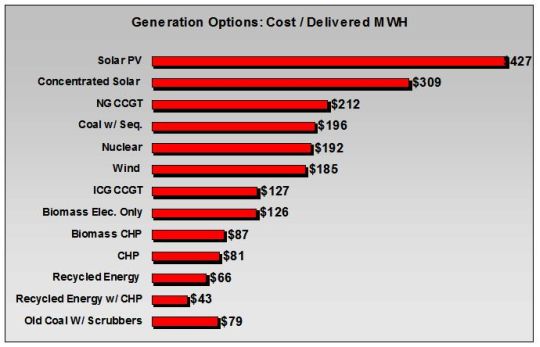
The chart below depicts a comprehensive analysis of the delivered cost of a megawatt-hour from old coal plants and from 12 cleaner options. The bottom bar depicts societal delivered cost from an old coal plant that has been retrofitted with pollution controls to meet 2015 EPA standards. This coal generation, the dominant form of U.S. generation, emits 1.05 to 1.25 tons of CO2 per delivered MWh. The other bars depict the cost of delivered power from 12 generation options with reduced or no CO2 emissions. The costs include capital amortization for generation, transmission and distribution and backup generation, plus fuel and operating costs and line losses, all spread over each technology’s likely operating hours per year. The costs also exclude all subsidies and thus depict full societal costs for each generation option.
Source: Internal analysis of Recycled Energy Development LLC.
The three lowest cost sources of clean energy cost less or the same as power from the dominant old coal plant generation, but these carbon-free and low-carbon options supply only 7.5 percent of U.S. generation. Instead, 56 percent of U.S. power comes from more expensive and dirtier old coal.
Every passing month sees more power industry requests to regulators and states to approve investment (i.e., guarantee returns) in integrated coal gasification plants, nuclear plants, and experimental coal plants that will attempt to sequester some of the CO2 emissions. These central generation options the power industry favors will cost the public between $127 and $212 per delivered MWh, which is three to five times the cost of power from the cheapest clean option—recycled waste energy. Sadly, some state governments are drinking this power industry Kool-Aid. Illinois just passed a law requiring distribution utilities to pay $210 per MWh (21 cents/kWh), plus delivery, for power from a new coal plant that hopes to sequester half of its CO2.
Many environmentalists lobby for a pure renewable energy portfolio standard, excluding the cheaper clean options. This mandate would effectively induce wind power, given the high cost of solar. New wind generation can deliver power at a lower cost than nuclear or coal with sequestration. What is surprising is that new wind is less expensive than delivered power from natural gas combined cycle plants. Yet the power industry has deployed 120,000 MW of new natural gas generation capacity since 1995. Capital costs for new gas turbine plants are less than half the cost of new wind capacity, but natural gas is so expensive that the plants operate less than 25 percent of the time. The capital recovery is spread over relatively few MWh. Our analysis assumed 30 percent per year load factor and still found natural gas more expensive than any technology but solar.
So much for the myth that “market forces” work in the electricity space.
Could government unleash market forces in the electricity space? Sure, but look at the changes required and then count votes:
- End all subsidies of petroleum, coal, nuclear, wind, biomass, and solar energy
- Repeal all electric distribution monopoly protection and allow anyone to install private wires
- Repeal all generation monopoly protection
- Privatize all federal power agencies, rural electric cooperatives, and rural utility service, exposing these customers to the cost of private capital
- Remove all rate making assurances of return on utility investment in generation, transmission, and distribution
- Remove all grandfathered permit status from all existing electricity and thermal generation plants and replace with output-based allowances that decline over time, forcing all generators to bear the cost of pollution
- Add carbon dioxide to the list of regulated pollutants and apply the same rules as above, thus sending price signals on the cost of pollution
What is the probability of the above changes to laws and regulations? Precisely zero!
Reps. Markey and Platts propose the next best thing, forcing the deeply protected power industry to move towards cleaner (and overall cheaper) generation options.
Comments
View as Flat
Nickz Posted 3:25 am
08 Feb 2009
The costs are generally higher than I would have expected, and I don't think the article will have credibility if no one can examine it's foundation - the "Internal analysis of Recycled Energy Development LLC".
Renewables's obstacles aren't technical, they're social: 20% of the workforce might be obsolete... http://energyfaq.blogspot.com/
Permalink
BILL HANNAHAN Posted 5:57 am
08 Feb 2009
What is surprising is that new wind is less expensive than delivered power from natural gas combined cycle plants. Yet the power industry has deployed 120,000 MW of new natural gas generation capacity since 1995. Capital costs for new gas turbine plants are less than half the cost of new wind capacity, but natural gas is so expensive that the plants operate less than 25 percent of the time. The capital recovery is spread over relatively few MWh.
The latest cost estimate for T Boon Pickens 4,000 MW wind project is $12 billion.
http://earth2tech.com/2008/06/10/cost-estimates-of-t-boon ...
Subtracting $2 billion for transmission lines (separate from the $3-6 billion for transmission lines to support wind power put up by ERCOT), the cost of the installed windmills is $2.50 per data plate Watt. Assuming a 35% capacity factor that is $7.14 per watt of production. The cost of wind mills to produce as much energy as a 1.5 GW nuclear plant with capacity factor of 90% is $9.6 billion.
But wind power is intermittent and subjected to wide spread common mode failure and seasonal variation. Wind needs conventional plants to stabilize the grid. Coal plants are designed for a 40 year lifetime and in 2007 the average age of a U.S. coal plant was 40.7 years. More gas plants will be needed to backup the windmills and stabilize the grid as coal plants are decommisioned. The cost of the gas plants and their emissions and the extra transmission lines should be added to the windfarms cost and emissions, but they are not included in the $7.14 per watt of wind power or the much lower wind cost quoted here.
From the Marky bill;
FEDERAL RENEWABLE ELECTRICITY
21 CREDIT.--The term `Federal renewable electricity
22 credit' means a credit, representing one kilowatt
23 hour of renewable electricity, issued pursuant to sub24
section (d)....
A retail electric supplier may satisfy the require3
ments of paragraph (1) in whole or in part by sub4
mitting in lieu of each Federal renewable electricity
5 credit, a payment equal to the lesser of--
6 ``(A) 200 percent of the average market
7 value of a Federal renewable electricity credit
8 for the previous compliance year, as determined
9 by the Secretary; or
10 ``(B) 5 cents, adjusted on January 1 of
11 each year following calendar year 2009 based
12 on the Gross Domestic Product Implicit Price
13 Deflator.
COST RECOVERY.--An electric utility, the retail
19 electricity sales of which are subject to rate regulation,
20 shall not be denied the opportunity to recover the full
21 amount of the prudently incurred incremental cost of re22
newable electricity or Federal renewable electricity credits
23 obtained, or alternative compliance payments made, to
24 comply with the requirements of subsection (c).
25
This is the price we pay for electing law school graduates instead of science and engineering graduates. They think that their laws can supersede natural law. It should be retitled the "Death for Poor People" bill.
These laws will further distort our energy systems leading to delay in development of good technology, higher prices, less reliability, and a lower quality of life here and all over the world. The people on the bottom rung of the economic ladder will suffer the most while our leaders pat themselves on the back at cocktail parties for doing such a great job.
I support the authors points 1 thru 7. The best solution is to level the field by adding all externalities, eliminate all subsidies and mandates, maximize R&D and let the market pick the best technology.
http://gristmill.grist.org/story/2009/1/5/132847/2209/#co ...
Instead of wasting our money propping up bad technology we should be spending it on the development of better technology while fossil fuel is still relatively abundant and cheap. Development is the expensive part of R&D and it is the part we have done very little of in the last 40 years, and we are just starting to pay for that.
Things Everybody Should Know About Energy
Permalink
Tasermons Partner Posted 6:20 am
08 Feb 2009
Apparently, you haven't heard that poor people are disproportinately affected by pollution from conventional power plants.
Likewise, conventional power plants also lower the property prices of surrounding land, essentially turning the investments of land owners into much less than what they could potentially be.
Wind power companies also often pay people sums for windmills that operate on their property, sometimes farmers or landowners who would otherwise be forced outta business due to otherwise stale economic conditions.
And renewables also create more jobs (per energy produced) than coal and some fossil fuel endeavors.
And because many large-scale renewable projects are located in rural or underserved areas, they contribute additional monies to local underserved school districts, resulting in greater educational opporunities.
Renewables help poor people much more than conventional and fossil fuels have.
Permalink
energy engineer Posted 7:10 am
08 Feb 2009
So the only real difference in the impact of Wind from dirty fuel is dispachability, not cost. As Gar has shown in the past, this can be resolved by a stronger grid (which we need anyways) and geographically-dispersed turbines.
All that said, recycled energy sounds very viable, with only stupid administrative obstacles holding it back. We have a race against time that we are losing, and I get the impression that this would be relatively quick to build out.
Is this true? I hope so...we will need many of these solutions in order to shutdown coal, starting very soon.
Permalink
GreyFlcn Posted 7:26 am
08 Feb 2009
http://greyfalcon.net/dubainukes.zip
-David Ahlport
Permalink
David Roberts Posted 8:38 am
08 Feb 2009
Weird how waste energy seems invisible to people. Even people reading an article about waste energy!
grist.org
Permalink
Karen Street Posted 9:03 am
08 Feb 2009
You're right, it's about waste energy. One problem is that that's not the argument that any of us intend to have, we all believe in using waste energy, up to a point. I visited a waste dump where the methane that used to be flared was now producing electricity, but it required a fairly substantial subsidy.
But the numbers do come across as non-mainstream analysis, including the current percentage of electricity that comes from coal. Since we're not going to get 25% of our energy from waste, and it's not clear to me that old coal with scrubbers counts as waste, and coal with scrubbers produces more GHG/kWh than the old polluting kind, and biopower pollutes but for some reason is called clean, the question is, where is the 25% clean electricity coming from?
I also don't believe that policy people believe in getting rid of subsidies for wind. Last I read, and this may no longer be true, a GHG tax that eliminates coal is insufficient to bring wind into the mix, and we want to bring wind into the mix. Even though wind must be subsidized, and even though wind uses fossil fuel backup (hopefully with CCS within a decade or two), it will be an important part of our energy portfolio.
I'm not really sure we want to go back to the days when anyone laid wires--it used to be chaotic when our population was much, much smaller.
Karen Street
Permalink
ids Posted 11:17 am
08 Feb 2009
Wierd about how Gristwash can't.
Permalink
jeffgreen11 Posted 12:08 pm
08 Feb 2009
This aritcle is very short term. Its the long term goal that is needed. Following cost willynilly is why we have the funky energy system we have now. Long term thinking is needed with leadership to reach that goal.
Its the consistent building over time of the energy infrastructure. Long term thinking is needed with leadership to reach that goal.
Permalink
Tasermons Partner Posted 1:16 pm
08 Feb 2009
It's like "clean coal" in that it's really just nothing more than a massive PR campaign.
Could it be viable? Yes.
Will the coal and fossil fuel companies or electric utilities ever get 'round to actually doing it on a very large scale? Almost certainly not.
But they can say that the possibility exists and that they're "working on it", so why go with "more expensive" renewable energy instead?
Just like "clean coal".
* rolls eyes *
Permalink
Gar Lipow Posted 4:56 pm
08 Feb 2009
Permalink
Gar Lipow Posted 5:05 pm
08 Feb 2009
Currently the compressed air is heated by natural gas as it expands. Thus much of energy to drive CAES turbines comes from natural gas. This is usually understated by comparing the gas used to drive a CAES turbine to a single cycle natural gas turbine driven without compressed air. But given the capital costs of CAES, a better comparison would be first rate combined cycle gas turbine - running at 58% to 60% efficiency. And it turns out the compressed air turbine uses only about 15% less natural gas per kWh than plain old highly efficient natural gas turbines. Hence, not much of a "storage" means. I should point out that when CAES first was developed combined cycle turbines were not in widespread use.
Permalink
kellermfk Posted 11:26 pm
08 Feb 2009
The "recycle energy" is generally cogeneration where energy from an industrial source is also used for electrical generation, creating chilled water for say air conditioning, etc. The applications are quite limited and thus "recycle energy" is not amendable for large scale use.
Unclear how the "costs" of generation were created; data seems inconsistent and unclear whether comparisons are "apples-versus-apples".
Permalink
tdmeeh Posted 11:50 pm
08 Feb 2009
http://www.warren-wilson.edu/~tmeehan/Sovakool_2008.pdf
Best,
Tim
Permalink
Sean Casten Posted 11:59 pm
08 Feb 2009
We've got a spreadsheet and will post as soon as Tom's computer is back near an internet link. The request is a good one, as it necessarily forces the conversation to the assumptions rather than assumptions about the assumptions. Apologies for not posting sooner.
Re: recycled energy vs. recycled energy w/CHP, here's a primer to our internal jargon: You have places where there is waste energy available from industrial waste heat to digester gases from water treatment plants. The broad commonality of those applications is that they involve the recovery of energy that would otherwise be wasted, leading to zero incremental emissions but generating power that can displace something dirtier off the grid. This, per the parlance in the chart is "recycled energy", and it is available anywhere there is waste energy. "Recycled energy w/CHP" is a subset of that space where the source of waste energy also has a thermal load, such that the energy recycling facility can generate both electricity and heat. It is more cleaner and often cheaper than CHP, but only available where there is a local thermal source.
A few examples may illustrate:
We are currently doing a project in West Virginia at a silicon plant, recovering waste heat from their submerged arc furnaces to generate ~45 MW of fuel-free power. The only significant use for thermal energy at the plant is in their arc furnaces, where the temperature requirements are so high (>4000F in the pile) that they can only be met with electricity. As such, our power plant will turn hot gas into steam and steam into power + soggy steam, but we must then install a condenser to turn that soggy steam back into water. That is pure "recycled energy", in our parlance - but note that the condenser is still wasting energy, heating up ambient air to cool the steam down and return the water back to our plant. It's a vast improvement over the current state of affairs (to the tune of 45 MW), but obviously not perfect, in the sense that it does not eliminate all thermal waste.
By contrast, a predecessor company did a project at a steel mill in northern Indiana recovering heat from the coke oven gases that were previously flared. Same basic configuration with hot industrial waste --> steam --> power. However, in that case, the plant uses a large amount of steam for process needs as well, so in addition to making power, the plant recovers the low pressure steam to meet process needs, effectively shutting down a coal boiler in addition to making 95 MW of fuel-free power. This, in our parlance, is "recycled energy w/CHP".
The latter is clearly more efficient, as it squeezes more useful Btus out of every wasted Btu. It also is often cheaper, since you don't have to install a condenser. In aggregate, these two factors explain why it has a lower calculated cost per MWh in the chart. However, since you cannot transmit thermal energy over great distances, it's opportunity space is somewhat more limited to those locations where wasted energy exists and there are significant on-site thermal loads.
(By contrast in the chart, "CHP" refers to fossil-fired combined heat and power plants that are substantially more fuel efficient than the grid, but not 100% fuel free.)
Hopefully that helps clear up some of the confusion?
Permalink
Gar Lipow Posted 1:06 am
09 Feb 2009
Permalink
amazingdrx Posted 1:26 am
09 Feb 2009
Because when and where the waste energy is produced it can't be used. Do you move buildings, factories, and cities to the generation points? No, that would be too slow and inefficient.
Do you move the power plants? No, it can't be done cost effectively with conventional power plants and wind, solar, and water power only exist in exploitable concentrations in certain regions and at times designated by nature. So what can be done?
A national HVDC super grid solves the problem. Could it cut 50% off of fossil and nuclear generation next week? Probably not, but using a super grid as a kind of national "battery" that would accept all the waste energy and renewable energy when and where it's generated, then provide a stable supply at anytime it's needed, could change the situation.
A grid like this slows down the rate of change in the system, that gives conventional sources the time needed to adjust to changing renewable supply and changing demand. That's the problem with coal and nuclear plants acting as backup, they can't be turned on/off quickly and efficiently.
It would allow a smooth transition between the present centralized power grid and a new distributed renewable smart grid. Efficiently drawing power from as many different widespread, diverse sources as possible.
Efficient low loss transportation of electricity, a real free market from coast to coast.
Computer modeling needs to be used to simulate the effect of a super grid on grid supply/demand timing problems caused by renewable intermittency and efficiency projects like this silicon furnace cogeneration system.
You can't shut the sun, wind, or waves or the silicon furnace on/off to match demand. With a national super grid acting as a "battery" you wouldn't have to.
Even in cases of a large surplus of renewables, the super grid could send the extra power to pumped hydro storage, desalination pumps, or even directly connected super capacitors or superconducting electromagnetic energy storage.
Eventually combustion and nuclear based power would not be necessary, but these would stabilize the super grid as long as it is necessary.
http://amazngdrx.blogharbor.com/blog John Schneider, Northern Wisconsin
Permalink
Karen Street Posted 1:42 am
09 Feb 2009
Using this, I found that IEA estimates wind costs at $75 - $97 MWh for high to medium wind sites, not counting upgrading grid or backup (generally expensive natural gas). Since 2004, turbine costs increased 20 - 80%.
I found nuclear costs to be $30 - $57/MWh. Presumably this has risen as well, with commodity costs. Transmission costs, which are lower than for wind, are not included.
Wind should be cheaper in US than Europe due to greater capacity factor here. IEA numbers assume economic lifetime of 25 - 40 years for a nuclear power plant, which means that the rest of the 80 years or so expected lifetime with operation costs below 2 cent/kWh is gravy.
Karen Street
Permalink
Pompey Road Posted 1:46 am
09 Feb 2009
As Yogi Berra once said its like déjà vu all over agai. It is more than just a little ironic to me that just as the country has an administration that is more inclined to be environmentally responsible and an advocate of alternative energy the country also has entered into a deep recessionary period. Some are predicting a depression. Well if history is repeating itself as when Roosevelt invested millions in energy related jobs to tackle the unemployment and expand a power source for home and industry, maybe we will be able to do the same with alternative energy.
The millions spent of the Hydro Dams out West and the TVA projects out east have paid back the economic portion of society 10 fold. No discussion here on the environmental impact. If the same thinking is applied on the same scale to alternative energy during this new economic collapse we should see the same results.
I know some will moan about the massive spending especially on the portions they will call waste. I will point everybody to the billions spent on the project to produce two bombs plus the one they exploded in the desert out West to see if it would work. Again no philosophical discussion of anything other than the economic.
If we have the will to spend the massive amount of money on alternative energy and mass transit we will reap the same future benefits as we did when we developed the TVA only with energy sources that do not destroy the planet.
The only difference this time will be the need to come out on the back side with an alterative energy and transportation manufacturing based economy without having to bomb every other countries manufacturing base to powder.
The spending and depression era programs and even the banking and market reforms never really got us out of our last depression. Pre depression employment never regained the same numbers until 1942. We become the manufacturer to the World only after Europe had Japan had its manufacturing capacity destroyed by that devastating war.
The trick this time will be to persuade the economist that the NEW WORLD ORDER economics of Bush I will not cover or replenish the massive debt we will accumulate during this latter Roosevelt style economic and social reordering. The multinational corporate model of this new universal capitalism that seeks cost reduction for labor and materials at the expense of their host country will have to be reevaluated. We can't fall back on a protectionist model or a nationalistic one but we will have to develop an economy that is at least 30% manufacturing based.
The manufacturing will now have to be worked around the newly created WTO and other trade agreements but it must be done to create a balanced economic system. A mix of service, information and tech jobs with a healthy manufacturing base is the only answer to a consumer economic model based on credit that has obviously failed.
The massive amount of borrowing will be an inflationary monster in short order after our bonds are degraded because China and Saudi Arabia pull back on their lending. The interest rate on the second and third round of money we will have to borrow will be the end of this economic model and cause the total collapse of this economic system. We have one chance only to get this right. Alternative Energy fueled economy with the alternative energy and transportation manufacturing jobs remaining primarily in the U.S. The icing on the cake would be for some Alternative Energy related manufacturing for Export paying off the massive amounts of debt we now have.
The eons of time and nature was good to us down here. It was not until we become civilized that destroying our habitat become fathomable or fashionable.
Permalink
Sean Casten Posted 3:06 am
09 Feb 2009
My suspicion, subject to verification is that their analysis includes one or more of the following:
It ignores the costs of distribution
It may include subsidies
It may exclude capital recovery
The point of Tom's analysis was to capture all universally. Note that some sources (e.g., CHP) are innately local and therefore avoid most/all of the transmission costs. This is blindingly obvious to anyone who has ever compared their retail price of power to wholesale prices, and yet absent from most analyses that make the implicit assumption that for rooftop solar to compete, it must be cheaper than central coal, as if that had any bearing.
Any new source must recover capital, and some of our biggest subsidies have to do with the fact that our regulatory model reduces the risk to some technologies. Thus, you often see analyses that compare marginal coal to new-build solar (or some other such metric) and conclude that the former pencils because the capital is already recovered while the latter can't compete in spite of it's lower variable costs because of capital recovery. It's tantamount to saying that you won't take a $70,000/year job because 5 years ago you earned $100,000. Interesting, but irrelevant.
(It is relevant if one is trying to figure out what is the next generator to be dispatched on the grid right at this moment, but not if we're trying to figure out what technologies ought to be built in the future.) To be honest, that larger societal question can only be answered if you include the full capital #s for all technologies and apply a consistent discount rate to all, so that you can then figure out which technologies may or may not be worthy of support. Per your note, there's simply no way you get to those nuclear numbers if you have to amortize capital at anything approaching market rates.
Final point on the subsidy side, it is extremely difficult to get an apples:apples comparison with wind, for all the subsidy reasons above; those deployments have been so heavily shaped by tax credits and resulting tax equity vehicles that you have a huge swing of #s out there. The subsidy free # is Tom's, but that doesn't change the reality from a utility planning perspective that they may well have power purchase agreements at substantially lower prices by virtue of the tax incentives.
I realize that this conversation will all be much easier once you have access to the spreadsheet. But just looking at those numbers, I'm quite certain it is not an apples:apples comparison.
Permalink
Gar Lipow Posted 3:16 am
09 Feb 2009
Permalink
Sean Casten Posted 3:32 am
09 Feb 2009
Biomass has a decided advantage over coal with CO2 sequestration for obvious capital reasons. The biomass bar that does show an advantage is the one that includes CHP, which is function of the thermal credit - obviously not available to large-scale, remote, central-station coal.
So wood doesn't end up cheaper than coal on a delivered, $/MWh basis if both are used in electric-only plants without CO2 control. Add waste heat recovery and/or CO2 sequestration on the coal plant and you start to get an advantage.
Permalink
TomCasten Posted 5:51 am
09 Feb 2009
Recycled Energy: Indusrial waste energy converted into electricity without further heat recovery
Recycled Energy CHP: As above, but instead of a condensing steam turbine that vents 75% of the exhaust energy, the thermal energy replaces boiler fuel. This approach has negative incremental fuel.
CHP: Conventional fossil-fueled combined heat and power, using a prime mover like a turbine or engine to produce electricity, and then recovering the exhaust for thermal energy.
These options all recycle otherwise wasted energy streams. The first two use byproduct heat from industrial processes while the third uses byproduct heat from electrticity generation
Biomass Electricity Only: Typical 20 to 40 MW biomass plant that condenses steam, achieves about 30% efficiency of fuel to power
Biomass CHP: Biomass, usually waste wood, that combines production of electricity first and then displaces boiler fuel with the low-grade thermal energy, and achieves 65% to 80% fuel to useful output efficiency.
Tom Casten
Permalink
TomCasten Posted 6:00 am
09 Feb 2009
Add a fantasy superconducting grid with no losses (vs.actual 7.5% average and 25% on peak losses) and it does nothing to utilize the 66% wasted byproduct heat at remote electricity generation plants (fossil, nuc or biomass) and does nothing to capture energy from industrial exhaust or flare gasses.
But if we built generation at factories ...
Tom Casten
Permalink
sunflower Posted 6:02 am
09 Feb 2009
Permalink
ids Posted 7:27 am
09 Feb 2009
Permalink