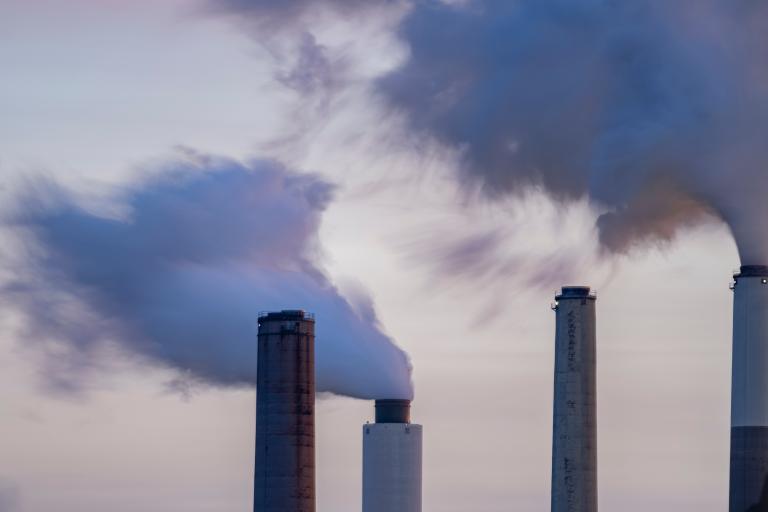
Say you said to yourself, “Gee, I wish we could prevent global warming.” Your next thought might be, “Gosh, where do greenhouse emissions come from?” Well, I asked myself just that question a while back. So I decided to jump into the IPCC Working Group III Assessment Report, and I’ve posted a Google workbook, called “GreenhouseGasEmissions,” which should let you know just about everything you always wanted to know about the global sources of carbon dioxide and other greenhouse gases.
The biggest surprise to me was the sheer number of major sources. I don’t know whether it would be easier to slay a few big greenhouse gas monsters or a bunch of medium-sized ones, but we’re basically stuck with the latter.
Speaking of monsters, according to my calculations, all coal-fired power plants together are responsible for 18 percent of global greenhouse gases (all of these figures are for 2004, in CO2 equivalent megatonnes, from IPCC Working Group III reports, and any errors are mine). Shutting down all coal-fired power plants would decrease greenhouse gas emissions by 18 percent—but that would still leave 82 percent, and I’m assuming we want to get as close to zero human-made greenhouse gas emissions as possible.
Amazingly, the fossil fuels (coal, oil, and natural gas) used to provide heat for buildings and industry are responsible for 21 percent of greenhouse gas emissions—more than all the coal-fired power plants. In a way, that statistic understates the importance of using carbon-free sources like wind, solar, and geothermal for electricity generation, because if we want to switch transportation from oil to electricity, we will have to replace transportation’s oil, responsible for 14 percent of emissions, with electricity sources that do not include the use of fossil fuels. And if we want to eliminate the emissions from heating, we will have to use carbon-free electricity and also redesign/retrofit buildings.
Forests might be some of the cheapest of the “lowest hanging fruit” to save, since they account for almost 16 percent of emissions. But I’m worried about what to do about belching livestock—how do we get rid of their 4 percent? It might be easier to prevent the 5 percent of all emissions caused by the overuse of nitrogen-based fertilizers.
Before we get into details, however, let’s take a stroll through the basics of greenhouse gas accounting.
There are various ways to look at the sources of greenhouse gas emissions, depending on the problem in which you are interested. The variation comes from the fact that fossil fuels are used to generate electricity, which is used for buildings and industry, and fossil fuels are also used directly in buildings, industry, and transportation. So is it important to know: the amount of greenhouse gas (GHG) emissions that fossil fuels emit? What the generation of electricity emits? Or what buildings or industry emit? It depends on what you’re interested in at the time.
Let’s start with my recalculation of a pie chart that the IPCC uses ([PDF], p.105), which separates electricity as a source of GHGs from each sector (you can see the following three tables at the top of the “Summary and Energy” tab in my workbook):
| Table 1. Electricity separated | ||
| Source | CO2 eq Mt | % of total |
| Electricity | 11,215 | 22.84 |
| Buildings | 5,515 | 11.23 |
| Industry + ff processing | 10,851 | 22.09 |
| Transportation | 6468 | 13.17 |
| Agriculture | 6,100 | 12.42 |
| Deforestation | 5,800 | 11.81 |
| Other forests | 18.62 | 3.79 |
| Waste Mgmt | 1,300 | 2.65 |
What this table means is that buildings emit 11 percent of GHGs before considering the electricity they use; industry, 22 percent. If we want to take the full account of GHG emissions for buildings, for industry, and the tiny bit for transportation, then we have to present a table that allocates electricity among buildings and industry (and the tiny bit for transport):
| Table 2. Electricity allocated to sectors | ||
| Source | CO2 eq Mt | % of total |
| Buildings | 13,215 | 26.97 |
| Industry | 13,893 | 28.35 |
| Transportation | 6,829 | 13.94 |
| Agriculture | 6,100 | 12.42 |
| Deforestation | 5,800 | 11.81 |
| Other forests | 18.62 | 3.79 |
| Waste Mgmt | 1,300 | 2.65 |
Notice that the last four entries didn’t change at all, because they don’t use electricity. These four I’ll call land use sources of emissions. Now, let’s say we want to know the responsibility of carbon dioxide from fossil fuels in our oncoming climate nightmare:
| Table 3. Fossil fuels separated | ||
| Source | CO2 eq Mt | % of total |
| Coal CO2 | 10,600 | 21.63 |
| Oil CO2 | 10,200 | 20.82 |
| Natural gas CO2 | 5,300 | 10.82 |
| Buildings | 2,000 | 4.08 |
| Industry | 2,130 | 4.35 |
| Agriculture | 6,100 | 12.42 |
| Deforestation | 5,800 | 11.81 |
| Other forests | 18.62 | 3.79 |
| Waste Mgmt | 1,300 | 2.65 |
| Methane from fossil fuel processing | 3,071 | 6.27 |
| Transportation nonCO2 | 636 | 1.30 |
Notice how buildings can be held responsible for 11 percent of total GHG emissions if electricity is separated out, up to 27 percent if electricity emissions are allotted to the final destination, and down to 4 percent if all fossil fuels are taken out (that last 4 percent is mostly gases from air conditioning, by the way). The decision about which to use depends on the question: What if we wanted to make all buildings zero emissions, that is, totally self-reliant for energy plus nonpolluting? Then use the 27 percent figure. What would we be left with if all fossil fuels were replaced with carbon-free sources? Use the 4 percent figure for buildings. And so on, for all sectors.
In part two, I’ll go through more details concerning the various main sectors. In the meantime, if you are so inclined, you can look at the “Details” tab of my workbook.
A note about sources: There are basically four sources of data from the IPCC for GHG emissions. First, there is a wonderful flowchart ([PDF], p. 259) from the International Energy Administration that shows the sources of energy and the final categories of use. Second, there are a few pie charts in the Introduction chapter of the Working Group III report ([PDF], p.103-5). Third, spread throughout the various chapters of the WG III assessment report are various pieces of data. Finally, the Netherlands Environmental Assessment Agency maintains a database called Edgar that is used throughout the IPCC reports.
However, these sources do not seem to match up exactly. Much of this is inherent to one problem: It is very difficult to estimate, over the entire globe, what humans are doing to emit greenhouse gases, and as the "Forestry" chapter explains, this is particularly a problem with forests (and to a lesser extent agriculture—energy use seems to be much easier to keep track of). However, the exact numbers are not important; what is important is to get some sense of the relative importance of various sectors, to know what sectors are involved, and ultimately, to solve the problem by eliminating virtually all GHG emissions.
Comments
View as Flat
Delay And Deny Posted 6:39 am
13 Jan 2009
Keep cooking the books so that you can sell more expensive plugin hybrids, and enlarge the money we pay to utilities.
...if there are self made Purgatories, then we all have to live in them.
--"This Side of Paradise", TOS
Permalink
Gar Lipow Posted 7:43 am
13 Jan 2009
Permalink
Jon Rynn Posted 7:59 am
13 Jan 2009
In other words, if we just focus on fossil fuels, we can see from table 3 that coal is responsible for about 22% of all GHGs, oil 21%, and natural gas 11%, without worrying about who's using what.
So for transportation, you can see from Table 1 that it is responsible for 6,428.
Now, if you look at the Google spreadsheet, on the "summary and energy" tab, I go into gory detail about where that comes from. It depends how you want to allocate, for instance, the methane that is released when processing fossil fuels, particularly natural gas; or if you just want to see CO2, which is 5,832 Mt, for transportation (assuming you agree with the way I allocate "losses" that coal, oil and natural gas involve).
So the short answer is, table 3 is showing fossil fuel CO2, and then everything else that is not fossil fuel CO2. Is that clear?
Permalink
Gar Lipow Posted 8:21 am
13 Jan 2009
Permalink
Jon Rynn Posted 8:46 am
13 Jan 2009
So industry has 2130 Mt quite separate from fossil fuels as energy -- much of that is from the production of concrete, which emits CO2 during the making of "clinker". However, the IPCC includes "nonenergy" fossil fuel emissions in this figure. They don't explain what they mean by that, but it may mean coal that is not used for energy, and oil and natural gas that isn't either -- the IEA figures are supposed to be exclusively for fuel-related uses of fossil fuel. At least, that's what I've been able to figure out. So maybe to be more clear, I should refer to "Coal CO2 energy" instead of just "Coal CO2", for instance.
Permalink
Curtis Moore Posted 10:29 am
13 Jan 2009
(For those seriously interested in an education on this subject, I refer you to the website of my book, saving-ourselves.com or my Health & Clean Air Newsletter, http://healthandcleanair.org/)
The six gases listed under the Kyoto Protocol and studied intensively by IPCC were selected in part because they cause global warming, but also because at the time they were listed the United States was pressing for a list that would facilitate emissions trading. Other nations, anxious to get the world's biggest polluter on board, yielded to U.S. demands for provisions that would facilitate emissions trading, because the Clinton-Gore Administration foolishly, and wrongly, thought U.S. industries might buy off on a regime based on emissions trading.
For trading to work--it never has, by the way--a molecule of one pollutant has to be roughly equivalent to another molecule of same pollutant. That, in turn, means the pollutant needs to be distributed roughly equally, so that the concentration of, say, CO2 is roughly the same over Berlin as over Bangkok and Baltimore. To reach such these roughly homogeneous distributions requires that the pollutants have relatively long lifetimes.
Thus, the "greenhouse gases" listed by the IPCC have lifetimes of up to 50,000 years (SF6). The shortest-lived is methane, which has a lifetime of about 12 years. Carbon dioxide, over which everybody is going crazy--and we absolutely, positively have to reduce CO2 emissions--stays in the system for about 3,000 years.
If you are scared to death, as I am, about what will happen if the Arctic melts, reducing CO2, SF6, etc. will not do the trick. To slow and preferably reverse warming and melting--which we must do to save ourselves--requires reducing emissions of other pollutants that cause global warming and have short lifetimes--and there are lots of these. Indeed, the non-Kyoto greenhouse pollutants are responsible a majority of the warming that has occurred to date.
Black carbon, for example, which is a major contributor to warming globally, but especially in snowy and icy areas like the poles and glaciers, has an atmospheric lifetime of one or two weeks. Tropospheric ozone, which most of us call smog, has a similarly short lifetime. Carbon monoxide (which destroys the hydroxyl radical that would otherwise scavenge methane) has a lifetime of a few minutes.
Trouble is, the levels of ozone or black carbon or carbon monoxide can vary immensely over a few hours or a few blocks. Therefore, they are not suitable candidates for trading. So the bad guys don't want them included, because there's lots and lots of dough to be made off selling emission reductions. (In one case, a $5 million investment yielded a $495 million profit--how do you like them apples?!)
On the other hand, we know how to reduce these non-Kyoto causes of global warming because we've been doing it for approaching a half-century to protect human health. These pollutants kill and cripple people who breathe, so starting in the 1960s California adopted measures to reduce them. Want to get rid of black carbon? Slap a trap oxidizer on a diesel. Want to eliminate methane? Collect and gasify cow, pig, poultry and human manure and use it to generate electricity, preferably with a fuel cell.
As to CO2, the rule of thumb is fairly simple: roughly two thirds comes from (a) powerplants and (b) vehicles. Emissions from powerplants could be cut roughly 66 percent by switching from coal to natural gas or using an advanced technology like IGCC or PFBC or using the 2/3s of the energy that goes up the stack or cooling tower as waste heat. Emissions could be cut 100 percent by making electricity from sunshine and wind. For cars and trucks, or their engines used on farms and construction equipment, vehicle miles traveled can be cut, decent bus and subway systems installed, congestion charges imposed, beefed up pollution controls required, etc. etc. etc., to quote the King of Siam.
We could honestly, seriously, easily cut emissions more than 50 percent with a couple, three years if we wanted to. Think about the United States making 100,000 fighter planes from a starting point of zero in the four years of WW II, and who knows how many tanks, trucks, jeeps, howitzers, ships and other instruments of war.
And make no mistake about it, our survival today is much more at risk than it was when Hitler and Hirohito were the enemy.
Permalink
Jon Rynn Posted 11:34 am
13 Jan 2009
One of the reasons I put this all together was so that people could correct it. Much of the data is presented without much explanation, and it should be possible to have some sort of wiki system to try to keep track of all of these things.
Unfortunately -- admittedly, from IPCC data -- power plants for electricity (about 22%) plus transportation would "only" be a little over one third of emissions. So it's going to take an across-the-board effort, across many areas of life, to solve this problem.
Permalink
Gar Lipow Posted 12:05 pm
13 Jan 2009
This is why I'm so insistent that we have to decarbonize the grid, increase electricity production and substitute electricity for fuel in most cases. Combined heat and power is a bridging technolgy, but ultimately we have to phase out most industrial emissions and most electrical emissions. Continuing industrial pollution at anything close to current levels won't get us where we need to go, even if we co-generate electricity from that same fuel. I'm not opposed to co-generation as part of the transistion, but over a pretty short period of time we will have to phase out most of the fuel burned in industry that we can get that waste heat from. This is not a matter of "picking winners" or "hating decentralization". It is a matter of what the science requires.
Permalink
tdmeeh Posted 12:24 pm
13 Jan 2009
I'm glad you called attention to the greenhouse gas output due to space heating. It's especially important in the northern half of the country. I came across a neat report recently that explains how native perennial prairie grasses grown on marginal farmland can be an excellent source of energy for space heating.
Grasses are native and you mow them once after the growing season, so fields provide decent wildlife habitat.
The annual yields are pretty darned high (~10 tonnes/ha) even with minimal fertilizer inputs. Legumes can be sown in so nitrogen input is reduced.
You densify the grass after cutting (briquettes or pellets) which is not a very energy intensive or technologically involved process. The end product is pretty portable.
Then you burn it in a boiler. There is no further processing so the net energy yield is pretty high (13 units energy out per 1 in).
The plants are perennial so tillage is minimal and carbon accumulates in the soil from root biomass production.
Farm income from harvested grasses offsets the drive to convert CRP grasslands to corn.
There has been a lot of talk about switchgrass as a feedstock for cellulosic ethanol production. But the net energy yield for switchgrass to ethanol is much lower. Maybe we should use wind/solar/geothermal electricity to drive our cars and grasses to heat our houses.
Just a thought.
The link to the report:
http://www.agrecol.com/AgrecolADDReport.pdf
Another good grass site:
http://grassbioenergy.org/
Best,
Tim
Permalink
Jon Rynn Posted 3:40 pm
13 Jan 2009
Permalink
Bob Wallace Posted 8:18 pm
13 Jan 2009
(Fill in your favorite X values.)
But now we realize that we can't wait that long. We've got to move quicker.
And we can't move instantly from fossil fuels to a pure electric system. We can't build wind, solar, etc. fast enough and we don't yet know how to build long range BEVs. So we need bridging technologies.
Burning grasses/wood pellets for heat would help as we retrofit ground effect heat pumps. Joe Average can install a fuel burning stove with hand tools.
PHEVs will let us avoid well over 50% of our petroleum needs for transportation as we improve battery technology.
Cogeneration lets us get more benefit from the fuel we do burn, thus allowing us to burn less.
Hopefully we will look back at these technologies in a couple of decades and ask "Remember when?".
Permalink
Gar Lipow Posted 2:40 am
14 Jan 2009
Permalink
biodiversivist Posted 2:08 pm
14 Jan 2009
If every car in America stopped running tomorrow, global CO2 emissions would be decreased by 3.5%, leaving a mere 96.5% to go. We focus on cars a lot because we feel we have at least a small measure of control over what we drive and how much we drive, unlike deforestation, which happens elsewhere and as individuals, there isn't a whole lot we can do about it.
Deforestation is not getting nearly enough attention.
In the end, it all comes down to biodiversity. Poison Darts--Protecting the biodiversity of our world
Permalink
JMG Posted 3:06 pm
14 Jan 2009
Millions more trips occur because the way we price auto travel (high buy in, cheap per trip) makes the apparent cost of each car trip seem lower for the least efficient mode (the car trip).
Millions of jet plane trips occur annually because people enjoy the perk and status of business travel, including to public and private conferences where they can meet with other environmental types and discuss the ever-worsening emissions situation that is really going to require some changes . . . by someone else.
Deforestation is a huge problem. I bet we'd be making more headway on it if majority world people didn't think we were such fucking hypocrites about who has to do what to reduce emissions.
The 5% Project
Let's live on the planet as if we intend to stay.
Permalink
biodiversivist Posted 1:26 am
15 Jan 2009
Most business travel is a waste of time and money, as are most meetings.
In the end, it all comes down to biodiversity. Poison Darts--Protecting the biodiversity of our world
Permalink
Jon Rynn Posted 1:54 am
15 Jan 2009
Globally, cars "only" emit about 6.3% of the total GHGs, but as I said, we have a bunch of "little" monsters, so everything sounds like "only".
Permalink
JMG Posted 2:50 am
15 Jan 2009
What is really needed to spark the culture change, whether in an employee-owned or publicly traded company, is commuter taxes, taxes that expressly target the peak demand on roadways, the daily commute. We need states to authorize and cities and counties to levy congestion charges where congestion is an issue and, where it is not, a tax on employers based on the total commuting distance of their employee base (the distance from their primary work site to their home), with the money going to fund auto-commute trip reduction efforts: mass transit, bikeways, bike lockers, shower facilities, telework supports, and even to help people deal with the costs of moving closer to their jobs.
All over America, the Road Gang is salivating over the "stimulus" spending and getting ready to turn the "stimulus" into a weight around our necks by pouring more lane miles, building bigger bridges and, in short, holding a 1950's retro sprawl build-out party, "for the economy!"
Which means that, when the party's over, the hangover is going to be crippling--we're going to be left with an even bigger maintenance deficit and have even less money to deal with it.
Rome collapsed when it could no longer afford to maintain and defend the infrastructure that such a far-flung empire required. Hmmmmmm ...
The 5% Project
Let's live on the planet as if we intend to stay.
Permalink