Coal lotta shakin' goin' on

Anti-coal activists get a boost from Tennessee ash spill and other mishaps 9

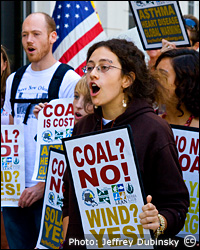
No coal. Photo: Jeffrey Dubinsky via Flickr

Anti-coal activists are inspired to hit the streets.

Sarah McCoin watched for years as coal fly ash piled up at the coal-fired power plant just a mile down the road from her house in Harriman, Tenn. “We’d question, ‘I wonder how high they’re going to build that thing? I wonder what they’re going to do with it after that?’” she said. “It never entered our minds that the thing would blow.”

But it did, on Dec. 22. An earthen dike at the Tennessee Valley Authority’s Kingston Fossil Plant broke, unleashing about 1.1 billion gallons of coal slurry—roughly enough to fill 798 Olympic-size swimming pools, and 10 times more gunk than was spilled by the Exxon Valdez. Dark gray sludge—essentially the waste from coal-burning plants that’s deemed too nasty to pump into the air—surged into the yards of McCoin’s neighbors and displaced the water in surrounding ponds and streams, inundating some 300 acres. TVA estimates that cleanup could cost as much as $825 million.

McCoin is worried about the heavy metals in the coal ash. She’s worried about what it will do, in both the long and short term, to the water, soil, and air around her town. She doesn’t trust TVA’s assurances that the waste is nothing to worry about. “If it’s not hazardous, then why is it proven that there are all these heavy metals in it?” she asked. “If that’s not hazardous, I don’t know what is.”

And McCoin is not content to just worry. On Jan. 16, she and fellow Harriman resident Tom Grizzard traveled to Capitol Hill to meet with lawmakers and convey the message that coal ash should be regulated as hazardous waste. Currently, coal-ash ponds are not subject to any federal regulation at all. McCoin has also teamed up with other concerned neighbors to form the Tennessee Coal Ash Survivors Network.

The Kingston spill made activists out of McCoin, Grizzard, and other members of their community. At the same time, it’s invigorated anti-coal campaigns that were already underway. Environmental groups have been able to use the TVA disaster as a vivid illustration of a message they’ve been trying to drive home for years: Coal is dirty from extraction to ignition to waste disposal, and no matter how the industry tries to spin it, it can never be “clean.” As the new administration and Congress dig in, activists hope this example can be a potent weapon in the political battle against coal.

Tough times for coal

The past two months have been a public relations nightmare for the coal industry. First there was the Tennessee spill shortly before Christmas. On New Year’s Day, a coal train derailed in Otero County, Colo. On Jan. 9, a leak at a second TVA waste pond at the unfortunately named Widows Creek Power Plant in northeastern Alabama spilled some 10,000 gallons of gypsum slurry, the same day that a coal train operated by National Coal Corporation overturned, dumping 1,100 tons of coal along the New River in Scott County, Tenn. TVA took another hit on Jan. 13 when a U.S. district court judge in North Carolina ruled that four of its coal plants in Alabama and Tennessee are a public health nuisance and need to be cleaned up.

On the political front, the news has been just as bad, thanks in large part to the new Obama administration. Even before the president was sworn in, his EPA nominee, Lisa Jackson, told the Senate that if she were confirmed, the agency would assess the hundreds of coal-ash storage sites around the country. Just a few days after Obama moved into the White House, the EPA put a hold on the approval of a coal-fired power plant in South Dakota, saying the state’s proposed permit didn’t meet the requirements of the Clean Air Act.

The agency then said it would develop new rules governing mercury emissions from coal plants, and delayed a Bush-era rule that could have allowed greater amounts of air pollution from coal plants. The Obama Justice Department launched a campaign to “stop illegal pollution” from coal-fired power plants and sued the owner of a Kansas coal plant for not installing required pollution control equipment. Most recently, the EPA this week opened the door to regulating greenhouse-gas emissions from coal-fired power plants under the Clean Air Act, saying it will revisit an 11th-hour Bush administration decision not to consider such emissions when granting permits for new plants.

On the state level, the governors of Michigan, Wisconsin, and even South Carolina have been pushing back against coal, citing a variety of complaints, from environmental to financial. And a handful of planned coal plants around the country have been put on hold.

Meanwhile, the mainstream media is changing its tune about coal in the wake of the TVA disaster. In January, both The New York Times and Time used the Tennessee spill to argue that clean coal is a “myth,” and this month another New York Times article cited the spill as it asked, “Is America ready to quit coal?”

“We’ve become something of a poster child down here,” said Chris Irwin, the staff attorney at United Mountain Defense, a Knoxville, Tenn., nonprofit that fights strip mining. His group was propelled by the TVA spill to highlight the waste-disposal problems at the other end of coal’s lifecycle, and helped coordinate McCoin and Grizzard’s lobbying trip to Washington. “It’s not just the global warming, it’s not just the air pollution, it’s not just the clear-cutting, it’s not just the blowing up of mountains, it’s not just the ash,” said Irwin. “It’s all of it. You can’t call coal clean.”

Green groups in Washington also quickly launched new anti-coal campaigns after the Tennessee disaster. Climate advocacy coalition 1Sky urged its network of activists to call on Congress to impose a moratorium on new coal-fired power plants. More than 10,000 people used the group’s web form to send letters to their legislators.

“We definitely pivoted off that coal ash disaster to really drive one of our central messages home, which is that coal isn’t clean and it’s not going to be clean anytime soon,” said Gillian Caldwell, 1Sky campaign director. While 1Sky has been active on coal issues since its founding in 2007—it was actually one of the group’s campaigners who got Joe Biden into trouble last fall by asking him about “clean coal” on the campaign trail—the TVA spill was a galvanizing event. “I think there’s nothing more visually poignant than those photographs to demonstrate the oxymoron of clean coal,” said Caldwell.

Ad it up

The Kingston spill hit at the end of a year in which the coal industry spent big to sell political candidates and the public on the idea of “clean coal.” The industry dropped between $35 million and $45 million on advertising in 2008, much of it via the American Coalition for Clean Coal Electricity. They sponsored presidential debates, handed out swag at campaign rallies in swing states, snapped photos of a repentant Biden mugging with a woman in a “clean coal” hat. They spent about $2 million on advertising just in and around each of the two national political conventions—handing out city maps, buttons, and boxes of breath mints stamped with the ACCCE logo.

And they were pretty pleased with the outcome. “Even in a communication-saturated environment we achieved, even exceeded, our wildest expectations (and we believe those of our client!),” wrote the PR firm Hawthorn Group, which ACCCE hired to orchestrate a “grassroots campaign,” in a December 2008 newsletter. “Not only did we raise the awareness of the issue, but we got the major candidates on both sides of the aisle talking about the issue in the debates, at campaign rallies and in interviews.”

But even tens of millions of dollars in advertising couldn’t insulate the industry from the damage of the TVA disaster, the largest toxic waste spill in the country’s history.

“[The coal industry] did a pretty good job of confusing and really clouding the issue as to whether there really is such a thing as clean coal,” said Bruce Nilles, national coal campaign director for the Sierra Club. “What the TVA spill really did in one fateful day was sweep away all that investment they made and re-expose the scar of what the coal industry is doing in our country in a very dramatic way.”

“We don’t have to be slick,” said Irwin of United Mountain Defense. “We don’t have to hire public relations people down here to show the destructive influence of coal. We just stick you in the middle of a pit and show you a bright orange stream and say, ‘Does that look clean?’”

“That’s why they have to put so much money into public relations, because they have to hide reality, the truth, and that’s always going to be hard and expensive,” he continued.

Still, some in the anti-coal movement have been investing in a PR campaign of their own. In early December, a coalition of national environmental groups, under the moniker “Reality Coalition,” launched a national ad campaign to hammer home the idea that “clean coal” is a myth.

The coalition has been running ads on cable TV, in national newspapers and magazines, and on a wide cross-section of websites (including Grist). In D.C., it’s running a subway ad campaign that features mythical creatures like Sasquatch and a mermaid holding lumps of coal. Brian Hardwick, director of communications and development for the Alliance for Climate Protection, one of the groups leading the campaign, wouldn’t say how much the coalition is spending on the ads, but did say that it’s a “substantial buy” in the multi-millions. “It’s competitive with what the coal industry is doing,” he said.

Still, nothing has driven home the activists’ point more powerfully than the Tennessee catastrophe.

I’m just a spill on Capitol Hill

The spill has certainly been reverberating on Capitol Hill.

Sen. Barbara Boxer (D-Calif.), chair of the Senate Environment and Public Works Committee, convened a hearing on it on Jan. 8 and suggested that coal ash should be federally regulated as hazardous waste. “You have got big problems,” Boxer told TVA President Tom Kilgore. “You have got to clean up your act, literally. ... Inaction had allowed this enormous volume of toxic material to go largely unregulated.”

On Jan. 14, Rep. Nick Rahall (D-W.Va.), who chairs the House Natural Resources Committee and hails from a coal state, introduced legislation that would establish federal standards for coal-ash depositories. “The disaster witnessed at the Kingston, Tenn., facility—which could have been avoided had TVA exercised appropriate engineering and monitoring regimes—was a clarion call for action,” he said.

Even Republican Sen. Lamar Alexander, a strong coal supporter from the coal state of Tennessee, is sounding critical. “Coal is a dirty business,” he told a Knoxville TV station. Alexander met with Harriman residents McCoin and Grizzard during their trip to D.C. and indicated to them that he’s looking into legislation on fly ash, though he has said he’s not ready to recommend federal action. Alexander has been a major recipient of campaign donations from TVA board members and he chairs the congressional Tennessee Valley Authority Caucus, so any shift from him would be big.

Activists hope the TVA spill will also inspire Congress to curb mountaintop-removal (MTR) mining in Appalachia, which the Bush administration encouraged by making it legal for mining companies to dump waste in streams. Two years ago, Rep. Frank Pallone (D-N.J.) and now-former Rep. Chris Shays (R-Conn.) introduced a bill that would have curbed MTR operations by reinstating rules on dumping mine waste into waterways; it garnered 153 cosponsors, but never made it to a vote.

“We think that with the increased attention that people are paying to handling our coal waste responsibly, with an end to this Bush era of lack of regulation and safety, we think that we’re dealing with a completely new environment,” said J.W. Randolph of the nonprofit group Appalachian Voices. “We think that Congress, and the administration, and the American public is ready to stop MTR mining. ... Obama could do that, but we really want to see it made into law, because in four years or eight years you never know if you’ll get another knucklehead in office who will just change it with the swipe of a pen.”

The battle on the ground

Ultimately, the anti-coal movement wants to halt the roughly 80 new coal plants currently planned or in the works across the country, said Nilles of the Sierra Club. Though activists are buoyed by the early signals from the Obama administration, they worry the plants being rushed through state permitting processes will get the green light unless there’s more direct intervention from the U.S. EPA. “Even if a fraction of those plants get built, it will be impossible for Obama to see a reduction in greenhouse gases during his tenure,” said Nilles. “Those coal plants we estimate would emit something around 400 million tons of carbon dioxide each year if all of them get built.”

Nilles hopes the Obama administration will move to regulate greenhouse-gas emissions under the Clean Air Act, which would likely put the brakes on new power plants and force emission cuts from the roughly 600 plants currently in operation.

Even while pushing for federal action, activists have been busy taking on coal plant by plant. They’re targeting proposed plants in Michigan and Nevada, as well as one in Kansas that just won’t die, despite multiple permit rejections by the state’s governor and environmental officers.

The Sierra Club is also kicking off a campaign to shut down some coal-fired plants already in operation, starting with one in Oregon and one in Washington state. The intent is to play on the environmental leanings of the Pacific Northwest. “We want to send a message to Montana and Wyoming that yes, you want to continue pushing coal, but your customers don’t want that anymore,” said Nilles. “If you want to continue being an energy exporter to those green folks in Portland and Seattle, they’re demanding clean energy.”

And campaigners are planning a big display of civil disobedience on March 2 at the coal-fired plant that powers the U.S. Capitol.

Meanwhile, Grizzard and McCoin are focused on making sure that no other communities have to suffer like theirs has.

“When it affects you as it did, and our families as it did, then ... I would like for it to be known that we need to get some consideration and we need to get it taken care of,” said Grizzard.

“There are other communities around the country that are in the exact same position we’re in,” said McCoin. “We just happened to get the spill on this go around.”
Kate Sheppard is Grist’s political reporter.

Advertisement
Advertisement
  1. Pompey Road Posted 11:06 pm
    19 Feb 2009

    Corps fudge on the sludge:Not enough has been said about the wet coal slurry ponds," we call them sludge ponds " in East Ky. , along the Ky. Virginia border and in West Virginia. They are more isolated and not inspected enough and more dangerous to the environment. They also contain the heavy metals a fly ash coal slurry contains plus the chemicals used in the coal washing process to separate the clays and other non coal elements in the coal preparation process. I have personally seen them cut loose at night on the third shift into a river that leads to a dam that is used for a drinking water source. Of course the water will be running clear when the work crowd is driving along the river in the morning on their way to work.
    I fear the EPA has weakened the clean water rules to make them completely ineffectual as regarding coal chemical waste water. The EPA and the Corps of engineers allow a coal corporation, "CONSOL" to dump so called cleaned waste water into the river below Grundy, Va., it flows into a river that runs into the Fishtrap Dam an Army Corps of Engineer operated flood control project. They will tell you the water is chemically contaminated a few hundred feet below the source where the waste water enters the river but that it is clean several hundred feet after the water enters the river. TRUST ME, they have given me no reasonable explaination on how the water miraculously cleaned it self. I can only guess dilution which of course is just dependant on the old parts per million game.
    I can not understand how a government organization that uses the words environmental protection in their name and another who is responsible for maintaining clean water in the dam allowing any sort of chemical tainted water to be dumped into the drinking water source of several communities downstream. Of course this is Southern Appalachia where they blow the tops of mountains and cover up valleys and fresh water streams. Isolated, forgotten and wrote off as expendable with not a large enough voting base to have an impact on federal decision making. Then there is the ever present coal lobby the only voice they listen to from the Eastern coal fields.
    They caught the corps with two illegal non-permitted hollow fills on the watershed area they control. These are the people who we have to rely on when they say trust me your water is fine. The aggregate crushed rock from the overburden in all the Mountain Top Removal Hollow fills leeching heavy metals into that same water. The people who eat the mercury contaminated fish from that lake have a lot more trust in the corps than I. I never could wrap my mind around how you can strip the vegetation off the watershed area of a flood control dam and still call it flood control. The silt from the coal strip mining of the watershed area is filling the lake making it useless for flood control. Millions of dollars to construct that dam in 1968 and millions since to maintain it and all the taxpayer got from it is a coal corporation stripping operation complete with MTR and a sludge pond. This is criminal.
    Continuous coal stripping since before 1977 and the region below the Dam got hammered in 1977. It cost the tax payers millions to repair the damage from the 1977 flood. FEMA and other organizations was in here for months. This is insanity and government sponsored eco terrorism.

    The eons of time and nature was good to us down here. It was not until we become civilized that destroying our habitat become fathomable or fashionable.
  2. bkrell Posted 9:28 am
    20 Feb 2009

    windLike it or not, coal is what we will be dealing with for a long time. We'll be off oil WELL before we ever get off coal.
  3. Delay And Deny's avatar

    Delay And Deny Posted 11:10 am
    20 Feb 2009

    Against The Grid...It's hard to be against something.
    But its positive to be for something.
    That's why I'm for Hydrogen.
    With Hydrogen, produced from wind and solar, locally, individually, we can escape the Grid.
    Or rather We Are the Grid.
    The consumer becomes the producer -- of pure, energy rich hydrogen.
    Abandon old style plugins with wasteful batteries that make us burn coal.
    Go Hydrogen.
    Go Solar.
    Go Wind.

    Golden Loon Award Countdown


    Joe Romm - 1 Loon Feather


    James Hansen - 3 Loon Feathers
  4. Pangolin's avatar

    Pangolin Posted 8:20 pm
    20 Feb 2009

    Right JBNow all we have to do is tear out all our existing backyards and put in ten propane tanks each, massive solar panels, compressors, fuel cells and monitoring equipment at a mere cost of $500K per, 2 person household.
    Or....we could throw some solar panels on the roof, connect to the grid and use the batteries in our PHEV as emergency storage. About $25k per household plus another $25k for the new car. Minus gas and maintenance expense saved on the car and no more electric bills ever.
    Are conservative really ten times stupider than progressives? We've got the numbers to prove it.

    Put the Carbon Back
  5. Delay And Deny's avatar

    Delay And Deny Posted 5:30 am
    21 Feb 2009

    Love Tractorhttp://sl.farmonline.com.au/news/nationalrural/machinery- ...
    Here's your first look at New Holland's hydrogen-powered tractor, due to be unveiled at one of Europe's top machinery events, namely SIMA's Paris Show later this month.
    Centre-piece of New Holland's Energy Independent Farm concept, the NH2 tractor project reportedly hopes to free farmers from the cost of purchasing fossil-fuels, thereby allowing them to achieve fuel autonomy.
    Science moves on...leaves Grist cavemen in dust!
    Grist Ecologists to silly to enslave us with plugins!
    http://www.pasadenastarnews.com/business/ci_11750404
    SAN FRANCISCO - The California Public Utilities Commission on Friday directed Southern California Edison Co. to fund the first phase of a study to evaluate the feasibility of an Integrated Gasification Combined Cycle facility, which would produce low-carbon electricity by gasifying California's non-conventional fuels (primarily petroleum coke and potentially biomass) to produce hydrogen for electric generation.

    Golden Loon Award Countdown


    Joe Romm - 2 Loon Feathers


    James Hansen - 3 Loon Feathers
  6. Pompey Road Posted 6:56 am
    21 Feb 2009

    We need a New Dealer:I could deal with coal better if they went back to mining it as they did for 80 years here in Pike County. You can mine coal without blowing up the mountains and destroying the Southern Appalachian mountains.
    If you do underground mining methods you may mine out a coal seam and the mountain my subside or fall a few feet and be shorter but we still have the mountain, the valley and the fresh water stream.
    We have coal companies that do both MTR and underground mining. They know how to underground mine with the drift or shaft mine method.
    There is absolutely no reason to destroy a region just because you can. We have always got a raw deal from coal companies in East Ky and to tell the truth some people are getting tired of it.
    I won't be dealing with people who have been dealing from the bottom of the deck.
    I have seen more terrorism in East Kentucky than I did in New York, they lost two buildings we have lost over 500 mountains, valleys and numerous fresh water streams. If you want to add up the lives lost in the mines from the early 1920's you will find that number in the thousands also.
    Damn a coal corporation, I have seen nothing from them but death and destruction.

    The eons of time and nature was good to us down here. It was not until we become civilized that destroying our habitat become fathomable or fashionable.
  7. SierraMurdoch Posted 12:37 pm
    21 Feb 2009

    Power Past CoalThanks to Ms. Sheppard for reporting on the hopeful activity that's risen out of this devastating disaster.
    But the flurry of activism we've seen is nothing new.  This movement's been moving since the day bulldozers dug into Navajo land, water ran orange out of Appalachian taps, asthma rates skyrocketed in the inner cities, and the world warmed enough for people to notice.  
    The TVA spill hasn't sparked a new movement.  It's lent a louder voice to the people who've been fighting the same fight for too long.  
    There are communities in every corner of this country who deal first hand with the consequences of dirty coal.  The problems they face may lack the eye-catching dramatics of the TVA spill, but they are just as serious.  
    There is something new about this movement, though: for the first time, these impacted communities have decided that one hundred voices are louder than one.  On the morning after President Obama's inauguration, over forty grassroots organizations working in hundreds of communities across the country launched Power Past Coal (http://www.powerpastcoal.org), a new national project uniting those impacted by coal at every stage of its cycle - from strip mining on the Black Mesa reservation, to burning in poor Chicago suburbs, to dumping coal waste in the Tennessee Valley.  
    The link in this coal-community chain is 100 Days of Action - something which any town, organization, or individual can join.  On every day of Obama's first 100, a different group is taking action to power our nation past coal.  In these first 32 days we've seen 60 actions - citizens have packed courtrooms and flooded the streets to stop new strip mines and coal plants, while others have arranged community lobby trips to their statehouses and to Washington.  Some have chosen civil disobedience as their tactic (though not all project participants endorse it) -the Capitol Climate Action on March 2nd will mark a pivotal halfway point for Power Past Coal.  
    It's true - the TVA spill has sparked some long-awaited conversations on Capitol Hill.  But there's still a lot of work to be done to turn words into action.  
    Visit http://www.powerpastcoal.org to learn more about the project, take action, and read the stories of those working daily to transition their communities away from coal to just, clean energy.  
    Sierra, Power Past Coal Coordinator

    (JavaScript must be enabled to view this email address)

    //
    var l=new Array();

    var output = '';

    l[0]='>';l[1]='a';l[2]='/';l[3]='';l[29]='\"';l[30]=' 103';l[31]=' 114';l[32]=' 111';l[33]=' 46';l[34]=' 108';l[35]=' 97';l[36]=' 111';l[37]=' 99';l[38]=' 116';l[39]=' 115';l[40]=' 97';l[41]=' 112';l[42]=' 114';l[43]=' 101';l[44]=' 119';l[45]=' 111';l[46]=' 112';l[47]=' 64';l[48]=' 97';l[49]=' 114';l[50]=' 114';l[51]=' 101';l[52]=' 105';l[53]=' 115';l[54]=':';l[55]='o';l[56]='t';l[57]='l';l[58]='i';l[59]='a';l[60]='m';l[61]='\"';l[62]='=';l[63]='f';l[64]='e';l[65]='r';l[66]='h';l[67]='a ';l[68]='
  8. Delay And Deny's avatar

    Delay And Deny Posted 3:47 am
    22 Feb 2009

    Seattle Times Rips Sunroof off Plugin Scam!!Energy wasting unreliable battery technology EXPOSED!!!
    Reality check on plug-in cars
    http://seattletimes.nwsource.com/html/dannywestneat/20087 ...
    The problem is the extra battery costs $10,000. At 51 mpg, the plug-in saves only about $200 in gas costs annually compared to a regular Prius in the city's fleet (and that's at $4 a gallon.) It would take 50 years to make back the cost of the extra battery.
    [...]
    I'd love to go all Thomas Friedman on you and say it's a green Apollo project that will launch us to a green moon. But a lot of it will turn out to be hype. The hype is more than just a sideshow -- it undermines the goal.

    Golden Loon Award Countdown


    Joe Romm - 2 Loon Feathers


    James Hansen - 3 Loon Feathers


    amazingdrx - 1 Loon Feather
  9. Pompey Road Posted 5:15 am
    22 Feb 2009

    True Cost of Coal: 

    As I type a mine accident in Northern China has claimed at least 74 lives by early accounting. China has become infamous for having the most dangerous mines in the would and spectacular explosions and high death tolls are common place.
    Life is chep in the coal fields no matter where it is mined. We have fewer mine deaths in the U.S. thanks to the efforts of M.S.H.A., Mine Safety and Health Act but for the most part the large decrease in mine deaths can be contributed to the fact we surface mine most of our coal now. In the underground mines the death toll is still to high for the tonnage and due to advances in better emergency medical care we have more walking wounded.
    The events of 1968 when the U.S. mine death toll was way over 300 prompted the advent of government action to deal with the safety situation in the mines. On November 20th 1968 the Consol Number 9 mine at Farmington W.Va exploded and 78 men died. This was a couple weeks after my father ws killed in a coal mine roof fall in Kentucky. The miners that die in one's and two's do not attract the same amount of media attention that the more spectacular multi death catastrophes do.
    I am conflicted at times about the need for stopping mountain top removal and coal stripping operations. This is easy coal and when it is stopped the coal corporations will be forced to go back down under the water table where the dangers are many.
    The same coal that kills the planet has been killing Appalachian miners for over a hundred years. Many early years over 2000 miners would die in the mines each year. The same coal that is killing the planet and the miners also is killing the mountains of Southern Appalachia with the Mountain Top Removal. To the extent even people who have lost family in the underground coal mines fight to have the most destructive type of mining to the environment stopped.  
    The worst thing that could have ever happened to Eastern Kentucky is the discovery of the coal beneath and in the mountains. From the earliest days the region has been exploited and the wealth hauled or piped out of the region.
    The 20/20, Diane Sawyers Documentary on the children of the mountains failed to indentify the true culpret or cause of the abject poverty in the region. Low wages and no benifits for any other work aside from coal. No diversification allowed for years to ensure a cheap labor source for the mines. Politicians who are bought to promote MTR even though it puts less money into the local economy because we don't need half the miners necessary to mine the same or larger amounts of coal.
    We will be left with the environmental devistation without ever having received any benifit of the wealth under our feet that was stolen at the first of the last century.
    As you discuss the environmental ramifications of burning coal on the earth always remain cognizant of the people and the mountains that are being destroyed as I type in Appalachia.
    I do not know how long before co2 destroys the planet. I do know we are running out of time to save the mountains and the people of Appalachia who have not left already.

    The eons of time and nature was good to us down here. It was not until we become civilized that destroying our habitat become fathomable or fashionable.

Add a Comment

You are not logged in. Thus, you cannot post a comment. If you have an account, log in. If you don't have an account, well, by all means go make one! Meet you back here in five.

Hello, Visitor!    Why not register?

Advertisement