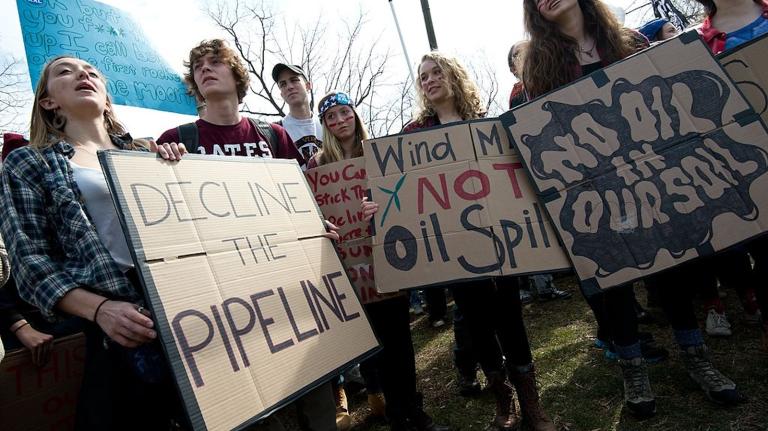
If only atmospheric chemistry gave you points for trying.
A year ago this week, we were celebrating. I and six college-age colleagues of mine, joined by thousands of organizers across the country, had managed to pull off 1,400 simultaneous demonstrations against global warming in all 50 states. Though we didn’t have much in the way of resources, Step It Up day was a success — and within a week, both the Obama and Clinton campaigns had endorsed our call for 80 percent cuts in carbon emissions by 2050.
The glow, shall we say, faded. Within a matter of weeks, the Great Arctic Melt of ’07 was underway, and the Northwest Passage was starting to open. In the months since, the science has continued to darken: there’s a growing perception among climatologists that the window for action is narrower than we’d imagined, and closing faster. A growing sense that, for instance, sea levels are likely to rise much more quickly and dangerously than we thought even a year ago.
And so — with your help — we’re trying again. This time, our effort is even more grandiose, arguably almost lunatic in its underfunded ambition. This spring, we’re trying to launch an international grassroots campaign, something that’s rarely been tried on any issue. It’s called 350.org, and on that arcane number hangs the story.
In the late fall, after the ice melt, NASA’s James Hansen gave a talk at the American Geophysical Union in San Francisco. He’s since joined with a number of colleagues to turn it into a paper that was submitted to Science last week. It offers, for the first time, a real target for humans to aim at — anything above 350 parts per million CO2 in the atmosphere, the authors say, is too high, at least “if humanity wishes to preserve a planet similar to that on which civilization developed and to which life on Earth is adapted.” Which, speaking for myself, seems like a good idea.
It’s a tough number — we’re already past it, at 385 parts per million CO2 and rising 2 parts per year as we burn ever more coal and gas and oil. We’re like the patient who finds out from his doctor that his cholesterol is too high. We’re out of the zone of safety and into the zone where heart attacks and strokes (ice shelf collapses? epic droughts?) become more likely. We’ve got to scramble back.
But how? The international negotiations that began in Bali to find a successor to the Kyoto treaty suddenly seem like the last bite at the apple, the last chance to really set the planet on a new path toward a low-carbon future at a speed that will get us there in time. They’ll conclude in Copenhagen in December of 2009, and if they don’t conclude successfully, the next round of global talks will probably be about how to deal with the effects of global warming.
Important stuff. At the moment, though, those treaty talks are going nowhere very special — between the recalcitrance of the U.S. and the understandable misgivings of the emerging Asian powers, they seem more likely to produce a tepid treaty that keeps us in the danger zone for decades to come, something we simply can’t tolerate. Consider President Bush’s speech earlier this week — if the Arctic melted last summer, why are we talking about curbing our power plant emissions in 2025?
So we need to rouse the world to a new sense of urgency and of possibility. Our plan — again, with your help — is to take the number 350 and beat it into every head and heart on planet Earth, to tattoo it into every brain. If our fellow earthlings know nothing else about climate change, they need to know that 350 lies in the direction of safety. We are busy trying to find artists, musicians, activists, preachers, athletes, and, well, normal people in all corners of the globe who will figure out how to make 350 the most well-known number on the planet.
Already it’s starting — 350 cyclists circling through Salt Lake City, earning real publicity as they did so. I was in Honolulu yesterday, where activists are figuring out how to put red tarps on the roofs of 350 homes in a single neighborhood that could have solar PV panels if only the utility would get out of the way. In Maui today, people promised to assemble 350 surfers off the beach for a photo. At an evangelical conference last week, pastors were talking about ringing their bells 350 times. We’ve heard from Mongolian cartoonists, Chinese universities, Canadians. Canadians!
Does it matter? Or is it just play? We think that if we can take that meme — 350 — and spread it everywhere, it will almost subconsciously set the bar for these negotiations much higher than it currently stands. We think it will nudge them sharply to the left, in the direction that physics and chemistry would indicate. We think 350 is the most important number in the world, and that at the very least everyone deserves to know it — to understand that the world we’ve spent millennia building lies now in its shadow.