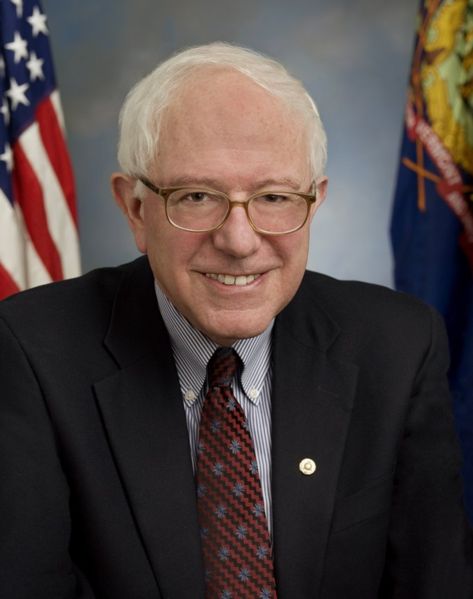
 Sen. Bernie Sanders (I-Vt.)On On Thursday, Sen. Bernie Sanders (I-Vt.) introduced a bill aimed at getting 10 million new solar rooftop systems and 200,000 new solar hot water heating systems installed in the U.S. in the next 10 years.
Cleverly titled the “10 Million Solar Roofs & 10 Million Gallons of Solar Hot Water Act” (PDF), it would provide rebates that cover up to half the cost of new systems, along the lines of incentive programs in California and New Jersey (not coincidentally, Nos. 1 and 2 in installed solar in the U.S.). It also includes measures to insure that those who receive assistance get information on how to make their buildings more energy efficient.
Sanders currently has nine co-sponsors: Environment and Public Works Committee Chair Barbara Boxer (D-Calif.) and Sens. Patrick Leahy (D-Vt.), Frank Lautenberg (D-N.J.), Robert Menendez (D-N.J.), Sheldon Whitehouse (D-R.I.), Ben Cardin (D-Md.), Jeff Merkley (D-Ore.), Kirsten Gillibrand (D-N.Y.), and Arlen Specter (D-Pa.).
The bill would accelerate what is already a fairly rapid pace of growth for distributed solar power. Distributed energy has a number of advantages over its central-plant competitors (both clean and dirty): it’s faster to build, avoids the need for expensive transmission lines, can use already developed land, and enhances community resilience and self-reliance. It’s also labor-intensive, creating more jobs per dollar of investment than its competitors — a feature that may make it more attractive during a recession, when Democrats are turning their attention to unemployment.
I chatted with Sen. Sanders about the bill, the growth of solar, and his colleagues’ peculiar fixation on nuclear power:
Q. How much would your program cost?
A. We think this will cost between 2 and 3 billion dollars a year, and at the end of a 10-year period we are going to be producing 30,000 new megawatts of energy — the equivalent of what 30 nuclear power plants produce. This is a very cost effective way of producing that energy.
Q. Even if you take half the price off a solar system, it still has relatively high upfront capital costs. Are you looking into ways for people to find financing?
A. Remember that there are already a lot of tax credits, federal and in many states. The federal tax credit would be up to 30 percent off the cost of a project. That’s a lot. Let’s say hypothetically you wanted to spend $40,000 on solar. If you take 30 percent off that, you’re down to $28,000. If you get state help you’re down to $25,000. Then the federal government would pay half of that.
That’s a pretty good deal! It could be a major incentive for people to use photovoltaics. And the more photovoltaics we use, the more will be built; the more that are built, the cheaper it becomes.
Q. What about the objection that it’s a subsidy that advantages some states (the sunny ones) over others?
A. The fact is that every state in this country can produce at least 10 percent of its electricity from solar. [Sanders’ press release cites ISLR’s report on Energy Self-Reliant States.] In Vermont, we’re moving on solar. New Jersey is one of the leading producers of solar energy in America. It’ll obviously work better in Florida and California — that’s true, and that’s great — but this is for all 50 states.
For people who are complaining about subsidies to energy, well, they’ve got to take a deep breath: huge amounts of money into nuclear, huge amounts of money into coal, huge amounts of money into oil. It is time that we begin to subsidize those technologies that are cutting greenhouse gas emissions and in the long run will be more cost-effective.
Q. Do you get the sense that your Senate colleagues appreciate the power of renewable energy, particularly distributed renewables?
A. No, they don’t. I’m a member of both the Environment Committee and the Energy Committee, and it just astounds me how little discussion there has been about the potential of sustainable energy in general and solar in particular. If you go to an Energy Committee meeting, it’s about nuclear, nuclear, nuclear. The general assumption is that nuclear is time-tested, it’s cheap, it’s reliable; solar is experimental, it’s fringe, maybe someday.
Roughly speaking, a new nuclear power plant will cost you about $10 billion. Then at some point you’ve got to decommission it and get rid of the waste — a great expense. The average nuclear power plant will produce about 1,000 megawatts for that $10 billion dollars. We can produce 30,000 megawatts for $30 billion and they’re going to produce it for $300 billion.
Now, theirs is baseload ours is intermittent, that is true. But having said that, our form of production is far more cost effective than nuclear. Have you ever heard anybody talk about that outside of the environmental community? You have not heard that discussion on the floor of the House or the Senate. And the reason you’re not hearing about this is the solar industry doesn’t quite have the clout that the coal industry, the oil industry, or the nuclear industry has.
Now, you asked me [about distributed energy]. We need to push solar, in all of its forms, as aggressively as we can. I’m not very sympathetic to people who tell us, “If we don’t move aggressively to cut greenhouse gas emissions the world will collapse, but I don’t like wind because a bird got killed.” According to the secretary of the interior, we can produce almost 30 percent of the electricity for homes in this country through solar thermal in the Southwest. That is extraordinary. We should begin building those things tomorrow.
It’s not a question of either/or. It’s both. It’s those, wind, geothermal, biomass versus coal and oil and nuclear. Our main job is to cut back greenhouse gas emissions in a fundamental way, and to transform our energy system. So people should be putting their shoulders to the wheel.
Q. Is anyone in Congress talking about the barriers to distributed energy posed by America’s complex regime of utility regulations?
A. Yeah, they are. Many of us like what Germany has done — feed-in tariffs. In Vermont, without state regulations, one of our major utilities has unilaterally instituted those with good results. A lot of the utilities are tied into coal and to gas, and they will be resistant. There’s always resistance to change. But I think we have the wind at our backs, or the sun in our faces, or whatever. We are making progress.
Q. What’s the road forward for the bill? Any chance it will be part of the upcoming jobs bill?
A. It’s certainly something I would like to see. In any vehicle, any venue we can get, we’re going to push it.
Read more interviews with members of Congress:
- Sen. Tom Udall (D-N.M.)
- Rep. Brian Baird (D-Wash.)
- Rep. Tom Perriello (D-Va.)
- Sen. Mark Udall (D-Colo.)