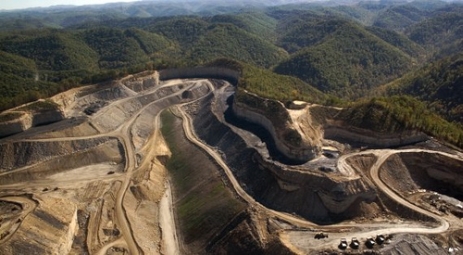
Scientists would shout this from the mountaintops, but ...Photo: farukahmet via Creative CommonsLet's say you trundle a bunch of enormous industrial equipment into North America's oldest mountains (an intact temperate ecosystem boasting rich biodiversity, including a number of endangered species), clear-cut the forests, blow millions of tons off the top of the mountains, dump the rubble into the pristine streams below, and carry out the coal you find on enormous trucks, at high speeds, on narrow roads, through some of America's oldest communities.
Think that would cause any ecological or human damage? Hmm ...
It might seem obvious, but as the media will tell you, "opinions on shape of earth differ," so it's helpful that a group of scientists has come along to assess the existing body of research on the subject.
And what does Science say? Yes, blowing up mountains causes environmental and health damage! Who woulda thunk it? In fact, the evidence is so clear that the scientists have taken the extraordinary further step of calling for an immediate moratorium on mountaintop removal mining permits.
The information is contained in a new paper being published today in the journal Science: "Mountaintop Mining Consequences." From the press release:
Based on a comprehensive analysis of the latest scientific findings and new data, a group of the nation’s leading environmental scientists are calling on the U.S. Environmental Protection Agency and the U.S. Army Corps of Engineers to stay all new mountaintop mining permits. In the January 8 edition of the journal Science, they argue that peer-reviewed research unequivocally documents irreversible environmental impacts from this form of mining which also exposes local residents to a higher risk of serious health problems.
...
Co-author Dr. Emily Bernhardt, of Duke University, explains that “The chemicals released into streams from valley fills contain a variety of ions and trace metals which are toxic or debilitating for many organisms, which explains why biodiversity is reduced below valley fills.” The authors provide evidence that mine reclamation and mitigation practices have not prevented the contaminants from moving into downstream waters.
The authors also describe human health impacts associated with surface mining for coal in the Appalachian region, including elevated rates of mortality, lung cancer, and chronic heart, lung and kidney disease in coal producing communities.
“Over the last 30 years, there has been a global increase in surface mining, and it is now the dominant driver of land-use change in the Central Appalachian region,” says Dr. Keith Eshleman also of the University of Maryland Center for Environmental Science. “We now know that surface mining has extraordinary consequences for both aquatic and terrestrial ecosystems. Notwithstanding recent attempts to improve reclamation, the immense scale of mountaintop mining makes it unrealistic to think that true restoration or mitigation is possible with current techniques.”
Ironically, this comes on the heels of the Obama administration's decision to approve a new MTR permit in West Virginia. Perhaps the EPA doesn't believe that blowing up mountains harms mountains?
UPDATE: I'm listening to a conference call with some of the scientists who wrote the paper. It's a real horror show.
The forests that get cleared store tons of carbon; the vegetation it's replaced with doesn't. So there's a climate change connection (aside from the obvious coal connection).
Blowing all this stuff destroys the landscapes ability to absorb rainfall, which leads to increased flooding downstream. And those effects are expected to persist for centuries.
The industry claims it's "replacing" headwater Appalachian streams, but you won't be surprised to hear that hydrologists find that claim absurd. The hydrology ends up different and the streams end up polluted with trace metals (poisoning those downstream). These trace metals are also associated with decline in invertebrate biodiversity.
Permits are considered individually, but multiple permits granted in the same watershed leads to additive effects that persist for decades after abandonment.
Concentrations of selenium in the water bioaccumulate in the food chain and effects are magnified. The fish become poisonous.
And of course the human toll: poisoned water leads to more deformities in babies and worse academic outcomes. Air quality is degraded, leading to respiratory diseases. And on and on.
God this is depressing. I wonder how Don Blankenship feels about it.
UPDATE 2: Now in Q&A with the scientists. One says, "this is the most heavily peer-reviewed paper I've ever published -- one review was 18 pages long."
The scientists received no outside funding for this; they donated their time. One says the project was sparked by a request from NGOs.
They're calling for a moratorium on permits until there can be a "rational hearing" on the science. Many of them were new to the issue when they started this; all of them seem kind of shocked by how horrific it is and by how little attention it's gotten.
Asked about new permit just issued for Hobet 45 mine, Dr. Dennis Lemly says the water issue weren't addressed. "This is just business as usual."
One problem with permits: they only address valley fill area. But pollutants escape and many of their cumulative effects are felt downstream.
Asked: are there technological options available to deal with the water quality properly? Lemly: sure, it's just a matter of cost. Dr. William Schlesinger adds: when you bury a stream, it's gone. There's no replicating it.
Dr. Emily Bernhardt: part of impetus of the paper was to provide regulators with a comprehensive overview. Met with a small group from U.S. EPA to present findings.
Bernhardt: all the data mining companies and the WV DEP collect information on surface water, but much of the pollution is found beneath the surface in water tables.
To me, the most amazing part of all this -- and clearly the scientists are amazed as well -- is the fact that there's never been a comprehensive assessment of MTR impacts before. We're blowing up mountains and we have no idea what the consequences are! The mind boggles. It's like the whole country is just discovering Appalachia.

Will Trader Joe's finally do right by farmworkers?
Why do we do better while the earth does worse?
Arcade Fire: 'The Suburbs' and bright green urbanism 


Comments
Post a Comment +
Thanks for reporting this so prominently on Grist.
Great article and info!
should have added:
to join the anti-mountaintop removal resistance please see:
http://www.mountainjusticesummer.org
http://www.climategroundzero.org
The headline (and tweet) seems to be mocking the science, not the practice the scientists are seeking to halt. You might want to lead with something more like "The Most Respected Body in American Science Calls for a Halt to Mountaintop Removal Mining" as I see nowhere in the article any so obvious claims as "blowing up mountains harms mountains." The science appears to be good and insightful, and the AAAS seems to agree.
Actually, this headline prompted me to finally donate some cash to Grist! I've been reading Grist for a couple years without having donated anything, yet I always appreciate when Grist make me laugh out loud -- I mean genuinely laugh! -- about such terrible things as mountaintop removal mining. I agree with you that scientists aren't to blame, and that instead we should be directing blame toward the mining companies and government bodies that issue the permits, however, we can all use a good laugh from time to time, and the content of the article explains that the scientists are working to stop the mining -- so it doesn't come across as mocking scientists if you read the whole thing.
^^^"The headline (and tweet) seems to be mocking the science, not the practice the scientists are seeking to halt." With all due respect, this is only true if you have an underdeveloped sense of humor. Is English your second language, by any chance? Ya' see, tha humor comes from repeating "mountains" and from the obvious fact that, of course, blowing up mountains with millions of pounds of nitrate explosives is harmful, and not only to the mountains. BTB, I agree, the science is good.
It's what we English people call 'irony'. A compelling and truthful title which works on every level.
No wonder you're depressed, David. Now I am too.
This is really an alarming news!! We must save our mountains as these are essential to life on Earth. Really an informative post. Keep it up the good work.
Force Factor Supplements
Hehey, yeah kind of ironic.
I got another one that kind of magnifies the Irony. It seems there is a process that has been known about for a very long time that could use solar furnaces to refine silicon from sand. The cost of refined silicon is the major factor in the cost of solar PV cells.
Energy is the major cost in refining silicon. Sand, the source for silicon, is plentiful and not a signifigant part of the cost.
Solar energy is free and abundant in deserts..which are made of sand.
Cheap enough solar PV, made with free solar energy from nearly free sand, would make it unecessary to blow up mountains to obtain coal.
Here it is, from wiki:
"Pure silicon (>99.9%) can be extracted directly from solid silica or other silicon compounds by molten salt electrolysis.[10][11][12][13] This method, known from 1854[14] (see also FFC Cambridge Process) has the potential to directly produce solar grade silicon without any CO2 emission and at much lower energy consumption."
http://en.wikipedia.org/wiki/Silicon
I hate to be the grinch again but the facts are that the regulators, the courts, and Washington know all the facts and have had summaries of the science in front of them for years, and nothing of positive substance has been done. The decision makers are under the influence of business, in this case coal and other fossil fuels. They will not make decisions in the favor of our mountains until, (1) a VERY large percentage of the population says yes we will conserve and pay higher prices for fossil fuels, or (2) alternatives become economically attractive to the extent that they drive coal and other dirty energies out of business. Honestly, do you see either of these things happening? Sorry to say, I don't. Washington will continue to debate and take money from dirty energy while our mountains continue to be destroyed. I have given up on West Virginia, the Mountain, I mean Moonscape State, where coal is simply too entrenched in the state politics. I hope there is still some hope for my state of Tennessee, and what's left of Kentucky.
It is movements like the anti-MTR groups that must continue to collect supporters, continue to write letters to congress, newspapers, and blogs that hopefully will alter the thinking of the consuming public to the extent that our decision makers will have no choice but to act or be replaced with honest politicians.
The strategic solution lies in massive support of R&D in the fossil alternatives area. I feel we are on ...read more
Shale gas in the region is more than sufficient to completely replace coal currently extracted by MTR. The shale gas industry is scaling up really fast in Pennsylvania, where nostalgic longing for the oil and gas heyday of the first half of the 1900s is enough to inspire broad popular support. This will soon spread to the rest of the north east USA. This is happening quietly and discretely now, but will soon be on the front page. MTR will be completely gone in less than 10 years is my prediction. Not the least because the hundreds of drilling rigs running the next 20 years and constructing of the required field infrastructure to process, compress and transport the natural gas will require 10s of thousands of good paying jobs which will make MTR operations look like the stone age. The natural gas will be used in super efficient power plants that will reduce all forms of air and water pollution and ash ponds a thing of the past. Goodbye MTR and coal power plants!
I hope that those upset by the damage done by the coal industry will be just as upset by the damage done to mountain ridges by blowing them up to ram in wind turbines. Then it may take up to 20 truckloads of cement to fill the hole. Commercial Wind is just as bad. There is nothing about a 400 foot turbine that you can recycle. Also, look up rare earth elements and how they are mined, and understand how much is used in making turbines. Just one turbine requires TWO TONS. Green campaigners love wind turbines, but the permanent magnets used to manufacture a 3-megawatt turbine contain some two tons of rare earth minerals. Read about how these elements are mined in China.
If you are against coal, then you must be against the wind industry, unless your green is the green of MONEY!
Keepers of the Blue Ridge is a great group working hard to fight commercial wind plants in the Appalachian Mountains!
http://www.keepersoftheblueridge.com
I'm not surprised that the Neodymium mines in China are screwing up their environment. That does not mean it can't be mined without doing so.
Let's put your TWO TONS into perspective:
1 kg of coal produces about 2kwh of electricity ( from http://en.wikipedia.org/wiki/Coal )
1 ton contains about 907kg. That means 2 tons of coal produces about 1.8mwh of electricity. If your 3-megawatt wind turbine is operating at a typical 30% capacity, that means it takes an average of 2 hours to produce the same amount of electricity from those 2 tons of coal.
If it lasts 20 years, that means it would produce 12x365x20 or 87,600 times as much electricity as those 2 tons of coal.
Ridgeprotector: Which "rare earth minerals" are you referring to?
Also, who is making 3 MW wind turbines? That is not a typical number from my experience.
Thanks,
Dan
MIKE_G: I really like your calculation! But I think you have not gone far enough. That's only the first 20 years. After that, the same location will provide another 20 years of wind, and so on. AND, the materials in magnets can be recovered and reused, the mountains, not so easy.
Coal miners are not happy about wind farms. Take a look at the EIA numbers which show that coal production dropped 10.9% last week over the same week in 2009. That has been the trend for the entire year. 11 percent reduction is reason to worry and a reason to try to reduce costs by mountain removal. However, you only get to remove the mountain once, and it can never be used as a source of wind power again.
That is the opposite of sustainable.
The web expert on rare earth metals and magnets and their various applications is at http://www.terramagnetica.com. He covers the environmental and market problem of rare earth metal mining in China extensively. There is also a fantastic article on use of superconducting concepts to replace the permanent magnets. There are at least 3 very competent technology developers working on concepts to revolutionize wind turbine design using superconducting generator technology. This technology is already being implemented by the US Navy though in the very near form of superconducting electric motors, so the concept is essentially proven. It just needs to be repackaged for wind turbines. If terramagnetica is right about this concept, we will soon see wind turbine prototypes in the size of 10-20 MW, which will be ideally suited for offshore use. There is already a huge push for offshore wind in northern europe based on modest but well-proven turbines in the size 3-5 MW, so the business case for the new superconducting turbines looks at first glance to be tremendous.
Interesting Todd, is the entire conduction path of the motor, rotor and stator windings, operated in superconducting mode? Or just the stator? Superconduction should make the generator much smaller and lighter allowing a taller tower, which in turn increases both wind speed and consistency.
Double the wind speed by going 30% higher with the tower and the power output increases by the cube, 8 times the power. The power production of a 3.6 mw GE machine with 8 times the output, almost heat and electrical resistance free, made possible with a superconducting generator? Over 30 mw. Capacity factor also increases with height because the wind is steadier at greater height above ground obstructions and friction.
And if the technology has advanced to superconducting generation, superconducting storage suitable for much higher capacity than is now in use in utulities (like the local grid powering my computer right now, that uses superconducting storage) should be next. Superconducting energy storage can store electricty from any source with almost no losses.
This is great news, especially alongside revelations about solar powered silicon refining and solar PV fabrication. 50 cent per watt renewable electric power systems with storage are a distinct possibility. At 5 cents per kwh, half the going retail rate, these systems would have a 5 year payback period. It won't be "too cheap to meter" as nuclear power fans boasted in the 50s, but it will be free after 5 years to the owners of renewable energy devices.
Forgive my ignorance (I ain't no scientist) but I would have thought that the constraint on wind turbines is not the size of generator, but the size of the turbine blades? At the end of the day we're trying to harvest the energy in the wind as efficiently as possible. Arguably 5 x 5mW turbines are only going to produce the same power as a single 25mW turbine. So if a wind farm is made up of one fifth the number of turbines (because of density constraints due to wind shadow effects) and with each turbine requiring 5 times the mass of materials to produce, in the end that wind farm will cost the same -- and be no more productive -- than a windfarm built on the same site but made up of the smaller turbines (within reason of course!).
Consequently the only advantage of smaller, lighter generators is if they're cheaper to make and contain fewer raw materials. As I've said in another post below, the height achievable is a function of lateral wind loadings rather than turbine weight. I hope this all makes sense.
[Sorry about my post below -- where I mention David McKay's book -- being in the wrong part of the thread; I'm new to Grist!]
JRWOODSMAN: I think the analysis on wind mills is made more complex by the fact that the size of the swept blade diameter is related to the power produced. A really excellent treatment of the this subject is put forth at
http://guidedtour.windpower.org/en/tour/wres/index.htm
Hence, in several respects, there is no way to directly equate 5, 5MW systems to a single 25 MW system - and I have never heard of such a thing. The operational dynamics of the two systems would not be the same. However, there is an optimal configuration. From what seems to be happening in the market, it appears that the 1.5 to 2.0 MW systems (280 ft towers) are pretty good.
As a practical matter, land-based wind turbines are limited by the size of the cranes used to construct them - about 300 foot tall towers. Lifting blades above that height is truly challenging and marginally valuable from an energy production standpoint. Moreover, maintenance of structures higher than that - a 30 story building - with cranes able to lift the mass involved, is very challenging. Above 300 feet - in windy areas, especially - things begin to get crazy and dangerous.
Because energy is conserved - the laws of thermodynamics - even if efficient methods are used to extract the energy in the air, the maximum extractable energy is limited by the air flow speed.
You said "Consequently the only advantage of smaller, lighter generators is if they're cheaper to make and contain fewer raw ...read more
I accept all that you say.
The point about the size of crane needed to erect turbines being the limitation is a very good one. As the size of crane goes up, the size of temporary road needed to support it would go up exponentially, thus bringing into play the law of diminishing returns.
You didn't address my point that in an area of a given size -- like the top of a mountain -- there's really no point in erecting bigger turbines, because you'd end up having to put them further apart due to the wind shadow equation. I suspect the same holds true even offshore: perhaps 5mW is the optimum.
JRWOODMAN: You said "You didn't address my point that in an area of a given size -- like the top of a mountain -- there's really no point in erecting bigger turbines, because you'd end up having to put them further apart due to the wind shadow equation. I suspect the same holds true even offshore: perhaps 5mW is the optimum."
In part, my reference to the linked discussion on wind power was intended to respond in more accurate terms to your issue. The point you raise is a good one, and is the reason why wind studies are done before wind farms are established. That turns out to be one of high arts of the wind business and a reason why we are forced to go where the wind is, not where we'd like it to be. In fact, the energy derived from a larger wind turbine is related to the square of the radius, hence a larger diameter creates much larger amounts of energy. For that reason, the bigger, the better.
Ok, as for the spacing, you're right that at some point the spacing and size get complex and approach a point of diminishing returns. However, that is different for different settings. There is no single precise answer. That said, given the limited size of the turbines at about 2 MW (300 feet) the spacing is pretty much what you see around the country: dispersed, off-set, & distant.
For a more specific calculator for "wind shade" see
http://guidedtour.windpower.org/en/tour/wres/shelter/guides.htm
As you will see from the reference above, the exact calculation is not an easy one.
Sorry, we're at cross-purposes; I'm not talking about shading. I found this which expresses it better than I have.
"To avoid “taking the wind out of each others sails”, wind turbines require spacing at 8 to 10 rotor diameters (downwind) and across-wind at c. 5 diameters (Manwell et al; 2002)."
Now do you see what I'm getting at? We're talking about pulling as much energy as possible out of the wind passing a mountain top. The bigger the turbines, the fewer can be erected.
Here is an article on the Navy's superconducting aircraft carrier motor Tod.
http://nextbigfuture.com/2009/01/365-megawatt-superconducting-motor.html
And here's an overview of EU and american efforts to scale wind turbines up to 10 mw and add high temperature superconduction.
http://nextbigfuture.com/2009/02/american-superconductor-and-department.html
I think that the Statoilhydro floating wind turbine technology would be a good way to go for really large, very high turbines. These devices can be manufactured in dry dock facilities on the side, reducing the problems of installing equipment at altitude, then righted after they are towed to their anchor location offshore.
Balast water pumped into the base sinks the bottom of the floating wind machine platform to right the device. That way heights over 500 feet above the ocean would be feasible.
Check out the statoilhydro machine:
http://amazngdrx.blogharbor.com/blog/_archives/2009/9/11/4318331.html
JRWOODMAN: What you may be talking about is a version of "shading," as explained at length below.
I think you are referring to "the Park Effect" which is set out at
http://guidedtour.windpower.org/en/tour/wres/park.htm
The "Park Effect" is there explained:
"As we saw in the previous section on the wake effect , each wind turbine will slow down the wind behind it as it pulls energy out of the wind and converts it to electricity.
Ideally, we would therefore like to space turbines as far apart as possible in the prevailing wind direction. On the other hand, land use and the cost of connecting wind turbines to the electrical grid would tell us to space them closer together.
As a rule of thumb, turbines in wind parks are usually spaced somewhere between 5 and 9 rotor diameters apart in the prevailing wind direction, and between 3 and 5 diameters apart in the direction perpendicular to the prevailing winds.
In this picture we have placed three rows of five turbines each in a fairly typical pattern."
The "wind shade" is what causes the spacing of wind turbines to be placed at specific distances from one another. The reference that I provided a "shade calculator" which is described as "This calculator shows the shelter effect (wind shade) of blunt obstacles (buildings, trees) in any 30 degree sector near a wind turbine. "
The "Park Effect" is further explained:
"Energy Loss from the Park Effect
With knowledge of the wind turbine rotor, the wind rose , ...read more
Precisely! I've not heard it called that before.
I guess in time as more and more turbines go up we'll get to the situation where all the variables will be understood in all their complexity.
One of the interesting conundrums is whether we could get to a position where the sheer number of turbines start to affect the wind speed over vast areas. Could we, I wonder, ultimately affect surface wind speeds globally? (A rhetorical question).
Thanks, Dan. keep up the good work.
Best wishes,
John
JRWOODMAN: You said; "One of the interesting conundrums is whether we could get to a position where the sheer number of turbines start to affect the wind speed over vast areas. Could we, I wonder, ultimately affect surface wind speeds globally? (A rhetorical question)."
I think this is a relatively small concern, given the actual total wind energy required is 10 terawatts [10exp(15)] worldwide, which is only equivalent to 10 million, 2 MW wind turbines in the whole world. Compare: we have something like 300 million cars in the US.
The total energy delivered by the sun to the earth is 1.7 x 10(17) watts, or 170,000 terawatts, or 17,000 times as much as needed.
That said, the link I first sent you points out that "About 1 to 2 per cent of the energy coming from the sun is converted into wind energy. That is about 50 to 100 times more than the energy converted into biomass by all plants on earth."
That means 1% of 170,000 terawatts, or 17,000 terawatts of wind energy - at all times. We only need 10 of the 17,000. I think we're pretty safe for the foreseeable future.
Consider this: how many tall buildings are their in the world, and how many of them are only 14 feet wide, and how much wind energy do they absorb or retard?
My suspicion is that we have several hundred million structures in the US alone that would potentially affect the wind more than wind mills, and there is still plenty to go round. Not to mention all the pesky trees which seem to ...read more
I would have thought that wind turbines are eminently recyclable, if and when necessary. The only components likely to wear out are the bearings, which can be easily replaced. They're more likely to be outdated by newer, more efficient designs which at some point will make it sensible to replace older versions. Once that concrete is in the ground it will support a tower -- or its replacement -- for evermore.
Making them lighter will not necessarily mean they can go higher as it's the lateral loads, not the weight, that's the limiting factor.
Having said all that, I agree that offshore should be the sites of first choice and not until the offshore turbines are all in place should we turn our attention to mountain tops or wilderness areas.
BTW, have you North Americans read David McKay's book, 'Sustainable Energy Without the Hot Air'? It can be downloaded for free at his website (just google the book title). Although it's UK-centric it's compulsory reading for anyone interested in the subject. It's also damn funny and a fantastic source of data on all types of sustainable energy. Highly recommended. David was invited by the UK government to become their Energy Adviser on the strength of this book, which is possibly why we've just made the commitment to a huge amount of off-shore wind.
JRWOODSMAN: The maintenance issues for wind turbines are beginning to be better understood - especially by investors. They are not entirely free of such issues, but with time, many of the challenges are being worked out.
I think you are right about the foundation concrete, assuming its poured and cured correctly, it could last centuries. And if the wind stays roughly the same, we're good to go.
The blades are made from materials which are not so easy to recycle, hence the notion that aluminum might be a better, long term approach. However, weight is a major driver in the opposite direction. Someone closer to the issue probably would have a better notion of which way is better.
Thanks for referencing the David McKay book. Numbers, objectively presented, what a concept!
JRWOODMAN:
I took a quick look at the McKay book, or at least an important part of it, and something caught my eye. I think he used a clever algebraic manipulation to simplify one of his calculations, but in so doing overlooked a critical assumption which turns out to be only true under the circumstances he describes. All other circumstances yield very different and much higher values. However, once he gets a number, he uses in many different settings. I think I will write this one up as a part of a column.
Again, thanks for the reference.
Dan
Ya' know, I've been marginally employed over the last five years (well, mostly UNemployed: believe me, I've been looking; no one seems to want an industrial worker as an employee, and I've looked elsewhere), so to come here to Grist and get a free education from such learned individuals has been a rewarding experience. When I read these and other posts, I don't experience the latent feeling that I've been wasting my time. Thanks to all for the education. Wobblie Pressman.