Such negative questions and attitudes are increasing. How refreshing, on cold, windy Thanksgiving Plus One Day, which we spend with our children and grandchildren, when I went outside to shoot baskets with 5-year-old Connor. Connor is very bright, but needs work on his hand-to-eye coordination. I set the basket at a convenient height for him, but his first several shots banged off the backboard off-target. Then he said, very brightly and bravely, “I don’t quit, because I have never-give-up fighting spirit.” It seems his karate lessons are paying off.
Some adults need Connor’s help. A Scientific American article by Michael Lemonick, “Beyond the Tipping Point”, described our 2008 paper “Target Atmospheric CO2 : Where Should Humanity Aim?” Lemonick concluded with the almost-obligatory “fair and balanced” opinion, delivered by Steve Schneider. In response to our conclusion that we must get atmospheric CO2 to peak during the next few decades, and then decline back to 350 ppm or less, Schneider opines “It has no chance in hell. None. Zero. The best we can do is to overshoot, reach 450 or 550 parts per million, then come back as quickly as possible on the back end.”
Everyone knows we are overshooting. The 2009 CO2 global mean is 387 ppm and it is increasing 2 ppm per year. In our “Target” paper we showed that, if coal emissions were phased down linearly to zero in 2030 and emissions from unconventional fossil fuels were prohibited, peak CO2 could be kept at about 425 ppm — or even lower if a rising carbon price made it uneconomic to go after every last drop of oil. But Hillary Clinton recently signed an agreement with Canada for a pipeline to carry tar sands oil to the United States. Australia is massively expanding coal export facilities. Coal-fired power plants are being built worldwide. Unless the public gets involved, young people especially, CO2 of 450 ppm or higher may become unavoidable.
What would make Schneider’s “450 or 550” ppm unavoidable is a defeatist attitude. Humanity does have a free will. We do not have to accept the inevitability of extracting and burning all of the most miserably polluting fossil fuels on the planet. What we need mostly is some gumption, some never-give-up fighting spirit. I am sending to Steve, a friend of almost 40 years, the addresses of some karate schools located conveniently.
Cavalier “450 or 550” also warrants comment. Coming back to 350 ppm or less from a temporary peak of 425-450 ppm is something that would be feasible this century, mainly via “natural” actions such as improved forestry and agricultural practices. 550 ppm is a whole different cup of tea, guaranteeing a chaotic situation with climate system amplifying feedbacks and dynamics out of humanity’s control.
The most foolish no-fighting-spirit statement, made by scores of people, is this: “we have already passed the tipping point, it is too late.” They act as if a commitment to a meter of sea level rise is no different than a commitment to several tens of meters. Or, if a million species become committed to extinction, should we throw in the towel on the other nine million? What would the plan be then — escape to Mars? As I make clear in Storms of My Grandchildren, anybody who thinks we can transplant even one butterfly species to another planet has some loose screws. We must take care of the planet we have — easily the most remarkable one in the known universe.
Let’s say we have passed a tipping point — say current atmospheric composition is enough to cause a large eventual sea level rise. What do we do? Wring our hands? What we must do is restore the planet’s energy balance, or make it slightly negative. That does not guarantee that heat already added to the ocean will not further erode ice shelves and cause sea level rise. But it gives us a fighting chance to minimize that problem. Of course, it would help if we knew the current planetary energy balance accurately, and the climate forcings — that’s the subject in chapter 4 of Storms.
Any Hope of Cutting Global Carbon Emissions?
Absolutely. It is possible — if we give politicians a cold hard slap in the face. The fraudulence of the Copenhagen approach — “goals” for emission reductions, “offsets” that render even iron-clad goals almost meaningless, an ineffectual “cap-and-trade” mechanism — must be exposed. We must rebel against such politics-as-usual.
Science reveals that climate is close to tipping points. It is a dead certainty that continued high emissions will create a chaotic dynamic situation for young people, with deteriorating climate conditions out of their control, as described in my book.
Science also reveals what is needed to stabilize atmospheric composition and climate. Geophysical data on the carbon amounts in oil, gas, and coal show that the problem is solvable, if we phase out global coal emissions within 20 years and prohibit emissions from unconventional fossil fuels such as tar sands and oil shale.
Such constraints on fossil fuels would cause carbon dioxide emissions to decline 60 percent by mid-century, or even more if policies make it uneconomic to go after every last drop of oil. Improved forestry and agricultural practices could then bring atmospheric carbon dioxide back to 350 ppm (parts per million) or less, as required for a stable climate.
Governments going to Copenhagen claim to have such goals for 2050, which they will achieve with the “cap-and-trade” mechanism. They are lying through their teeth. Unless they order Russia to leave its gas in the ground and Saudi Arabia to leave its oil in the ground (which nobody has proposed), they must phase out coal and prohibit unconventional fossil fuels.
Instead, the United States signed an agreement with Canada for a pipeline to carry oil squeezed from tar sands. Australia is building port facilities for large increases in coal export. Coal-to-oil factories are being built. Coal-fired power plants are being constructed worldwide. Governments are stating emission goals that they know are lies — or, if we want to be generous, they do not understand the geophysics and are kidding themselves.
Is it feasible to phase out coal and avoid use of unconventional fossil fuels? Yes, but only if governments face up to the truth: as long as fossil fuels are the cheapest energy, their use will continue and even increase on a global basis. Fossil fuels are cheapest because they are not made to pay for their effects on human health, the environment, and future climate.
Governments must place a uniform rising price on carbon, collected at the fossil fuel source — the mine or port of entry. The fee should be given to the public in toto, as a uniform dividend, payroll tax deduction, or both. Such a tax is progressive — the dividend exceeds added energy costs for 60 percent of the public. Fee-and-dividend stimulates the economy, providing the public the means to adjust lifestyles and energy infrastructure.
Fee-and-dividend can begin with the countries now considering cap-and-trade. Other countries will either agree to a carbon fee or have duties placed on their products that are made with fossil fuels. As the carbon price rises, most coal, tar sands and oil shale will be left in the ground. The market place will determine the roles of energy efficiency, renewable energy, and nuclear power in our clean energy future.
Cap-and-trade with offsets, in contrast, is astoundingly ineffective. Global emissions rose rapidly in response to the Kyoto Protocol, as expected, because fossil fuels remained the cheapest energy. Cap-and-trade is an inefficient compromise, paying off numerous special interests. It must be replaced with an honest approach, raising the price of carbon emissions, and leaving the dirtiest fossil fuels in the ground.
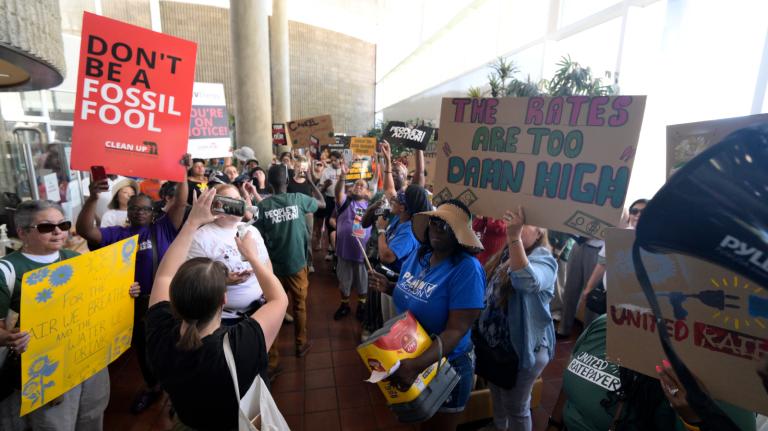
Are we going to stand up and give global politicians a hard slap in the face, to make them face the truth? It will take a lot of us — probably in the streets. Or are we going to let them continue to kid themselves and us, and cheat our children and grandchildren?
Intergenerational inequity is a moral issue. Just as when Abraham Lincoln faced slavery and when Winston Churchill faced Nazism, the time for compromises and half-measures is over. Can we find a leader who understands the core issue, and will lead?