 If I told you how much energy your neighbors use on average, and whether you fell above or below that average, would that induce you to save more energy? What if, depending on whether you came in above or below average, you got an emoticon on your energy bill? Say, a smiley face if you save more energy than they do, a frowny face if less.
Sounds silly, right? We’re all rational people here. We do things for considered reasons, not some cartoon face!
Except not so much. In a 2007 experiment in California, homeowners given an emoticon on their bill in addition to information about their neighbors’ energy usage saved 40% more energy than those given information alone. :o
It turns out we’re surrounded by cartoon faces, all sorts of cues and stimuli that trigger behaviors without engaging the conscious mind. Most of these automated behavioral reactions evolved over time because they helped human societies function better. But precisely because they have evolved to be automatic, they can lead us astray.
The fact that human behavior is governed in part by automated, non-rational behavioral routines is old news to any number of disciplines, from sociology and psychology to history to neurobiology. It’s also well known among corporate marketing departments. But the news has been somewhat late coming to economics, which at least in the Enlightenment west begins with the assumption that human beings are rational actors who weigh costs and benefits and maximize self-interest. The fledgling field of behavioral economics has been trying to change this, incorporating the knowledge that people are Predictably Irrational, as the recent bestseller by economist Dan Ariely puts it. (See also The Myth of the Rational Market by Justin Fox and Nudge by Richard Thaler and Cass Sunstein.)
Understanding human irrational (and arational) behavioral patterns can, among other things, help policymakers design more efficient and efficacious policy interventions. It can help us rectify our collective weaknesses, blind spots, and myopia.
What does this have to do with making buildings more efficient? In my last post on building efficiency, I took a look at a few market failures standing in the way of exploiting the enormous potential of building efficiency. Market failures can generally be solved by properly aligning incentives. Some of the most interesting barriers to efficiency, though, are not market failures but what mainstream economists call “behavioral failures” — failure to behave like economists say you oughtta. Failure, that is, to behave like a rational actor maximizing self-interest.
Understanding why and how such failures occur, drawing on the latest social psychological research, can help us accelerate the financial savings and greenhouse-gas-emission reductions that efficiency brings. That kind of research peaked around the energy crisis of the ’70s but has been anemic and underfunded since. Luckily, the stuff seems to be getting some attention in the energy world. In 2007, the House Subcommittee on Research & Science Education held a hearing on “The Contribution of the Social Sciences to the Energy Challenge.” The same year saw the launch of the Behavior, Energy and Climate Change Conference, devoted to “practical application of social and behavioral insights to address our climate challenges.” (ClimateWire had a nice write-up of the 2009 meeting, which wrapped up last week.) I expect this will be a fun area of research to watch over the next few years.
——
The most puzzling behavioral phenomenon to understand when it comes to building efficiency is that Most People Won’t Do Sh*t (MPWDS). “Most people” includes people who could make money by doing sh*t, people who say they will do sh*t, even people who have promised to do sh*t. I’ve heard from people who write about energy efficiency for a living, know exactly what to do to make their homes more efficient, and still don’t do sh*t. It’s hard to disentangle the reasons why — some mix of status quo bias, hyperbolic discounting, and loss aversion to begin with — but it’s clear that public surveys and polls about this tend to be misleading. What people say they’re willing to do and what they demonstrate they’re willing to do are very different things. Attitudes don’t translate into actions.
Politicians and political activists often seem obsessed with massaging public attitudes. Meanwhile, the American advertising industry has transformed the country repeatedly since WWII by attending to how people act. They understand social and behavioral cues, fear and aspiration, emotional triggers.
To see an example of how these social cues work, consider an experiment run by respected social psychologist Robert Cialdini, author of Influence: The Psychology of Persuasion, a work popular among business and marketing students. “A Room with a Viewpoint: Using Social Norms to Motivate Environmental Conservation in Hotels” compared the reactions of hotel guests to three different messages on their towel racks. Michelle Nijhuis summarizes:
First, they tested the familiar exhortations to “Help save the environment” and “Help save resources for future generations.” These messages had similar success rates, convincing an unimpressive 30 percent of guests to reuse their towels after one night.
Things improved, however, when the research team resorted to peer pressure. The invitation to “Join your fellow guests in helping to save the environment”–including the justifiable statement that nearly three-quarters of guests used their towels more than once–garnered a 44 percent participation rate after one night. Then, the researchers drew guests’ peers even closer: “Seventy-five percent of the guests who stayed in this room … [used] their towels more than once,” they asserted. With the ghosts of former guests peeping over their shoulders, nearly 50 percent of hotel customers hung up their towels.
There’s a simple social psychological phenomenon at work here: the flocking instinct. People want to do basically what People Like Them do. They don’t want to be outliers.
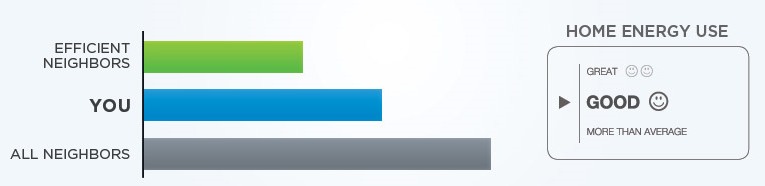
And that’s not all: they want that conforming behavior affirmed. Remember that smiley face? In another semi-famous Cialdini experiment, “The Constructive, Destructive, and Reconstructive Power of Social Norms” (PDF), a group of utility customers were divided. The first group got straight information about how their energy use compared to similar households — below or above average. The response was fairly predictable if you understand that human beings are tribal and want to follow the norms of their tribe: they moved toward average. Energy wasters wasted less, but energy savers wasted more, which is known as the “boomerang effect.”
The second group of customers was given both information and “an injunctive message conveying social approval or disapproval).” That message? Right: smiley face for the savers, frowny face for the wasters. In the second group, wasters saved more, but savers didn’t backslide; their actions saving energy were being reaffirmed by their tribe. On average, the second group of utility customers saved fully 40% more energy than the first.
One remarkable note about both the hotel towel messages and the utility smiley faces: neither approach had ever been tried by the industries. It was not a process of trial and error. The techniques that radically boosted efficacy were a direct result of social psychological theory. Applying social psychology to policymaking can work.
Indeed, it’s beginning to be applied. For example, a software startup called Opower is partnering with 21 (and counting) utilities to scale the smiley face approach up. The information they offer utility customers is deceptively simple, but quite effective.
The behavioral approach is catching on:
This interest in consumer psychology is a new paradigm for utilities, which for years were run by engineers and, says [Opower co-founder Alex] Laskey, “without regard to customers.” Tim Stout, vice-president of energy efficiency at [Massachusetts utility] National Grid, admits that most of the company’s efforts toward conservation have been tied to infrastructure and hardware–the installation of insulation or weatherization, rebates for more efficient equipment. “When we look at the remaining potential for efficiency,” Stout says, “changing consumer behavior is the next wave of savings that needs to be tapped.”
This is what it comes down to: those who would tap the potential for building efficiency are ultimately trying to change the way people behave: the way they heat and cool, they way they light, the way they invest. As we’ve seen, neither knowledge nor willingness is sufficient. A more sophisticated understanding of behavior is required to overcome the barriers to action.
The immediate implication is that the federal government should reconsider the overwhelming proportion of energy research and funding that goes to technology and focus at least a little more on social psychological research and pilot projects that attempt to apply that research in ways that shift consumer and investor behavior. That kind of work is complementary to a technology approach and can substantially reduce its cost.
In the Art of War, Sun Tzu said, “Know the enemy and know yourself; in a hundred battles you will never be in peril.” In the battle to drive efficiency, we are our own worst enemy; we must come to understand ourselves.