As resurrections go, it was a speedy one. On Monday, much of the world’s media declared that the chances of a worthwhile deal being reached at next month’s international climate talks were as dead as the proverbial dodo. By Tuesday, however, the conjectured corpse was clearly still alive, if not exactly kicking.
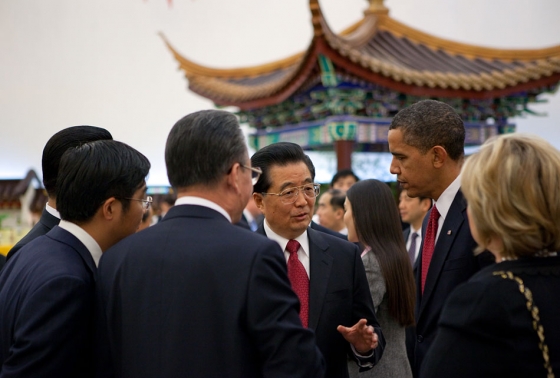 President Barack Obama and President Hu Jintao were quick to insist this week that their two nations are committed to making Copenhagen a success. Above, the two leaders together at a reception before the formal state dinner at Great Hall of the People in Beijing, China on Nov. 17, 2009.Photo: White HouseThe cause of the premature obituaries were weekend statements by President Barack Obama and Danish Prime Minister Lars Løkke Rasmussen that it would not be possible to finalize a full, legally binding treaty when diplomats from around the world gather in Copenhagen starting Dec. 7. This, we were told, would turn the meeting into little more than a talking shop, while the real negotiations were postponed until later.
But as Grist readers already know, the fact that the conference will not produce a full-blown treaty is old news. I reported it here two weeks ago, together with quotes to that effect from German Chancellor Angela Merkel and the United Nations’ top climate official, Yvo de Boer.
The excruciating slowness of the U.N. negotiating process (which, after a combined eight weeks of formal talks in three cities starting last spring, still failed to produce a final negotiating text) and the recalcitrance of the U.S. Senate in passing a climate bill long ago assured it would be impossible to tie up a full treaty in Copenhagen.
My article also explored the alternative set out by Rasmussen at the weekend — also already suggested by Merkel and de Boer — of a “political” agreement, which would later be formalized in a treaty. Far from being a talking shop, the Copenhagen conference would be expected to agree on all the main elements of a climate pact, including big greenhouse gas emission cuts by rich countries, sharp reductions in the rate of growth of emissions in rapidly industrializing ones, and funding to help meet the vast costs faced by poor countries in controlling their own emissions and adapting to the potentially catastrophic consequences of climate change.
Rasmussen spelled this out in his statement, though it was little reported, making it clear that the conference must reach a “binding” deal that is “precise on specific commitments” and “provides for immediate action.” He went on: “We cannot do half a deal in Copenhagen and postpone the rest till later. We need the commitments. We need the figures. We need the action.”
By Tuesday evening, it was clear that such a deal was still a possibility. Obama and Chinese President Hu Jintao, who as the leaders of the world’s two greatest polluters will do more than anyone to determine whether the conference succeeds or fails, agreed to press for it. “Our aim,” said Obama, echoing Rasmussen’s words, “is not a partial accord or a political declaration but rather an accord that covers all of the issues in the negotiations and has an immediate operational effect.”
The two leaders agreed that “transitioning to a low-carbon economy is an opportunity to promote continued economic growth and sustainable development in all countries” and struck deals to launch “a joint energy efficiency action plan and a partnership on renewable energy and the electric power grid” — steps welcomed by Timothy Wirth, president of the United Nations Foundation, who has put much effort into building links between the two countries.
At the same time, environment ministers from 40 key countries — assembled this week for a two-day preparatory meeting in Copenhagen — made good progress towards a political agreement. “My feeling is that it looks better today than when we started meeting,” said Danish Energy and Climate Change Minister Connie Hedegaard, when the talks ended on Tuesday evening. And indeed — though there is still a very long way to go — an agreement is marginally closer than before the weekend alarm.
Much depends on whether the U.S. Senate can demonstrate real progress on a climate bill that would cap and gradually lower America’s greenhouse gas emissions. The hope is that enough will be achieved by senators over the next few weeks to enable Obama to go to Copenhagen with a provisional offer of emission reductions, pending passage of the legislation in early 2010. That, in turn, would make international agreement possible.
But time is short. If the Senate ties Obama’s hands, it will be hard to salvage much in Copenhagen; the obituaries will then be due. As Achim Steiner, the executive director of the U.N. Environment Program, put it this week, there remains an “extremely high” risk of continuing deadlock.
If Obama assures the conference that the U.S. Congress will finalize a climate bill, the legislation would have to be passed by the end of spring, since the American midterm elections will be approaching fast. Failure to pass a bill by then would be disastrous.
It is all very difficult. But there is a chance that, with luck and skill, a climate-saving deal can be reached. And while far from ideal, the hope that a deal is still salvageable is a lot better than the doom that was so widely pronounced at the start of the week.