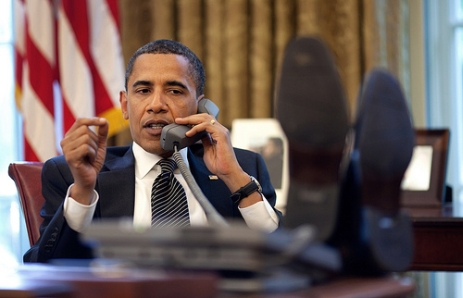
In his latest column, Bill McKibben lays a wide range of sins at the feet of Barack Obama, accusing him of “fibbing and spinning” on climate change. He says Obama is “not particularly focused” on climate (while linking to coverage of an Obama speech dedicated to climate). He says that by putting health care ahead of climate change, Obama “guarantee[d] that health care would occupy most of the year.” He says that by focusing on green jobs and energy security rather than climate change, Obama has “left the door open for climate deniers to have a field day.” Obama’s administration is “spinning” by focusing on the still-common 450 ppm number for atmospheric CO2 rather than the 350 ppm favored by some activists and scientists.
I could not be more sincere when I say that I wish Obama were responsible for health care reform dragging on, for climate deniers and delayers, for the lack of ambition U.S. negotiators can promise the international community. If these things were a matter of Obama simply not trying hard enough, perhaps he could be persuaded to try harder. He’s a reasonable guy!
Alas, despite the far-reaching powers people tend to ascribe to the U.S. presidency in general and Obama specifically, it seems to me the real culprit is—yes, I’m going to say the same thing again, I’m boring!—the U.S. Senate.
Bill says Obama is using the Senate like Bush used China, as an excuse for delay. The analogy is apt insofar as China was out of Bush’s control and the Senate is out of Obama’s. But it’s inapt in that there’s plenty Bush could have done without China and he didn’t; there’s plenty Obama can do outside the Senate and he’s doing it. When it comes to matters under executive branch control, the progress over the last 10 months has been amazing—new fuel-economy rules, new enforcement of efficiency standards, EPA moving forward on CO2 regulations, energy standards and goals for all federal departments, tons of green stimulus money, national retrofit programs, delay of mining and drilling permits, sustained bi- and multi-lateral international climate diplomacy ... the list goes on. Obama is doing what a president can do—more than any president has ever done.
Ultimately, then, Bill’s beef comes down to Obama’s supposed refusal to “push the Senate as hard as [he] possibly can.” Tellingly, there are no details offered on what this pushing might involve, just some handwaving at “spending political capital.”
But how to push the Senate? That’s the most important question! Surely it deserves a little more attention.
Bill Clinton tried getting out ahead of Congress to prod it to action. He sent Gore to Kyoto promising ambitious action on climate. He handed Congress a health care reform bill that he (or rather his wife) had hashed out behind closed doors in the White House, ready to go.
Conservative Democrats bridled; they felt no loyalty to his agenda; they rejected the Kyoto treaty; they picked at the health bill and were happy to let it die.
Obama has been trying the opposite strategy. He is very carefully instructing his international negotiators not to promise anything that the Senate hasn’t already signed on to. (That means waiting for the Senate to pass a bill.) On both health care and clean energy, he has laid out a set of broad principles and let members of Congress work out their own bills, cheerleading occasionally from the sidelines. On health care, the progress has been impossibly slow, dragging out longer than anyone not totally cynical about the Senate could have predicted. But it’s been progress. On clean energy, the strategy worked like a charm with the House clean energy bill. Obama mostly let Reps. Henry Waxman (D-Calif.) and Ed Markey (D-Mass.) handle it, with some crucial behind-the-scenes help. The administration strongly endorsed the bill when it passed. A roughly similar bill got to the Senate and raced through Sen. Barbara Boxer’s (D-Calif.) progressive Environment and Public Works Committee.
And ... conservative Democrats bridled; they felt no loyalty to Obama’s agenda; they’re trash-talking Copenhagen; they’re picking at the clean energy bill and are happy to let it die. (See: Jim Webb.)
That’s two very different executive strategies that ran into similar wankery from conservative Senate Dems. Maybe our conclusion should be that the problem is conservative Senate Dems. Many such Dems come from states that voted for McCain and/or Bush. Obama has no leverage over them; support from Obama isn’t important or necessarily helpful for their electoral prospects. Unless they feel constrained by party discipline like their colleagues on the other side of the aisle, or God forbid feel the pull of conscience, they have no incentive to work to pass the progressive agenda Obama campaigned on. Nor do they have reason to accept any treaty his administration signs that goes beyond what they’ve already agreed to. Dems desperately need their votes, but they don’t desperately need other Dems, and there’s just very little in Obama’s arsenal with which to “push” them. The dysfunction of the Senate is structural; it’s not in Obama’s power to change, no matter how much he tries, no matter how much capital he spends.
The difference between Clinton’s flamboyant rhetorical pushing and Obama’s relatively laid-back style is this: Obama’s still has a chance to work. However frustrating it may be to activists who want bigger words, bolder promises, and faster action, the fact remains that the Dems are within reach of passing a health care reform bill and have at least laid out a path to passing a clean energy bill and ratifying a binding international climate treaty in 2010. It’s too early to deem Obama’s leadership a failure.
Yes: political realities can be changed. The kind of broad grassroots movement that Bill McKibben himself has been so instrumental in creating can shift the tectonic plates. But a crucial step in that process is to accurately identify what and who is blocking progress. It’s not Obama who deserves the ire of the 350 army. It’s Max Baucus (D-Mont.). It’s Ben Nelson (D-Neb.). It’s Jim Webb (D-Vir.). It’s Evan Bayh (D-Ind.). It’s the filibuster! These targets are harder to reach and in many ways less satisfying to battle, but they are the real locus of delay and inaction.
Comments
View as Flat
Flynnternet Posted 6:21 am
17 Nov 2009
Permalink
Catmoves Posted 2:32 pm
17 Nov 2009
Taking a shot at Bill McKibben is not going to do a single thing to get BO to focus on the issue.
Using a balky Congress to defend The One? Oh, shame on you.
Here's some points:
1. B. Obama in the leader of the Democrat Party.
2. Both houses of the Congress are controlled by Democrat votes.
3. The leader of the party needs, then, to lead the party.
4. Having basically ignored this issue during the "honeymoon" period, our leader has failed his chance to be really effective where climate change is concerned.
5. He seems even less interested now.
You also state: "He (Bill McKibben) says Obama is 'not particularly focused' on climate (while linking to coverage of an Obama speech dedicated to climate)."
May I point out that one more speech from B. Obama is no longer likely to interest the American public? I've seen it written in more than one place. The public is giving him his due as an orator, but the grade is F as far as being able to get action from a recalcitrant Congress.
Making excuses is not really anything like making progress, now is it?
Permalink
Bill McKibben Posted 8:57 am
17 Nov 2009
By the way, some of us both write about this stuff and organize about it. Why don't you coordinate a vigil outside your senator's office--or help make one happen outside Max Baucus's. We could definitely use your help!
Permalink
laservisor Posted 7:19 pm
17 Nov 2009
Permalink
Ted Glick Posted 9:04 am
17 Nov 2009
No. Wrong. There is no filibuster in the House, where coal state Democrats wreaked their havoc on the legislation-writing process, leading to a very problematic climate bill.
Ted Glick
Permalink
David Roberts Posted 11:00 am
17 Nov 2009
The Senate does not represent the country in a democratic way; rural and low-population states are over-represented. And the bill there will need far MORE than a majority to pass. The combination of those two facts means that the resulting bill will be far to the right of the median -- far, far worse than the House bill -- and for all that, it may not pass at all.
Just because you don't like either one doesn't mean the situations in the House and Senate are parallel.
Permalink
Sam Penrose Posted 10:10 am
17 Nov 2009
1) Email to the national office via their online forms is recommended approach.
2) Phrasing the question is not so easy and probably matters. Here’s what I came up with:
“Currently most major legislation requires the support of 60 senators. Does the Senator support changing Senate rules to allow a simple majority of Senators to better implement their agenda?”
Suggestions for improving this language would be awesome. Also, how about surfing to your Senators’ sites at (lastname).senate.gov and putting the question to them?
Permalink
neosapiens Posted 10:56 am
17 Nov 2009
Permalink
joowan1 Posted 10:58 am
17 Nov 2009
Permalink
paroneanu Posted 11:21 am
17 Nov 2009
Nevertheless, what do you suggest as a "concrete" way to move forward?
Permalink
joowan1 Posted 12:40 pm
17 Nov 2009
What I'm saying is where's the help for local people on the ground starting green businesses and green training programs from 350, or would they rather just take pictures of them and send them to Congressmen and women in the form of a photo petition?
How about helping people write and pass Legislation on a state and city level that makes their goals more concrete and longterm?
Movement building is only half the battle, we need help from national/international organizations like these who say they speak for the people, but aren't actually doing anything productive and long-term on the ground level.
Permalink
jhenn Posted 11:32 am
17 Nov 2009
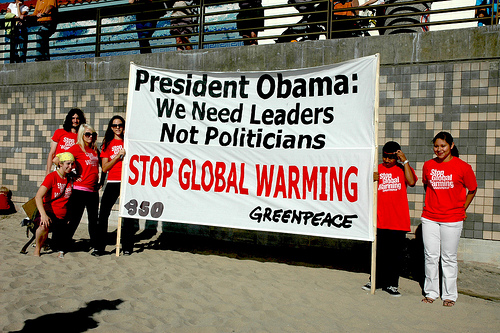
The point that Bill and many others are making (see Greenpeace's banner hang on Mt. Rushmore for example) is that Obama needs to step up is public campaigning for a strong clean energy and climate bill. I agree that he's doing some work behind the scenes, but without the President's vocal leadership there is no way we'll get a climate bill that's anywhere close to what science says is necessary.
Let's not forget what we're talking about here: a complete rewiring of the US economy that puts our country on a war time footing to simultaneously take on poverty and pollution. That's not something that Congress is capable of legislating. That kind of action takes leadership along with laws.
And that's where Obama isn't doing his part. Contrast these two scenes. Scene one, Obama making a major speech on the levees of New Orleans to announce a new Clean Energy Jobs Corps designed to get America off fossil fuels and stop the climate crisis. Scene two, Obama sitting at a palace in Singapore guarded by barbed wire and issuing statements designed to undercut progress on an international climate treaty.
That second scene happened on Monday, when Obama did more to deflate hopes for action at Copenhagen then any nay-saying Congressman could ever accomplished.
But that first scene is what we desperately need. Obama's greatest moments have come when he's been put on the ropes (think Rev. Wright and the race speech in Philadelphia). It's not easy taking on someone we worked so hard for -- I also went door to door for Obama in New Hampshire, South Carolina, New Mexico, and Nevada -- but sometimes it's necessary.
Here's one more vote for tough love.
Permalink
Sam Penrose Posted 11:41 am
17 Nov 2009
Permalink
sunflower Posted 12:06 pm
17 Nov 2009
Permalink
neosapiens Posted 12:17 pm
17 Nov 2009
Permalink
David Roberts Posted 12:59 pm
17 Nov 2009
Permalink
Sam Penrose Posted 12:20 pm
17 Nov 2009
Permalink
Glenn Hurowitz Posted 1:00 pm
17 Nov 2009
But Obama doesn't need to make dramatic statements. He just needs to be clearer about what he's pushing for in regulation under the Clean Air Act. He really just has to say one sentence: "My administration will use its regulatory authority through the Clean Air Act and other mechanisms to achieve emissions reductions 40 percent below 1990 levels by 2020. I'm happy to sign a climate bill that provides more flexibility to US companies than regulation, but if that doesn't happen, we're going to do everything we can to switch America to a clean energy jobs economy as quickly as possible." Then, the burden is on the polluters to pass a bill. Game over. Hell, he could even have EPA administrator Lisa Jackson say it. More: http://www.thenation.com/doc/20090511/radford?rel=hp_currently
Permalink
skitters Posted 1:52 pm
17 Nov 2009
http://envirogy.wordpress.com/2009/11/17/putting-the-eggs-in-the-nuclear-basket/
Permalink
John Deans Posted 5:33 pm
17 Nov 2009
Permalink
jayohara Posted 6:41 pm
17 Nov 2009
Actually, if Obama is smart (which I think he is), he WANTS us to get a little impatient with him. The way to get what we want is to change political reality. How do we do that? By organizing a movement that is capable of exerting pressure on decision makers. A movement that is powerful enough to (in the paraphrase of LBJ) go out and make Obama do it.
Bill isn't therefore attacking Obama, quite the opposite - he's doing what's necessary to allow Obama to do the right thing. By changing political reality - by amassing our forces of the people against the vested fossil fuel interests - we create the space for The Changeinator to start putting this on the front burner.
Here in Massachusetts a group of students are leading campaign called "The Leadership Campaign" for 100% Clean Electricity in the next decade - the sort of WWII mobilization that we'll need to make this happen. They've been camping out on Boston Common every week, lobbying, organizing, and they just had a very productive meeting with the Governor today.
So as the stickers on the green hard hats say, let's "Get To Work!"
Permalink
Ben Lieberman Posted 7:55 pm
17 Nov 2009
It was never a secret that health care was going to come first, and yes it has been a long, hard slog, and achieving health care for all Americans is still going to be hard.
The Obama adminsitration has already taken unprecdented steps to tackle global warming via the EPA, but legistlation is still necessary, and yes the Senate is an incredibly arcane, cumbersome, slow-moving and obstructionist, and un-representative body that probably should not exist.
With all due respect, the key is to win support for pricing carbon--without first gaining support for that principle it does not matter what target you set 350-450 or any other number--you will miss them all.
The 350 events showed a lot of effort, and I enjoyed hearing Bill's mother speak at the event in Concord Massachusetts, but there was also a usual-suspects feel to the event. What wuld be an effective means to sway swing Senators on this issue? Will vigils prove effective?
This is the first real chance we have had to begin to tackle this threat. Insulting the President who has already done more than any other on this issue is a huge mistake. Use of words such as "fibbing" only serves to marginilize environmentalists.
Permalink
splashy Posted 5:24 am
18 Nov 2009
There are many people that could do a world of good for the environment if they only could make sure at the same time that they and their families had their health issues covered. That's why so many work for the big businesses, when they would rather start their own companies.
That's also why so many big businesses LIKE having the health care club to hold over the heads of their most valued employees. It makes for less competition for them, the ability to exploit the talents of many employees, and fosters more loyalty from their employees even when they abuse and use them.
So, maybe getting health care fixed will go a long way toward getting everything else fixed.
Permalink
tweetingdonal Posted 8:13 pm
17 Nov 2009
The responsibility for American behaviour rests with us, the American people. It is our job to become informed, to grasp the situation at hand, and tell our REPRESENTATIVES that we want them to act. I guarantee the folks on the Hill or at 1600 Pennsylvania will listen if the people say, "fix it or be voted out".
All the BlameStorming does not good. Get the people behind you... the rest must follow.
Permalink
jayohara Posted 8:45 pm
17 Nov 2009
Right On TWEETINGDONAL!
Permalink
David Roberts Posted 1:11 am
18 Nov 2009
http://www.guardian.co.uk/commentisfree/michaeltomasky/2009/nov/17/obama-administration-congress
Permalink
Tim Burrows Posted 3:54 am
18 Nov 2009
In my view there is a massive underinvestment in energy efficiency right now. Why? Because energy is artificially cheap. Once a carbon price is in place, businesses will analyse their internal cost of abatement (see http://www.northmoregordon.com/index.php?option=com_content&view=article&id=63:getting-your-greenhouse-in-order&catid=39:ideas&Itemid=58) and make the right decisions. As long as the government continues to throw money at renewables in preference to genuine least-cost emissions reduction alternatives, society will be paying an unnecessary price for emissions reductions.
Permalink
splashy Posted 5:12 am
18 Nov 2009
Permalink
amazingdrx Posted 9:12 am
18 Nov 2009
What we should be angry about is the lack of action on computer modeling of the interaction of a distributed renewable generation and storage smart grid with our present central "dumb" fossil and nuclear powered grid. Different possible transition paths need to be explored and explained to policymakers and the public.
Then maybe political choices could be made with intelligence behind them, instead of lobbyist cash? Where should incentives go to encourage the best possible transition for the climate and the economy?
Assume cost trends in renewable energy will be going down with mass production and that the price of fuel based energy will go up. As fossil and nuclear power industries are forced to accept the cost of the messes they have made, and are continuing to make, the price will rise even faster than inflation in oil, natural gas, and coal based energy.
The effect of price spikes in oil and natural gas due to international conflagrations and storms and market manipulation should be considered too. Super computers are designed for these complicated simulations afterall, and we the people did pay for them (secretary Cho's old lab, Lawrence Livermore for instance). So what's the holdup?
We want better rhetorical ammunition to fight the denier/delayer corporate lobbyist astroturfers. Step aside please coal and nuke lobbyists, we the people need some cutting edge technology applied to the new energy economy roll out and the all important political decisions involving subsidy diversion from fossil and nuclear power to renewables.
The planned "communist" economy of China is beating US capitalists. Time for some planning of our own.
Permalink
HealthyHiker Posted 11:06 am
18 Nov 2009
Permalink
Mike Tidwell Posted 2:35 pm
18 Nov 2009
http://www.grist.org/member/view-all/posts/1675
Mike
Permalink
Earthgal Posted 5:01 pm
18 Nov 2009
Permalink
Jason D Scorse Posted 5:52 pm
18 Nov 2009
Permalink
Jason D Scorse Posted 5:53 pm
18 Nov 2009
Permalink
dave shukla Posted 7:11 am
21 Nov 2009
The "Change We Can Believe In" is that which ordinary people participate in bringing about. Simple.
Dave Shukla
Permalink
johnpdeever Posted 9:17 am
24 Nov 2009
Permalink