Take it with a grain of salt

SolarReserve’s 24/7 solar power plant 98

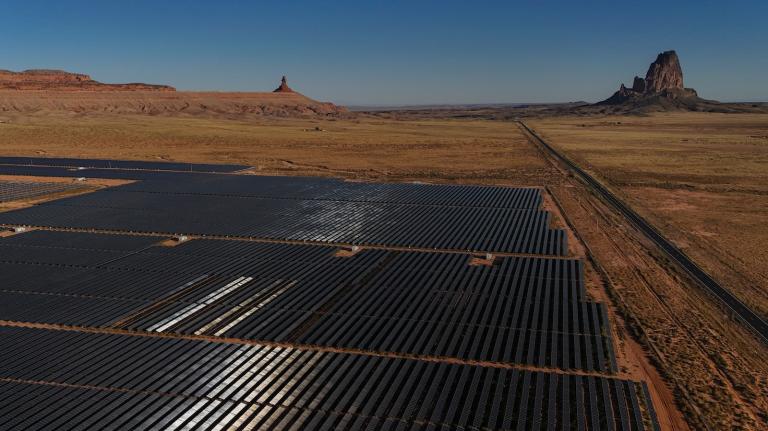
Solar panelsPhoto: SolarReserveAt Rocketdyne’s San Fernando Valley headquarters outside Los Angeles there’s a whiff of the right stuff—of crew-cut guys in short-sleeve white shirts and skinny black ties—in a vast room that holds the massive rocket engines that propelled John Glenn and the Apollo 11 crew into space.

In one corner of this corporate space museum stands something different, though. It’s a scale model of a solar power tower, technology Rocketdyne developed a couple of decades ago as a spinoff of its work for NASA.

Here’s how it works: An array of mirrors called heliostats focuses sunlight on a receiver filled with molten salt; the stored heat can produce steam to run a solar power plant 24/7—the elusive Holy Grail of solar energy. The technology, cast off as a non-commercial curiosity in the age of $18-a-barrel oil, is now being revived and could make Rocketdyne and its parent company, United Technologies, a big player in green tech.

A Santa Monica startup called SolarReserve—founded by, yes, rocket scientists from Rocketdyne—has licensed the solar power tower technology, turning the Silicon Valley model on its head: Take a proven yet obscure technology developed years ago by an old-line tech company and marry it to the entrepreneurial culture of a startup.  

The company was in the news last week when it filed an application with California regulators to build a 150-megawatt solar power plant in the Sonoran Desert east of Palm Springs. The Rice Solar Energy Project will be able to store seven hours of the sun’s heat so it can be released when it’s cloudy or at night to create steam that drives an electricity-generating turbine. Future versions of the solar farm will be able to store up to 16 hours of solar energy. Other solar power companies are using energy storage but SolarReserve’s technology is a potential game-changer (more on that in a bit).

SolarReserve has kept a low-profile. Not surprising for a company founded by executives who previously needed government security clearances to get into their offices. (I only found out about the Rice project when I noticed SolarReserve had filed an application with the California Energy Commission.)

The company first caught my attention when a day after Lehman Brothers collapsed last September—setting off the global economic meltdown—the startup issued one of its rare press releases, announcing it had raised $140 million from a blue-chip roster of big players, including Citigroup and Credit Suisse.

A few weeks later I flew to Los Angeles to meet SolarReserve president Terry Murphy and his team, headquartered somewhat incongruously around the corner from Geffen Records, Lionsgate, and other outposts of the entertainment-industrial complex.

The SolarReserve execs were affable and eager to discuss their technology but close-mouthed about the dozens of deals they said were in the works for Big Solar power plants to be built in the desert Southwest and overseas. (One tantalizing hint they dropped was the interest of an unnamed utility in a massive complex of 10 SolarReserve power towers that would generate 1,000 megawatts.)

I’ve kept in touch with Murphy and even as the credit crunched worsened and the solar industry began to consolidate as startups ran out of money, he remained confident that SolarReserve would remain on track.

“We’re capable of riding this out,” Murphy told me a few months ago.

That’s because as investors run away from financing billion-dollar solar power plants using untried technology, SolarReserve’s ace in the hole is Rocketdyne and United Technologies.

The company that guaranteed Neil Armstrong made it to the moon will guarantee the performance of SolarReserve’s solar power plants. In these tough times, that’s what it takes to raise money on Wall Street or from well-capitalized utilities.

“SolarReserve has a very credit-worthy backer—United Technologies—which has said it will stand behind that technology and which gives them an edge,” said Tom Glascock, a global finance partner at the San Francisco law firm Orrick, at a recent seminar for green tech movers and shakers.

Rocketdyne’s molten salt technology was proven a decade ago at the 10-megawatt Solar Two demonstration project in the desert outside Barstow, Calif.

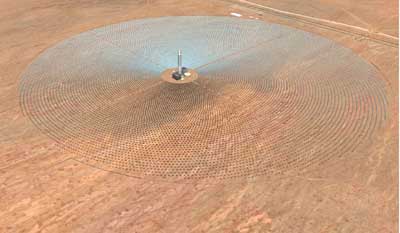
Solar Reserve’s planned Rice solar power plant will dwarf Solar Two. More than 17,000 heliostats—each mirror is 24 feet by 28 feet—will form a circle around a 538-foot-tall concrete tower. Atop the tower will sit a 100-foot receiver filled with 4.4 million gallons of liquefied salt.

When the sun rises each morning, the heliostats will focus their rays on the receiver, heating the salt to 1,050 degrees Fahrenheit. The hot salt will flow into a steam generation system that will drive a conventional turbine housed in a power block. After the sun sets, the salt will retain heat which can be used to generate electricity when demand spikes.

“The California utilities have peak demand from 1 p.m. until 8 p.m. so we are designed to run at 100 percent capacity during the full peak period into the evening,” Kevin Smith, SolarReserve’s chief executive, wrote in an e-mail message. “In addition, because of the storage capabilities, the facility is flexible enough to accommodate other requests from the utility after the sun goes down provided we understand the requests in advance.”

By being able to tap solar electricity on demand, utilities—at least those in the Southwest—could forgo spending billions of dollars on fossil fuel power plants that are fired up only a few times a year to prevent blackouts when everyone turns on their air conditioners on a hot day.

The Rice project is to be built on private land that is the site of a World War II-era Army airfield near the desert ghost town of Rice.

I happened to visit the site in late 2007 with an executive from Silicon Valley solar startup Ausra, which was shopping for land for solar power plants. Old artillery shell casings litter the desert scrub and you can still see the outlines of old runways. A massive concrete tarmac now serves as a parking spot for snowbirds’ RVs.

Ausra, an early player in the solar power plant business, has since dropped out, electing to focus on supplying solar thermal technology to developers rather than building its own projects.

With the Rice Solar Energy Project, SolarReserve is on the launch pad. Now it just needs to prove its salt.

Todd Woody covers green technology and the environment from Berkeley, where he’s a contributing editor at Fortune Magazine and writes his Green Wombat blog. He’s one of the few people on the planet who has seen the rare northern hairy-nosed wombat in the wild.

Advertisement
Advertisement
  1. amazingdrx's avatar

    amazingdrx Posted 11:10 pm
    09 Nov 2009

    The rocket scientists are up against google?

    http://www.reuters.com/article/GlobalClimateandAlternativeEnergy09/idUSTRE58867I20090909

    That could be rough.

    Raser makes a better closed cycle turbine system too. Water based turbines are not as efficient unless the steam is discarded. And water use is the Achilles heel of coal and nuclear already, do we want to go there with solar too? I think not.

    These solar heat storage turbine systems would work better in conjunction with heat hungry factories. Like maybe silicon fabrication/solar PV cell plants for instance? Now there's a winning technology. Green manufacturing of solar PV that provides cogenerated power for the grid even after the sun sets.

    Lots of US dollars held by the Saudis might just be available to invest in technology like this. They want to go with solar as their oil dries up. Let's make a deal. Our technology and their money could build solar powered PV factories all over their deserts and ours.

    Heed this trend silicon valley.
    1. Bob Wallace Posted 12:34 pm
      11 Nov 2009

      X - you didn't do Google justice. (Thanks for the link.)

      "...Google is looking to cut the cost of making heliostats, the fields of mirrors that have to track the sun, by at least a factor of two, "ideally a factor of three or four."

      "Typically what we're seeing is $2.50 to $4 a watt (for) capital cost," Weihl said. "So a 250 megawatt installation would be $600 million to a $1 billion. It's a lot of money."

      That works out to 12 to 18 cents a kilowatt hour."

      --

      "Another technology that Google is working on is gas turbines that would run on solar power rather than natural gas, an idea that has the potential of further cutting the cost of electricity, Weihl said.

      "In two to three years we could be demonstrating a significant scale pilot system that would generate a lot of power and would be clearly mass manufacturable at a cost that would give us a levelized cost of electricity that would be in the 5 cents or sub 5 cents a kilowatt hour range," Weihl said."

      When you find this stuff wish you would shout it out. ;o)
      1. amazingdrx's avatar

        amazingdrx Posted 10:34 pm
        11 Nov 2009

        Yep Bob, good eye. I was looking at the heliostat cost cutting, missed the rest. When is Google going to call us for new ideas? Hehey.

        I think the integrated solar furnace powered silicon fab/solar PV cell factory with CAES featuring geothermal well heat and factory waste heat for boosting the turbine air, with biogas/natural gas fuel cell backup is something they would want to try.

        You just know someone at Google is putting these pieces together. These are exciting times to be a geek.
  2. Gene Preston's avatar

    Gene Preston Posted 8:57 am
    10 Nov 2009

    Solar and nuclear power compliment each other. A small amount of nuclear base load and quite a lot of solar for daily peaking power. I have small subdividion example of this posted here: http://egpreston.com/costofnuclear.pdf. Now if you try to make solar displace nuclear you are going to be terribly dissapointed. Nuclear base load literally kills solar on the cost per kWh alone. So why would you want to make the claims that solar can provide base load power. Maybe its because you are not really interested in the lowest cost power but instead are just plain anti nuclear. What do you think England just did with their solar and nuclear options? They just approved ten new nuclear plants. Solar power in cloudy England would be a complete flop.
  3. GreeningTX Posted 12:08 pm
    10 Nov 2009

    Mr. Preston, please don't talk about nuclear's cost/kWH without including the extremely-long-term costs of waste disposal.
    1. Gene Preston's avatar

      Gene Preston Posted 1:02 pm
      10 Nov 2009

      Sure, no problem. The next generation of nuclear reactors are being designed to use the nuclear waste as its fuel, eliminating long term storage of "waste" altogether. The only waste products remaining after the life of the fuel would be a few years instead of millenia. These are the IFR nuclear reactors and you can find a lot about them on google. There needs to be an IFR demo reactor constructed to show that the concept works. If it does, then we have a way to completely burn up the nuclear waste since nuclear waste is its primary fuel. Its been estimated that our existing stockpile of nuclear waste can run all the electric power for the US in IFR plants for hundreds of years. Once we switch to IFR plants we do not need to mine any more uranium, not mine any coal, nor mine just about any kind of energy. One reason big business is opposed to IFR nuclear power is because it has the potential for putting all other energy sources out of business. No wonder there are so many special interest groups who want to keep it from ever developing. However it is the future and will be developed. India is currently working on IFR type plants using Thorium fuel, which India and the US have plentiful supplies of. Korea is working on IFR ideas to eliminate the nuclear waste problem in their small crowded country, where there is no room to store nuclear waste. Look for S Korea to be a leader in nuclear technologies. Japan has the same problem and has a number of nuclear innovations. They are easy to locate on the internet using google - try Toshiba 4S for a starter. The Russians and Chinese just signed a deal the other day where Russia builds two fast neutron nuclear plants in China. England just yesterday said they were entering a program of acclerated nuclear power development in England building ten new nuclear plants so they can address GHG and well as get of fossil fuels. I could go on and on....
      1. Grapejuice Posted 7:12 pm
        10 Nov 2009

        The technology you say will take care of nuclear waste is completely untested at this point. It's not a valid 'counter technology' to solar until that point because the two benefits you extol - existing supply of fuel and no 'waste' costs are currently fantasy.
      2. lonepine's avatar

        lonepine Posted 11:24 am
        11 Nov 2009

        To me the big problems about nukes are proliferation and long term waste management.

        So a few more questions about IFR, which sounds promising if it can happen. I understand that current LWR "burn" only a small percentage of their fuel, leaving great big piles of waste (the amount of waste is something like 90% of what the fuel was). An IFR can result in far less waste.

        Some questions:
        1. How much waste per MW say, does an IFR produce compared to current reactors? And what is this waste? What's its radioactivity? What's its half-life? Other than its radioactivity, how toxic is it? Can it be used for a fission bomb? Or a dirty bomb?

        2. The IFR uses liquid sodium instead of water or gas as its working fluid and moderator. Sodium's nasty stuff- burns when it touches air or water. So in addition to worrying about a radioactive core, radioactive waste, and radioactive fuel, how do we manage liquid sodium safely?

        3. In addition to a potential leak of sodium and its safety and environmental concerns, what happens to the reactor core if there's a leak of its sodium working/coolant fluid? In current LWR designs, a leak of water can be disastrous: the core isn't able to get rid of its heat fast enough (since heat flows much more slowly through the air that would displace leaking water), and risks melting and falling apart = big problem. So since all pipes leak, no matter what, what happens in an IFR if its working fluid/moderator starts to fall in volume, replaced by air?

        4. Can an IFR be made to be inherently safe? E.g., I understand that some gas cooled reactors are "inherently" safe b/c if there is ever a loss of cooling fluid (which in this case He gas), the air which would displace it can also transfer heat adequately from the core, averting the risk of the core overheating, falling apart, melting, etc.

        5. What is the carbon and water footprint of nuclear fuel mining and processing, say per MW electricity produced?

        Thanks.
      3. Gene Preston's avatar

        Gene Preston Posted 9:19 am
        12 Nov 2009

        Supplying base load power with wind and solar is also untested as well as the rather massive amount of transmission that will be needed in the US connecting the different regions. Its not going to happen. In England solar and wind are incapable of suppling the renewable power so some level headed thinkers have finally taken the correct action -- see this http://news.bbc.co.uk/2/hi/uk_news/politics/8349715.stm and this http://www.timesonline.co.uk/tol/news/politics/article6910307.ece
      4. lonepine's avatar

        lonepine Posted 9:32 am
        12 Nov 2009

        What I think are reasonable questions in my other comment still stand unanswered...

        Look- many environmental and social problems can be summed up in a couple words: too much. If instead of 5B people burning fossil fuels, we only had 2B. Or if instead of 150 nuke plants around the world, we had only 30, then the problems associated with them would be much more manageable.

        Imagine what would happen to any of our cities if just one dirty bomb were detonated- what would happen? Imagine one in downtown London, Shanghai or Manhattan? Can nuclear waste be used to make a dirty bomb? Forget about enriched U or Pu.

        So maybe, as in the past, burning coal and oil was a completely reasonably idea after deforestation in the British Isles. In the same way, building more and more nukes seems like the right thing to do in the present era of GHG induced climate change. But we KNOW of the risks of nuclear waste, and now we're on the path to create more without any plan to manage these risks. That's close to simply unethical.
      5. Bob Wallace Posted 10:22 am
        12 Nov 2009

        "Supplying base load power with wind and solar is also untested..."

        Not exactly true. The math has been done. We've got wind, solar, and storage in the system right now. We know how they operate and how to size each as we go forward.

        "...as well as the rather massive amount of transmission that will be needed in the US connecting the different regions. Its not going to happen."

        It's already underway. Read up on Tres Amigas. There's a brand new article on the MIT site today.

        http://www.technologyreview.com/energy/23928/

        "In England solar and wind are incapable of suppling the renewable power"

        England isn't a solar hotspot. But the UK has several times the wind they need to power themselves. Most likely they will build lots of wind (and tidal) and trade it for hydro from Iceland/Scandinavia, solar from Spain/Italy/North Africa. Read up on the European Super Grid. It has also already been started.

        I'll give you a UK paper link. That way you'll know that England has heard about it....

        http://www.guardian.co.uk/business/2009/nov/01/solar-power-sahara-europe-desertec

        "... so some level headed thinkers have finally taken the correct action -- see this..."

        Well, there is a group of people in England who want to build a bunch of reactors rather than go the renewable route. Will they win out in the end? I sort of doubt it.

        When push comes to shove the bottom line generally wins.
      6. amazingdrx's avatar

        amazingdrx Posted 10:21 am
        13 Nov 2009

        That Tres Amiga link is awesome Bob. The question that comes to mind is why are they not using the superconducting bridge circuit for storage? And will the insistence on superconduction slow down the rollout of a national HVDC grid?

        The objection to using regular copper underground for HVDC supergrid connection was that individual lines have to be buried a few meters apart to avoid overheating. The idea of cooling one or two really large hollow conductors in a concrete channel with the cooling fluid circulating inside and outside the conductors and dumping heat to the ground (or to cold air in winter)would take care of that.

        Then as superconducting technology is rolled out, the copper could be replaced in an orderly transition with the same concrete channels in place (just like fiberoptics are replacing copper in information technology). Pretty interesting article, they mentioned overhead power line NIMBYism and using freeway median right-of-way.

        Now I guess they better check out the transitional technology I mentioned and also using the superconducting loop to store power. Once the system is up and running it might even store a certain amount of power anyway, by testing that effect and enhancing it, who knows we may get a national electron superconducting highway that stores power too.

        That would be good. A good use for excess renewable energy would be to store "cold" to keep the superconducting lines cold enough. A gas that liquifies a few degrees just below the liquid nitrogen superconductor coolant could act as cold storage. That cold storage could be "recharged" whenever excess wind or solar power was available. Eliminating the losses due to refrigeration of the superconducting line.

        Starting with buried fluid cooled copper and transitioning to superconductor line, sited in the same installations in freeway median, would provide a gradual, affordable transition to fully superconducting national HVDC grid. Will it also store power?

        There's some suspense for the Tres Amiga project. The other question I have is how will this be re-regulated? That issue is going to have to be faced up to, corporate power unlimited, produces unlimited corruption. That is not the way to start this green energy re-evolution, monopoly corporate market manipulation.
      7. Bob Wallace Posted 11:22 am
        13 Nov 2009

        X - Here's an article that claims burying HVDC costs about the same as stringing it overhead.

        http://www.renewableenergyworld.com/rea/news/article/2009/03/invisible-underground-hvdc-power-costs-no-more-than-ugly-towers

        I suspect Tres (if it happens)is likely to eliminate the need for a nationwide HVDC transmission line. Hooking all three regional grids together would get the job done.

        BTW, the big dig against desert solar playing a big role in the power game is the NIMBY resistance to transmission lines. We've already got the Pacific Intertie running from the Pacific Northwest to SoCal and sweeping through western Nevada along the way. And we've got the Intermountain HVDC connecting Utah and SoCal. The real estate for the main transmission lines is captured.

        Oh, and the Intermountain is being extended to bring Wyoming wind to SoCal.

        "Wyoming wind is very valuable in Los Angeles because wind peaks in the evening, hours after electrical demand peaks in the afternoon. The two-hour shift in sun position between Los Angeles and Wyoming causes wind output to almost perfectly match electrical demand. HVDC power links pay for themselves quickly because the spot price of electricity varies by as much as 3:1 through the day and can be mismatched by as much as 33:1 between unconnected areas."
      8. lonepine's avatar

        lonepine Posted 12:41 pm
        13 Nov 2009

        Some questions about transmission lines:

        1. Does the energy required to maintain superconducting temps "pay" for itself? I.e., is the energy saved by using superconductors greater than the energy required to cool them?

        2. Is there a way to sell the heat from transmission lines to where it's needed? Like, Yahoo should place its heat producing server farms to a greenhouse...
      9. Gene Preston's avatar

        Gene Preston Posted 2:58 am
        14 Nov 2009

        The Tres Amigas substation is a waste of money because the three affected regions, ERCOT, SPP, and WECC were not involved in the planning process. All three regions are building new transmission lines but those lines are hundreds of miles from Tres Amigas. For Tres Amigas to be successful will require a few years of planning for the new lines and a way to finance them. I would say the the time period to realize the benefit from Tres Amigas is of the same time scale as building a new power plant. If all went well it would take about 5 years of planning and approval from regulatory agencies as well as a way to determine who pays for them. In ERCOT that process still took a few years through its CREZ process, even though Texas is transmission line friendly. SPP and WECC will have a difficult time with paying for the new lines connecting to Tres Amigas so expect that process to go slowly. But first the Tres Amigas folks have to get a buy in to the project from those three regions. My take on what the three regions are saying about Tres Amigas is that they think it's not going to happen. Lets wait and see...
      10. Bob Wallace Posted 10:59 pm
        14 Nov 2009

        " There needs to be an IFR demo reactor constructed to show that the concept works. If it does, then we have a way to completely burn up the nuclear waste since nuclear waste is its primary fuel"

        There have been several built. Most (all but two?) are now closed and Britain is currently in the process of decommission theirs.

        Tried. Stumbled.

        Additionally, IFRs are only useful for spent fuel. We can't burn the vast amounts of non-fuel radioactive waste piled up with nowhere to go. Spent fuel is a small, small part of the problem.


        (Google could be your friend.)
      11. acnicolet's avatar

        acnicolet Posted 6:55 pm
        18 Nov 2009

        Whoa, hey hoo! To whoever said that wind turbines, killing birds is a problem. Im sorry, but I have to stop you there... It might be that a couple of baldheaded eagles and rare beautiful birds are killed once in a while, but why dont we look at the big picture then, and try to guess what causes more bird-kills... Carbon, Sulfur gasses and Nitrous Oxide released by coal, oil and gas - or a few birds. And thats not all:

        The bird-killing myth is VERY popular! My guess is that its because it is so visual. Its easy to imagine a bird being chopped up by a windturbine. Less so imagining the procreation- and hormonal disturbances as well pollution of drinking water for all other wildlife caused by the alternatives.

        The fact is that turbines kill very few birds compared to other human activities. Check out page four here:

        http://www.awea.org/pubs/factsheets/050629_Myths_vs_Facts_Fact_Sheet.pdf

        If wind turbines are really a problem for wildlife, then the solution is to make them fewer but bigger. Why is the Tehapachi desert in California littered with hundreds KW-generators, when a fraction of MW generators could create the same amount of power, cheaper and more effectively. Why have not more states opted in on off-shore wind turbines, proven extremely beneficial in so many European countries. (e.g Horns Rev II, Rødsand II and Anholt off-shore wind-parks in Denmark are 200MW, 200MW and 400MW respectively. The London Array (currently under construction) will be 1,000MW). And if you think its unreliable, think again, watch the movie on this page that describes how wind is currently used to power 20% of Danish power needs.

        On a final note. In Germany and Germany (leading wind power countries), studies of bird wildlife in connection with wind turbines, has proved that in many circumstances, the migratory and local birds learn to navigate around and avoid the windturbines.

        Im not saying birdkills should be completely dismissed - but using it, as it if ofen the case, as a main argument against wind-energy is a fallacy at best.
  4. skitters Posted 12:20 pm
    10 Nov 2009

    ...but solar power in California, Nevada and Arizona is another thing. This is really interesting technology and is a potential game changer for renewables. Finally a renewable technology that can store power, good stuff!!!
    http://envirogy.wordpress.com
    1. Gene Preston's avatar

      Gene Preston Posted 1:21 pm
      10 Nov 2009

      Its not going to happen. The environmentalists in CA will not allow all the new power lines that will be needed to power up CA using desert type large scale solar power. And those are the types of solar installations that are making the big gains in efficiency, not the rooftop solar. Not only that, there is not enough water in the desert SW to wash all those solar panels and keep them clean and working. Rooftop solar is so inefficient CA will go broke before enough solar is installed to even make a small dent in the total energy requirements. Good luck CA, because soon you will be completely broke following your current path toward energy independence.
      1. Bob Wallace Posted 11:32 pm
        10 Nov 2009

        Gene - just where do you get your facts? Environmentalists are going to stop transmission lines?

        And solar PV and thin film aren't increasing in efficiency?

        And there's not enough water to clean the panels?

        You are a major shoveler of stuff that could be used to make biogas.
      2. Matt Petryni Posted 4:05 am
        11 Nov 2009

        Yeah Gene, if the environmentalists actually go and block upgrades to transmission lines, I'll buy into your crap. For the time being, I'd rather just wait and see what happens.

        Hopefully most intelligent environmentalists understand the necessity of a better transmission grid to their end goals.

        As for your issue about solar panel cleaning (you're kidding me, right?), I'll let those below speak for me, their insight on this problem is pretty valuable and well-informed.
      3. amazingdrx's avatar

        amazingdrx Posted 7:56 am
        12 Nov 2009

        "Its not going to happen. The environmentalists in CA will not allow all the new power lines that will be needed "

        Nobody will allow or invest in the cloud of overhead power lines you claim is necessary. That's a big reason that a buried transmission line, that carries the same current as about a tenth of the 80,000 megawatts of overhead AC transmission lines you recomend, is the way to go with a national electron super highway.

        8 central power plant's worth of transmission with 2 or 3 times the current capacity of the equivalent conductor area suspended on towers, ought to be enough for main lines, then maybe 2 or 3 power plant's worth of capacity for feeder lines from prairie wind farms and solar furnace powered cogenerating factory areas with heat and compressed air storage for 24/7 power.

        If the buried HVDC lines are actively cooled with circulating fluid that dissipates resistance heating to the ground, emergency peak carrying capacity would be greatly enhanced. No heat, sag, and failure, that limits the capacity of over head lines, or low efficiency AC transmission, or NIMBY lawsuits to stop this technology.

        Why give this new energy economy manufacturing to other countries, why not pioneer smart super grid technology here and reap the job growth it will create? To make deniers, delayers, and naysayers calm and happy in their waning years? Not a good basis for national energy policy.
      4. Gene Preston's avatar

        Gene Preston Posted 9:40 am
        12 Nov 2009

        Q - And solar PV and thin film aren't increasing in efficiency?

        A - I didn't say they weren't increasing in efficiency. What I said is that other costs for the rooftop solar are increasing in costs and that is tending to hold installation costs constant at around $7 per watt. The source was a recent presentation by Lighthouse Solar here in Austin.

        Q - And there's not enough water to clean the panels?

        A - see http://thephoenixsun.com/archives/5222

        Q - You are a major shoveler of stuff that could be used to make biogas.

        A - thanks. I really have no bias for any source (except I am anti CCS because it doesn't work). I likewise have some concerns about nuclear but I am not anti nuclear the way some people are anti nuclear. I think if its done right it could be a source of energy that is important in GHG reductions. I have concerns about rooftop solar not producing enough energy. However DOW is going to start selling rooftop shingles that replace regular rooftop shingles. Those might be more economic since you would avoid a lot of other expense. When these solar shingles begin showing up in Home Depot I will change my comments about rooftop solar. I am pro centralized solar. I am pro wind and I do wind studies for a living see http://egpreston.com . I do real studies, not hokey studies we see posted here on the internet. My client succeed or die based on my recommendations. If I give bad economic advice about the transmission system they could have a failed project financially. Look on my web page in the middle for five scenarios I have prepared as though I was going to build a renewable power supply right here in central texas that I would be willing to live in and could pay for.
      5. Gene Preston's avatar

        Gene Preston Posted 9:47 am
        12 Nov 2009

        Here are some transmission projects being opposed in California. I think these references pretty well speak for themselves: http://www.google.com/search?q=california+oppose+power+lines&rls=com.microsoft:en-us:IE-SearchBox&ie=UTF-8&oe=UTF-8&sourceid=ie7&rlz=1I7ADBR
      6. Bob Wallace Posted 11:09 am
        12 Nov 2009

        Q - And solar PV and thin film aren't increasing in efficiency?

        "A - I didn't say they weren't increasing in efficiency. What I said is that other costs for the rooftop solar are increasing in costs and that is tending to hold installation costs constant at around $7 per watt. The source was a recent presentation by Lighthouse Solar here in Austin."

        Have you considered that your local installers are charging what the market will bear?

        Efficiency is increasing, more efficient installation systems are coming to market, prices will drop.

        Wind costs a nickel to make. It's selling sometimes for as much as eighteen cents because that's what the market is willing to pay.


        "Q - And there's not enough water to clean the panels?
        A - see http://thephoenixsun.com/archives/5222"

        Your link has nothing. "An amazing amount" is not a measurement. There is nothing about work on water efficient cleaning techniques nor using treated waste water, for example.

        Come on Gene. Don't be a problem finder. Be a problem solver.

        And if you can't find a solution to a problem that you spot, then how about presenting your concern as a question and see if others here have an answer.

        For example, "Are desert solar sites going to be able to clean their mirrors? Where will they get the water?"

        Take that great big step up the competence ladder...
      7. Bob Wallace Posted 11:45 am
        13 Nov 2009

        "Your browser added an extra " at the end of the link which is why you got nothing. Here are some references talking about water usage by high efficiency solar power plants."

        No, that '"' was in my reply. How do you think I got the "An amazing amount" quote if I couldn't open the link?

        Now, I read most of your links. Granted, there is not a lot of extra water in the desert. That's what makes it a desert.

        If you read your own links carefully you will see that they contain both hype and solutions.

        One talks of water used for cleaning panels "dripping onto the ground". No reason for that at all. Installing a water collection gutter at the bottom of the panels would be both easy and cheap.

        Additionally, dust doesn't need to be washed off. It can be blown off with compressed air. It's not like dust particles are covered with glue.

        Then, as another article points out we don't have to cool solar thermal with water. Heller process cooling eliminates 97% of the water needed to cool steam back to liquid form.

        The scarcity of water in the desert is well know. The solutions are available through engineering and siting. And even to the extent that some water is needed it will be more efficient to bring that water to the desert than to bring sunshine to the water.
      8. lonepine's avatar

        lonepine Posted 7:32 am
        14 Nov 2009

        A lot of this debate is predicated on the importance of centralized power stations. If we can increase residential and even industrial energy efficiency, then a lot of this problem could be obviated.

        It seems to me that investments in energy efficiency with the goal of minimizing the need for huge central power plants, be they solar, coal, nukes, wind, is something we should also invest in. The era of cheap joules is currently plateauing and may be declining. Instead of finding other ways to increase supply, how about reducing our demand?

        Finally, could remote wind and solar be used to produce chemical energy (like H2), that gets transported or piped around, in lieu of expensive new power lines?
      9. Bob Wallace Posted 9:29 am
        14 Nov 2009

        Lonepine, you're right about the advantage of creating power closest to where is it to be used, but where used is sometimes not where the richest amounts of wind and sun are found.

        Finances will sort this out. The guys who shove numbers around spreadsheets will discover the best places to spend the dollars. Most likely they will find that it makes sense to put solar panels on rooftops in LA for afternoon AC, but it also makes sense to build some solar thermal in the deserts to supply power when the sun goes down.
      10. Gene Preston's avatar

        Gene Preston Posted 10:06 am
        14 Nov 2009

        Energy efficiency and conservation are good goals. However we are about to double our electric power energy usage if we move most of transportation over to being electric powered. Thinking we are going to get by with today's energy resources and no new base load power plants is illogical thinking. The best way to keep us stuck on both coal power and on burning oil and gasoline in our vehicles is to not build new nuclear powered generation. I'll place my bets on that. Well there is another way. Financial collapse of the US would drastically cut our power usage. But thats not the goal is it? Or is it?
      11. Bob Wallace Posted 11:26 pm
        14 Nov 2009

        Under construction at the moment is a 4,500 megawatt line from Tehachapi to Ontario, 250 miles.

        There is not a lot of new line installation in CA at the moment as there is a large scale study underway to determine where the new lines are needed.

        One line that is likely to be upgraded is the one from Humboldt over to the Central Valley. At the moment PG&E is installing a large gas 'quick spin' gas turbine site (we have natural gas wells in-county) in preparation for a large coastal wind farm. The turbines, and perhaps a pump-up hydro conversion for our local power producing dam will serve as fill-ins for the wind.

        It is expected that due to our excellent wind site we will generate far more wind electricity and we will ship this inland. The existing small line runs right through the land of one of the most active environmentalists in the area and he is loudly applauding the projected upgrade to the line.

        He well understands, as most environmentalist whom I know, that the transition off fossil fuels will require some 'give aways', but the net result will be a huge gain.
  5. acnicolet's avatar

    acnicolet Posted 4:06 pm
    10 Nov 2009

    I love this concept! It is clearly the future. (Lucky that dust usually can be swept of a mirror without using much water).

    Talking about power transmission etc. I really wish someone would make a website like this for the USA, showing state import and exports of power. Its a GREAT idea!

    http://www.energinet.dk/Integrationer/ElOest/ElsystemetLigeNu/energinet1.swf

    Legend is:
    Produktion i MW = Production in MW
    Centrale Kraftvrker = Central powerplants
    Decentrale kraftvrker = (Yes you guessed it)
    Vindmller = Windturbines
    Nettoudveksling = Net power exchange
    Elforbrug = Power consumption

    Havmllepark = Offshore Windpark
    Luftledning, vekselstrm = SUspended transmission lines, AC
    Kabel, vekselstrm = Cable transmission lines, AC
    Luftledning, jvnstrm= Suspended transmission lines, DC
    Kabel, jvnstrm = Cable transmission lines, DC

    ------------

    Tell me what you think. Its the offical webpage of the Danish Power Administration Agency, energinet.dk
    1. amazingdrx's avatar

      amazingdrx Posted 10:26 pm
      10 Nov 2009

      Good point ac.

      If everything were washed and cleaned with 90% compressed air (people, clothes, dishes, windows, dogs...) and 10% water and composting toilets and pinpoint irrigation were the norm, and nukes and coal plants were shut down, maybe, just maybe water would be less of a problem someday.

      But then there is the problem of climate change and melting glaciers and drought. I like wind/wave powered floating desalination to augment waning natural water supplies.

      Great site too, are those 60kv DC underwater cables (kables)? Flow charts like this might just show how a distributed renewable smart grid could work with visual representation. All the conjecture filled with theory laden utility engineering terminology just doesn't penetrate the mass media public mind set.
      1. acnicolet's avatar

        acnicolet Posted 5:29 am
        11 Nov 2009

        I beleive the blue ones are 400kv. Yes I love this! (http://www.energinet.dk/Integrationer/ElOest/ElsystemetLigeNu/energinet1.swf) (see legend in post above). Its such a nice and mainstream way of showing the real-time power flow in and out of the country. Denmark is only the size of a small US state though, but Imagine a map of the whole united states showing real-time import of wind, export of solar, geo-termal and traditional power sources etc. between states. That is how a smart grid would work perfectly. It would be a perfect demonstration on how benificial the grid would be.

        The danish system is a part of Nordpool, a scandinavian organisation trading power between scandinavian countries. When wind is high, we export excess windpower to norway. When wind is low, we import stored Norwegian hydropower from the fjords. Same goes on with germany and solar, wind and (unfortunately) coal.

        I wish someone would make an article about this. I found a good video produced by energinet.dk (Danish energy association) that tells about how wind power is intergrated into the grid without compromising energy security: http://www.youtube.com/watch?v=Gp--1Pf-7zk&feature=related (short version)

        The long version (12 minutes) is on http://www.energinet.dk on the bottom of the page.
      2. amazingdrx's avatar

        amazingdrx Posted 8:13 am
        11 Nov 2009

        Nordpool! Very cool ac. I wonder if Gar could do an article on this? He is pro-electron super highway. Cost of the buried and underwater HVDC would be most interesting. Maybe a danish grid expert would write an article on this?

        It would be helpful to have a cost estimate for buried HVDC cable to use in designing a hypothetical super grid for the USA. With no over heat, sag, and failure effect, like overhead lines, and half the transmission losses, the copper in overhead lines could be recycled and put to better use, carring 2 or 3 times the power per cross sectional area, in a buried national smart grid. A "Yankpool"?

        Mass produced concrete channel and conductors that swim in insulating coolant, installed with robotic digging, assembley, and placement equipment? Buried in freeway median, with the parts delivered by semi, that might beat the cost of overhead wires in terms of dollars per kwh transported?

        Stringing overhead wires on towers assembled with cranes can run into a lot of cost over runs. Not to mention the delays created by NIMBY lawsuits against overhead power transmission. That adds huge cost and delay,as we see happening with new nuclear power plants, time is money.

        When will the Norwegian Statoil Hydro floating wind machine be connected to Nordpool? There's a date to celebrate for renewable distributed smart grid boosters ...everywhere!

        On second though, Grist why not send me to report on Nordpool? Hehehey.
      3. Bob Wallace Posted 10:53 am
        13 Nov 2009

        X -

        Here's an article that claims that buried HVDC costs approximately the same as hanging it overhead.

        http://www.renewableenergyworld.com/rea/news/article/2009/03/invisible-underground-hvdc-power-costs-no-more-than-ugly-towers
      4. Gene Preston's avatar

        Gene Preston Posted 3:57 am
        14 Nov 2009

        The idea that an underground line is lower in cost when that line is out in the boondocks, like New Mexico or west Texas is nonsense. There is a several times difference in cost for an underground DC line versus an overhead DC or AC line. I know that a 2000 MW 500 kV line on towers could be built for about $2 million per mile. At worst it would be 1000 MW per $2 million per mile. I see references listing undergound DC at about $6 million per mile. If you do a search for DC projects, the only use of underground DC is in areas where AC overhead is not an option. Also, you have to keep in mind that those lines are your lines. You will pay for them. Every dollar you fork up to the power company for exotic projects like underground DC lines is money out of your pocket. Why build these lines at all? If you had reliable 24/7 generation on site you would not need any of these cross country lines. That's what we should strive for, a system that does not need these lines at all. Unfortunately storage needed for wind and solar is not available except in a few places that can use hydro for storage, and its not in CA or TX. The only reliable source of power today for 24/7 generation is nuclear power such as the Toshiba 4S 10 MW plant, when put in place and turned on, runs for 30 years on its initial loading of fuel and this plant only takes up a small footprint and only costs a fraction of what solar costs and with this plant you don't need new power lines, which is just what CA residents want.
  6. Brudaimonia Posted 11:06 pm
    10 Nov 2009

    It's good that several commenters mentioned water. That will be the linchpin for whether this technology will be scaled up out west, no matter who's the financial backer or how many rocket scientists they employ.

    How much of the steam is recycled through the system? If a closed system, how much water loss is there? How will new water be delivered to the desert? Can it use reclaimed water? Is that cost-effective? And so forth.

    Until these questions are answered sufficiently I don't think anyone can be completely comfortable with this technology being the Holy Grail of renewable energy.
    1. Matt Petryni Posted 4:15 am
      11 Nov 2009

      "Until these questions are answered sufficiently I don't think anyone can be completely comfortable with this technology being the Holy Grail of renewable energy."

      No one should be completely comfortable with there being a "Holy Grail" of renewable energy at all. Solar is not the sole solution, nor will be wind, nor any magic bullet of this sort. It's going to be a lot of things at once, and perhaps most importantly, the way we live is simply going to change to accommodate that fact. Our lifestyle is driven entirely and irrefutably by our biological and technological access to resources - energy among them - and our potential therein to survive. It does not and will not work the other way, ever. If the resources or technology no longer exist to support our current lifestyle, that lifestyle will simply cease to exist as well.

      This progression will most likely be fairly gradual with a series of critical "tipping points," but only time will tell how it all plays out.
      1. Brudaimonia Posted 12:17 pm
        11 Nov 2009

        Agree about there being no one Holy Grail, or Silver Bullet...pick your symbol. My comment was directed towards the article's use of the term specifically for the solar energy industry.

        There inevitably will be lifestyle changes, but *at best* they will be gradual. Through smart planning they will not involve unbearable hardship. However, if the "complacency or panic" dichotomy of the public and political landscape stays in place, we may unfortunately see (and are already starting to see, I would argue) the "hard", unprepared-for lifestyle changes.

        What we need is to plan for as soft of a landing as possible.
  7. Bob Wallace Posted 11:46 pm
    10 Nov 2009

    Brud - The collector/turbine parts of the systems are closed. The steam produced is cooled down to below boiling and recycled through the collectors. Where water loss comes into the picture is cooling down that steam.

    One answer to high water needs is using indirect dry cooling systems (Heller systems) with concentrated solar sites. With Heller system cooling you can reduce water consumption by 97% with only a slight decrease in power output.

    http://climateprogress.org/2009/04/29/csp-concentrating-solar-power-heller-water-use/

    Some concentrated solar will use water for cooling but they will be located near existing cities and will use reclaimed water from water treatment plants. One is that is now being built in CA is using water from a nearby city, then further cleaning the water and returning it to the aquifer.

    Cleaning water for mirrors/panels will be minimal. Cleaning will be done at night when temps are generally much less than day, thus not as much evaporation. And they're not going to just spray everything down with a hose and let the water run on the ground....
    1. amazingdrx's avatar

      amazingdrx Posted 10:05 am
      11 Nov 2009

      Actually Bob I think Raser technologies has the right idea, a closed cycle turbine system, smart grid ready and able to tap all kinds of waste heat. For cooling of the condensation part of the Carnot cycle, ground source cooling using a circulation fluid would be excellent, the waste heat could even be dumped under a city, farming area, or greenhouse to cut winter heating loads.

      Have you heard of compressed air energy storage that pumps air underground into geothermally heated areas, then uses the air to drive turbines for grid power backup on demand. This could be built in conjunction with concentrating solar heat storage. The problem with compressed air energy storage has always been the lost heat of compression.

      And the problem with geothermal is water use and earthquake danger from steam lubricating underground rock layers. Storing compressed air inside a deep well pipe in hot (dry) rock would solve these.
      1. Bob Wallace Posted 11:16 am
        11 Nov 2009

        Compressed air storage - CAES. There are two facilities in existence now, one in the US. Alabama, I believe. It's an above ground design.

        Work is underway to build a large underground CAES in Iowa. We have all sorts of underground "cavities" that can be used for CAES, from drained aquifers to limestone caverns to salt domes.

        CAES does need some natural gas so it is not as CO2 free as one would desire.

        Here's a good read...

        http://energyeconomyonline.com/Utility_Scale_Storage.html
      2. amazingdrx's avatar

        amazingdrx Posted 10:20 pm
        11 Nov 2009

        Yeah Bob there was an article here on natural gas turbines being adapted to run on compressed air to do away with the compressor losses in the turbine.

        It dawned on me then that geothermal heat or solar furnace heat could substitute for the heat provided by the gas combustion. A very efficient backup for those renewable heat sources would use the natural gas (or biogas) in a solid oxide fuel cell first, extracting 50% of the energy directly in the form of electricty. The high temperature waste heat from the fuel cell could then be used to help powere the CAES fed turbine.
  8. Max8806's avatar

    Max8806 Posted 10:13 am
    11 Nov 2009

    I don't get how solar power that produces power at night would be the holy grail for solar. Power is worth more during the day, so even if that storage is 100% efficient, it's still not worth doing.

    On the storage side, all solar needs is reasonably efficient short-term storage so that they can provide a fairly predictable/dispatchable amount of power, without having to cut output suddenly and sharply if it gets cloudy for a bit. That would allow it to participate in capacity and Ancillary Services markets as well as energy.

    The real holy grail of solar is bringing the cost of energy down so that it doesn't need $4 of subsidies for every $1 in revenue from selling electricity.
    1. Gene Preston's avatar

      Gene Preston Posted 2:48 am
      14 Nov 2009

      Its true that power is worth more during the day. The reason for the need for nighttime power is because only coal and nucelar are the real power sources for 24/7 generation. Gas and oil are too expensive for 24/7 operation. Now coal is too polluting with CO2 emissions, leaving only nuclear as the only source for 24/7 power. But there are those who do not want to expand nuclear power so they need a source of power other than nuclear to provide nighttime power, thus the 'holy grail' for solar is to be able to provide 24/7 power so that nuclear is not needed.
      1. Bob Wallace Posted 9:41 am
        14 Nov 2009

        Come on Gene. You're in the power business.

        Hydro runs reliably at night. Energy stored in batteries or as compressed air runs reliability at night. Just like coal and nuclear.

        The wind blows at night, usually stronger than during the day in many places.

        We know how to build pump-up hydro, CAES, and flow battery storage. If all we had were the wind and storage tools we could build a 24/365 grid. And, at $0.13 per kWh for the wind/CAES package, this would be less expensive than nuclear.

        And it would be dispatchable power.

        (BTW, even natural gas generation would be cheaper than nuclear, but it would leave us with a CO2 problem.)

        At least at this point no one is talking about building solar thermal with more than a few hours storage. The need is to create after sundown peak supply.
      2. Gene Preston's avatar

        Gene Preston Posted 10:37 am
        14 Nov 2009

        There really is no hydro capability in Texas because there is not enough water, not enough rainfall. I suspect if you wanted to create new hydro in the west, it would have to be in the Pacific NW rather than in CA which is water deficient like Texas. You might find a place in CA where you could make pumped hydro with salt water, but I'm sure the environmenatal damage would prevent it from ever being constructed, so hydro is not really an option. The hydro you already have in CA was developed long ago and for the utilities to keep the hydro they already have is a struggle. There is an environmental movement to convert some of the hydro back to its natural pre hydro states. So I would expect that hydro in the future in CA and the west may actually be shrinking with time.

        So if you wanted to add more base load capacity, you would have to have an energy storage mechanism. If you want battery storage, lets say you want 12 hours of battery storage for 100 MW continuous power. That battery would cost you 1$/w for the converter and 0.4$/wh for the batteries. Since you have only a few hours to charge it up, you would need maybe twice the capacity of the electronic converter. So the cost of the battery storage would be $200 million for the converter, and 1e8(.4)(12) = $480 million dollars for a total cost of 680 million dollars, and thats just for a single 100 MW battery that runs only 12 hours from a full charge. In addition to this you would need a wind generator that could produce 200 MW at erratic times, just to charge the batteries, and not even to serve load when its generating, unless the batteries were topped off. That wind generator would cost $2/w plus another $1/w for transmission which would be a cost of $600 million dollars. The total cost of supplying base load power at night with this wind and battery system has a cost of $1.28 billion dollars.

        If we cost the Toshiba 4S plant at $10/w that is a cost of $1 billion dollars for the 100 MW base load plant which seems to not be much difference. However the Toshiba plant required no new transmision and will run much longer than 12 hours. After 12 hours our wind/battery system is run down and is out of service. So how much battery storage do we need to make the wind/battery system reliable? Thats one of the big problems with that design. Get ready for the lights to go out with non 24/7 power.
      3. Max8806's avatar

        Max8806 Posted 10:58 am
        14 Nov 2009

        Gene good point, I would just add that only nuc and coal run at night because demand is lower - if demand were higher we would still run the gas because its dispatchable, just not "baseload" because the marginal cost is so high.

        But you hit on a good point, which is that greens conflate stopping global warming with killing nuclear.
      4. Bob Wallace Posted 10:49 am
        18 Nov 2009

        Gene, being a Texan you might find this Wall Street Journal article interesting...

        "Is the rapid growth of wind power in Texas actually making electricity cheaper?

        Yes, says Bernstein Research in a recent report, “Will Wind Power Blow Texas Generators Away?,” a follow-up to their own prior effort. The idea is that wind power is steadily replacing more expensive forms of power generation, essentially natural gas.

        The more wind power there is—and Texas is the sixth-biggest wind power country in the world–the less need there is to turn to gas-fired turbines to cover the last bit of demand. Bernstein figures this trend will only accelerate in the next few years."

        http://blogs.wsj.com/environmentalcapital/2009/08/10/blown-away-wind-power-makes-electricity-cheaper-in-texas/
      5. Gene Preston's avatar

        Gene Preston Posted 11:07 am
        18 Nov 2009

        Thanks for the link. I am doing some wind transmission studies right now so don't have much time to spend here. I have a new map and new data for the CREZ lines. In the 2013 data there is 10,000 MW wind in west texas and another 1200 MW on the coast. With the new CREZ lines now in the planning cases, we can expect wind to take another leap upward in new capacity above the 10,000 I stated above. I didn't even see the new 600 MW of chinese wind in the case. I see that Cielo is working on that plan. Maybe they will give me a call soon to see how to hook up all that wind and make it work without too many curtailments.
      6. Bob Wallace Posted 12:00 pm
        18 Nov 2009

        Gene, let me stick this reply here. It's off topic to the thread, but I don't want to spend time searching for the correct place.

        You've made the claim that when we switch to EVs we will have to double the amount of electricity that we produce. Let's look at some facts.

        --

        Transportation uses 28% of all US energy inputs - coal, oil, nuclear, renewables, etc.

        Cars and light trucks use 60% of that 28%, or 16.8%.

        ICE engines are very inefficient, wasting 80%-90% of that 16.8% as heat. So less than 4% of all US energy inputs are used to actually propel cars and light trucks.

        7.3% of our energy inputs are from renewables (hydro, wind, geothermal, etc.)

        We already create more than enough renewable power to fuel a number of EVs equal to all ICE cars and light trucks now on the road.

        Out of the 16.8% of energy inputs that are used for cars and light trucks around 75% would be saved, freeing up 12% or more of our energy inputs for other uses or conservation. We could cut overall energy use and import no foreign oil.

        Here are the supply/demand percentages. Page 3.

        http://www.eia.doe.gov/aer/pdf/pages/sec2.pdf

        According to Gar Lipow who blogs on this site "it would take about 20% to 25% of (our current supply of) electricity to drive an electric light vehicle fleet."

        We would have to divert some energy supply to the creation of electricity, but we would in no way have to double electricity generation. And we are already installing large amounts of wind production which creates available late night power that is ideal for charging EVs.

        Additionally a significant amount of electricity and natural gas is consumed extracting/pumping oil and refining it into gasoline. It's not clear if the EIA allocates that energy usage to transportation (27.8%), Industrial (20.6%) or Electrical (40.1%) portion of our demand distribution. It might be that the situation is even more favorable for the transition away from oil. The electricity that now produces gasoline might be available to charge batteries.
      7. Gene Preston's avatar

        Gene Preston Posted 1:12 pm
        18 Nov 2009

        Maybe it is less than 50%. However, the fuel price being less for electricity than gasoline might allow people to drive more with EVs than than do now. Its a possiblity. My double estimate did not include how industrials would react. Your observation that a declining usage on oil freeing up elecric energty is interesting because a lot of the pumping of old wells here in Texas depends on the price of oil they can sell their oil for, and the price for electricity they have to pay for electricity. I see a lot of old oil rigs that appear to not be running. My ex neighbor was a petro engineer who made a living by calculating when oil well owners should run them and when to not run them.

        Back to that statement I made that the electric load might double when transportation is include, I had estimated that a home that used 12500 kWh annually, might be a home kids and soccer moms doing a lot of driving. If the family had a total of 25,000 miles annually in EVs then their electic energy for transporation might be about 12,500 kWh. This would allow for about 68 miles per day. Of course the actual average could be higher or lower. Certainly two or three EVs could put that many miles on their cars each day. Also, in planning for a new load, like EVs, its better to plan a little more than you think you will actually need, because invariably there will be delays in building the T&D system and you will probably wind up with a system that cannot supply as much energy as hoped for. So I thought that by overinstalling a bit, it would give us some breathing room. If we actually did solve our energy supply problem, people might feel compelled to celebrate by driving more and not feel guilty about doing it. Right now I feel guilty taking a drive on a sunday afternoon because I am wasting gas doing so, because its a non renewable source I am using up. That needs to change.
      8. Bob Wallace Posted 1:43 pm
        18 Nov 2009

        I don't believe that you stated that "might" double. Go back and check your statement and see if you didn't actually say "will" double.

        Will people drive more if it costs "fuel" per mile drops from $0.125 ($3 gas in a 25MPG car) to $0.03 ($0.105 kWh electricity in a 0.25 kWh mile EV)? Sure, they might. But even if they drive twice as much EV electricity consumption still would be 50% or less of what we generate right now. And are you willing to argume that people would double their driving?

        As for your 25K mile driving family, why not use real data rather than made up data? Here's what the EPA says: "12,000 miles". 32.9 miles per day.

        http://www.epa.gov/OMS/climate/420f05004.htm

        "So I thought that by overinstalling a bit, it would give us some breathing room."

        No, you just threw out a very incorrect number as a fact. Just like you threw out "wind turbines kill birds", "environmentalists will block building new transmission lines" and "Jacobson and Delucci did not take transmission costs into consideration".

        Until you cease just throwing stuff out you will have little to no credibility. And that's a shame as you apparently do know something about electricity transmission. But, based on how you have posted incorrect statements, I can't trust what you say even about your field of expertise.
      9. Gene Preston's avatar

        Gene Preston Posted 5:08 pm
        18 Nov 2009

        Bob, I searched every occurence of double and did not see that I ever said "will double". When I do the search I only find your statement about "will double". So how much do you think transportation will increase the electric load?

        The wind generator blades killing birds puts environmentalists in an awkward position. There are reports like this http://www.usatoday.com/news/nation/2005-01-04-windmills-usat_x.htm but you don't accept it because it messes up your utopian view of solar power and wind generators scattered across the lands. All I can say is I would hate to be a migrating bird landing in a lake near a wind generator. Its well known that west Texas is not likely to have many bird kills because the land is so dry the wind generators are at locations where there is no water. The bird kills is an environmental factor my engineering friends have to account for when doing environmental impact assessments. That and a whole lot of other environmental factors. Possibly wind generators out in the Gulf will not have that many bird kills since birds tend to stay close to shore. I'm sure we will have environmentalists fighting environmentalists over the bird killing issue. Just because you said its not a problem does not make the issue go away.

        The Jacobson and Delucci cost analysis is laughable. All they did is compare some cents per kWh costs from other papers. This is not how cost analysis is done. The way to do cost analysis is to first design a workable system, a total workable system with all components working electrically together every moment of every hour. When that is done you then determine the cost of each component. You determine how the system is to be financed. And this is a continuous model, stretching over many years, possibly 40 years would be best so we can get a clear picture of the present and future and the in between years. The costs are added up and the annual total cents per kWh is calculated. The present value of the system costs are also calculated. Once that plan is finished you then start asking what if questions and develop alternative plans. These are complete alternative plans that will work electrically every hour of every day. The costs of the alternative complete plans are compared. The ability of the plans to avoid GHG are compared. Eventually after some effort the best plan emerges. It is robust in that the plan will be able to handle a lot of what if snafu's. Did Jacobson do this? No. And neither has anyone else in the US done this. But this is the job of the utility planner. I guarantee you that every large electric utility in the country develops these alternative plans and studies them closely. However in the case of some anti nuclear companies like Austin Energy, their assumptions are so wild they force the outcome to come out like they want it to come out. I.e. keep changing the input data until the results show that solar is the best answer for everything. Unfortunately the world does not care about warped input assumptions and these fallatious studies will never come to pass. Let me elaborate on just one such study, but I need to stop this posting and put it in the next posting.
      10. Gene Preston's avatar

        Gene Preston Posted 5:38 pm
        18 Nov 2009

        Ok lets talk about solar. Austin Energy has an interesting case example. The philosophy of Austin Energy on subsidizing rooftop solar was to pay for the cost of the solar cells themselves and then the homeowner would pay for the rest of the installation. That was prior to the feds solar subsidies. The goal was to achieve 100 MW rooftop solar by 2020, i.e. in about ten years. This is a reasonable goal considering the total system is about 2000 MW peak load and there is a lot of summer AC load that is coincident with the solar generation. AE was budgeting about 4 million per year for subsidies, probably because the program was going rather slowly before the feds subsidies. But lets see what AE should have been budgeting. The rooftop solar costs about $7/watt. 100 MW would be a total system cost of $700 million. AE was paying for a little less than half in subsidy costs. If the program installed 10 MW of rooftop solar each year for 10 years the goal would be met. But 10 MW of solar costs $70 million dollars. Austin Energy should have been spending about $30 million each year on subsidies. But they were spending only about $4 million each year. The solar program was dragging, and was not going to meet its goal of 100 MW by 2020. Then the feds started kicking in more subsidy costs and the homeowner was paying less. This resulted in a huge increase in solar rooftop installation requests. It became clear to AE that their $4 million funds were going to quickly run out. So why didn't they just declare that the program was wildly successful and go ahead and fund it at a higher level? I thought they should, and if they did, the 100 MW goal would have been met. The whole community was shocked to hear the other day that the solar subsidy program was being stopped and there would be no more subsidies for a while until AE could figure out a way to finance it.

        Here is the fundamental problem with financing rooftop solar. The utility does not own the solar panels. The homeowner owns them. If the utility owned the panels the utility could simply borrow money to pay for the panels. The panels would show up as an asset the utility owned. The books would show the debt had an equal amount of equity in the panels. But not owning the panels creates a problem. It cuts off the ability of the utility to borrow money. Since it cannot borrow money to fund the solar rooftop installations, it must get the money out of current revenues. And this is what Austin Energy has been doing for several years. The money is charged (was charged) through the fuel adjustment charge. I asked the PUCT if this practice is ok and they said the municipalities have a lot of flexibility in what they can put into the fuel adjustment charge, so I guess its ok to pay for solar panels in the fuel adjustment charge. However, we also have had customers recently complaining about an increasing cost of electricity on their bills. Some of this increased cost is the subsidy of the solar rooftop panels. So when the solar program really took off, Austin Energy was not in a position to pile all that extra money they needed into the fuel adjustment charge. It would have caused an embarrasing rate increase and then everyone would see the actual cost of how much the solar program was actually costing us. Austin Energy had been wracking its brains trying to think of new ways to finance its solar program, which is highly successful by the way. But every thing they look at has an increasing cost that becomes a burden. They have even considered getting the solar panel financing mixed in with the collection of taxes each year. I recall that several years ago someone suggested that the city's retirement funds be used to pay for solar panels. That went over like a lead balloon and thank goodness that was not done. One way to get more revenue is to trick customers into an ATT type rate where they pay a flat monthly rate and then at the end of the year the left over money is used to finance the solar subsidies. These ideas are getting more devious so I will be keeping an eye on my elecric bills trying to determine how much my payments are paying for other rich people to install their solar panels. Isn't this fun?
      11. acnicolet's avatar

        acnicolet Posted 6:46 pm
        18 Nov 2009

        Whoa, hey hoo! To whoever said that wind turbines, killing birds is a problem. Im sorry, but I have to stop you there... It might be that a couple of baldheaded eagles and rare beautiful birds are killed once in a while, but why dont we look at the big picture then, and try to guess what causes more bird-kills... Carbon, Sulfur gasses and Nitrous Oxide released by coal, oil and gas - or a few birds. And thats not all:

        The bird-killing myth is VERY popular! My guess is that its because it is so visual. Its easy to imagine a bird being chopped up by a windturbine. Less so imagining the procreation- and hormonal disturbances as well pollution of drinking water for all other wildlife caused by the alternatives.

        The fact is that turbines kill very few birds compared to other human activities. Check out page four here:

        http://www.awea.org/pubs/factsheets/050629_Myths_vs_Facts_Fact_Sheet.pdf

        If wind turbines are really a problem for wildlife, then the solution is to make them fewer but bigger. Why is the Tehapachi desert in California littered with hundreds KW-generators, when a fraction of MW generators could create the same amount of power, cheaper and more effectively. Why have not more states opted in on off-shore wind turbines, proven extremely beneficial in so many European countries. (e.g Horns Rev II, Rødsand II and Anholt off-shore wind-parks in Denmark are 200MW, 200MW and 400MW respectively. The London Array (currently under construction) will be 1,000MW). And if you think its unreliable, think again, watch the movie on this page that describes how wind is currently used to power 20% of Danish power needs.

        On a final note. In Germany and Germany (leading wind power countries), studies of bird wildlife in connection with wind turbines, has proved that in many circumstances, the migratory and local birds learn to navigate around and avoid the windturbines.

        Im not saying birdkills should be completely dismissed - but using it, as it if ofen the case, as a main argument against wind-energy is a fallacy at best.
  9. Bob Wallace Posted 10:50 am
    11 Nov 2009

    Max - the peak demand hours reach well into the evening hours after the sun has gone down. While commercial use is dropping as the sun sets, residential use climbs.

    Concentrated solar with storage is being built, as far as I know, with only enough storage to provide for after sunset peak hours, not all night long.

    Overall, storage is the next technology that needs some serious attention, IMO. Wind is fairly mature with production costs having reached grid parity long ago. Solar prices are rapidly dropping with some indication that First Solar thin film has reached grid parity in very sunny locations.

    We often have too much power available on the grid during late night hours. Being able to shift some of that power to peak hours would let us start shutting down some coal burners.

    At least two utility companies have large scale storage projects in the work, one CAES and one pump-up hydro.

    In addition there is a CAES project underway in Iowa.

    http://science.howstuffworks.com/iowa-stored-energy-park.htm

    And an innovative pump-up hydro system using an excavated lower reservoir.

    http://www.riverbankpower.com/page.asp?id=6&name=AquabankOverview

    It makes sense to start slowly with storage build out so that the technology can be refined, but apparently the economics support building storage now. Riverbank Power's pump-up is projected produce a good return simply purchasing current off-peak power and selling it to peak. Enough profit that it is well funded by private money and receiving no governmental subsidies.
  10. christophersj Posted 10:54 am
    11 Nov 2009

    MAX8806, dont forget about the charging of vehicles at night at people's homes. Millions and millions. Isnt that a big night-time draw?

    And everybody else: there is indeed a portion of the environmental movement aimed at interrupting any new transmission lines and land-scraping solar fields. Personally, I think think that some compromises can be made in order to insure minimal damage, but I am wary of "land use environmental fundamentalist" making a strong push against wind and solar fields in remote locations. Dont be surprised when this happens. I've seen the extremism around this even here on Grist boards, especially at the old Grist, which had a larger community.
  11. Max8806's avatar

    Max8806 Posted 11:07 am
    11 Nov 2009

    Bob: I never said there was no use for storage purely to arbitrage offpeak power over to sell at peak, but this article is about doing the exact opposite. You are right that many systems see a second peak around 7 or 8pm when everyone is home with the tv/ac/oven/whatever on, but the title of the post is 'solar reserve's 24/7 solar power plant,' which is another thing entirely.

    ChristopherSJ: There are not millions and millions of electric vehicles charging at people's homes. It may or may not happen in the future, who knows maybe advancements in prius and others keep hybrids a few thousand dollars cheaper and sufficiently fuel efficient to keep EV's a niche market.

    But regardless, I find it extremely unlikely that power will ever be worth more at 2am than 2pm. After all, you could charge your EV at work at 2pm as well. People would presumably do it whenever its cheapest, but I still think its going to be a long time until the price of electricity is independent of time-of-day. And until then, power will be worth more during the day than night.
  12. Bob Wallace Posted 11:42 am
    11 Nov 2009

    Max - the title of this article is terrible. Quite misleading.

    I read another article yesterday on this site about Cash for Clunkers and it really stunk. I really wonder about the quality of editors this site employees. They are letting some junk slip through.

    As for 2AM/2PM, the economics are going to shift as renewables and storage are built out.

    Right now power is quite cheap some nights as coal and nuclear can't be slowed down and wind sometimes picks up. With affordable storage (built storage or V2G) that off peak power will become more valuable, but it will still have to carry the cost of the storage method.

    Later on solar might become so inexpensive (it's on the way) that it would be cheaper to charge your ride during the day.

    Except on really hot days when ACs are sucking everything available.
  13. acnicolet's avatar

    acnicolet Posted 10:18 am
    12 Nov 2009

    @ Gene
    When reading your article it also says: "The majority of the UK's ageing nuclear infrastructure will have to be decommissioned by 2023, leading some experts to warn of the prospect of power shortages if capacity is not added."

    So what we are talking about is not a sudden revalation from the british government, more than it is busines as usual. Britain has a very serious energy problem at this moment (which you must not be completely aware of). And it is simply not realistic to be able to replace ALL the current nuclear power with renewables before the old ones "run out". Thus, it is more out of absolute neccesity and desperation, than it is a result of "level headed" thinkers taking action. The US has plenty of opportunities to slowly phase out coal for example. Britain does not.
    1. Gene Preston's avatar

      Gene Preston Posted 3:47 pm
      12 Nov 2009

      Well actually the current plants will be cleaned up, new technology added, capacity increased, etc. This is going on all over the world, the nuclear plants are being upgraded and capacity increased, even at existing sites. You make it sound like they are worn out, when in fact they do have some maintenance and in the process of maintenance and refueling they will make modifications to improve the performance of existing nuclear plants. I took the article to mean that additional nuclear plants would be added in addition to those already existing. Of course the new plants are probably located beside existing plants.
  14. Bob Wallace Posted 11:14 am
    12 Nov 2009

    Acnicolet -

    Are you suggesting that the UK could build replacement reactors quicker than wind farms and HVDC lines west to Iceland and east to France?
    1. Gene Preston's avatar

      Gene Preston Posted 3:59 pm
      12 Nov 2009

      The wind farms can be built quickly but the transmission lines connecting them to the grid are more difficult and will take longer than the wind farms themselves. Also, new lines must be constructed connecting together the different regions separated significantly, and these lines are being constructed also, such as a new line from Spain to France. I would expect these new lines will take a decade or so to build out as wind keeps being added. Also, keep in mind that the only thing that is holding up the construction of a nucelar plant from being constructed in a 5 year period is the regulatory and approval processes. Also, new nuclear plants in new locations will also require new lines and these may be as difficult to build as the nuclear plants themselves. One advantage nuclear has over wind is that the plant can be located relatively closely to the load center, such as Chicago and the wind at that location may not be suitable. Well another advantage is the nuclear does not need as many backup lines to supply power when the nuclear plant is off line because it is almost never off line, unlike wind which is off line about 70 percent of the time and power has to be brought in to replace the wind power that would have been there if it was running.
      1. Bob Wallace Posted 6:32 pm
        12 Nov 2009

        Your timing for a new nuclear plant in five years is incorrect, Gene. It's a "wish" timeline. They just aren't built that quickly, even after permits are in place.

        Don't be fooled by all the people who talk about how wonderful Gen IV plants will be. We're having trouble getting Gen III up and going.

        Additionally there's a huge problem with having enough trained and skilled people to build plants. The huge time and money overrun in Finland is partially due to inexperienced people screwing up.

        --

        Ever look at a US wind map? Here. Take a look a what is just east of Chicago....

        http://www.windpoweringamerica.gov/wind_maps.asp

        See all that lovely purple? They are already in the process of putting turbines out there.

        Now, nuclear may not require transmission lines as long as a more remote wind farm, but that doesn't mean that it would be cheaper to build the reactor.

        Remember, it was George Bush's Energy Department that concluded that Americans could get 300 gigawatts of wind by 2030 at a cost of 6 to 8.5 cents per kilowatt-hour, including the cost of transmission to access existing power lines.

        Including the cost of transmission lines.

        And remember, new nuclear power should cost $0.17 to $0.22 per kWh plus fuel, operation and maintenance costs. Three to four times the cost of wind including transmission lines.

        Oh, and no, wind is not "off line about 70% of the time". That's just a stupid statement.

        One third of produced wind is available 85% of the time, just like a coal plant. Not even nuclear is 100% of the time, more like 90%.

        The other two thirds can be stored and fed back in so that wind can be available 24/365. And at a cost of approximately $0.13, well under the cost of nuclear.
      2. Gene Preston's avatar

        Gene Preston Posted 10:00 am
        14 Nov 2009

        Wind has an average 30% capacity factor. Thats equivalent to it being at full output for 30% of the time which means that if it were at full output 30% of the time it would have an equivalent outage time of 70%. Stupid doesn't have anything to do with the performance of the generator. Only the analysts. Yes, I do wind power studies in that area. Its tiny compared to the other generation in the area. George Bush was wrong about wind and so was T Boone. George and T Boone didn't understand about how the system operates and how transmission limits what wind can be added. The nuclear O&M cost is about 1.6 cents per kWh. Even at 20 cents per kWh nuclear is still only half the cost of rooftop solar, and it even supplies power at night. The Toshiba 4S plant is designed to operate 30 years on a single load of fuel. It should be able to achieve 100% capacity factor for years. There is no way to store the wind energy. Batteries are prohibitively expensive. I'm sorry the facts do not align with your energy wishes.
      3. Bob Wallace Posted 10:32 am
        14 Nov 2009

        No, Gene. Your argument is totally bogus. Wind has very little outage time, in fact, connected wind farms have a complete outage of 15% or less. Equal to a coal plant and only a bit less than a nuclear plant.

        85% of the time connected well-sited wind farms produce 1/3rd of their capacity.
      4. Bob Wallace Posted 10:39 am
        14 Nov 2009

        Gene, has anyone built a Toshiba 4S?

        If so, how much did it cost?

        How long did it take, post permit, to construct?
      5. Gene Preston's avatar

        Gene Preston Posted 10:49 am
        14 Nov 2009

        Bob, since wind is not predictable nor schedulable, breakage of the wind generator is not the problem. The failure mechanism is the wind itself. If you were to treat wind generation in a probabilistic study, you would only be concerned about the output power distribution, which looks like a random variable. Now you would model that output as a two state model with 30% up time and 70% down time. A slightly more accurage model would have more states, such as 5% at full output, 10% at 80%, 10% at 50%, 10% at 30% output, etc, whatever produces the same energy as the 30/70 two state model. With a bunch of wind generators it would not make much difference if you used a two state model for wind or a multistate model. One important thing though is the common mode outage, where the wind generators all swing together in one geographic area because of the common wind pattern. Geez Bob I did my PhD on this topic. This is elementary stuff. The more complicated model is connecting together large areas with transmission to try to take advantage of diversity of the wind. You can do that without a transmission model, i.e. study the diversity, which Jacobson has apparently done, however the load flows have not been run for those power exchanges to see if the system holds together. As far as I can tell no one has really modeled the big system correctly.
      6. Gene Preston's avatar

        Gene Preston Posted 10:53 am
        14 Nov 2009

        No noone has built a Toshiba 4S. They are waiting for NRC approval. The NRC says its too busy to review the design and to wait a few years before they get around to it. I suggested to Toshiba they forget about the US and just go build the plant somewhere else in the world. Lets face it, the US is getting way behind in technology. We are going to look like idiots at the upcoming climate change conference.
      7. Bob Wallace Posted 11:09 am
        14 Nov 2009

        "A slightly more accurage model would have more states, such as 5% at full output, 10% at 80%, 10% at 50%, 10% at 30% output, etc, whatever produces the same energy as the 30/70 two state model."

        No, that's not a "slightly more accurage model", it is a greatly more useful model. It tells you what the bottom end, the baseload is and how much storage/dispatchable energy you need to even out the flow.

        Using the data that Adkins and Jacobson used, we know that one gig out of three produced gigs is there 85% of the time. That is nothing like there being no wind 70% of the time.
      8. Gene Preston's avatar

        Gene Preston Posted 2:20 pm
        14 Nov 2009

        The wind generator produces a limited amount of energy regardless of when it is produced. Use of a two state model or a multi state model will have no bearing on the problem because we have to design the system for any possibility you can think of as far as combinations of high wind and low wind output. Furthermore the wind is highly varible from year to year so the probabilistic model is suspect anyway. I.e. there is no such thing as a good state model describing a wind generator because it will vary from year to year. Concerning wind not being there 70% of the time. If I convolved just two wind generators widely separated (each random and not associated with the other) and each had states of 30% up and 70% down then the two together appear to have the same states as 9% up, 42% at half output, and 49% at no output. Convolving in a third generator would make the three generators appear as a single multi state generator with states 2.7% max output, 18.9% at 2/3 output, 44.1% at 1/3 output, and 34.3% at no output. After convolving hundreds of these two state generators together you will have about the same total wind distribution regardless of whether you used multi states for each generator or not. But this assumes randomness among the generators, which the wind is not. So I guess we would need a good wind model that is probabilistic. I assume Jacobson did this, but I have not checked their model yet. When I get a chance I will and see if I can estimate the amount of transmission needed to support their plans for tapping into the wind east of the rockies.
      9. Bob Wallace Posted 11:10 pm
        14 Nov 2009

        "The wind generator produces a limited amount of energy regardless of when it is produced."

        Wind turbines produce what they produce. It's call capacity. Not to be confused with nameplate, which is best conceptualized as "top speed" in your car.


        "Use of a two state model or a multi state model will have no bearing on the problem because we have to design the system for any possibility you can think of as far as combinations of high wind and low wind output"

        Pure hokum. You have to design the system based on reality. Reality is the wind blows full speed 30% of the time and does not blow 70% at no place in the world. Your model gives you crappy results because you start with crappy assumptions.

        Here's Archer and Jacobson, 2007. Give it a read.

        They do not model. They used actual data for the year 2000 obtained from the National Climatic Data Center.

        http://www.stanford.edu/group/efmh/winds/aj07_jamc.pdf
  15. Bob Wallace Posted 10:51 am
    14 Nov 2009

    "You might find a place in CA where you could make pumped hydro with salt water, but I'm sure the environmenatal damage would prevent it from ever being constructed, so hydro is not really an option. The hydro you already have in CA was developed long ago and for the utilities to keep the hydro they already have is a struggle. There is an environmental movement to convert some of the hydro back to its natural pre hydro states. So I would expect that hydro in the future in CA and the west may actually be shrinking with time.

    Many of the existing dams in CA can be converted to pump-up hydro by creating a lower reservoir at the base of the dam and switching out existing turbines with turbine/pump units. In fact, we could add several more turbine/pumps to most dams as the water flowing out of the dam will be sent back up when there is surplus/cheap power on the grid.

    --

    And your continued slams on environmentalists are just unfounded. While there may be a few who object to any new transmission lines, etc. you need to realize that it is the environmentalists who have brought the problems of climate change to public awareness.

    It's the environmentalists who best understand that to save the greater environment we will have to mess up some tiny bits with wind farms, solar fields, and transmission lines.
    1. Gene Preston's avatar

      Gene Preston Posted 11:11 am
      14 Nov 2009

      The father of the CO2 problem is James Hansen. I would heed his advice if you want to save the planet: http://bravenewclimate.com/2008/11/28/hansen-to-obama-pt-iii-fast-nuclear-reactors-are-integral/.

      I am only pointing out that environmentalists in CA are blocking transmission projects that are needed for renewable projects. I'm not against environmentalists. However they need to realize that their success at blocking both transmission and nuclear projects is harmful in dealing with the CO2 problem.
  16. jnewton Posted 1:42 pm
    17 Nov 2009

    I've come to this argument later, but this sounds a lot like solar thermal as proposed by David Mills, first in Australia - whose conservative fossil fuel powered government wouldn't support him, now in California as Ausra.

    As I understand it, there is already a pilot project running in New South Wales, and Ausra is working on several other projects to supply base load in California.

    Now here's the problem. You hear very little about solar thermal. Why? Here's my take on it.

    The sun is free, the technology relatively inexpensive - unlike non-renewable energy sources like coal and nuclear (uranium) where huge amounts of money are made ripping the stuff out of the ground and building the power plants. As the English say, where there's brass there's muck.

    But eventually we'll have to get back to using the primal source of energy - the sun - to produce our energy.
    1. lonepine's avatar

      lonepine Posted 2:41 pm
      17 Nov 2009

      I spent some time in an "eco-lodge" whose hotwater was all solar thermal. The showers were HOT!!! Even in the morning, after a full night. So simple- just a big ol' thermos bottle with black glass (sometimes evacuated) tubes sloping down. No pumps: just thermosiphon: water in the black glass tubes (collectors) rises as it heats up; coole water in the tank falls to take its place, and to warm up. A float valve (think toilet tank) keeps it full of water. Result: hot water for up to three days. A 160L tank costs US$200. From China. The installed base of solar hot water heaters in China is equivalent to the thermoelectic capacity from 40 nukes. So somone's making money off of solar thermal. Just not Americans.

      More to read:
      http://tinyurl.com/yaywym9
  17. jnewton Posted 2:58 pm
    17 Nov 2009

    Slightly different system Lonepine - Ausra and Solareserve both use mirrors to concentrate the suns rays, then take the heat and transport it in steam (in the case of Ausra) and store it in salt - in both cases for later use, giving 24 hour solar energy
  18. Bob Wallace Posted 8:04 pm
    18 Nov 2009

    Gene, I'm taking my reply down here as things are getting lost higher in the discussion.

    From you - "So how much do you think transportation will increase the electric load?"

    Average miles driven per year 12,000 (1)
    Typical EV kWh per mile 0.25
    kWh per EV per year 3,000
    Registered cars and light trucks (2009) 238,300,000 (2)
    kWh to Power All Cars and Light Trucks 714,900,000,000
    kWh Generated in US (2007) 4,157,000,000,000 (3)

    Percent Total US Generated Electricity 17

    Add in some for transmission/distribution loss (7%) and some for battery charging loss (10%) and we end up with needing approximately 20% of the electricity currently produced if we transformed all cars and light trucks to EVs overnight.

    This does not credit back the electricity currently used to extract, refine and distribute gasoline.

    (1)http://www.epa.gov/OMS/climate/420f05004.htm
    (2)http://money.cnn.com/2009/03/13/news/companies/vanishing_cars/index.htm
    (3)http://www.eia.doe.gov/bookshelf/brochures/epa/epa.html
    1. Bob Wallace Posted 11:35 pm
      18 Nov 2009

      Electricity used to refine oil. (2008) 42,682,000,000 kWh
      Electricity needed for fleet of EVs. 714,900,000,000 kWh
      Percentage of fleet needs now used by refineries. 6%

      http://tonto.eia.doe.gov/dnav/pet/pet_pnp_capfuel_dcu_nus_a.htm
    2. Gene Preston's avatar

      Gene Preston Posted 3:36 am
      19 Nov 2009

      I have to do a search now to locate statements in this listing. I think your .25 kWh per mile only applies to the smallest of EVs. I think that Suburban sized EVs and people with a heavy foot on the accelerator make .5 kWh per mile more realistic. In the case of Austin Energy, there is no oil pumping load or industrial load for the preparation of oil, so there would be no savings in the demand and energy for that segment. Its true that there may be savings elsewhere for this category, but not in Austin. I think your 20% increase in load is a bit low. In Austin the residential load is less than half the load as I recall but is close to half. I think your average distance driven per year of 12,000 miles is reasonable but may be on the low side for young families. Using my .5 kWh per mile average would produce a more realistic 6,000 kWh per year for transportation. If the residential customer used 12,000 kWh per year on average for their home, that would make transportation load increase the residential load by 50% instead of 100%. Ok, I'll agree to that. I'll go back and modify my assumptions on my web page for how a small comminity could go to 100% renewables to reflect the 12,000 kWh annually for their home plus 6000 kWh for transportation if you think that improves my credibility. But I run the risk of underforecasting the future electrical load in doing so. Think about what happens when a system is underdesigned versys when it is slightly overdesigned. Thats another topic.

      The Jacobson paper broad brush is a starter. Right off the bat, a look into the details derails the plan. The hydro assumption is wrong. The ability to implement wind is overly optimistic. The need for new new lines and their costs are brushed under the rug. The ability to finance rooftop solar is not understood. I just posted the problems AE is having funding the rooftop solar program. Its a complex matter that Jacobson is completely unaware of.
  19. Bob Wallace Posted 8:13 pm
    18 Nov 2009

    From Gene - "The wind generator blades killing birds puts environmentalists in an awkward position."

    Perhaps you'd like a different view...

    "A study from the National Research Council last year tallied bird kills from total anthropogenic bird deaths, and found collisions with wind turbines comprised a minute fraction of human interaction bird deaths. Only 3 out of 100,000 anthropogenic bird deaths were from turbines. Cats and buildings had a far higher kill rate.

    Nevertheless The Heartland Institute, a well known climate change denier group puts out regular bulletins keeping the idea alive that wind farms are bird killing machines. Their claim that Altamont Pass kills 4,700 birds a year is wildly at odds with both the original NREL counts (pg 22) and the Defenders of Wildlife count of 96 tallied at the now obsolete small turbines built in the 70’s, the worlds oldest and deadliest wind farm."

    http://cleantechnica.com/2009/10/28/wind-turbines-dont-kill-birds-coal-plants-do/

    If you read the article you will find some turbine/bird kill data and links to the studies.

    Remember, Altamont was a badly designed wind farm. The use of grid towers turned out to be a bad idea and did result in some raptor deaths. You'll notice that wind turbines now use monopods.

    And if you are really interested in learning facts, not just repeating winger spouting points, you might look for the data on off-shore turbines and migrating birds. There's data. There's no problem.
  20. Bob Wallace Posted 8:34 pm
    18 Nov 2009

    From Gene -

    "The Jacobson and Delucci cost analysis is laughable. All they did is compare some cents per kWh costs from other papers. This is not how cost analysis is done. The way to do cost analysis is to first design a workable system, a total workable system with all components working electrically
    together every moment of every hour."

    No Gene, you misunderstand the importance of Jacobson and Delucci. Their paper is not a detailed cost analysis, nor is it intended to be.

    Jacobson and Delucci offer a broad-brush feasibility study which tells us that we can power the entire world with renewable power. They show that we have the necessary energy, we have the technology needed to capture that energy, we have the materials to build that technology, and we can do it in reasonable time frame.

    They show us that we need not cook ourselves into extinction via pumping CO2 into the atmosphere nor do we need to leave an incredibly dangerous radioactive future to those who follow us.
    1. Gene Preston's avatar

      Gene Preston Posted 3:49 am
      19 Nov 2009

      Bob, lets talk about solar. This is a problem with rooftop solar that is not understood by the public but is a real problem. Austin Energy has an interesting case example. The philosophy of Austin Energy on subsidizing rooftop solar is to pay for the cost of the solar cells and then the homeowner would pay for the rest of the installation. That was prior to the feds solar subsidies. The goal was to achieve 100 MW rooftop solar by 2020, i.e. in about ten years. This is a reasonable goal considering the total system is about 2000 MW peak load and there is a lot of summer AC load that is coincident with the solar generation. AE was budgeting about 4 million per year for subsidies, probably because the program was going rather slowly before the feds subsidies. But lets see what AE should have been budgeting. The rooftop solar costs about $7/watt. 100 MW would be a total system cost of $700 million. AE was paying for a little less than half in subsidy costs. If the program installed 10 MW of rooftop solar each year for 10 years the goal would be met. But 10 MW of solar costs $70 million dollars. Austin Energy should have been spending about $30 million each year on subsidies. But they were spending only about $4 million each year. The solar program was dragging, and was not going to meet its goal of 100 MW by 2020. Then the feds started kicking in more subsidy costs and the homeowner was paying less. This resulted in a huge increase in solar rooftop installation requests. It became clear to AE that their $4 million funds were going to quickly run out. So why didn't they just declare that the program was wildly successful and go ahead and fund it at a higher level? I thought they should, and if they did, the 100 MW goal would have been met. The whole community was shocked to hear the other day that the solar subsidy program was being stopped and there would be no more subsidies for a while until AE could figure out a way to finance it.

      Here is the fundamental problem with financing rooftop solar. The utility does not own the solar panels. The homeowner owns them. If the utility owned the panels the utility could simply borrow money to pay for the panels. The panels would show up as an asset the utility owned. The books would show the debt had an equal amount of equity in the panels. But not owning the panels creates a problem. It cuts off the ability of the utility to borrow money. Since it cannot borrow money to fund the solar rooftop installations, it must get the money out of current revenues. And this is what Austin Energy has been doing for several years. The money is charged (was charged) through the fuel adjustment charge. I asked the PUCT if this practice is ok and they said the municipalities have a lot of flexibility in what they can put into the fuel adjustment charge, so I guess its ok to pay for solar panels in the fuel adjustment charge. However, we also have had customers recently complaining about an increasing cost of electricity on their bills. Some of this increased cost is the subsidy of the solar rooftop panels. So when the solar program really took off, Austin Energy was not in a position to pile all that extra money they needed into the fuel adjustment charge. It would have caused an embarrasing rate increase and then everyone would see the actual cost of how much the solar program was actually costing us. Austin Energy had been wracking its brains trying to think of new ways to finance its solar program, which is highly successful by the way. But every thing they look at has an increasing cost that becomes a burden. I do not see a solution other than the solar panel industry providing solar panels at about half their current cost. Possibly the new DOW solar roof shingles will allow this to happen. But until it does, solar will just play a minor role in meeting our energy needs.
      1. Bob Wallace Posted 10:48 am
        19 Nov 2009

        Current (sucker) cost at your Home Depot? That is not the future of rooftop solar.

        The future of rooftop solar is closer to $1 per watt for the panels and another buck or so for installation.

        Austin's apparent financing screwup is not likely to be the model adopted by other locations.

        One more likely model, low interest loans tied to local property tax. That way if the owner sells those payments are assumed by the purchaser. Homeowner sells surplus power to the utility.
      2. acnicolet's avatar

        acnicolet Posted 12:16 pm
        19 Nov 2009

        Dear Bob - Im writing my thesis about solar power, and I am curious to where can find the $1 dollar figure you are referring to. I agree that its very cheap and that $1 dollar is close, but do you have a good source I can use?

        Andreas
      3. Gene Preston's avatar

        Gene Preston Posted 1:07 pm
        19 Nov 2009

        If you had $1/w with $2/watt installed rooftop solar cost it would be wildly popular. It might be pretty popular at $4/w. Bob, you mentioned financing solar through a homeowner's loan. Although that helps the homeowner, it doesn't help the utility in coming up with its cash needed for the subsidy program. The subsidies need to take a solar system costing $8 per watt down to about $2 per watt, or take the cost of a $32000 installation down to $8000 after rebates and taxes to get the homeowners really excited. At $2/w subsidies would not be needed. So even homeowner financing does not produce cash for the utility to give to the homeowners. As long as solar panels are in the $6 to $8 per watt range, subsidies will be needed, and unfortunately the utilities don't have enough cash to cause a significant amount of MW to be installed in one year. I see no way around this problem other than dropping the cost of solar panel installations down to the $2 per watt range. if we wish hard enough do you think it will happen?
      4. Bob Wallace Posted 1:29 pm
        19 Nov 2009

        "If you had $1/w with $2/watt installed rooftop solar cost it would be wildly popular. It might be pretty popular at $4/w."

        Right now I can buy panels - retail - for $3 a watt. I don't know what the discount to an installer would be, but it's at least 20%. Our local "guru of all things power" gets us stuff like panels from retail merchants. They give him a 20% discount and he splits it with us.

        So your installer is likely paying $2.40 per watt or less.

        "Bob, you mentioned financing solar through a homeowner's loan. Although that helps the homeowner, it doesn't help the utility in coming up with its cash needed for the subsidy program."

        The major subsidies are coming from the federal government, not the utility company. Here's something I just received today...

        "Today is the best time in history to purchase a commercial or residential solar electric system.

        The Federal Tax Credit for residential solar systems was extended and expanded, effective January 1, 2009.

        Previously, there was a $2000 cap on the tax credit but that cap has been lifted and the tax credit is now 30% of your system cost. Combined with State rebates the savings can be even greater.

        The system must be placed into service after December 21, 2008

        The system does NOT have to be the taxpayers primary residence

        The bill allows taxpayers to use the credit to offset AMT liability

        Unused credits can be carried forward (see your tax adviser for details)

        Examples of how this works:

        If your PV system costs $9,000
        & your tax liability for the year is $6,000
        You would reduce your tax liability by $2,700 and only pay $3,300."

        The best way for utility companies to encourage homeowner rooftop installations might be to establish good purchase of generated electricity plans. Guarantee a fair price for each kWh supplied to the grid and guarantee that price for the life of the loan.


        "I see no way around this problem other than dropping the cost of solar panel installations down to the $2 per watt range. if we wish hard enough do you think it will happen?"

        I'm not going to take time to work the numbers right now, but I think your $2 is lower than the profit point. That said, we could look at what it is currently costing to manufacture a watt of solar, less than $1. Wishing seems to be working quite well....
    2. Bob Wallace Posted 1:05 pm
      19 Nov 2009

      Acnicolet -

      Today's news...

      "The company's first product, which Reddy says will sell for $1 per watt next year, will contain a single layer of the nanocrystals."

      http://www.technologyreview.com/business/23980/

      From a little while back...

      "First Solar's claim to fame for the past several years has been in its ability to churn out large numbers of panels and a fairly low cost. Last month, the company said it was able to produce panels at $1.08 per watt. The figure, however, is a blended average of all of the company's factories. First Solar's cost out of its Malaysian factories is lower, closer to 75 cents."

      Over a year ago First Solar announced a price of $0.86 from its Malaysia plant, and I think $1.15 at their US plant. Looks like they have pulled manufacturing costs lower.

      http://www.greentechmedia.com/articles/read/first-solar-reaches-grid-parity-milestone-says-report-5389/

      Now, how about a return favor? Take a look at this part of the "First Solar Reaches Grid Parity" article and see if you can flesh out...

      "The plant, located in the Nevada desert near Boulder City, costs $0.075 per kilowatt hour to install without any subsidies, Bachman wrote. Conventional power fed into the grid costs $0.09 per kilowatt hour.

      ....

      Bachman's cost calculations, of course, are impacted by a number of factors. Others will likely come to different conclusions. Part of the calculation relies on what others are achieving in other locations with different kinds of panels. Nonetheless, it underscores the progress the industry is making toward the important milestone."

      Any idea what the "Others will likely come to different conclusions." means? Does it mean that others will ignore Bachman's figures because they don't want to believe them or that there is some obvious problem with Bachman's figures?

      I've held back on widely quoting that article and $0.09 kWh price because that sentence has bother me.

      Also, rumor has it that NanoSolar broke the $1 manufacturing cost sometime back, but I can't give you a link to anything solid. If you turn up something in your searching please post.
      1. acnicolet's avatar

        acnicolet Posted 1:58 pm
        19 Nov 2009

        Hi Bob thanks for the links.

        Well I can certainly understand your hesitating, that is VERY low! I've crunched the numbers before so its no big deal to change a couple of parameters.

        EIA estimates overnight capital costs are $6.038 per Watt for average PV in 2007. So first, we are relaxing that assumption to $3.17 per watt in 2009 as mentioned in the article.


        EDIT: Arizona average on positive assumptions is 27% capacity factor. Giving extra credit for superb location could render 30% which leaves us with the second set of assumptions at $0,0691 /Kwh - still.... its VERY optimistic

        O&M costs per Kwh are, according to EIA, 11.68/Kw (2007) following the same reduction in O&M as capital costs gives us $6.13 yearly O&M costs per KW installed.

        Now, here come the technicalities. Adjusting the peak, nameplate capacity to an actual output figure. For CA on average the calculated capacity factor (Actual output W compared to nameplate W) is 19% using the following assumptions:

        Adjusted for insolation uncertainty
        +/- 9%

        Adjusted for nameplate uncertainty +/- 5%
        +/- 5%

        Dirt on modules, reduction of efficiency, exp(93%)
        -7% +/- 2 percentage points (pp)

        Wiring Loses 3% - 7%
        -5% +/- 2pp

        Inverter heat loss 6 - 10%
        -8% +/- 2pp

        19% is the average CA figure. Using an optimistic figure for CA-averages gives 23%. So since the project at hand is in the desert probably has higher insolation than average CA, we can use an optimistic measure like 25% capacity factor.

        Now, with a 30-year project life, 80% debt financing at r=5% and 20% equity financing at r=12% and a 3% O&M cost escalation year-to-year we get a cost per Kwh at $0,1136 / Kwh

        Which is not 0,07.

        If I change the assumptions to 28% capacity factor, 40-year lifetime, 90% debt financing at r=4%, 20% equity financing at r=10% and O&M cost escalation of only 1%. THEN we get $0,07412 /kwh

        You can EASILY attain 7 cents / Kwh by up-adjusting the capacity factor but Im pretty sure that has been calculated correctly. I've used solar insolation data (Sun Hours on fixed flat panel receivers facing south at latitude) from the National Solar Radiation Database, http://rredc.nrel.gov/solar/old_data/nsrdb/. As you might know, the peak watt measure of panels assumes radiation of 1000W/m2 which is a lot more than any place delivers in California or anywhere on the planet for that matter.

        Hope it helps! :) Tell me what you are writing?
      2. Bob Wallace Posted 10:11 am
        20 Nov 2009

        I wonder if Bachman might have been talking only overnight costs? I don't have access to his numbers, so there's no way to tell how the final number might have been reached.

        But looking at your $0.11 kWh number, we need to remember that solar is not competing against 24 hour average power costs, but peak hour costs. At eleven cents it seems to me that we've reached, or nearly reached, the point where utilities are going to opt for solar as a peak demand supply. The competition is largely natural gas.

        With solar fuel costs are fixed at zero. There's no carbon emission to be controlled, paid for, or offset.

        And I think that utilities recognize that by purchasing solar now, even if it makes them a bit less money, they are speeding the cost drops which will create a very affordable peak power supply.
  21. acnicolet's avatar

    acnicolet Posted 4:52 am
    19 Nov 2009

    Whoa, hey hoo! To whoever said that wind turbines, killing birds is a problem. Im sorry, but I have to stop you there... It might be that a couple of baldheaded eagles and rare beautiful birds are killed once in a while, but why dont we look at the big picture then, and try to guess what causes more bird-kills... Carbon, Sulfur gasses and Nitrous Oxide released by coal, oil and gas - or a few turbines. And thats not all:

    The bird-killing myth is VERY popular! My guess is that its because it is so visual. Its easy to imagine a bird being chopped up by a windturbine. Less so imagining the procreation- and hormonal disturbances as well pollution of drinking water for all other wildlife caused by the alternatives.

    The fact is that turbines kill very few birds compared to other human activities. Check out page four here:

    http://www.awea.org/pubs/factsheets/050629_Myths_vs_Facts_Fact_Sheet.pdf

    If wind turbines are really a problem for wildlife, then the solution is to make them fewer but bigger. Why is the Tehapachi desert in California littered with hundreds KW-generators, when a fraction of MW generators could create the same amount of power, cheaper and more effectively. Why have not more states opted in on off-shore wind turbines, proven extremely beneficial in so many European countries. (e.g Horns Rev II, Rødsand II and Anholt off-shore wind-parks in Denmark are 200MW, 200MW and 400MW respectively. The London Array (currently under construction) will be 1,000MW). And if you think its unreliable, think again, watch the movie on the bottom of this page that describes how wind is currently used to power 20% of Danish power needs:

    http://www.energinet.dk/en/menu/Frontpage.htm

    On a final note. In Germany and Germany (leading wind power countries), studies of bird wildlife in connection with wind turbines, has proved that in many circumstances, the migratory and local birds learn to navigate around and avoid the windturbines.

    Im not saying birdkills should be completely dismissed - but using it, as it if ofen the case, as a main argument against wind-energy is a fallacy at best.
  22. Bob Wallace Posted 10:30 am
    19 Nov 2009

    "I have to do a search now to locate statements in this listing. I think your .25 kWh per mile only applies to the smallest of EVs. I think that Suburban sized EVs and people with a heavy foot on the accelerator make .5 kWh per mile more realistic."

    A mixed 0.325 kWh fleet of 0.25 and 0.5 kWh vehicles raises the percentage of electricity used to 22%. A fleet that averages 0.5 kWh per mile raises the percentage to 34%, one third of your 'off the cuff' number.

    "In the case of Austin Energy, there is no oil pumping load or industrial load for the preparation of oil, so there would be no savings in the demand and energy for that segment. Its true that there may be savings elsewhere for this category, but not in Austin."

    I have not been posting about "Austin". This discussion is about the entire US, and sometimes about the entire planet.

    "I think your average distance driven per year of 12,000 miles is reasonable but may be on the low side for young families."

    You claim to have a Ph.D. and don't know the meaning of the word "Average"?

    "Using my .5 kWh per mile average would produce a more realistic 6,000 kWh per year for transportation. If the residential customer used 12,000 kWh per year on average for their home, that would make transportation load increase the residential load by 50% instead of 100%."

    You have shifted the metric to household from overall national generation. Bogus.

    "Ok, I'll agree to that. I'll go back and modify my assumptions on my web page for how a small comminity could go to 100% renewables to reflect the 12,000 kWh annually for their home plus 6000 kWh for transportation if you think that improves my credibility."

    Gene, I'm going to be very blunt with you.

    You have near zero credibility with me. In fact, you are something of a counter-indicator of the truth.

    "The Jacobson paper broad brush is a starter."

    It is a starter. It is a very, very important starter.

    Jacobson and Delucci are the explorers who first sail far over the horizon and return to inform us that there is no edge over which we must fall and there is a fine new world to be investigated.

    "The hydro assumption is wrong."

    Explain, please.

    "The ability to implement wind is overly optimistic."

    Explain, please.

    Lay out your argument with some supporting facts and I'll forward them to Mark.

    "The need for new new lines and their costs are brushed under the rug."

    Again, page 64. Lower left. "Cost to Generate and Transmit Power in 2020".

    BTW, Jacobson has a Ph.D. in civil engineering. I suspect he understands what it takes to put a large scale utility system together.

    "The ability to finance rooftop solar is not understood. I just posted the problems AE is having funding the rooftop solar program. Its a complex matter that Jacobson is completely unaware of."

    Again, Ph.D. in civil engineering, Stanford faculty, living in CA where there's lot of rooftop installed. I'm not sure I'd put any money on Jacobson being unaware of rooftop solar and the financing thereof....
  23. Gene Preston's avatar

    Gene Preston Posted 10:48 am
    19 Nov 2009

    Well I guess it really doesn't matter whether I have credibility or not. The system will either work or it won't. I don't think the system you envision will work. Eventually the successes and failures will become easier to see and we can go from there.
    1. Mikey400's avatar

      Mikey400 Posted 9:47 am
      22 Nov 2009

      I agree with you :)
  24. acnicolet's avatar

    acnicolet Posted 6:23 pm
    19 Nov 2009

    Regarding the EDIT part. Move it to the bottom of the comment to make everything make more sense :)
    1. Gene Preston's avatar

      Gene Preston Posted 7:56 am
      20 Nov 2009

      Ok I'll post this at the bottom. Bob, I looked up the web sites for First Solar. They seem to be interested mostly in utility centralized projects. I talked with other experts here in Austin and it was their opinion that the low price First Solar offers would not be available to homeowners until production increases substantially. I.e. the manufacturers of the lower priced panels will try to price them at a higher market value until sales exceed demand resulting in a price drop. The installed price is not likely to come down any time soon unless low cost panels are massively produced. Possibly if the installed price could be dropped down to $4 per watt installed then utilities would not need to offer subsidies and the problem Austin Energy is having would no longer be a problem. My reference to Home Depot that you made fun of is a realistic one. If the panels are so widely available they start appearing in home depot, then you know that the market is finally driving the prices downward. Solar panels on rooftops can be attractive to homeowners at the $4/watt level provided the feds continue their incentive. If the feds do away with theie program, the price needs to come down to a much lower level, such as $2/watt installed that you mentioned. The $1/w panel plus $1/w installation and electronics requires that the installation be very simple such as the DOW shingles concept. There is not going to be a lot of money made by installers if the price is to be brought down to the $2/w intalled level. It's probably going to be a roofer who nails down the panels and plugs them together as they are being laid down. Then the electronics will be nothing more than hanging a DC to AC converter box in the garage and plugging in the panels and plugging in the box to a wall outlet (240 VAC if its a high powered panel such as 5 to 10 kW). If that happens you could see a huge growth in home grown solar, but not much money made by installers as our President envisions. The President's two ideas are inconsistent, i.e. making solar panels affordable and providing a lot of new jobs. Those new jobs represent an additional cost of the solar panels. To get the solar panel cost down low will require doing away with jobs to cut expenses. Therefore, for the rooftop solar program to be most successful, it should not create a whole lot of new jobs, but just a few jobs, with some of those jobs in large automated factories cranking out the panels, and then the same low tech roofers installing the panels that normally install roof top shingles. Thats the way its going to have to be to be a successful and economic program.

Add a Comment

You are not logged in. Thus, you cannot post a comment. If you have an account, log in. If you don't have an account, well, by all means go make one! Meet you back here in five.

Hello, Visitor!    Why not register?

Advertisement