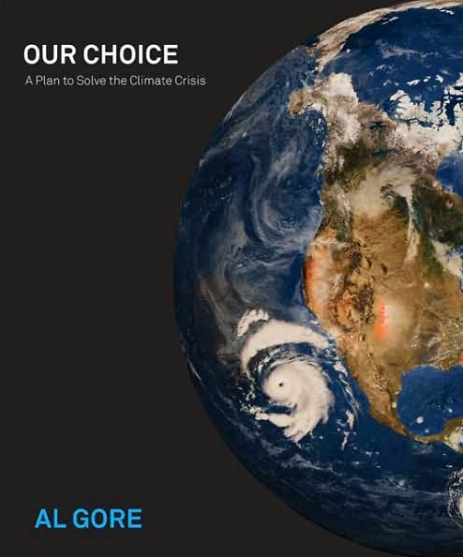
Al Gore’s last book, in case you hadn’t heard, was about the climate problem. The new followup to An Inconvenient Truth lays out solutions. The Vice President, Nobel laureate, and veteran climate advocate describes the most promising responses to the climate conundrum in Our Choice, released November 3. We’re tracking reviews, analysis, screeds, and tirades on the book right here.
Comments
View as Flat
Steven Earl Salmony Posted 1:14 pm
03 Nov 2009
Where are more leaders like Al Gore who are willing to openly support science that is being presented in the solid scientific observations and consensually validated empirical data of the IPCC? The pivotal climate change conference in Copenhagen is to occur next month. Look at the disarray in which we find ourselves now and how far we have to travel in a short time to reach legally binding commitments that move the human community away from precipitating some unimaginable sort of global ecological wreckage.
What would the world we inhabit look like if scientists like Galileo had chosen to adopt a code of silence and maintain the gag rule promulgated by the rich and powerful in his day. In such circumstances, Galileo as well as scientists today would speak only about scientific evidence which was deemed by the super-rich and powerful Masters of the Universe among us to be politically convenient, religiously tolerable, economically expedient, socially correct and culturally prescribed. Scientists would be effectively breaching their duty to science and humanity to tell the truth as they see it, as best they can report it.
Science must overcome silence, lest everything our leaders say they are trying to preserve and protect could be ruined.
Perhaps there is something in the great work of Al Gore, the scientists of the IPCC, and the leaders at the upcoming United Nations Climate Change Conference that will give Galileo a moment of peace.
Permalink
Gene Preston Posted 5:34 pm
03 Nov 2009
Permalink
neosapiens Posted 2:32 pm
05 Nov 2009
We need to be pursuing all ways forward, and reward the cheapest and quickest ways to transition to low-carbon energy. Rooftop solar may only be a small part of the solution from a total gigawatt point of view, but it has great potential to shift public sentiment in favor of renewables in general, since it is a way that ordinary people can take responsibility for their impact on the environment. Rooftop solar is available now, and is in fact getting cheaper year by year. I think that Amory Lovin's point about nuclear being too slow to implement and too costly is pretty compelling: in a level playing field, not many nuclear plants would be built, but solar, biomass, combined heat and power, and other small and medium-scale projects are being built and given a level playing field, they would be the clear winners. Even with enormous incentives, nuclear plants aren't being built. Shift the incentives from fossil fuels to distributed power and renewables, and let the market sort out the winners.
Permalink
ToddinNorway Posted 5:15 am
06 Nov 2009
1. Shale gas as a fuel for power generation completely outcompetes coal in N. America. Latest generation combined-cycle natural gas power plants will replace old, low-efficiency coal plants at a break-neck speed. This will reduce unit CO2 emissions from power generation by 65%, and criteria pollution by 100% compared to old coal plants. Mountain-top mining will cease due to it being economically uncompetitive. Other regions of the world will repeat this success where shale gas resources are found.
2. Radical improvements in electricial generator concepts, now being tested for marine applications and hydroelectric dams, will allow wind turbines to achieve up to 20 MW nameplate capacity, compared to max. 5 MW today. These will be best suited for offshore service, and there will be 100's of GW of capacity installed in a decade using this. On land, the biggest units will perhaps double in capacity from typically 2 MW to 4 MW for a single wind turbine. The wind turbine business case will "take off".
3. Thin-film PV will deliver integrated, utility-scale, grid-connected systems for less than $3/Watt (peak). These installations will be typically 20-40MW, and will dominate the market for peak-load power generation in the market where about 150 million North Americans live. In China, there are already plans for a 2 GW(peak) facility to be built using thin-film PV. This concept will be copied many, many times as the thin-film innovation process continues to lower costs and increase conversion efficiencies. Subsidies will disappear in the next 5 years.
4. Building-integrated thin-film PV, like the roof shingle system recently advertised by Dow Chemical, will be installed in tens of millions of roofs world-wide, with minimal subsidies due to the rapidly falling costs of thin-film PV and the built-in cost advantage of BIPV. Typical installation will have 2-10 kW (peak)capacity. The sum effect will be hundreds of GW (peak) that will provide a large fraction of residential electricity needs in many important regions.
Permalink
Gene Preston Posted 6:23 am
06 Nov 2009
emissions:"
Permalink
ToddinNorway Posted 8:00 am
06 Nov 2009
Permalink
Gene Preston Posted 9:25 am
06 Nov 2009
Permalink
ToddinNorway Posted 3:56 pm
06 Nov 2009
Permalink
Gene Preston Posted 4:32 am
07 Nov 2009
Permalink
starlatifah123 Posted 5:37 pm
12 Nov 2009
beat making software
beat maker software
Permalink