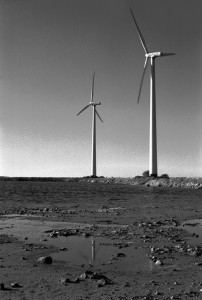
The Danes have an enduring relationship with wind. This is symbolized by the big, honking wind turbine that looms like a bird of prey over the parking lot outside the Bella Center, the venue for the U.N. Climate Change Conference Denmark is hosting in December.
It was a Dane, physicist H.C. Oersted, who discovered electrical induction, the principle at work inside wind and other electric generators. Danish farmers brag they were the first in the world to generate electricity from wind.
The Danes are now hard at work cracking one of the great challenges of wind power: the fact that the wind blows when it darn well pleases. Sometimes it blows hard when there isn’t much need for the resulting electricity. Sometimes the air is becalmed when electricity is needed the most.
Wouldn’t it be nice if households in Denmark had nice batteries to store the wind power coming off the country’s wind farms?
Denmark’s plan is to get those batteries into households using a Trojan horse strategy. The batteries will be mounted on four tires. If lots of Danish people switch from gasoline cars to all-electric plug in cars, each of those cars will have a nice set of batteries that can suck in wind power when the wind blows and use the power whenever there is a need to drive somewhere.
If this tactic of sneaking batteries disguised as new cars into Danish garages is to work, the electric car has to become a mass market item. For that, two big things have to happen. First, electric cars have to be capable of driving longer distances. To do that, a California company, Better Place, has come up with pit stops equipped with robots that will quickly swap out depleted batteries for charged ones.
Second, for electric cars to become widespread, they need to be comparatively cheap. The Danish government is pulling that off by making new electric cars exempt from a huge (180 percent!) environmental tax that applies to gas cars.
If all goes well, Danish roads could be swarming with mainly Renault-Nissan electric cars in a couple of years (Better Place has a strategic partnership with the carmaker). If all goes especially well, Denmark could eventually end the import of oil, courtesy of the wind.
Watch David Brancaccio’s report on Green Denmark—airing this week on PBS stations nationwide (schedule).
Comments
View as Flat
amazingdrx Posted 11:09 pm
29 Oct 2009
But once again it's a good idea to explain how a distributed smart grid smooths out the fluctuations of solar, wind, wave, and ocean current power. And can use biogas from the waste biomass stream as a very efficient, GHG cancelling backup source for renewables.
Think about it this way: if we have one wind machine, the power output varies as the wind varies. If we have 8 windfarms, in different locations, all connected over a smart grid, the fluctuations are greatly reduced. I mention 8 windfarms because Gar Lipow wrote a piece here on Grist a few years back that studied the output from 8 wind farms, that verified that effect.
Now if we add rooftop solar on every suitable roof, that further smooths supply. Peak demand generally coincides with peak solar.
Now in the case of a coastal country like Denmark add in wave and tidal/ocean current generation. Another stabilizing source.
And then there is distributed fuel cell/turbine biogas cogeneration, that a smart grid will power up or down to match supply and demand. This goes good with factory energy needs like heating and can be integrated with solar furnace factory heating. It can make each factory a distributed generation site, with solar heat stored for night time power generation along with biogas/natural gas backup.
Now consider a smart grid's ability to control load by timing power use and storing heating or cooling in building mass, water heaters, and freezers. And consider the effect of consaervation, using ground source heating/cooling and heat from rooftop solar cogeneration.
And here's the really great factor in all this, people are willing to sacrifice some convenience for the climate. If they have to get by with emergency power only once in awhile would that be such a tragedy? It's much better than brownouts or blackouts, so common with the present central power plant grid model.
And by all means! Get those vehicles plugged in, that will be a huge storage medium, perfect for smart grid control. Batteries in homes and buildings are good too, they provide the ultimate storm outage protection, along with rooftop solar.
So don't worry so much about renewables being unreliable, taken all together with smart grid technology, it's all good.
Permalink
Biodiversivist Posted 2:40 pm
30 Oct 2009
Slide # 2 of the bioethanol plant is interesting. The caption says:
"..The idea is to use straw left over from farmer's fields rather than from corn.."
According to this link:
http://www.google.com/hostednews/ap/article/ALeqM5i7vUtLGiDHp6gRom-AZMaRObyzTAD9BK80F00
"Farmers might be paying a price if they sell plant residue from harvested cornfields.
The leftover plant material — also called corn stover — is being bought by some energy companies. They turn it into pellets and sell it to coal-fired power plants.
Some companies will pay up to $20 a ton for long-term contracts. At an average of 3 tons per acre, a mere 100-acre field could yield a gross profit of $6,000.
But University of Nebraska-Lincoln farm experts say that residue is even more valuable to the farmer by adding nutrients and lending structure to the soil.
Experts say the nutrient value of corn residue ranges from $17 a ton to $46 a ton.
Without that residue, the farmer will have to add more fertilizer, raising input costs."
Another case of one step forward, two steps back. The caption also says:
Just when the fuel can be produced in a quantity needed for widespread use remains an open question."
"When" may very well be "never." We can wait for better biofuels that don't consume the planet.
I would think that the battery in a plug-in hybrid could also be used along with wind and solar. You don't need an all electric car for this purpose. I strongly suspect that electrified cars will accelerate consumer purchases of solar panels. They compliment one another and create a non-linear change for the better.
PBS, like newspapers, is good for entertainment but a poor media for conveying complex topics. Blogs work better for complexity. PBS viewers will never be told that plug-in hybrids would also work or that the bioethanol plant is likely a waste of valuable funding.
Permalink
vbstenswick Posted 6:38 pm
30 Oct 2009
Permalink
BlackbirdHighway Posted 7:38 am
01 Nov 2009
I have solar panels on my roof that power the car and partially power the house. You can't get panels for your roof that turn sunshine into gasoline!
When this V2G technology is worked out, we are going to find that life is a whole lot better for everyone except big oil companies and middle east oil producing countries. If they are smart, they will start getting into the wind and solar business now.
Permalink
amazingdrx Posted 8:26 am
01 Nov 2009
It would be good to make a deal ASAP with them. We supply the scientific and technical expertise, they supply the capital (the money we gave them in return for their oil), and we team up and build solar mass production facilities in the US and Saudi Arabia, with the factories powered by concentrating solar furnace cogeneration.
The silicon (it's in the sand)is refined and fabricated into PV cells using solar power, then as the materials cool overnight, cloased cycle turbines supply power from the waste heat all night. It's a winner. The big cost in solar PV is the fabrication energy.
Or maybe we ought to just wait and let a Chinese state owned corporation (socialist) build out the new renewable global energy economy? Who needs hi-tech manufacturing jobs? Not US, we can just keep borrowing to live. Hehey.
Permalink
Biodiversivist Posted 10:03 am
01 Nov 2009
Those are well-deserved bragging points ;) Hope others are secretly envious and making plans to emulate you. It will get easier and easier to do so as consumer demand spurs companies to compete for their dollars. Where would we be without early adopters?
Permalink
Ogemaniac Posted 12:35 pm
01 Nov 2009
In a brilliant stroke of luck, we happen to have the mother of all pumped storage opportunities in that the world's largest lakes happen to lie directly in between some of the world's best wind and some of the world's biggest power loads. There is a technical article floating around the net that decribes, for example, how pumping about one inch of water from Lake Ontario into Lake Erie during times of excess generation, we could fashion a ~18GW power plant that had virtually no effect on the natural flows at the falls.
There are already some "smaller" facilities on the Great Lakes, like the 1.8GW facility in Ludington, Mi. Note that 1.8GW is around the output of two coal plants...this isn't trivial stuff. The environmental impact is neglible compared to the benefits. There is no impact on Lake Michigan's level, of course. The water is pumped up about 500 feet to an artificial lake of around 100 acres. One of the bigger environmental issues with the facility was fish getting trapped in the intake pipes, but netting has largely mitigated this. There is no technical reason that many more such facilities could not be built. Indeed, I once saw a talk by the CEO of one of the two major power companies in Michigan (who co-own the Ludington facility), and he pointed out that they had scoped out other places to put similar facilities. It is all a matter of $$$.
Permalink