Send your question to Umbra!
Q. Dear Umbra,
For those times when fresh vegetables are not available, are canned or frozen veggies the way to go from a sustainable and nutritional standpoint? Assume that we recycle in our household. Cheers!
Mark L.
Sanford, Fla.
A. Dearest Mark,
I thought you Floridians would just live on fresh oranges and lemons all winter. Scurvy must have its opposite, I suppose, and one never hears of orange casserole or orange stew.
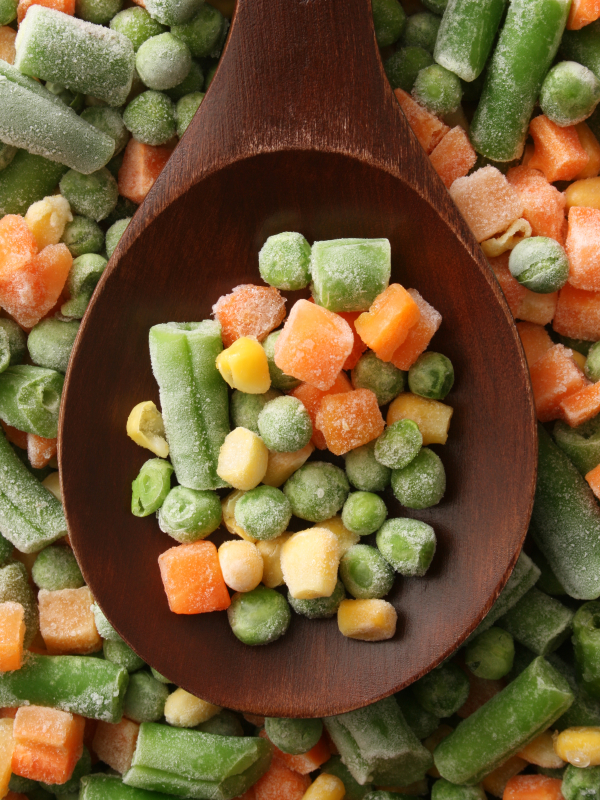
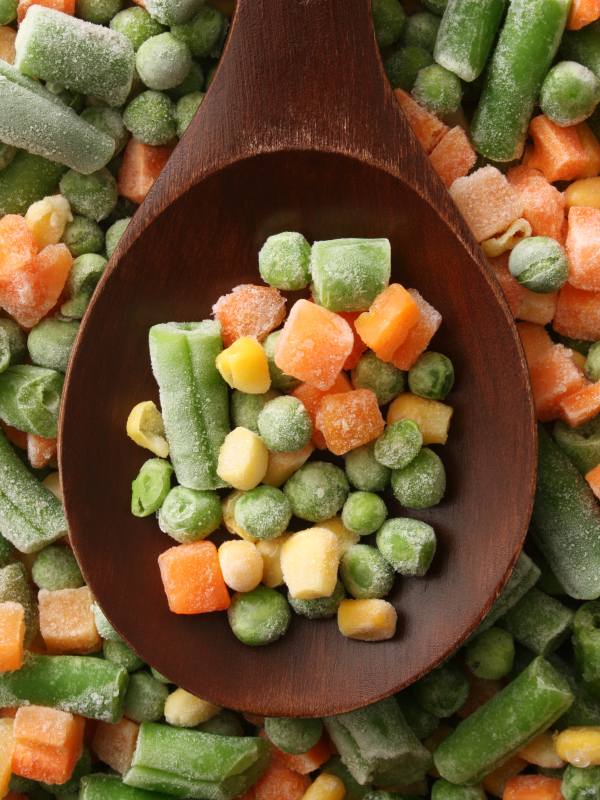
On the sustainability front, there is no clear and dominant difference between canned and frozen veggies—or, to say that another way, studies differ. The major ding on frozen food is the energy you use to keep it frozen; for canned, it’s the energy used to make the cans.
Based on what I read, I would recommend that if you cannot purchase fresh vegetables for some reason, you purchase high-quality processed vegetables with no additives, that you eat frozen vegetables within two weeks, and that you religiously recycle your steel cans. Of course, you should first be buying whatever fresh produce is available in wintry Florida.
Grade A frozen foods are harvested when ripe and quickly taken to the freezing plant, where they are (even more quickly) flash frozen at extremely low temperatures. The modern industrial freezing process retains almost all the original nutritional value of the food (according to nutrition guru Marion Nestle’s helpful book What to Eat). Good to go on the nutrition angle. But it’s important to have an efficient freezer. One study using 1970s data found that the longer frozen foods sit in the freezer, i.e., are using energy in storage, the more they fall behind canned goods in the efficiency smackdown.
The canned goods are a bit less nutritious, but a study that looked closely at this issue found the differences between frozen and canned carrots to be insignificant. Carrots in syrup, or whatever they might put carrots in, would of course fall in to the category of dessert or a processed food, and cannot be favorably compared to fresh. As you know, the ecological issue with canned carrots is the steel can itself, which has high embodied energy costs. If a study assumes the recycling of the steel can, then canned vegetables can compete favorably with frozen vegetables on the sustainability index. (One health consideration is that BPA is often used in the linings of such cans.)
All this to say, the two forms of commercial preservation are ecologically comparable, so we can all put this issue out of our minds and focus on eating our recommended daily allowance of fruits and vegetables. As we discussed last week vis bike helmets, it is ecologically important to remain in good health and away from hospitals. Fruits and vegetables help us achieve this goal. They also help us eat low on the food chain, an even more vital objective in the sustainable kitchen.
Five a Day-ly,
Umbra
Comments
View as Flat
askantik Posted 7:05 am
26 Oct 2009
Also, is there any way to avoid BPA or know which manufacturers use it in their cans? I'm assuming BPA is still allowed even in organic certification, but you'd think that maybe some organic/natural companies have voluntarily opted out of using BPA. I buy mostly organic canned goods, but I buy the store brand organic because of price (sorry, I can't spend $2.50 on a really nice name brand can of chili beans when I need 3 or 4 cans to make a big batch of chili). As for store brands, there's not a lot of info on them online, as you can imagine.
http://www.mothering.com/discussions/showthread.php?t=852625
That thread lists some responses by Thai Kitchen, Whole Foods brand, and Edward and Sons about BPA in their coconut milk. TK and WF said they use BPA and Edward and Sons said they do not, but they use "Epoxy Phenolic Aluminised Sulphur Resistant lacquer" on the inside of their cans. So no Bisphenol-A, but it is "phenolic" (which means made of phenols). I don't know much about organic chemistry at all, so I don't know. It seems like if steel cans are such a problem that they always need some kind of liner, maybe we should switch to glass jars?
Permalink
vwg123 Posted 7:22 am
26 Oct 2009
Permalink
ebrown53717 Posted 2:01 pm
26 Oct 2009
Permalink
Tasermons Partner Posted 11:52 am
26 Oct 2009
The more items there are in a fridge or freezer, the harder it must work to keep all those items cool.
The things in your fridge (generally) have a higher temperature than what you'd have the air temperature of the fridge set on. Thus, they let off heat into the surrounding air, and the fridge has to work harder to keep the temperature down, which consumes more energy.
Think of it like this: an air conditioner has to work harder to cool a room packed with people than a room that is empty. (Refrigeration systems work somewhat differently than air conditioners, but the principle is the same.)
Also, having more items generally assumes that you open your fridge/freezer more often, thus using more energy.
Permalink
bkallen Posted 12:24 pm
26 Oct 2009
Permalink
askantik Posted 12:26 pm
26 Oct 2009
Permalink
Cara_J Posted 11:18 am
27 Oct 2009
A freezer is definitely NOT more efficient when empty. The room full of people analogy doesn't work. People are alive and constantly generating heat. Food items in your freezer are NOT generating their own heat.
In fact, a full freezer should use less energy. An empty freezer is full of air, which has some mass but nowhere near the mass of all those food items. The freezer is working all the time to remove heat from inside the freezer to the outside. Once food items are frozen, they will lose heat only slowly to the outside when the door is opened. The freezer thus doesn't have to work as hard. Air, on the other hand, not only heats up more quickly but also physically moves in and out of the freezer when door is open, mixing with warm air.
However, don't pack in foods too tightly in the freezer. Air needs to circulate around items to help cool them down.
Permalink
vwg123 Posted 7:20 am
26 Oct 2009
Permalink
askantik Posted 7:31 am
26 Oct 2009
Permalink
lblakely Posted 8:15 am
26 Oct 2009
Permalink
Samantic Posted 8:18 am
26 Oct 2009
On the bean question, dry beans, cooked in a pressure cooker are cheap, require far less energy if they are shipped, and tastier, in my experience.
I grew up in South Florida and no one I knew canned, but one can start later in life, as I have.
Permalink
PARice Posted 10:03 am
26 Oct 2009
Dr. Frederic Vom Saal said that bisphenol A is used in all cans manufactured in the U.S. So the safest bet is to buy food that is in glass jars or frozen. I have to admit, however, that I don't trust the plastic bags used for frozen foods and don't know if the crap in plastic bags leaches into the food in any way.
Permalink
hil Posted 10:09 am
26 Oct 2009
Permalink
bkallen Posted 10:46 am
26 Oct 2009
Permalink
Ian Hough Posted 12:31 pm
26 Oct 2009
And ditto to HIL. I've always heard it takes energy to bring the stuff you put in your fridge or freezer down to temperature, but after that it helps maintain the temperature - http://brighterplanet.com/conservation-tips/57-keep-drinking-water-in-the-fridge
Permalink
bkallen Posted 1:33 pm
26 Oct 2009
Other factors: Canning vegetables in the fall helps keep the house warm, but canning in summer might cause the air conditioner to be fired up. On the other hand, drying vegetables in the summer can use the sun's energy, whereas drying in the fall would require the energy used in a dehydrator or oven.
Permalink
Laura K Posted 4:12 pm
26 Oct 2009
Permalink
Tasermons Partner Posted 9:00 pm
26 Oct 2009
Permalink
kceridon Posted 8:23 am
27 Oct 2009
Energy use is a better term for this discussion. The main thing here is that a set volume of material with higher thermal capacity takes longer to CHANGE temperature and one with lower thermal capacity. To cool a material with higher thermal capacity, it takes more energy. So, to get your veggies to 32F from 65F, it takes more energy than to get the same volume of air to 32F from 65F. The second part is warming the veggies versus the air. The veggie will not warm up as fast as the air. No matter how well a freezer is insulated, if it is off, it will heat up sooner or later. If it is full of veggies, it will take longer to heat up than if it is empty due to the larger thermal capacity. The compressor on a freezer turns on and off in response to the change in temperature, so if your freezer is full of veggies rather than air, it will turn on and off less frequently. If it is full of air it will cool off faster and the on cycle will be shorter. However, the temperature changes really quickly this way and the freezer commonly overshoots is prescribed temperature which is wasteful.
All of that said, it is a somewhat complex issue and I have not done the numbers to say which is better, but my gut says, you should have some capacity in your freezer. Besides, what's more of a waste of perfectly good energy than an empty freezer? However, to really improve the performance of your freezer, you are far better off keeping it as far away from your stove/oven and heaters and near the coolest part of your house or kitchen. You should limit the amount of time you open it and set the temperature to the highest tolerable setting - stick an oven thermometer in there if you don't have a temp setting to find a good temp.
Also, the same can be said for ovens. Your oven heat air to temps past the set temp so that your food reaches the desired temp. This is why metal pans burn edges of cakes, but that is a story for another day.
BTW - Just to establish my cred, I have a master's in cryogenics.
Permalink
Carey Posted 6:54 am
28 Oct 2009
http://bit.ly/Ext2Pangea
Permalink
PARice Posted 8:03 am
28 Oct 2009
However, the less-than-perfect condition is that the freezer door is opened and closed throughout the day, which means that a full freezer consumes less energy.
Permalink
kceridon Posted 8:12 am
28 Oct 2009
Sorry to get super nerdy on here, but I am what I am.
Permalink
PARice Posted 8:23 am
28 Oct 2009
Below is a report I did on plastics for a former client, who would not mind if I shared it with you.
No. 1, polyethylene phthalate (PETE).
1. This is usually a clear plastic found in soda, water, and vinegar bottles; medicine containers; backing for photography film;
2. There is only a small amount of leaching of phthalates into liquids stored in a PETE bottle, according to Lynn R. Goldman, professor of environmental health at the Johns Hopkins Bloomberg School of Public Health in a New York Times news article, published Jan. 5, 2008.
Phthalates, considered by some to be a hormone disrupter, may cause decrease in sperm quality, genital defects, and reproductive impairments in boys, especially, and men and early puberty in girls. Two types of phthalates have been banned in the European Union, Japan, and Argentina. Oregon and other states have considered bans on phthalates.
3. In the same New York Times article above, Frederick Von Saal, a University of Missouri scientist who has studied plastics for years, said that reuse and scratching of PETE bottles can lead to leaching of antimony into the liquid. However, Von Saal points out that researchers don’t know what to look for in plastics because the industry will not tell them everything that is used to manufacture of plastics.
Other articles show that there is leaching of other chemicals from PETE, especially if it is heated, but
3. There is little data on its human carcinogencity, according to the World Health Organization’s International Agency for Research on Cancer, which means more research needs to be done.
No. 2. High Density Polyethylene (HDPE).
1. This seems to be one of the safest plastics. It is the thick plastic used in containers for detergent, bleach, shampoos, motor oil, newer bullet-proof vests, Tyvek ® envelopes and moonsuits. Usually it comes in cloudy bottles.
2. There is little data on its human carcinogencity, according to the World Health Organization’s International Agency for Research on Cancer. So, right now there is little we can say about it.
No. 3, Polyvinyl chloride (PVC) (vinyl chloride is chloroethene, Polyvinyl chloride is chloroethene homopolymer).
1. It is used in many commercial cling wraps, water pipe, gas and sewer drainage, flooring, construction uses (including window frames, doors, wire sheathing), imitation leather, furniture, and vinyl wallpaper. It has been used in baby teethers and squeeze toys, beach balls, bath toys, dolls, knapsacks, raincoats, and umbrellas, those crinkly-sounding plastic trays in boxed cookies or chocolates, candy bar wrappers, and bottles. And there are PVC-covered paper clips).
2. The manufacture of PVC produces dioxins.
3. According to the website, http://www.inchem.org, a joint effort between the International Programme on Chemical Safety (IPCS) and the Canadian Centre for Occupational Health and Safety (CCOHS), PVC is a human carcinogen with significant exposure to workers and some exposure to the general public (Inchem relied on information from WHO's International Agency for Research on Cancer). From inchem.org: “Several independent but mutually confirmatory studies have shown that exposure to vinyl chloride results in an increased carcinogenic risk in humans, involving the liver, brain, lung and haemo-lymphopoietic system.”
4. Some studies have found higher rates of testicular cancers and a rare form of liver cancer among PVC workers.
5. Phthalates are used to soften PVC in some uses. See entry above under No. 1, polyethylene.
6. From inchem.org, “In one epidemiological study, an excess of foetal (fetal) mortality was reported among wives of workers who had been exposed to vinyl chloride, indicating a possible mutagenic effect in human germ cells.”
7. From inchem.org: “Studies which indicate increased rates of birth defects among the children of parents residing in communities where vinyl chloride production and polymerization plants are located indicate the necessity for further investigation of the teratogenicity of vinyl chloride and its polymers in both animals and humans. A teratogen is something that interferes with fetal development.
No. 4 Low Density Polyethylene (LDPE)
1. Used in wrapping films, grocery bags, sandwich bags, food storage bags, “soft” bottles.
2. According to the World Health Organization’s International Agency for Research on Cancer, there are no studies on the carcinogencity of polyethylene.
No. 5 Polypropylene (PP)
1. Found in Tupperware, syrup bottles, yogurt tubs, diapers, outdoor carpeting, margarine containers, rigid containers, some baby bottles, cups, and bowls.
2. IARC’s Working Group stated in a paper there was little research done on Polypropylene to determine its carcinogenicity. Although when under-the-skin implantation occurred with PP in rats, sarcomas developed at the site of implantation.
No. 6 Polystyrene (PS).
1. Styrofoam, Used in puffy food containers, cups, disposable eating ware (clear and colored), bakery shells, meat trays, cheap hubcaps, packing peanuts and other packing material, and foam insulation.
2. According to IARC’s Working Group, studies were not available on styrofoam’s carcinogenicity, meaning that the studies have not been done but they should be done. However, the IARC report explicitly states “styrene is mutagenic.”
From Greenpeace: “Polystyrene is widely used for foam insulation and also for hard applications like cups and toys. Its production involves the use of known (benzene) and suspected human carcinogenic substances (styrene and 1,3-butadiene). Styrene is also known to be toxic to the reproductive system.”
No. 7 Various plastics, mostly polycarbonate (bisphenol A)
1. Used in the lining of cans in canned food, hard plastic baby bottles, 5-gallon water bottles, plastic silverware, Lexan products, Nalgene bottles, and plastic supply cups and as a dental sealant.
2. One thing you may not know is that (from Greenpeace) Polycarbonate (Bisphenol A) … is usually made with the highly toxic phosgene, derived from chlorine gas. PC does not need additives but does need solvents for its production, such as methylene chloride, a carcinogen. Other solvents used may include chloroform, 1,2-dichloroethylene, tetrachloroethane and chlorobenzene.”
Permalink