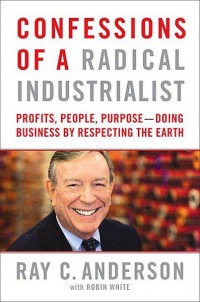
Ray Anderson set out to make his business sustainable long before green was the flavor of the month. Reading Paul Hawken’s The Ecology of Commerce in 1994 literally changed his life, inspiring him to overhaul his carpet company, Interface, and aim for zero waste and zero environmental impact. Now, with his new book Confessions of a Radical Industrialist, he wants to spur other business leaders to “climb Mount Sustainability.”
Anderson recently dropped by the Grist office and we asked him how his own ascent is going so far.
—–
Q. You’ve been working for the last 15 years to make your company sustainable. What do you know that other companies need to know?
A. Well, it’s hard. It’s the work of a lifetime. It takes an awful lot of patience and stick-to-itiveness.
We’re 15 years into a 26-year journey — that’s how long we calculate it will take us to get to a zero footprint, taking nothing from the earth that’s not naturally, rampantly renewable and doing no harm to the biosphere.
Q. How long did it take your company to recoup the investment that you initially made?
A. No time. From day one, we were ahead of the game. Tackling waste — that’s where the low-hanging fruit is. We declared war on waste: only zero is acceptable. Doing everything right the first time, every time, including making no scrap and no off-quality. When we measured ourselves against that kind of perfection, we found 10 percent of the sales dollar going down the drain as waste, most of it considered allowable, expected.
Fifteen years later, we’re only halfway there. But we’ve saved over $400 million, which has more than financed everything else that we’ve done — the R&D, the capital expenditures, the process changes, employee training, the whole ball of wax.
Q. Is that a technique that’s replicable?
A. Yes. We ought to be doing this anyway in business. When you set that bar at zero, that’s a stretch, but it’s easy to understand.
Q. Are there things you thought would be easy to do that have turned out to be really difficult?
A. The technologies didn’t exist and we didn’t know what it was going to take to create them. We couldn’t have done it by ourselves. We didn’t know how long it would take to get suppliers involved, or get new inventors inventing things that we’d never heard of. So there was a big mystery about it all.
But we had a clear vision and that was the main thing. Climb that mountain clear to the top.
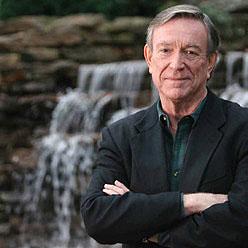
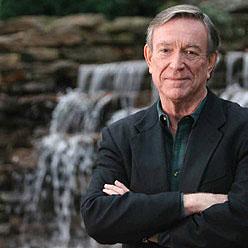 Ray Anderson.
Q. In the whole lifecycle of your products, what was the hardest aspect to get within that sustainable margin? Transportation?
A. No, transportation is miniscule in the grand scheme. The important thing is the technologies for recycling. Today they have been invented and we’re increasing recycled content. Like 35 percent now of our raw material comes from used products, post-consumer recycling. At the time I wrote the book, I think it was 28 percent, so it’s moved up since.
Q. You’re not turning plastic bottles into carpet — you’re turning old carpet into new carpet, right?
A. Yeah, the ideal product is our own product from 20 years ago. And we’re also recycling other carpet manufacturers’ carpets too.
Q. As a business leader, what do you want to see Congress do about climate change?
A. Put a price on carbon. I’d prefer to see it done through tax shifts, taxing bad things instead of good things. A shift in those taxes even in a revenue-neutral way that just puts a price on carbon so that an honest market can then work. Today it’s a dishonest market, blind as a bat, just stumbling around ignoring the externalities.
Q. As you’ve made sustainability core to your business, have you gotten new customers through that effort?
A. Yes. There was a survey done of commercial interior designers three or four years ago, who very heavily influence our marketplace, and 91 percent said they preferred recycled content. Not just accepted it, but preferred it. Today it’s probably even higher than that.
It was that community, interior designers, who were asking us the question 15 years ago: “What’s your company doing for the environment?” So when we began to actually do something, they began to embrace us for what we were doing. The goodwill of the marketplace is amazing.
If you had to state the pure dollar-and-cents business case for sustainability, our cost is down, not up — the waste-elimination effort alone has more than paid for all the rest of this. Our products are the best they’ve ever been. Biomimicry has had a huge influence; it’s a wellspring of innovation. Our people are galvanized around a shared higher purpose. You can’t beat it for attracting people and motivating people. And the goodwill of the marketplace is just astonishing. What else is there that underlies shareholder value but cost and products and people and market? That’s it. It’s a better business model without doubt.
Q. Do you think the business community at large is capable of a shift to sustainability?
A. They will either do it or be superseded by those who do. The industrial system that operates today is undermining the basis of the industrial system; it’s committing suicide because nature is that undergirding factor. There’s no business that can operate without air and water and food and energy and materials and climate regulation and ultraviolet radiation shields and pollination and seed dispersal and distribution. All of those are supplied by nature. If we kill nature, we will certainly kill the economy. When somebody sits down and tries to figure out the value of nature, it’s very simple: Whatever the economic GDP is today, that’s the value of nature, because none of it would exist without that undergirding.
Q. Are there examples of other businesses you’ve influenced?
A. I claim some credit for Wal-Mart. They sent two teams to our factory in Lagrange, Ga. — one lead by Mike Duke, who is the president/CEO now, and one lead by Doug McMillon, who is now the No. 2 man. Each of them came and spent the day there understanding what we were talking about and what we were doing. They went away satisfied that it’s doable, which was a huge hurdle for them to get over before they went to 60,000 suppliers and said, “You gotta do this too.” I think that was a hurdle that we helped them clear. Since then they’ve been going gangbusters.
Q. So what’s next for you?
A. We’ve got the rest of this mountain to climb.