

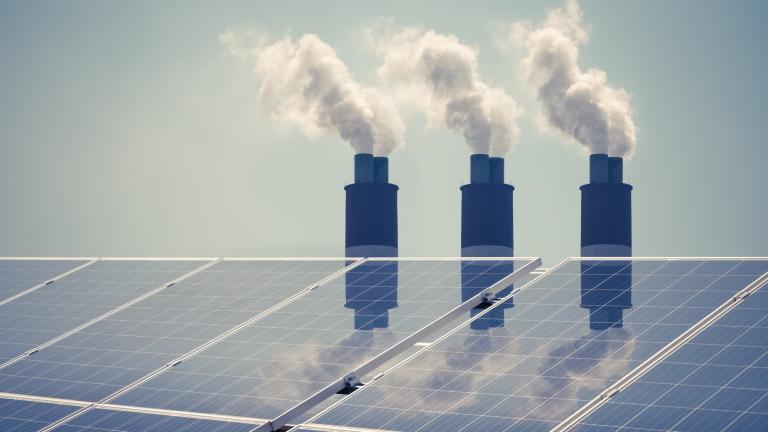
The EPA made an announcement today that lots of folks seem to be misinterpreting as “proposed regulations on power plants.” That’s not what they are.
What was announced today is the “tailoring” rule; it establishes that when the EPA regulates stationary sources, it will only regulate those that emit more than 25,000 tons. This is a modification of the threshold now in the Clean Air Act, which is 250 tons. If EPA regulated every source emitting more than 250 tons, it would be a nightmare (churches! schools! marathons!). There’s some dispute about whether the EPA is legally allowed to do this; not surprisingly, I hear different things from different sides of the aisle. It is sure to be litigated.
This announcement has been expected for a while, by the way, so it’s not quite so epochal as some are making out.
When the new EPA fuel economy regulations go into effect in 2010, that will automatically—as in, by law—trigger regulations of stationary sources. Such sources will have to get permits showing that they’ve used Best Available Control Technology to reduce CO2. BACT has not yet been defined for CO2. That’s going to be a huge and incredibly contentious fight. Now, at least, we know when the fight will start.
If you’re interested, I wrote a comprehensive rundown on EPA regulation of CO2. It explains what to expect in clear language. Also it has bunnies.
Comments
View as Flat
Tasermons Partner Posted 7:23 pm
30 Sep 2009
Also possible that this part of larger political maneuver to push for new climate bill. May force conservative to go for what they see will be "the lesser of the two evils". They'd be more likely to go for a bill where they could push for some of their compromises, as opposed to outright regulation by the EPA.
Permalink
foodprovider Posted 6:43 am
01 Oct 2009
Permalink
Steven Earl Salmony Posted 5:31 am
01 Oct 2009
Perhaps necessary change is in the offing and comes soon enough.
Steven Earl Salmony
AWAREness Campaign on The Human Population
established 2001
http://sustainabilityscience.org/content.html?contentid=1176
Permalink
foodprovider Posted 6:46 am
01 Oct 2009
Permalink
SkyHunter Posted 12:15 pm
01 Oct 2009
By charging polluters to pollute and investing the revenues into cleaner technology does three things:
1. Makes dirty power more expensive.
2. Which makes cleaner power more competitive.
3. All the while developing better cleaner alternatives.
Permalink
foodprovider Posted 12:42 pm
01 Oct 2009
Permalink
Jag4331 Posted 1:47 pm
01 Oct 2009
Also, your example of the European cap-and-trade system has a false premise. GhG emissions have risen because the system was not given the fullest opportunity to succeed. One big reason: the credits were not auctioned off but given away based on what turned out to be erroneous estimations of EU members' relative emissions. Hopefully, a U.S. cap-and-trade system will not make the same mistakes, if the system is not debilitated by nay-sayers.
In fact, I agree with you. A cap-and-trade system is not the best solution. It has potential loopholes for graft and corruption. But that's also the nature of business-as-usual, and I'm guessing you don't have many anarcho-Marxist leanings. Rather, we should put in place a flat levy on carbon that applies to all taxpayers. For those who are able to reduce their emissions over time (by changing lifestyle and consumer choices), they will see increasing savings over time as the levy rises. This seems to be the simplest, most effective and, hopefully, equitable way to promote clean alternatives and make real the existing, and invisible, cost of a dirty energy system.
Permalink
Tasermons Partner Posted 9:20 pm
01 Oct 2009
Assume for a moment that this was true.
Considering that we consume more energy than any other country, and even more than several entire continents (even though several of those countries have more industry), and that we "use" most of that energy wastefully, would it really be bad to tax energy?
Yes, we'd end up paying more for energy, but wouldn't that also force people to conserve energy more wisely? Because, let's face it, they're not gonna conserve on their own unless there is an economic incentive.
Permalink
foodprovider Posted 9:35 am
02 Oct 2009
Lets put up wind turbines, outfit the dams on the Mississippi river with water turbines, capture the methane off of the landfills, put up solar panels. Reverse the ordinaces that restrict the siting of wind farms, and methane digesters. Enough of the "not in my neighborhood" attitude.
Permalink
sukumar Posted 9:06 am
06 Oct 2009
Permalink
SkyHunter Posted 11:13 am
02 Oct 2009
Since I have already switched to a low energy, low carbon, low pollution lifestyle, the impact on me would be negligible.
Externalizing the cost and passing it on to posterity is like stealing from your children. I say pay the price now, or better yet, make changes to your lifestyle so that you are part of the solution, instead of the problem.
Be the change you want to see in the world.
Permalink
foodprovider Posted 8:29 am
05 Oct 2009
If you want more money so will everyone else. The employers won't be able to pay you. Cap & Trade is Bad for us. It will cost us jobs, and raise our cost of living. Other countries are just waiting for us to enact this so they can capitalize. This will not keep america strong.
Permalink
SkyHunter Posted 12:16 pm
05 Oct 2009
The future of the American economy is technology, specifically green energy technology. Cap and trade can be applied to imported goods to make goods produced domestically, with zero emissions, much more competitive with a comparable item produced in China and shipped here.
Permalink
Tasermons Partner Posted 7:25 pm
06 Oct 2009
> Everything will cost more
Considering that we are the world's largest consumer economy, despite the fact that we have only around 5% of the population, and that much of the goods we consume are now considered "disposable" and with relatively short life-spans, yet their manufacture still consumes vast amounts of resources, and that having our economy so widely based on consumerism (relative to other sectors) is bad for long-term economic growth, (not to mention the fact that Americans, in general, are notorious for the want of instant gratification, and for NOT saving money for their personal futures) then is having to pay more for most goods really a bad thing?
Long-term, it should have positive repercussions. It would encourage savings of money, natural resources, and help balance out the quick boom-bust cycle of the economy.
Permalink
Tasermons Partner Posted 7:27 pm
06 Oct 2009
Everything will cost more.
Considering that we are the world's largest consumer economy, despite the fact that we have only around 5% of the population, and that much of the goods we consume are now considered "disposable" and with relatively short life-spans, yet their manufacture still consumes vast amounts of resources, and that having our economy so widely based on consumerism (relative to other sectors) is bad for long-term economic growth, (not to mention the fact that Americans, in general, are notorious for the want of instant gratification, and for NOT saving money for their personal futures) then is having to pay more for most goods really a bad thing?
Long-term, it should have positive repercussions. It would encourage savings of money, natural resources, and help balance out the quick boom-bust cycle of the economy.
Permalink
Clifford Wells Posted 5:04 pm
03 Oct 2009
As several on grist have noted, there is some low-hanging fruit in efficiency, thermal heat re-use, and better demand monitoring, but I don't know if there is anything to strip out CO2 of the stack emissions. The idea is simply to not emit as much CO2 in the first place.
This is contrary to clean air engineering we've done since 1970. Back then we had problems with carbon monoxide (CO) emissions, so by using better combustion practices, oxygenates in motor fuel, and things like that, CO was dramatically reduced. It is a true success story of the Federal Clean Air Act.
So I am quite mystified, although I do agree that the issue will be litigated for several years, delayed, and possibly require Congressional action - for example on the threshold for a CO2 "major source."
Then there's the grandfather issue. After all these decades, we still have major sources that predate the Clean Air Act and they don't have to do anything except for some "Sub-part D" requirements, pretty easy stuff. However, is a major source is modified with respect to emissions or fueling rate, the operator must get a new source review permit, federal operating permit, and undergo BACT or whatever (there are many flavors, from BART to MACT). This of course consumes many millions of dollars without even fixing the problem, and the lawyers laugh all the way to the bank, no matter if they win or lose.
But if it works, and there really is BACT or whatever for major CO2 emitters, then I prefer that method to the smoke-and-mirrors of cap and trade.
Permalink
Tasermons Partner Posted 7:29 pm
06 Oct 2009
Everything will cost more.
Considering that we are the world's largest consumer economy, despite the fact that we have only around 5% of the population, and that much of the goods we consume are now considered "disposable" and with relatively short life-spans, yet their manufacture still consumes vast amounts of resources, and that having our economy so widely based on consumerism (relative to other sectors) is bad for long-term economic growth, (not to mention the fact that Americans, in general, are notorious for the want of instant gratification, and for NOT saving money for their personal futures) then is having to pay more for most goods really a bad thing?
Long-term, it should have positive repercussions. It would encourage savings of money, natural resources, and help balance out the quick boom-bust cycle of the economy.
Permalink